DARK FIRESORIGINS UNKNOWN

Author: Dark Fires

  • Student CubeSats Launch Toward the ISS for Radio and Radiation Tests

    Two student-built CubeSats are on their way to the International Space Station after the 13 October 2026 launch of SpaceX’s CRS-35 cargo mission. PROVES-Maia and PROVES-Taygeta will use the station as a staging point before deployment into their own orbits.

    The launch announcement records liftoff at 6:33 a.m. EDT from Cape Canaveral, Florida. The satellite missions combine hands-on engineering education with experiments in amateur-radio communication.

    A university’s first spacecraft

    Texas State University’s account describes Maia as its first university-owned and operated satellite to reach space. The university’s Space Lab built and tested it, and plans to command it from its own ground station after deployment.

    Maia carries MOSAIC, a system developed at Texas State for trying out instruments and spacecraft components. Its payload includes a university-designed sensor for radiation in low Earth orbit. Students from several technical disciplines contributed to the hardware, software and preparations.

    The distinction between launch and deployment matters. Texas State says Maia will spend time aboard the station before being released. Contact and independent mission operations follow that release; today’s launch alone does not establish that every experiment has worked.

    Shared hardware, different experiments

    The 13 October CubeSat mission overview places both spacecraft in the Pleiades Five collaboration. Its openly documented PROVES platform lets university teams build on a shared spacecraft design.

    Maia is intended to relay amateur-radio messages. Taygeta, a collaboration involving Cal Poly Pomona and Mt. San Antonio College, carries a camera and a radiation experiment alongside its radio mission. Operators on the ground are expected to be able to request images and measurements.

    The programme also plans to test communication between spacecraft using the open-source DRIFT routing protocol. Those demonstrations remain mission objectives. Their eventual results will show how well the shared platform works as a practical route into spaceflight for student teams.

  • ESA and Astronomers Team Up to Reduce Satellite Interference

    The European Space Agency has joined an international effort to make satellites less disruptive to astronomy. A new agreement with the International Astronomical Union’s Centre for the Protection of the Dark and Quiet Sky links spacecraft engineering with the needs of observatories.

    The agreement was signed in Antalya, Türkiye, on 7 October 2026. The IAU’s 9 October announcement identifies ESA as the first space agency to join the centre.

    Two kinds of interference

    Satellites can affect observations in different ways. Sunlight reflected from a spacecraft can leave a streak across an optical image. Electronics aboard it can also produce unwanted radio emissions, making it harder for radio telescopes to isolate faint signals from space.

    ESA’s 8 October account emphasizes work before launch: darker surfaces, quieter electronics and models that predict how a spacecraft will appear to telescopes. ESA will bring technical expertise and connections with industry to that effort.

    A satellite trail crosses a Hubble exposure of the interacting Mice galaxies.
    A satellite crosses Hubble’s view of the Mice galaxies. This archival example, released in 2023, illustrates the optical problem; it is not an image of the new agreement. Credit: NASA, ESA, STScI. Image and context; use policy.

    What the collaboration will work on

    The IAU lists several practical areas: sharing methods for measuring satellite brightness and radio-frequency effects, developing more flexible operating modes, and improving coatings, materials and manufacturing. Standards and guidance for responsible spacecraft behaviour are also part of the planned cooperation.

    Image processing can help with some contamination. In the Hubble example above, STScI explains that the trail can be identified and the scene recovered using other exposures of the same target. That illustrates one mitigation technique, rather than a universal answer to satellite interference.

    The new memorandum establishes a programme of cooperation. Its value will depend on the technologies, operational changes and adopted practices that follow. For skywatchers and researchers alike, the important test is whether future spacecraft measurably reduce their impact on observations.

  • EAGLE Simulations Put the Milky Way’s Habitability in Cosmic Context

    EAGLE Simulations Put the Milky Way’s Habitability in Cosmic Context

    Finding a planet at the right distance from its star is only one part of assessing its prospects for life. The surrounding galaxy has a history too: stars explode, black holes flare and neighboring stars can disturb planetary orbits.

    A study posted on October 5 uses the EAGLE galaxy simulations to examine that larger setting. Luke Barnes and colleagues find that the present-day Milky Way looks fairly typical among environments favorable to long periods of planetary habitability. Their paper is listed as accepted for publication in Monthly Notices of the Royal Astronomical Society.

    Putting habitability into a simulated universe

    EAGLE follows the growth of galaxies in a simulated volume more than 300 million light-years across. It begins before stars and galaxies have formed, then models the behavior of matter as cosmic structures emerge. Gas cools, stars form, and energy released by stars and active galactic centers changes what happens next.

    This approach lets researchers compare environments that would be impossible to watch evolve directly over billions of years. The project’s explanation of its methods also stresses the difficulty: a galaxy simulation has to connect processes operating on vastly different scales. Some physics is represented through simplified prescriptions, and the resulting virtual galaxies are checked against observations.

    Barnes and colleagues add a habitability model involving stellar lifetimes, planet formation and five kinds of possible disruption: two types of supernova, gamma-ray bursts, close stellar encounters and quasar radiation. They track available habitable time, distinguishing events that remove existing life from those that could make a planet persistently unsuitable.

    Two scales of a habitable zone

    The familiar stellar habitable zone concerns the range of distances where a planet might maintain liquid water on its surface. Its location depends on the star. A dim star’s suitable region lies closer in, while a brighter star’s lies farther out.

    A galactic calculation asks a wider question: how does the neighborhood help or hinder the survival of such environments? The two scales complement each other. A relatively quiet place in a galaxy cannot compensate for every problem on a particular planet, and a favorable orbit around one star does not erase the history of its surroundings.

    NASA’s astrobiology guidance on planetary habitability treats the problem as a combination of conditions, including accessible ingredients, energy and environments in which organisms could survive. The presence of suitable conditions still leaves the separate question of whether life actually began.

    A useful comparison, with substantial uncertainties

    The new model finds the most hazardous environments in young galaxies forming stars rapidly. Its conclusions depend on uncertain damage thresholds and simplified catastrophe models. The authors call for better spatial resolution, more frequent simulation snapshots and improved treatments of local conditions. They also leave the probability of life originating as an unknown.

    That makes the study useful as a way to compare assumptions. Changing a hazard model or the probability of planet formation can show which conclusions hold up and which depend strongly on those choices. The result is a framework for testing galactic habitability, rather than a census of inhabited planets.

    The broader lesson is that time belongs in the search for suitable worlds. A potentially favorable environment has a past, and its long-term survival is part of the scientific question.

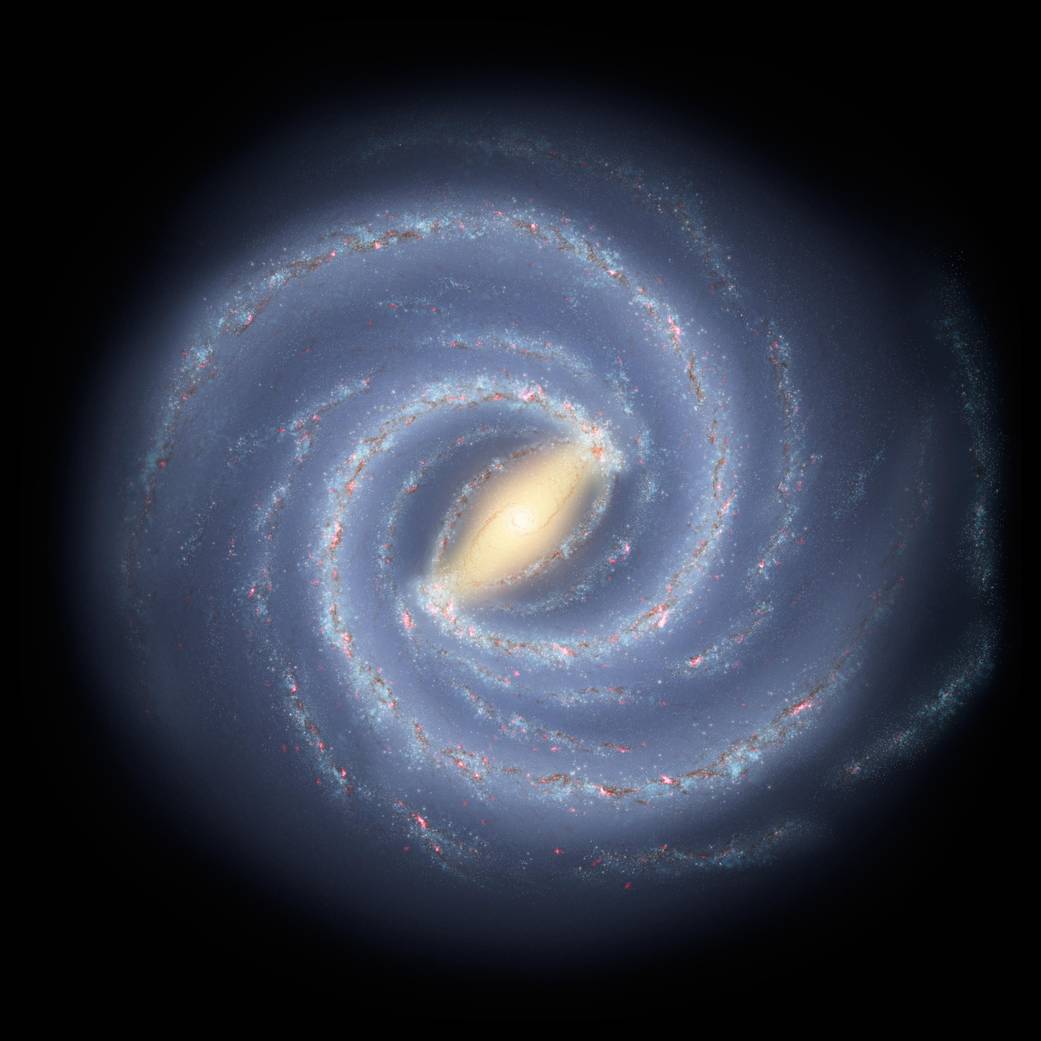
    An archival artist’s concept of the Milky Way, published by NASA in 2009. This illustration is not an output of the new habitability model. Credit: NASA/JPL-Caltech.

  • TESS Reaches the 1,000-Planet Milestone

    TESS Reaches the 1,000-Planet Milestone

    NASA’s TESS mission has reached a milestone that reflects years of work beyond the spacecraft itself: 1,000 planets discovered with its data are now counted as confirmed worlds.

    The NASA Exoplanet Archive announced the milestone in its October 8 update, when 70 new planets entered the archive. Those additions brought the archive’s overall confirmed-exoplanet count, across missions and discovery methods, to 6,445. The same update listed 4,823 TESS project candidates awaiting confirmation.

    The numbers describe that dated archive release. New additions can change the totals, and adding a planet to a catalog is not necessarily the day it was first observed or its discovery announced.

    From a dip in starlight to a confirmed world

    TESS launched on April 18, 2018 and remains in an extended mission. Its central method is to watch stars for small, repeated changes in brightness. A planet crossing the face of its star can block a little starlight, producing a transit.

    As NASA described when science operations began in July 2018, the mission was designed to concentrate on nearby, bright stars. That choice makes promising systems more accessible to follow-up observations. TESS supplies the initial light curves; additional measurements help researchers establish what caused the signal and characterize the object.

    The archive’s inclusion criteria require sufficient follow-up or validation to make a false-positive interpretation unlikely, with results accepted in the peer-reviewed literature. A promising candidate has therefore passed a different evidential threshold from an object on the confirmed list.

    There is also a terminology wrinkle. The archive places statistically validated planets in its confirmed category, rather than giving them a separate status. That label does not mean every planet has an equally precise mass measurement, or that astronomers know its atmospheric composition.

    A growing sample, with different kinds of worlds

    A NASA overview released in May showed how varied the TESS harvest has become. The mission has found worlds spanning a wide range of sizes, including planets that may be volcanic, planets losing material to their stars and planets orbiting two stars. Its four cameras monitor broad sky sectors for about a month at a time, while repeated visits build longer records.

    That diversity makes the growing catalog useful for comparative planetary science. Researchers can ask how sizes and orbits vary, then select particular systems for more demanding observations. A larger sample also provides more opportunities to find unusual objects that challenge existing formation models.

    The count alone cannot tell us how many inhabited worlds exist. As NASA’s habitable-zone guide explains, a planet’s distance from its star is only a starting point for assessing whether liquid surface water could be possible. The star’s radiation and the planet’s physical conditions matter too. Even an Earth-sized world needs much more investigation before its environment can be understood.

    The thousand-planet milestone is therefore both an achievement and a starting list. Each confirmed world contributes a better-established target, and the remaining candidates give observers plenty of work still to do.

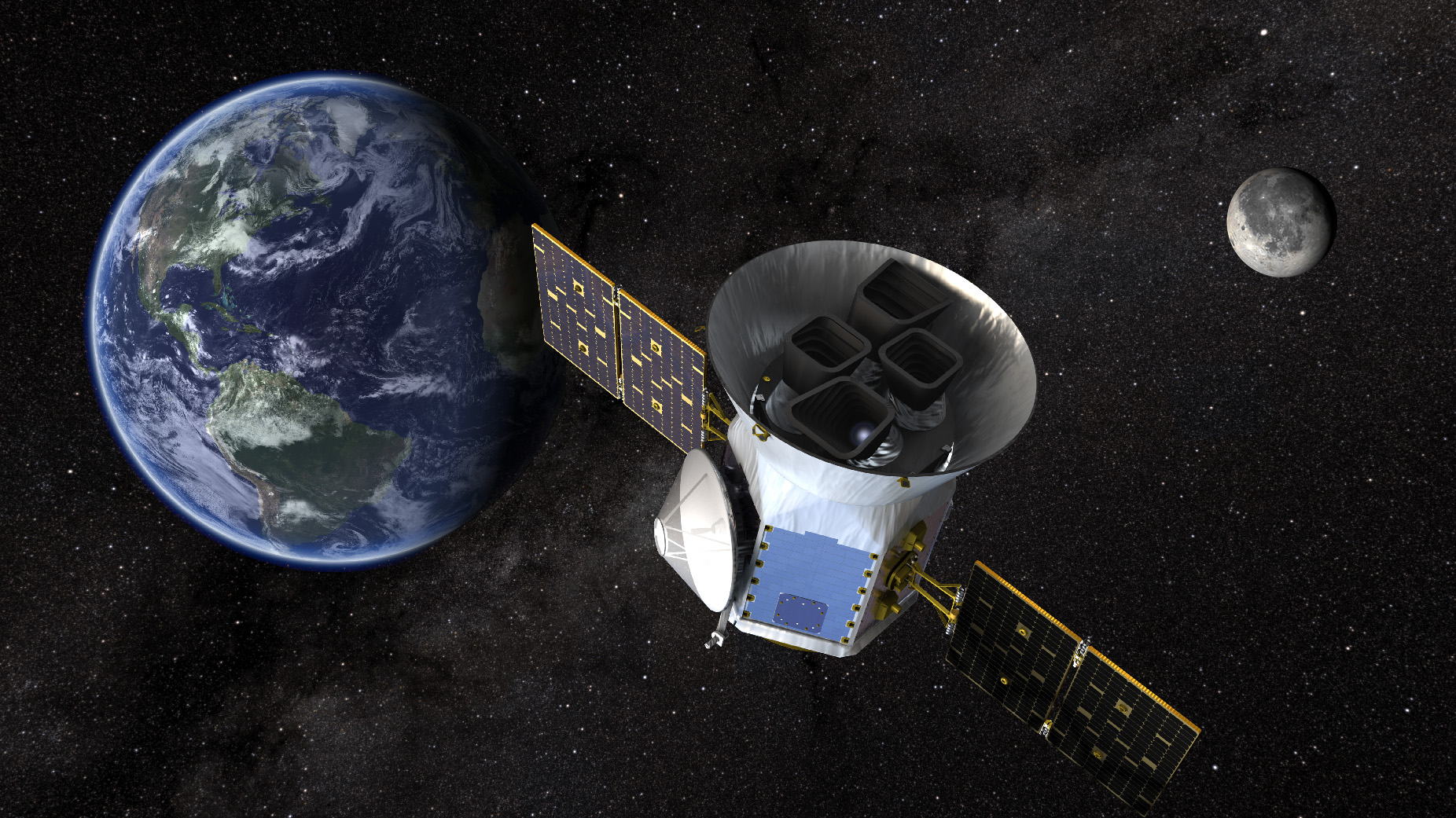
    An archival artist’s illustration of TESS. Credit: NASA’s Goddard Space Flight Center.

  • Webb Tracks Changing Water Clouds on the Cold Brown Dwarf WISE 0855

    Webb Tracks Changing Water Clouds on the Cold Brown Dwarf WISE 0855

    A cold, faint neighbor of the Sun is giving astronomers a more detailed view of weather beyond our solar system. Webb observations of WISE 0855 reveal changing atmospheric chemistry and evidence that patches of water clouds have different thicknesses as the object turns.

    The University of Arizona announced the findings on October 8. Led by Brittany Miles, the team studied the brown dwarf for 11 hours, recording a spectrum every 15 minutes. At about 7.5 light-years away, WISE 0855 offers an unusually close laboratory for understanding cold, planet-like atmospheres.

    Reading the weather in infrared light

    Webb’s Near-Infrared Spectrograph, NIRSpec, separates incoming light by wavelength. Different molecules absorb different parts of that light, leaving patterns that reveal composition and physical conditions. Following those patterns through time can show changes that a single brightness measurement would conceal.

    There is an important distinction between measuring a light curve and resolving a weather map. These observations combine light from the visible face of WISE 0855. Researchers reconstruct the atmospheric behavior by comparing that changing spectrum with physical models; Webb has not photographed individual clouds moving across a resolved globe.

    In the research paper, submitted September 17 and listed as accepted by The Astronomical Journal, the largest changes occur in carbon-monoxide absorption, reaching about 10 percent at some wavelengths. Carbon monoxide and phosphine vary together, pointing to a contribution from deeper atmospheric layers. Cloud-thickness changes affect higher, lower-pressure regions.

    The distinction helps explain why all parts of the spectrum do not brighten and fade together. Warm gas can move upward from the interior, carrying chemistry that differs from what would be expected if every layer simply reached local chemical equilibrium. Higher clouds change how much light escapes from below.

    A longer story about a very cold world

    Water clouds on WISE 0855 have been under investigation for years. In 2016, a Gemini North study obtained an infrared spectrum after roughly 14 hours of observations spread across 13 nights. A cloudy atmosphere model gave a better fit than a cloud-free one. That work already supplied evidence for water or water-ice clouds beyond the solar system.

    The new result adds a time dimension and separates atmospheric effects more clearly. Calling it the first water-cloud discovery would lose that earlier history. The advance is evidence for changing cloud thickness alongside changing molecular signatures.

    WISE 0855’s characteristic temperature is around 265 kelvin, about minus 8 degrees Celsius, although its atmosphere contains different temperatures at different depths. Its similarities to giant planets make it useful for testing atmospheric physics. Clouds and phosphine in this setting do not establish biological activity. Our guide to reading biosignature claims explains why a molecule needs environmental context before it can support a biological interpretation.

    More observing time is needed

    The paper leaves important questions open. The available Webb and earlier Spitzer observations do not establish a consistent rotation period. Longer observations at multiple epochs would help distinguish atmospheric patterns and test proposed jets or storms.

    For now, the changing infrared spectrum provides a clearer view of how clouds, temperature and vertical mixing work together on a cold world. Those lessons can sharpen the models used to interpret giant exoplanets elsewhere. SPHEREx’s broader brown-dwarf sample supplies a complementary test of how well atmosphere models reproduce observed spectra.

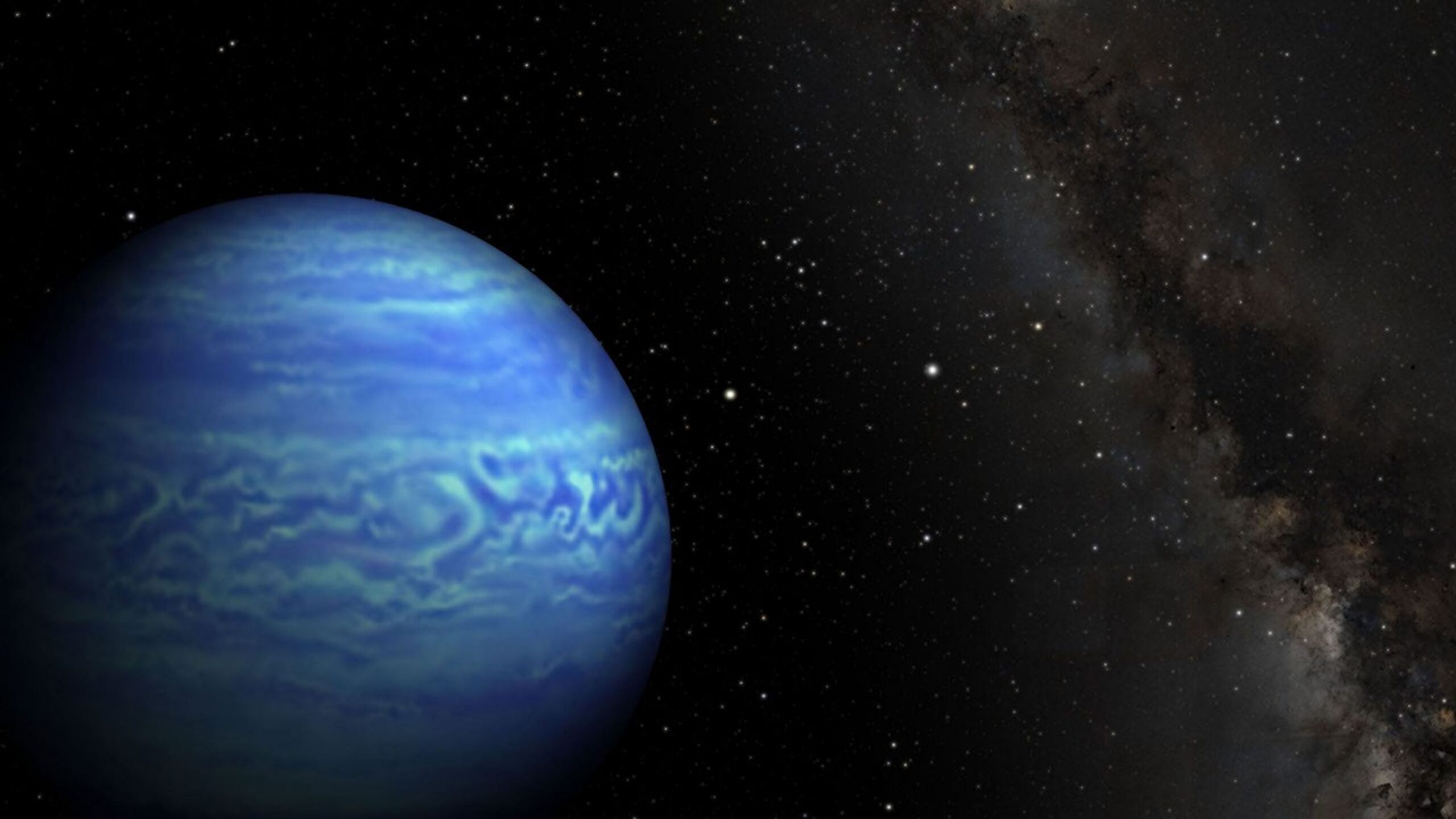
    An archival artist’s concept of WISE 0855, released in 2014. The colors are illustrative; this is not a Webb image of its clouds. Credit: NASA/JPL-Caltech/Penn State University.

  • Chandra’s New Galaxy Views Celebrate Swift’s Rapid Response to the Universe

    Chandra’s New Galaxy Views Celebrate Swift’s Rapid Response to the Universe

    A new collection of galaxy images highlights a partnership that has helped astronomers study some of the universe’s most energetic activity. Released on October 8, the views combine observations from NASA’s Chandra X-ray Observatory and Neil Gehrels Swift Observatory with data from other telescopes.

    The Chandra release features the Small Magellanic Cloud and the spiral galaxies NGC 1097, NGC 4151 and NGC 1365. Its timing is poignant: Swift is approaching the end of its orbital life after an unsuccessful attempt to raise its altitude.

    The collection brings older observations together in newly released presentations. It offers a useful way to understand what different instruments contribute when astronomers examine the same object across several forms of light.

    Fast reactions and detailed views

    Swift launched in November 2004 to investigate gamma-ray bursts and other changing cosmic events. Its three telescopes cover gamma rays, X-rays, ultraviolet and visible light. The spacecraft’s ability to redirect its attention quickly lets it begin studying an outburst while that event is still unfolding.

    Chandra adds exceptionally sharp X-ray observations. A fast response can establish when and where something is happening; a detailed view can help distinguish the sources and structures responsible. Coordinated measurements allow researchers to investigate a phenomenon with more information than either observatory could supply alone.

    In the Small Magellanic Cloud image, ultraviolet, X-ray, infrared and optical measurements reveal different parts of a nearby galactic neighbor. The other three galaxies contain actively feeding supermassive black holes. Their bright central regions show how strongly the surroundings of a black hole can radiate as material is heated.

    These are data-based composite images. Colors represent selected wavelength ranges, including radiation invisible to human eyes. The color key is therefore part of the scientific explanation: it tells the reader which instrument or kind of light produced a feature.

    Why Swift’s orbit is running out of time

    Space near Earth still contains a thin atmosphere. Over time, drag removes orbital energy from satellites, lowering their altitude. Increased solar activity intensified the drag affecting Swift, which has no propulsion system to maintain its orbit.

    NASA contracted Katalyst Space to build a servicing spacecraft called LINK, designed to approach Swift, grasp it and lift it higher. LINK launched in July, but communications and orientation-control problems prevented it from carrying out the planned boost. NASA’s September 28 account of the effort says the agency ended its involvement on September 3; LINK re-entered the atmosphere on September 25.

    The attempted rescue had already shaped Swift’s observing schedule. Controllers spent months pointing the observatory in ways intended to reduce drag, balancing its orientation against power and instrument-safety constraints. This bought time for the servicing effort while limiting normal science observations.

    A legacy built on catching change

    After the boost plan was scaled back, Swift resumed scientific work. A September 25 operations update reported that its Burst Alert Telescope was detecting gamma rays again and that automated repointing had restarted.

    Normally, a detection by that wide-field instrument can interrupt the day’s planned observations. Swift then turns its other telescopes toward the event. That ability to react autonomously is central to the observatory’s contribution to time-sensitive astronomy.

    The same update estimated that Swift would reach an altitude where science operations become difficult in early to mid-October. It was a forecast, not an announcement that observations had ended. The October 8 Chandra release described the telescope as nearing its final days in orbit; neither source establishes an exact end date.

    Whatever the remaining operational time, the accumulated observations will retain their scientific value. The new galaxy collection illustrates why: measurements taken by different observatories, sometimes years apart, can be brought together to reveal structures and physical processes more clearly. Swift’s contribution extends from its rapid response to a fresh flash in the sky to the long-lived record that astronomers continue to examine.

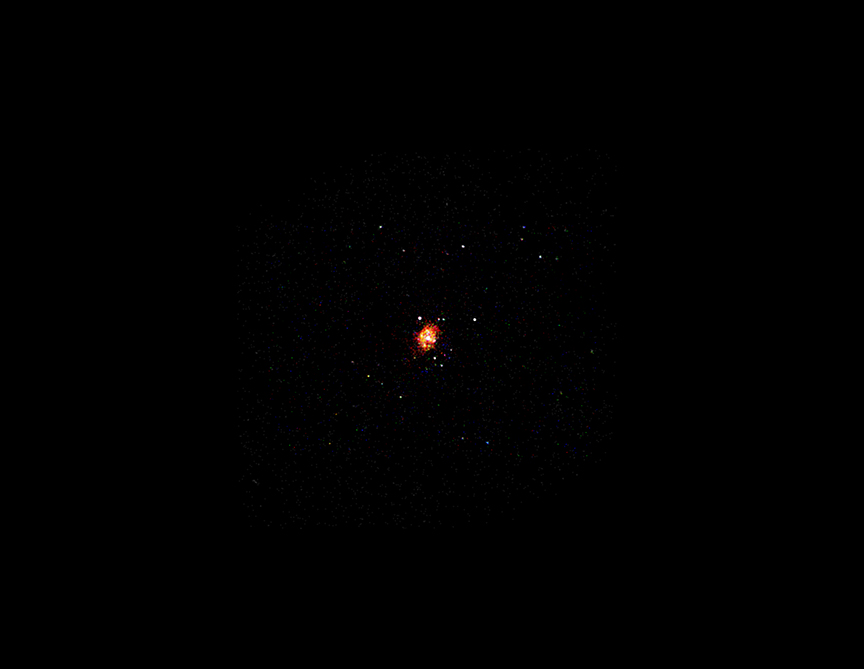
    Image: The Chandra X-ray component of the October 8 NGC 1097 release. This is an X-ray data image, rather than the full optical and ultraviolet composite. Credit: NASA/CXC/SAO; image processing: NASA/CXC/SAO/L. Frattare. Image source; usage information.

  • MMX Nears Launch for a Journey to Bring Pieces of Phobos Home

    MMX Nears Launch for a Journey to Bring Pieces of Phobos Home

    Japan’s next sample-return mission is approaching its scheduled departure for Mars. Martian Moons eXploration, or MMX, will investigate Phobos and Deimos, collect material from Phobos and aim to deliver it to laboratories on Earth in 2031.

    JAXA’s published launch plan targets 4:41:03 a.m. Japan Standard Time on October 20 from Tanegashima Space Center. That is October 19 at 19:41:03 UTC. The spacecraft will fly on an H3 rocket, with a reserved launch period extending from October 21 through November 7 if the initial opportunity is missed.

    NASA announced on October 8 that it will hold a mission briefing on October 15 to explain its contributions. The latest schedule calls for arrival at Mars in August 2027 and sample collection no earlier than December 2028. Those dates describe the current mission plan, with several demanding operations still ahead.

    Two competing histories for the Martian moons

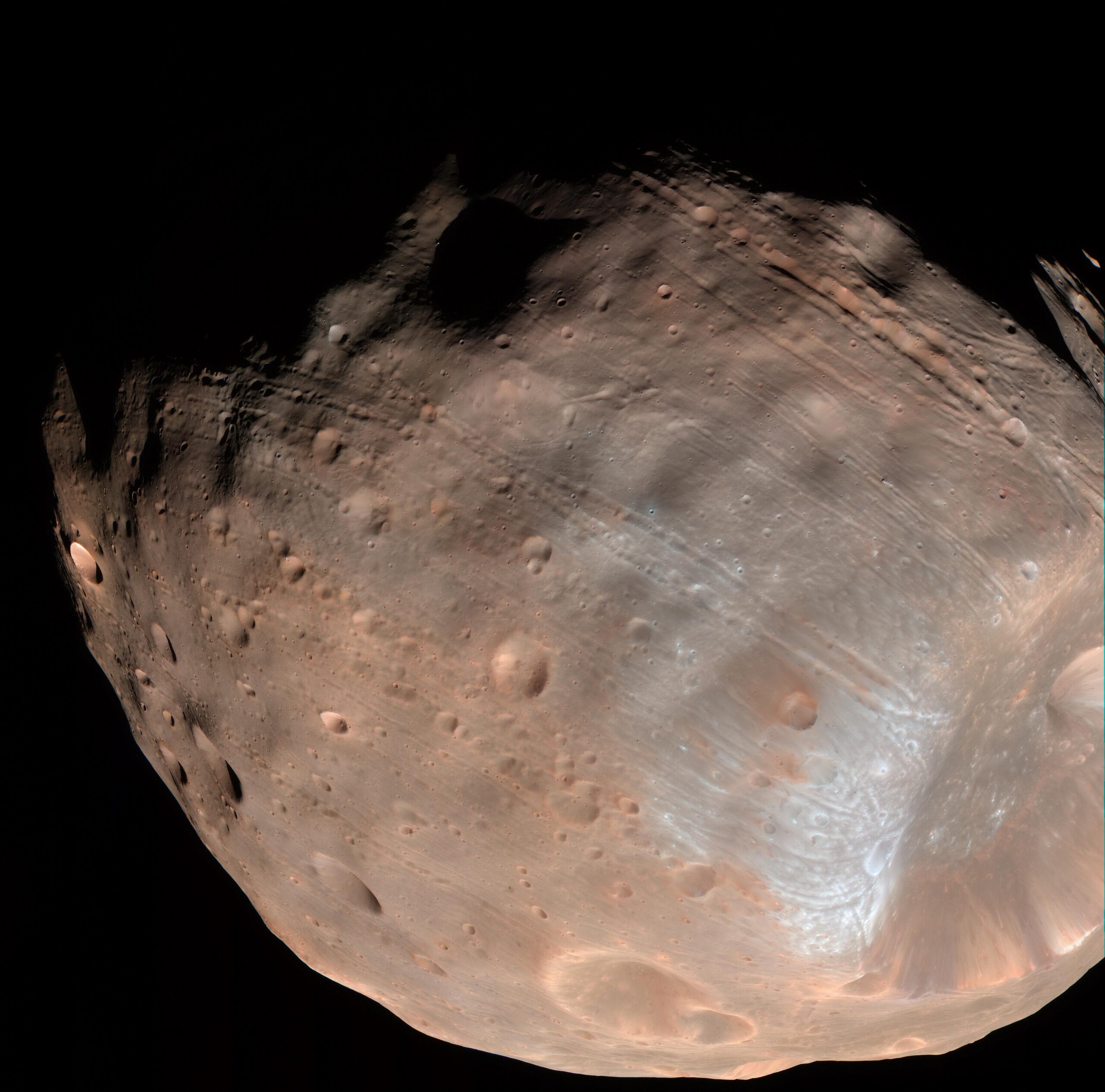
    Phobos and Deimos are small, irregular bodies whose origins remain uncertain. One leading explanation is that they began as asteroids and were captured by Mars. Another is that they formed from material thrown into orbit after a large object collided with the planet.

    The alternatives imply different histories for the moons’ ingredients. Identifying their composition could therefore help researchers reconstruct events in the early Mars system and understand how material moved between different regions of the young solar system.

    JAXA’s mission overview describes a program combining measurements of surface shape, internal structure, composition and gravity with returned rock and sand. These observations will give scientists several independent ways to test an origin model. A successful explanation must account for both what the moons are made of and their physical properties.

    Phobos is the sample target, but Deimos is also part of the survey. Studying both bodies will provide context for interpreting the material eventually delivered to Earth.

    Reading the surface before collecting it

    One of NASA’s principal contributions is MEGANE, the Mars-moon Exploration with Gamma-rays and Neutrons instrument. Developed by the Johns Hopkins Applied Physics Laboratory, it will measure radiation emerging from Phobos to help determine the elements present near the surface.

    The NASA mission description explains that the energies of the detected neutrons and gamma rays carry information about elemental composition. That gives the spacecraft a chemical view that complements its images. A photograph can show a crater or a patch of different-looking terrain; compositional measurements can investigate whether the material itself differs.

    NASA is also contributing a pneumatic sampling mechanism developed by Honeybee Robotics, communications and navigation support through the Deep Space Network, and funding for participating U.S. scientists. The mission is led by JAXA with international partners, bringing together different instruments and exploration systems around a shared sample-return objective.

    JAXA’s plan also includes deploying the small IDEFIX rover to inspect the surface before the main spacecraft’s landing. Reconnaissance is particularly valuable when an operation must work on unfamiliar ground under very weak gravity.

    Why the return journey matters

    Orbital measurements reveal where a sample comes from and how its surroundings fit together. Bringing material home would add access to laboratory techniques that cannot all be carried on a spacecraft. Researchers could examine the same grains using different methods and compare their findings against the larger-scale maps gathered at Mars.

    For now, the next milestone is departure. Reaching Mars, surveying the moons, selecting a suitable location, collecting material and completing the journey back are separate challenges. NASA’s October 15 briefing is scheduled for 4 p.m. EDT, with audio carried on NASA’s live-coverage page.

    The scientific payoff would be a much firmer account of how two familiar but poorly understood moons came to orbit Mars. Their surfaces may preserve evidence that distant observations have so far been unable to resolve.

    Image: Phobos observed by the HiRISE camera on Mars Reconnaissance Orbiter on March 23, 2008. Color combines blue-green, red and near-infrared measurements. Credit: NASA/JPL-Caltech/University of Arizona. Image source; usage information.
  • Brain Models, Crop Disease and Faster Lab Tests Head for the Space Station

    Brain Models, Crop Disease and Faster Lab Tests Head for the Space Station

    A small collection of brain-tissue models, a plant-disease experiment and a faster way to analyze biological samples are among the research heading to the International Space Station on SpaceX’s next cargo flight. Readers who want to see the orbiting laboratory for themselves can use our guide to spotting an ISS pass. NASA detailed the investigations on October 12, ahead of Dragon’s planned launch the following morning.

    The 35th SpaceX commercial resupply mission is targeting October 13 at 6:33 a.m. EDT, or 10:33 UTC, from Cape Canaveral Space Force Station. The schedule remains subject to launch conditions and mission operations. Dragon is carrying more than 6,300 pounds of supplies, equipment and research.

    The new science preview highlights four investigations from NASA’s Biological and Physical Sciences division. Together they address practical questions about maintaining healthy crews and reliable food production farther from Earth, where returning a sample to a laboratory will be much harder.

    Small tissue models, carefully controlled comparisons

    The AVATAR-Org1 investigation will send laboratory-grown human brain-tissue models to the station for five weeks. Researchers will compare them with matching tissue maintained on Earth, looking for cellular changes associated with the spaceflight experience.

    NASA’s experiment description calls these models miBrains and says they contain seven primary cell types found in the human brain. The project will also test whether living brain tissue can be grown, monitored and studied reliably during flight. Establishing a workable research method is part of the objective.

    The models offer a controlled way to examine cells, but findings will need careful interpretation before they can explain health effects in an astronaut. The immediate work concerns cellular responses and experimental methods. Any future treatment or protective measure would require further investigation.

    Another cargo investigation, MINDS, uses brain organoids to study inflammation associated with neurodegenerative disease. NASA’s mission overview describes combinations of cells from multiple people intended to capture more patient diversity. MINDS and AVATAR-Org1 are separate experiments, with different questions and tissue-model approaches.

    Keeping crops and crews healthy

    The MVP-Plant-02 experiment tests whether a fungal disease develops more quickly or becomes more severe in microgravity. Investigators will compare molecular and structural changes in infected plants grown aboard the station with those grown on Earth.

    That comparison matters for space agriculture. A dependable crop system would provide fresh food and dietary variety, while plants could contribute to air and water recycling. Disease resistance is one of the requirements such a system must meet. The experiment is testing a hypothesis about disease severity; its launch does not establish the result.

    Meanwhile, the GEARS investigation returns for its fourth and final planned stay. Astronauts will repeatedly sample station surfaces to monitor antibiotic-resistant organisms. The study focuses on how bacteria survive in an enclosed microgravity environment and how crews might be protected during longer missions.

    Tracking those organisms over time can provide information that a single sampling visit would miss. The goal is to understand and manage infection risks, with potential relevance to enclosed environments on Earth as well.

    Getting answers without shipping samples home

    The fourth investigation will test a compact microplate reader that reached the station earlier this year. ELISA MABL will assess its ability to perform assays that measure biological markers, including antibodies, antigens and proteins.

    Analyzing samples on board could shorten the wait for results and reduce the need to preserve specimens until they can be returned. The demonstration will check both the reliability of the assay in microgravity and whether the reader produces data of the required quality.

    For this flight, NASA is planning Dragon’s docking for October 15 and a return in mid-November. The cargo also includes the final pair of roll-out solar arrays for the station’s power augmentation. The research will begin another cycle of delivery, onboard work and analysis, turning an operational resupply mission into a set of tests for living and working deeper in space.

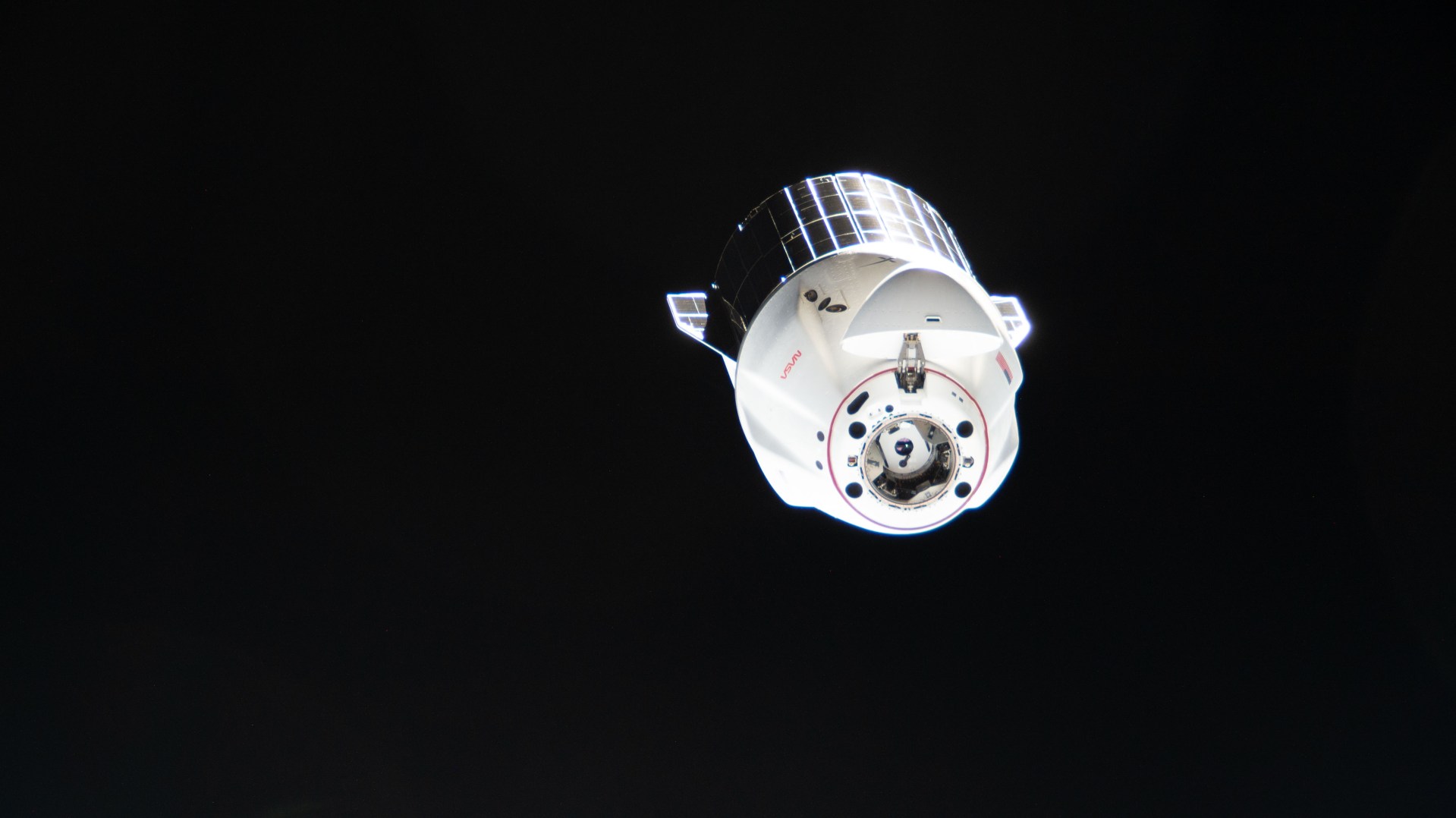
    Image: Archive photograph of a Dragon cargo spacecraft departing the station on June 16, 2026, used by NASA in its CRS-35 launch advisory. Credit: NASA. Image source; usage information.
  • Perseverance Breaks the Off-World Driving Record as Its Mission Enters a New Phase

    Perseverance Breaks the Off-World Driving Record as Its Mission Enters a New Phase

    Perseverance has become the most-traveled vehicle on the surface of another world. A drive on October 11 brought its total distance to 45.22 kilometers, or 28.10 miles, passing the 45.16-kilometer record held by Opportunity.

    The milestone arrived on the rover’s 2,006th Martian day. It also comes at the start of a newly approved mission extension, running from October through roughly the end of 2028. NASA’s October 12 announcement places the achievement in a scientific setting: Perseverance is crossing ancient terrain beyond Jezero Crater’s western rim, with possible traces of long-vanished hydrothermal activity among its next targets.

    More ground covered between instructions

    The record-breaking drive covered 91.31 meters. Over the whole mission, however, the larger change is how much of the route Perseverance can manage for itself. Its AutoNav system photographs the ground, builds a three-dimensional assessment of hazards and chooses a path between planned waypoints while the wheels are moving.

    More than 90 percent of its total driving distance has used AutoNav to evaluate the terrain. That compares with about 5 percent for the first version of Martian AutoNav used by Spirit and Opportunity. Perseverance has covered as much as 412 meters in one sol, the name for a Martian day.

    Autonomy helps make good use of a rover’s limited working time. Waiting for a new set of instructions can interrupt an otherwise safe traverse. Letting the machine handle nearby obstacles allows planners to concentrate on the destination and the observations it should make there.

    A separate navigation upgrade addresses a problem that grows during long drives: uncertainty about the rover’s exact position. In February, NASA described Mars Global Localization, which compares navigation-camera panoramas with onboard maps made from orbital images. The system can locate the rover to within about 25 centimeters in roughly two minutes.

    That work runs on a processor originally used to communicate with the Ingenuity helicopter. Reusing the hardware gives Perseverance a way to check its position without waiting for specialists on Earth to match the same views.

    A route into older Mars

    Perseverance is traveling through a region called Lac de Charmes toward an area named Idubi. The science team hopes to find evidence of ancient hydrothermal systems there, environments in which heated water interacted with rock. Establishing whether those systems existed requires observations of the rocks and their chemistry; reaching a promising location is the beginning of that investigation.

    The rover has already moved from Jezero’s former lakebed through deposits left by a river and up toward the crater rim. Along the way it has collected 29 rock and regolith samples. The rim provides access to impact-related rocks about four billion years old, helping extend the geological story beyond the sedimentary environments explored earlier in the mission.

    Plans for the extension include traveling south along the rim toward Rainbow Falls, a block of ancient crust about 100 meters wide that was lifted by the impact that formed Jezero. Different stops along that route can expose different chapters of Mars’s history.

    What the distance record means

    Opportunity needed nearly 15 years to establish its total; Perseverance reached the new mark in about five and a half. The comparison reflects substantial improvements in driving and navigation, alongside the different terrain, hardware and scientific priorities of each mission.

    The practical reward is a broader choice of rocks to investigate. Efficient travel gives scientists more opportunities to connect distant outcrops, test geological interpretations and select samples. With mobility systems reported fully operational in the latest update, the next part of Perseverance’s journey will put that reach to work in some of the oldest accessible terrain around Jezero.

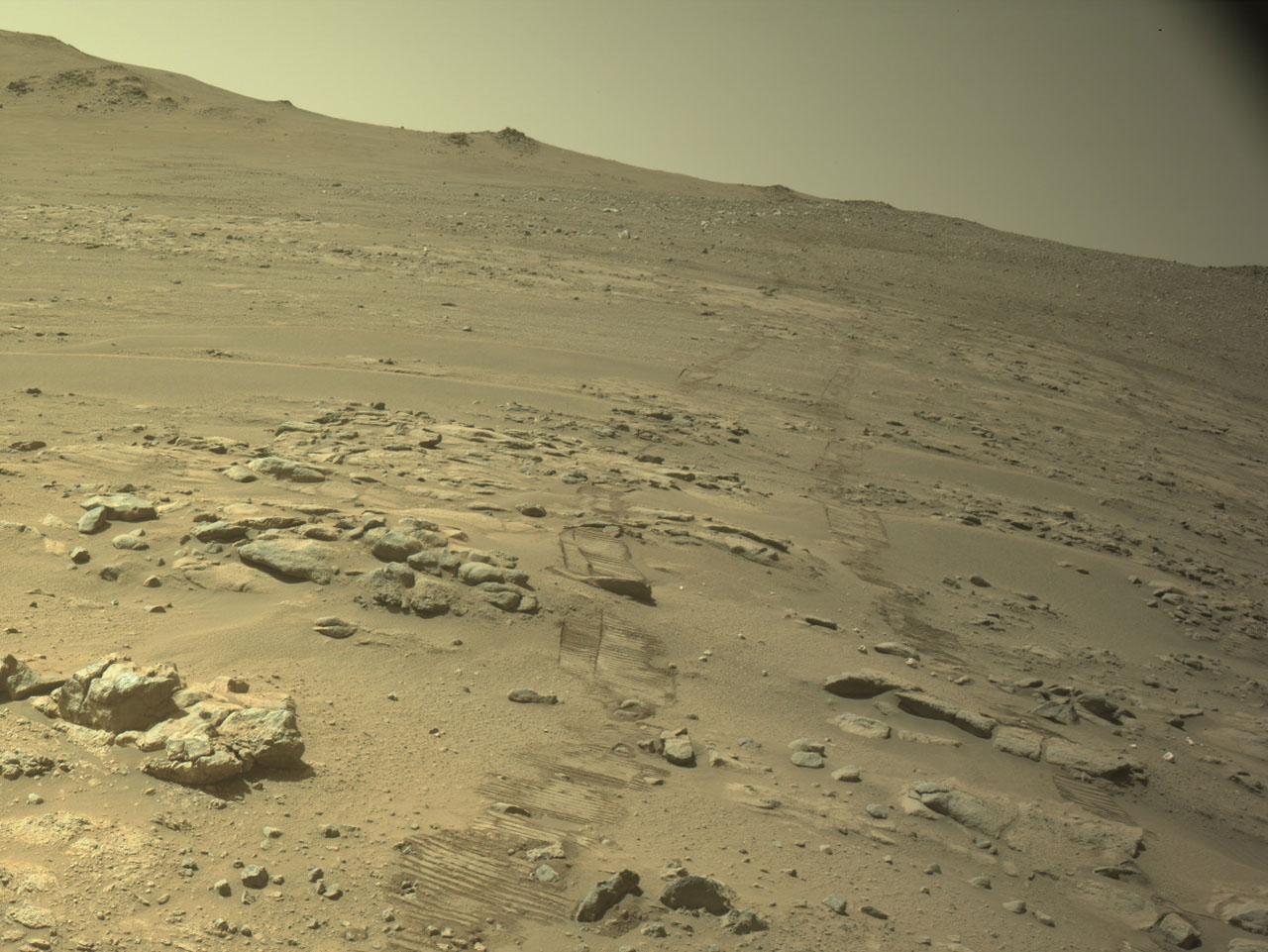
    Image: Perseverance navigation-camera view from October 11, 2026, the day its driving distance passed Opportunity’s record. Credit: NASA/JPL-Caltech. Image source; usage information.
  • GEP’s September UFO Report Logs 49 Submissions and 21 Open Cases

    GEP’s September UFO Report Logs 49 Submissions and 21 Open Cases

    Germany’s Society for the Study of the UFO Phenomenon, known as GEP, has published its September 2026 reporting roundup. The monthly report records 49 submissions, with 28 cases marked completed and 21 still open at the end of the month. Its useful contribution is a case-by-case record that lets readers follow how unusual observations are investigated.

    GEP announced the release on October 4. The organization receives reports from Germany, Austria and Switzerland, as well as German-speaking witnesses describing events elsewhere. The publication is therefore a regional reporting snapshot rather than a worldwide survey.

    When a report arrives matters

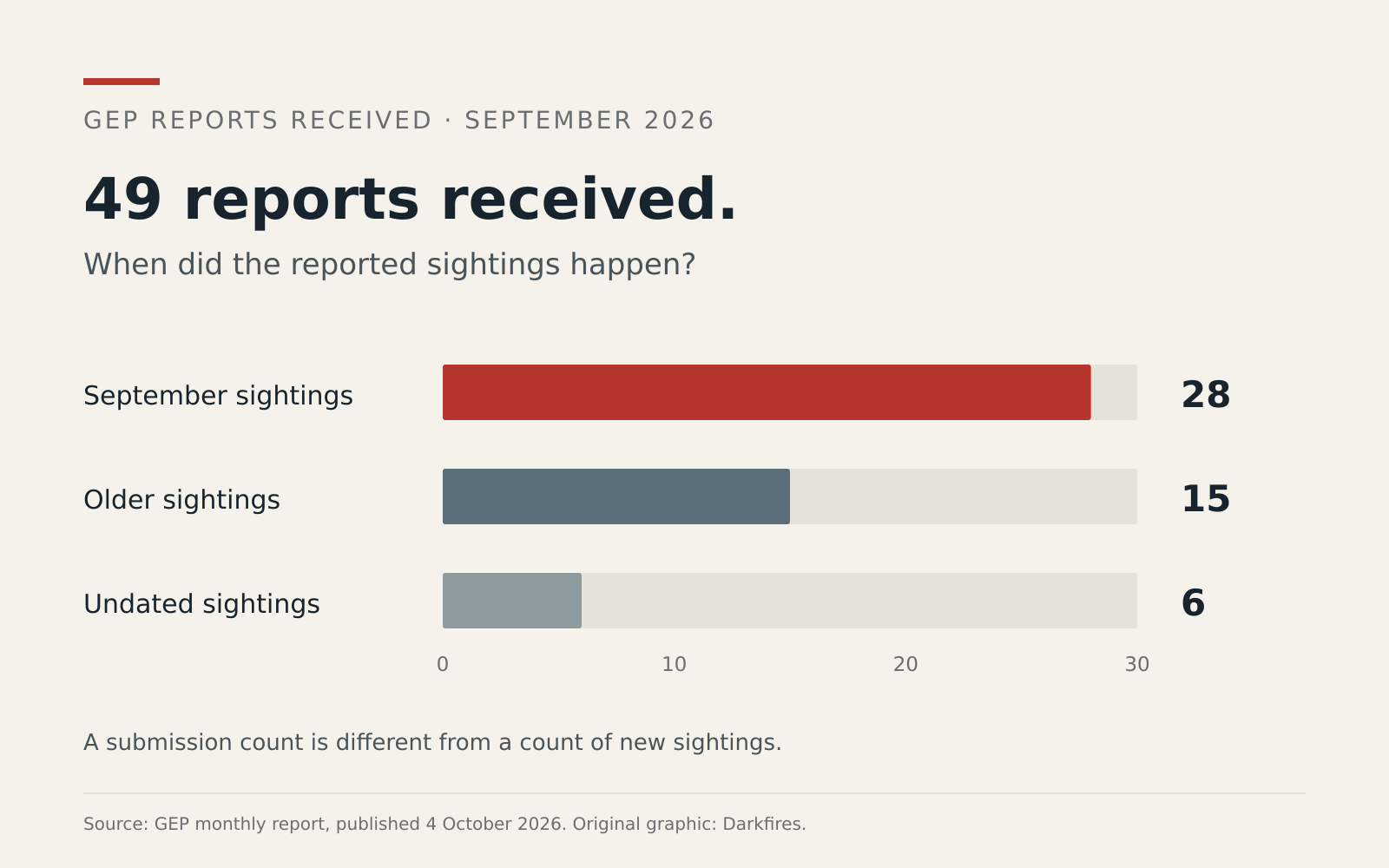
    The 49 submissions matched August’s total. Only 28 concerned events during September itself; 15 described older sightings and six lacked a date. That distinction matters when interpreting a monthly count: an increase in incoming reports could include memories of events years earlier.

    The report also lists 29 submissions with image material. Among the completed entries, GEP identifies a September 28 light filmed in Labin, Croatia, as the International Space Station, and a September 29 object filmed in Leverkusen-Rheindorf as a foil balloon. Elsewhere, a completed entry ends with insufficient data. A completed investigation therefore does not necessarily supply an identification.

    A snapshot that can change

    GEP’s release notice explains that the monthly reports preserve the state of an investigation at month-end. Later changes are not retroactively incorporated into those summaries. An open entry means that assessment was unfinished at that point; it should not be read as a final judgment that an observation resists conventional explanation.

    For readers comparing months, this creates a practical rule: use the monthly PDF to establish what was reported and assessed then, and consult the current case record for subsequent developments. Those two records answer different questions. A later identification would update the investigation without making the original month-end summary inaccurate.

    Following the underlying data

    A separate GEP dataset deposited on Zenodo on October 3 carries version number 2026.09. It provides a downloadable CSV with case identifiers, observation dates and times, locations, report narratives, classifications and investigation results. GEP says personal information about the reporters is excluded. The release forms part of a versioned series, allowing researchers to identify which snapshot they used.

    The organization’s October statistical dashboard provides a broader view of its archive. It lists 6,726 cases overall and uses 5,673 classified cases as the denominator for several headline percentages. Identified cases account for 81.9 percent of that classified subset; insufficient-data cases account for 11.5 percent. Its combined problematic/good/best-UFO grouping accounts for 2.3 percent.

    Those percentages describe the dashboard’s categories, not the September intake alone. A comparison with NUFORC’s archive and grading system shows why each organization’s definitions and reporting dates need to stay attached to its figures. They also should not be turned into a probability that a randomly observed light has an exotic origin. Cases reaching a voluntary reporting organization depend on who notices something, who chooses to report it and what evidence remains available.

    What readers can examine

    GEP’s research overview describes an approach combining individual case investigation, statistical analysis, witness assessment and technical observations. It explicitly includes viewing conditions, memory and possible misinterpretations when considering testimony.

    The latest releases make that work easier to inspect at the level where conclusions are actually reached: individual reports. Readers can compare a witness’s description with the recorded outcome, check the observation date against the submission date, and see whether a conclusion is final or pending. Keeping those distinctions visible gives the September figures more value than a headline count on its own.

    Image: Original Dark Fires graphic. Data: GEP September 2026 monthly report.