Germany’s Society for the Study of the UFO Phenomenon, known as GEP, has published its September 2026 reporting roundup. The monthly report records 49 submissions, with 28 cases marked completed and 21 still open at the end of the month. Its useful contribution is a case-by-case record that lets readers follow how unusual observations are investigated.
GEP announced the release on October 4. The organization receives reports from Germany, Austria and Switzerland, as well as German-speaking witnesses describing events elsewhere. The publication is therefore a regional reporting snapshot rather than a worldwide survey.
When a report arrives matters
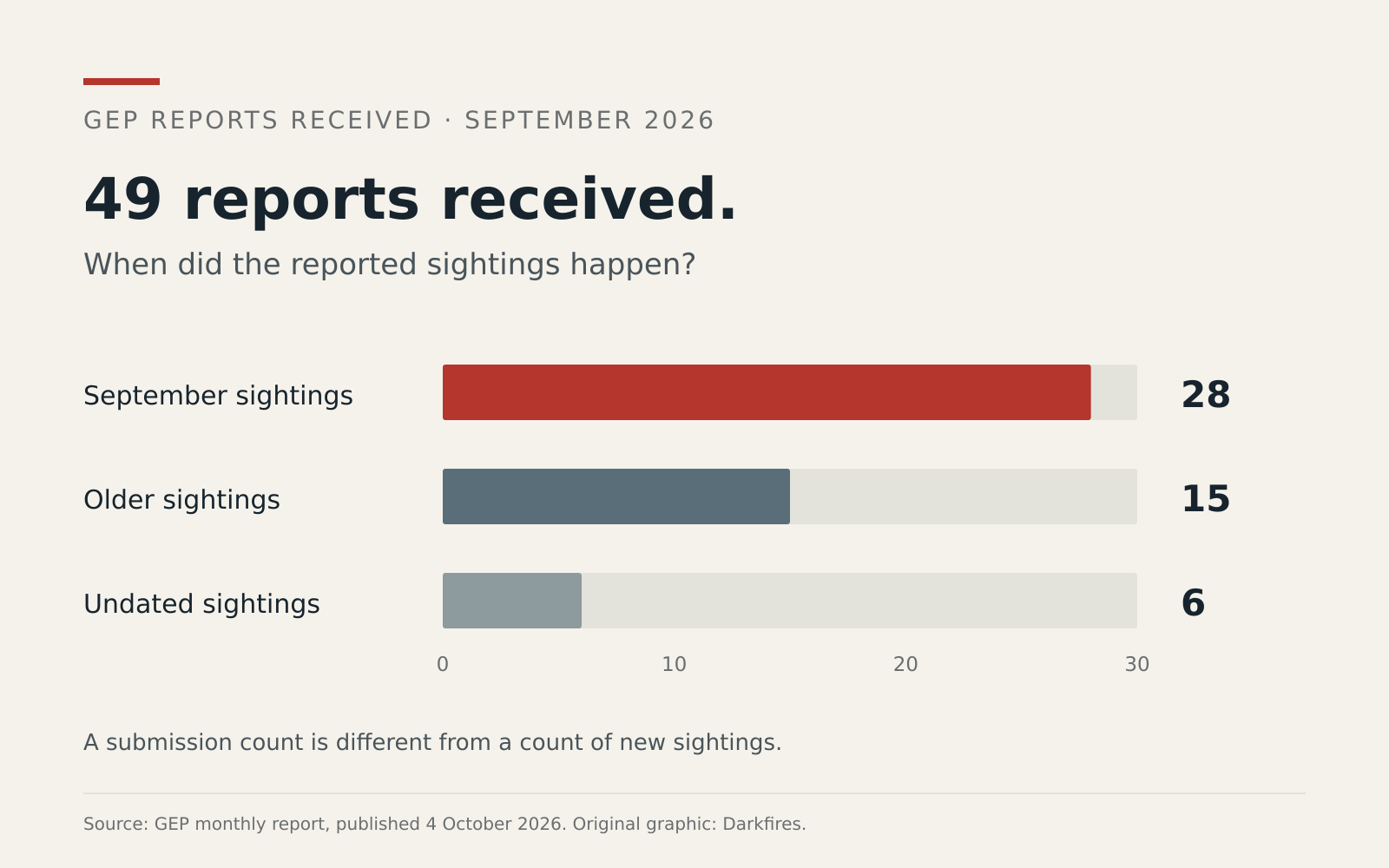
The 49 submissions matched August’s total. Only 28 concerned events during September itself; 15 described older sightings and six lacked a date. That distinction matters when interpreting a monthly count: an increase in incoming reports could include memories of events years earlier.
The report also lists 29 submissions with image material. Among the completed entries, GEP identifies a September 28 light filmed in Labin, Croatia, as the International Space Station, and a September 29 object filmed in Leverkusen-Rheindorf as a foil balloon. Elsewhere, a completed entry ends with insufficient data. A completed investigation therefore does not necessarily supply an identification.
A snapshot that can change
GEP’s release notice explains that the monthly reports preserve the state of an investigation at month-end. Later changes are not retroactively incorporated into those summaries. An open entry means that assessment was unfinished at that point; it should not be read as a final judgment that an observation resists conventional explanation.
For readers comparing months, this creates a practical rule: use the monthly PDF to establish what was reported and assessed then, and consult the current case record for subsequent developments. Those two records answer different questions. A later identification would update the investigation without making the original month-end summary inaccurate.
Following the underlying data
A separate GEP dataset deposited on Zenodo on October 3 carries version number 2026.09. It provides a downloadable CSV with case identifiers, observation dates and times, locations, report narratives, classifications and investigation results. GEP says personal information about the reporters is excluded. The release forms part of a versioned series, allowing researchers to identify which snapshot they used.
The organization’s October statistical dashboard provides a broader view of its archive. It lists 6,726 cases overall and uses 5,673 classified cases as the denominator for several headline percentages. Identified cases account for 81.9 percent of that classified subset; insufficient-data cases account for 11.5 percent. Its combined problematic/good/best-UFO grouping accounts for 2.3 percent.
Those percentages describe the dashboard’s categories, not the September intake alone. They also should not be turned into a probability that a randomly observed light has an exotic origin. Cases reaching a voluntary reporting organization depend on who notices something, who chooses to report it and what evidence remains available.
What readers can examine
GEP’s research overview describes an approach combining individual case investigation, statistical analysis, witness assessment and technical observations. It explicitly includes viewing conditions, memory and possible misinterpretations when considering testimony.
The latest releases make that work easier to inspect at the level where conclusions are actually reached: individual reports. Readers can compare a witness’s description with the recorded outcome, check the observation date against the submission date, and see whether a conclusion is final or pending. Keeping those distinctions visible gives the September figures more value than a headline count on its own.
Image: Original Dark Fires graphic. Data: GEP September 2026 monthly report.
Leave a Reply