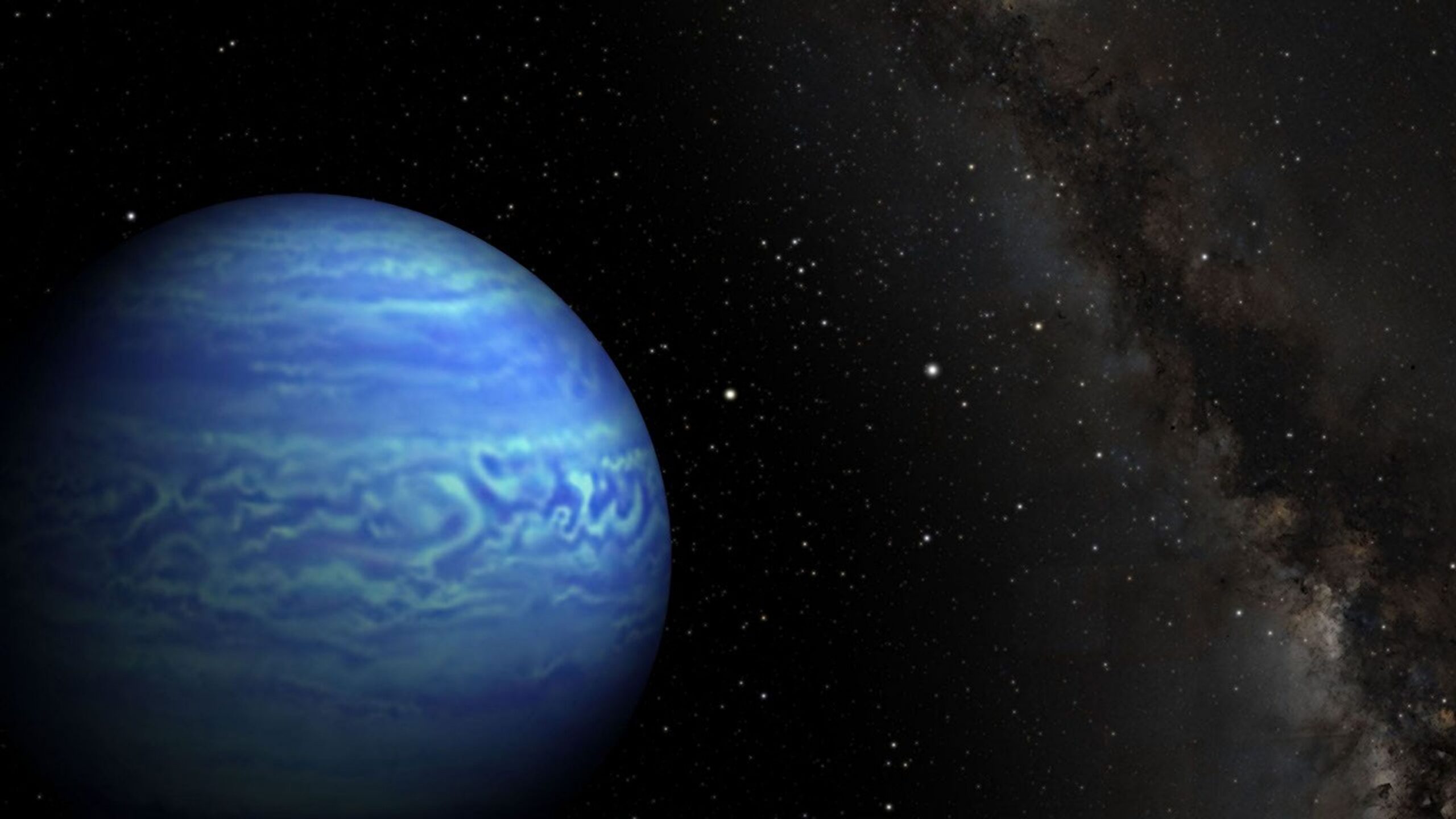
A cold, faint neighbor of the Sun is giving astronomers a more detailed view of weather beyond our solar system. Webb observations of WISE 0855 reveal changing atmospheric chemistry and evidence that patches of water clouds have different thicknesses as the object turns.
The University of Arizona announced the findings on October 8. Led by Brittany Miles, the team studied the brown dwarf for 11 hours, recording a spectrum every 15 minutes. At about 7.5 light-years away, WISE 0855 offers an unusually close laboratory for understanding cold, planet-like atmospheres.
Reading the weather in infrared light
Webb’s Near-Infrared Spectrograph, NIRSpec, separates incoming light by wavelength. Different molecules absorb different parts of that light, leaving patterns that reveal composition and physical conditions. Following those patterns through time can show changes that a single brightness measurement would conceal.
There is an important distinction between measuring a light curve and resolving a weather map. These observations combine light from the visible face of WISE 0855. Researchers reconstruct the atmospheric behavior by comparing that changing spectrum with physical models; Webb has not photographed individual clouds moving across a resolved globe.
In the research paper, submitted September 17 and listed as accepted by The Astronomical Journal, the largest changes occur in carbon-monoxide absorption, reaching about 10 percent at some wavelengths. Carbon monoxide and phosphine vary together, pointing to a contribution from deeper atmospheric layers. Cloud-thickness changes affect higher, lower-pressure regions.
The distinction helps explain why all parts of the spectrum do not brighten and fade together. Warm gas can move upward from the interior, carrying chemistry that differs from what would be expected if every layer simply reached local chemical equilibrium. Higher clouds change how much light escapes from below.
A longer story about a very cold world
Water clouds on WISE 0855 have been under investigation for years. In 2016, a Gemini North study obtained an infrared spectrum after roughly 14 hours of observations spread across 13 nights. A cloudy atmosphere model gave a better fit than a cloud-free one. That work already supplied evidence for water or water-ice clouds beyond the solar system.
The new result adds a time dimension and separates atmospheric effects more clearly. Calling it the first water-cloud discovery would lose that earlier history. The advance is evidence for changing cloud thickness alongside changing molecular signatures.
WISE 0855’s characteristic temperature is around 265 kelvin, about minus 8 degrees Celsius, although its atmosphere contains different temperatures at different depths. Its similarities to giant planets make it useful for testing atmospheric physics. Clouds and phosphine in this setting do not establish biological activity.
More observing time is needed
The paper leaves important questions open. The available Webb and earlier Spitzer observations do not establish a consistent rotation period. Longer observations at multiple epochs would help distinguish atmospheric patterns and test proposed jets or storms.
For now, the changing infrared spectrum provides a clearer view of how clouds, temperature and vertical mixing work together on a cold world. Those lessons can sharpen the models used to interpret giant exoplanets elsewhere.
An archival artist’s concept of WISE 0855, released in 2014. The colors are illustrative; this is not a Webb image of its clouds. Credit: NASA/JPL-Caltech/Penn State University.
Leave a Reply