NASA’s TESS mission has reached a milestone that reflects years of work beyond the spacecraft itself: 1,000 planets discovered with its data are now counted as confirmed worlds.
The NASA Exoplanet Archive announced the milestone in its October 8 update, when 70 new planets entered the archive. Those additions brought the archive’s overall confirmed-exoplanet count, across missions and discovery methods, to 6,445. The same update listed 4,823 TESS project candidates awaiting confirmation.
The numbers describe that dated archive release. New additions can change the totals, and adding a planet to a catalog is not necessarily the day it was first observed or its discovery announced.
From a dip in starlight to a confirmed world
TESS launched on April 18, 2018 and remains in an extended mission. Its central method is to watch stars for small, repeated changes in brightness. A planet crossing the face of its star can block a little starlight, producing a transit.
As NASA described when science operations began in July 2018, the mission was designed to concentrate on nearby, bright stars. That choice makes promising systems more accessible to follow-up observations. TESS supplies the initial light curves; additional measurements help researchers establish what caused the signal and characterize the object.
The archive’s inclusion criteria require sufficient follow-up or validation to make a false-positive interpretation unlikely, with results accepted in the peer-reviewed literature. A promising candidate has therefore passed a different evidential threshold from an object on the confirmed list.
There is also a terminology wrinkle. The archive places statistically validated planets in its confirmed category, rather than giving them a separate status. That label does not mean every planet has an equally precise mass measurement, or that astronomers know its atmospheric composition.
A growing sample, with different kinds of worlds
A NASA overview released in May showed how varied the TESS harvest has become. The mission has found worlds spanning a wide range of sizes, including planets that may be volcanic, planets losing material to their stars and planets orbiting two stars. Its four cameras monitor broad sky sectors for about a month at a time, while repeated visits build longer records.
That diversity makes the growing catalog useful for comparative planetary science. Researchers can ask how sizes and orbits vary, then select particular systems for more demanding observations. A larger sample also provides more opportunities to find unusual objects that challenge existing formation models.
The count alone cannot tell us how many inhabited worlds exist. As NASA’s habitable-zone guide explains, a planet’s distance from its star is only a starting point for assessing whether liquid surface water could be possible. The star’s radiation and the planet’s physical conditions matter too. Even an Earth-sized world needs much more investigation before its environment can be understood.
The thousand-planet milestone is therefore both an achievement and a starting list. Each confirmed world contributes a better-established target, and the remaining candidates give observers plenty of work still to do.
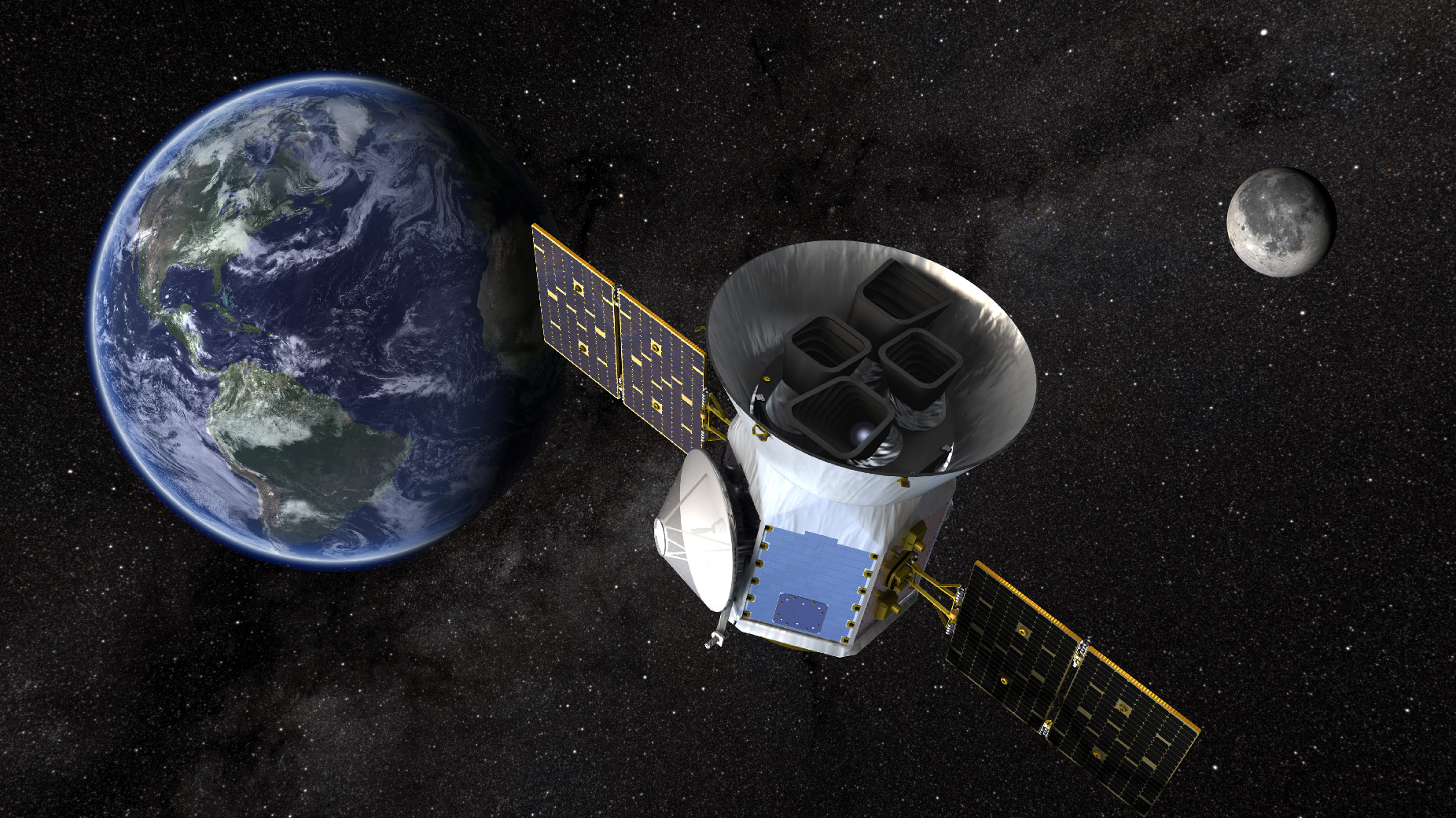
An archival artist’s illustration of TESS. Credit: NASA’s Goddard Space Flight Center.
Leave a Reply