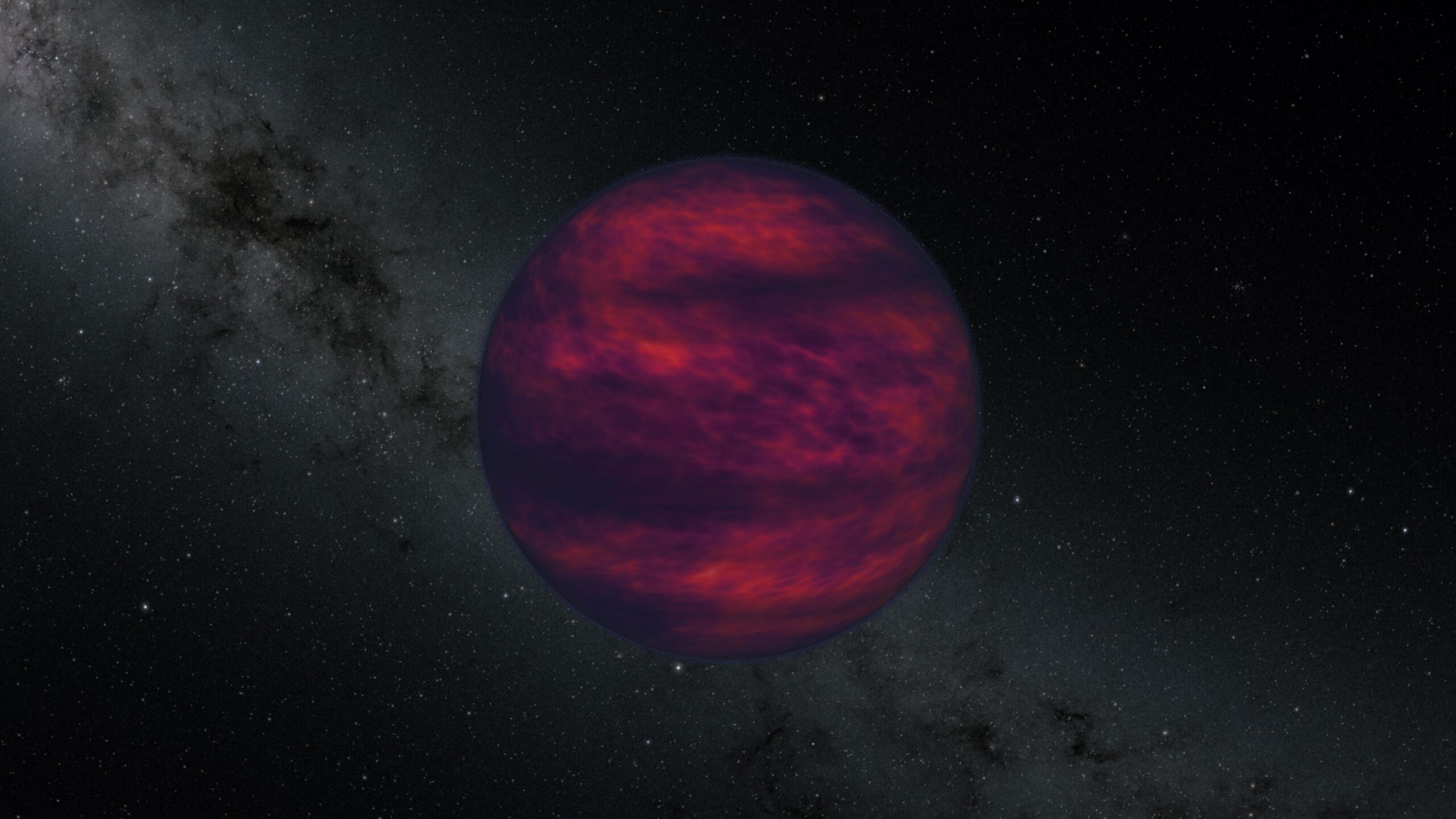
Artist’s concept of a brown dwarf. SPHEREx is measuring the light of these faint objects to investigate their atmospheres. Credit: NASA/JPL-Caltech.
NASA’s SPHEREx space telescope is turning the faint glow of brown dwarfs into a test of atmospheric science. An October 8 announcement describes observations revealing water, carbon dioxide, carbon monoxide and methane in these dim objects, alongside a challenging result: leading models still cannot reproduce all the details of their light.
The study, led by Zafar Rustamkulov, examines a sequence of nearby brown dwarfs spanning spectral classes L0 through Y4 and temperatures of roughly 2,500 to 250 kelvin. Its July preprint preceded publication in The Astrophysical Journal on September 28. This week’s news brings the results to a wider audience.
Reading the light of dim worlds
Brown dwarfs form through the collapse of gas but lack enough mass to sustain the hydrogen fusion that powers ordinary stars. Their atmospheres can nevertheless resemble those of giant planets. The free-floating objects discussed in NASA’s announcement radiate their own heat as they gradually cool.
Reading that light requires spectroscopy. A normal image compresses much of an object’s information into its apparent brightness and color. A spectrum separates the light by wavelength, exposing patterns that different materials leave behind. As NASA’s spectroscopy explainer describes, those patterns let researchers investigate composition and temperature without collecting a physical sample. The result is a set of chemical clues that can be compared with predictions for a model atmosphere.
Where the models fall short
The researchers compared their measurements with several established atmosphere-model families. The calculations broadly followed the changing chemistry, yet had trouble matching different wavelength regions simultaneously. Problems were especially pronounced around the L/T transition, with large discrepancies near carbon dioxide and carbon monoxide features. Within the Elf Owl model family, the sample favored weaker vertical mixing over stronger mixing, offering a specific direction for further testing.
The cloudy transition is important because cooling can change both what an atmosphere contains and how easily light escapes it. NASA’s account describes thinning clouds and increasingly methane-rich atmospheres. Even objects with similar temperatures can produce noticeably different spectra, complicating the task of making a single model fit them all.
Water and carbon-bearing molecules may sound familiar from discussions of habitable planets. Here, however, their detection describes atmospheric chemistry; the study makes no claim of life. Finding a molecule and establishing a biological origin are separate scientific questions. Readers should also avoid treating a water signature as evidence for an ocean or an Earth-like surface.
A growing comparison sample
SPHEREx was launched on March 11, 2025. Its planned two-year all-sky survey is designed to gather data on more than 450 million galaxies and more than 100 million Milky Way stars. Brown-dwarf research demonstrates how such a broad survey can also illuminate nearby objects that are difficult to characterize.
The practical value of this work lies in comparison: observed spectra show where theoretical atmospheres succeed and where they need improvement. Expanding those tests to larger samples should help distinguish recurring physical effects from the peculiarities of individual worlds.
Leave a Reply