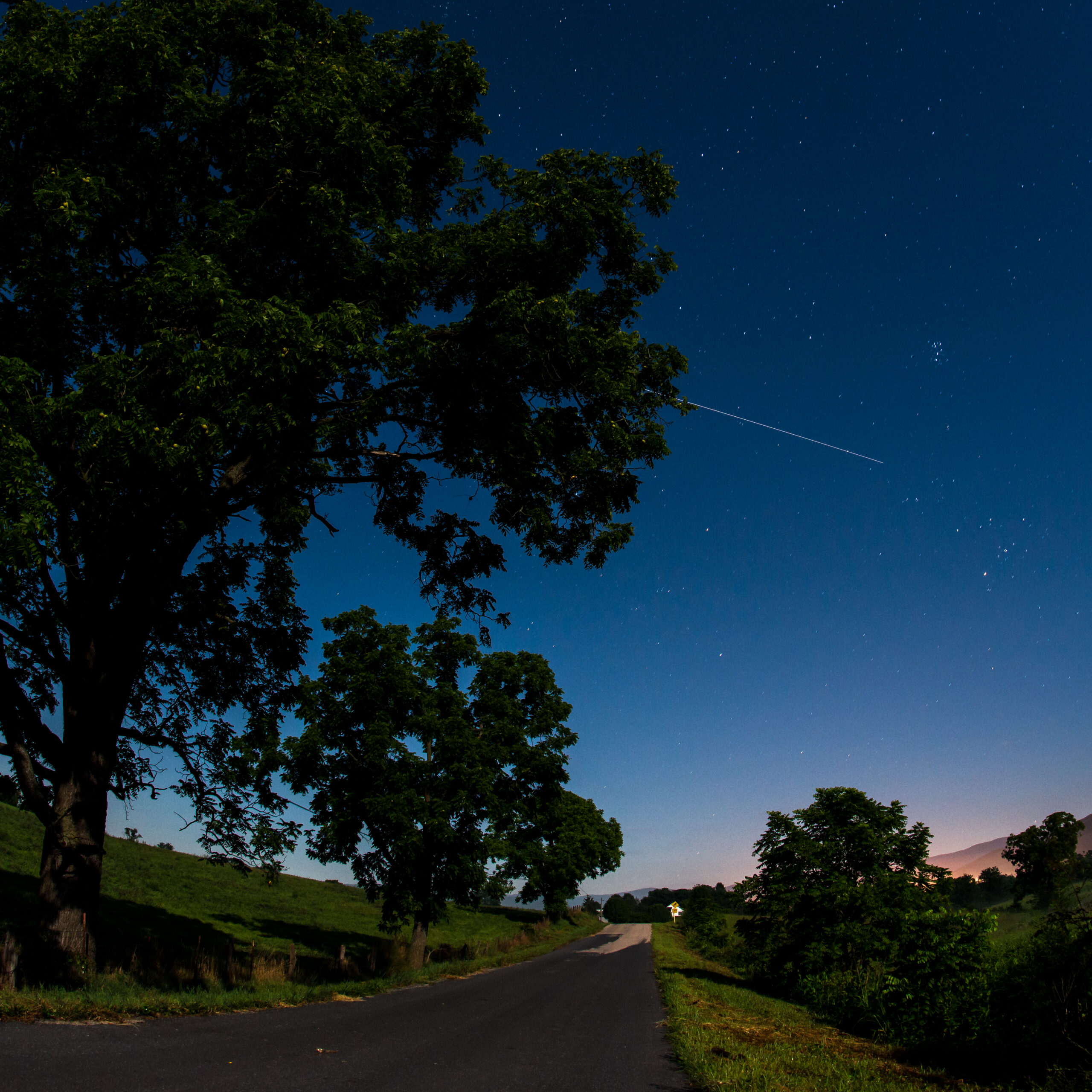
The International Space Station leaves a trail in a 30-second exposure over Elkton, Virginia, on August 1, 2015. To the eye, it appears as a moving point. Photo: NASA/Bill Ingalls. Image source.
.jpg)
A bright point appears above the horizon, moves steadily between the stars and fades from view. With the right timing, that small light can be the International Space Station, carrying people and experiments around Earth. You can watch a pass with your eyes alone.
The useful first step is a prediction for where you will be standing. NASA’s Spot the Station page links to its official app and explains how to read a sighting. A pass visible from one city may be low, hidden or invisible from another.
Pick a pass before you go outside
The free app is available for iOS and Android. According to NASA’s current FAQ, it shows the start time, duration, maximum height and directions in which the station will appear and disappear. Times use the local time zone of the selected location, including daylight-saving adjustments.
Check those details before choosing your viewing spot. If the pass begins low in the west, a tall building on that side could hide its first moments. A higher pass gives you more room to work with when nearby roofs or trees obstruct the horizon.
Arrive a few minutes early, confirm your direction and put the phone away once you know where to look. You can enable alerts if you want help remembering, but simply checking the upcoming sightings is enough to plan an evening outside.
What the numbers mean
Height in a sighting forecast means an angle above your horizon. Zero degrees is the horizon; 90 degrees is directly overhead. It is not the station’s altitude above Earth. The compass directions describe where to start looking and where the visible part of the pass should end.
The ISS usually looks like a bright moving star. It does not show the regularly blinking navigation lights associated with an aircraft. At ordinary naked-eye viewing distances, you will see a point of light rather than individual solar panels or modules.
Why it can vanish halfway across the sky
The station shines by reflecting sunlight. Good sightings often occur around dawn or dusk, when the ground is dark enough for contrast while the spacecraft remains sunlit. An overhead orbital pass does not automatically produce a visible sighting.
It can also move into Earth’s shadow while still high in your sky. NASA’s FAQ explains that entering or leaving shadow can shorten the visible portion of a pass. A fading light can therefore fit a perfectly ordinary orbital journey.
Checking a light you have already seen
Brightness alone is a weak identification. Other satellites also reflect sunlight, and NASA’s skywatching guide notes that some can brighten suddenly or fade as their illumination changes. Compare several details: the time, your location, the direction of travel and how long the light remained visible.
For a useful record, note those details as soon as you can, along with a familiar landmark in the same direction. A short video can preserve timing, but a close-up dot without surrounding stars or landmarks often gives little sense of its path.
A planned ISS pass is an enjoyable way to practise. Once the forecast and the moving light line up, the evening sky becomes a little easier to read. The observation needs no telescope, and the next opportunity may only require stepping outside.
Leave a Reply