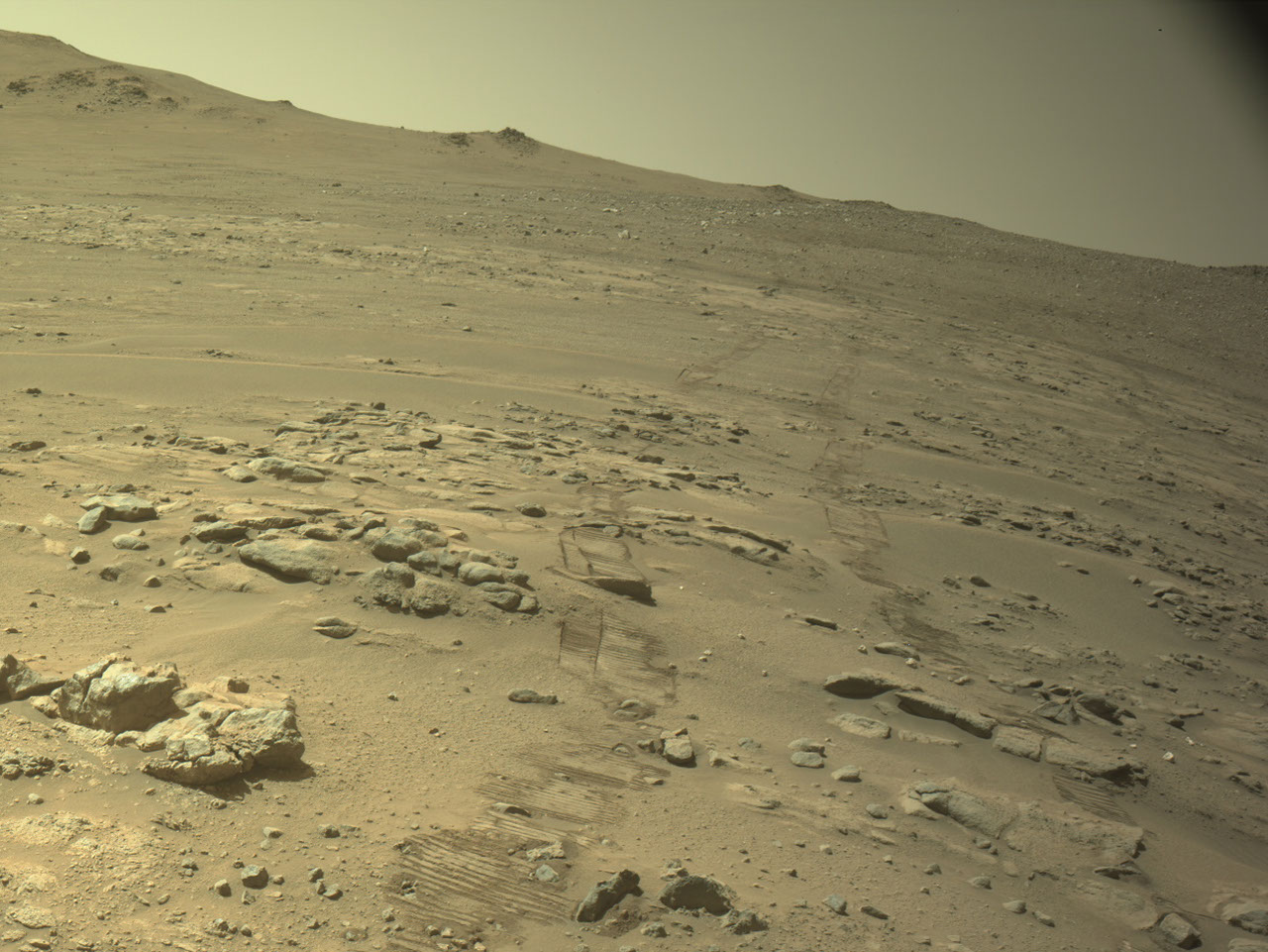
Perseverance has become the most-traveled vehicle on the surface of another world. A drive on October 11 brought its total distance to 45.22 kilometers, or 28.10 miles, passing the 45.16-kilometer record held by Opportunity.
The milestone arrived on the rover’s 2,006th Martian day. It also comes at the start of a newly approved mission extension, running from October through roughly the end of 2028. NASA’s October 12 announcement places the achievement in a scientific setting: Perseverance is crossing ancient terrain beyond Jezero Crater’s western rim, with possible traces of long-vanished hydrothermal activity among its next targets.
More ground covered between instructions
The record-breaking drive covered 91.31 meters. Over the whole mission, however, the larger change is how much of the route Perseverance can manage for itself. Its AutoNav system photographs the ground, builds a three-dimensional assessment of hazards and chooses a path between planned waypoints while the wheels are moving.
More than 90 percent of its total driving distance has used AutoNav to evaluate the terrain. That compares with about 5 percent for the first version of Martian AutoNav used by Spirit and Opportunity. Perseverance has covered as much as 412 meters in one sol, the name for a Martian day.
Autonomy helps make good use of a rover’s limited working time. Waiting for a new set of instructions can interrupt an otherwise safe traverse. Letting the machine handle nearby obstacles allows planners to concentrate on the destination and the observations it should make there.
A separate navigation upgrade addresses a problem that grows during long drives: uncertainty about the rover’s exact position. In February, NASA described Mars Global Localization, which compares navigation-camera panoramas with onboard maps made from orbital images. The system can locate the rover to within about 25 centimeters in roughly two minutes.
That work runs on a processor originally used to communicate with the Ingenuity helicopter. Reusing the hardware gives Perseverance a way to check its position without waiting for specialists on Earth to match the same views.
A route into older Mars
Perseverance is traveling through a region called Lac de Charmes toward an area named Idubi. The science team hopes to find evidence of ancient hydrothermal systems there, environments in which heated water interacted with rock. Establishing whether those systems existed requires observations of the rocks and their chemistry; reaching a promising location is the beginning of that investigation.
The rover has already moved from Jezero’s former lakebed through deposits left by a river and up toward the crater rim. Along the way it has collected 29 rock and regolith samples. The rim provides access to impact-related rocks about four billion years old, helping extend the geological story beyond the sedimentary environments explored earlier in the mission.
Plans for the extension include traveling south along the rim toward Rainbow Falls, a block of ancient crust about 100 meters wide that was lifted by the impact that formed Jezero. Different stops along that route can expose different chapters of Mars’s history.
What the distance record means
Opportunity needed nearly 15 years to establish its total; Perseverance reached the new mark in about five and a half. The comparison reflects substantial improvements in driving and navigation, alongside the different terrain, hardware and scientific priorities of each mission.
The practical reward is a broader choice of rocks to investigate. Efficient travel gives scientists more opportunities to connect distant outcrops, test geological interpretations and select samples. With mobility systems reported fully operational in the latest update, the next part of Perseverance’s journey will put that reach to work in some of the oldest accessible terrain around Jezero.
Image: Perseverance navigation-camera view from October 11, 2026, the day its driving distance passed Opportunity’s record. Credit: NASA/JPL-Caltech. Image source; usage information.
Leave a Reply