Finding a planet at the right distance from its star is only one part of assessing its prospects for life. The surrounding galaxy has a history too: stars explode, black holes flare and neighboring stars can disturb planetary orbits.
A study posted on October 5 uses the EAGLE galaxy simulations to examine that larger setting. Luke Barnes and colleagues find that the present-day Milky Way looks fairly typical among environments favorable to long periods of planetary habitability. Their paper is listed as accepted for publication in Monthly Notices of the Royal Astronomical Society.
Putting habitability into a simulated universe
EAGLE follows the growth of galaxies in a simulated volume more than 300 million light-years across. It begins before stars and galaxies have formed, then models the behavior of matter as cosmic structures emerge. Gas cools, stars form, and energy released by stars and active galactic centers changes what happens next.
This approach lets researchers compare environments that would be impossible to watch evolve directly over billions of years. The project’s explanation of its methods also stresses the difficulty: a galaxy simulation has to connect processes operating on vastly different scales. Some physics is represented through simplified prescriptions, and the resulting virtual galaxies are checked against observations.
Barnes and colleagues add a habitability model involving stellar lifetimes, planet formation and five kinds of possible disruption: two types of supernova, gamma-ray bursts, close stellar encounters and quasar radiation. They track available habitable time, distinguishing events that remove existing life from those that could make a planet persistently unsuitable.
Two scales of a habitable zone
The familiar stellar habitable zone concerns the range of distances where a planet might maintain liquid water on its surface. Its location depends on the star. A dim star’s suitable region lies closer in, while a brighter star’s lies farther out.
A galactic calculation asks a wider question: how does the neighborhood help or hinder the survival of such environments? The two scales complement each other. A relatively quiet place in a galaxy cannot compensate for every problem on a particular planet, and a favorable orbit around one star does not erase the history of its surroundings.
NASA’s astrobiology guidance on planetary habitability treats the problem as a combination of conditions, including accessible ingredients, energy and environments in which organisms could survive. The presence of suitable conditions still leaves the separate question of whether life actually began.
A useful comparison, with substantial uncertainties
The new model finds the most hazardous environments in young galaxies forming stars rapidly. Its conclusions depend on uncertain damage thresholds and simplified catastrophe models. The authors call for better spatial resolution, more frequent simulation snapshots and improved treatments of local conditions. They also leave the probability of life originating as an unknown.
That makes the study useful as a way to compare assumptions. Changing a hazard model or the probability of planet formation can show which conclusions hold up and which depend strongly on those choices. The result is a framework for testing galactic habitability, rather than a census of inhabited planets.
The broader lesson is that time belongs in the search for suitable worlds. A potentially favorable environment has a past, and its long-term survival is part of the scientific question.
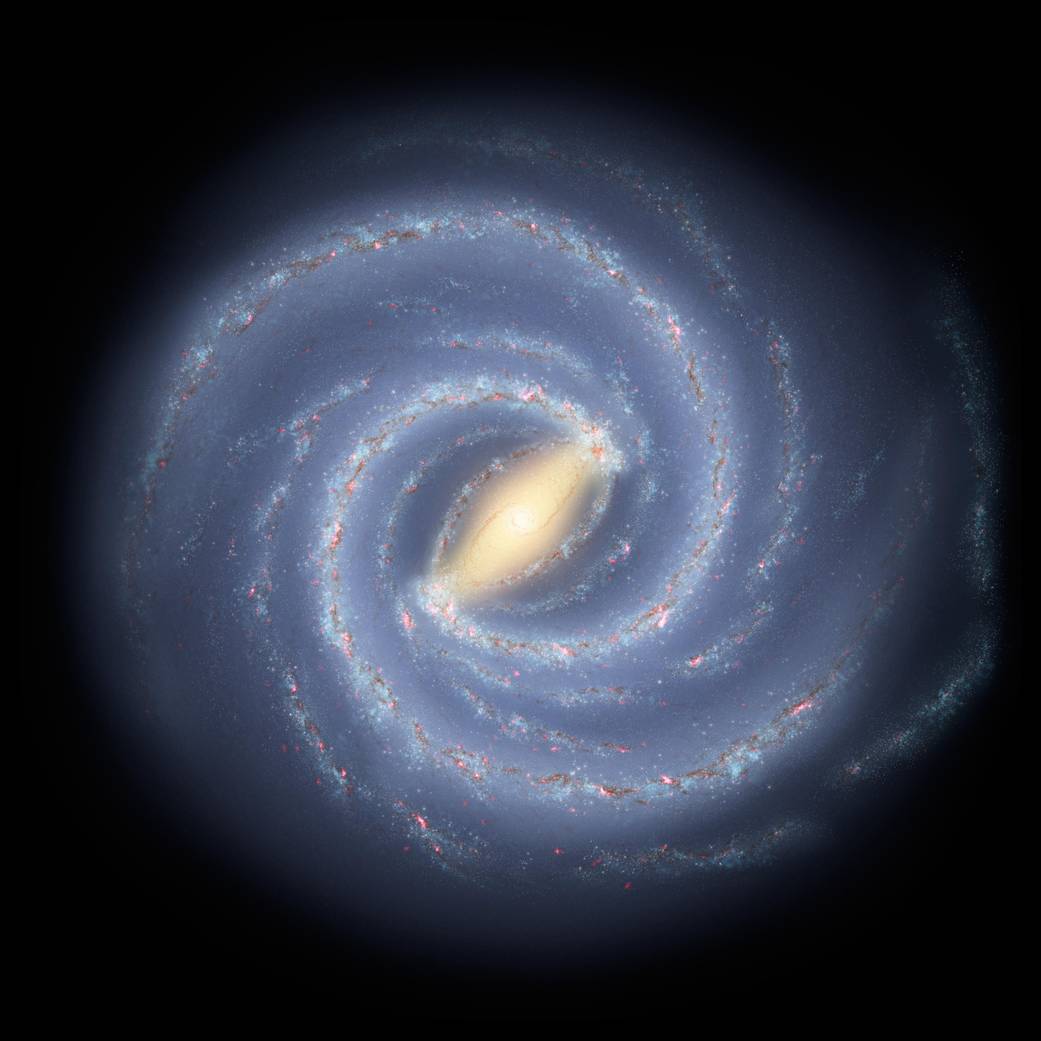
An archival artist’s concept of the Milky Way, published by NASA in 2009. This illustration is not an output of the new habitability model. Credit: NASA/JPL-Caltech.
Leave a Reply