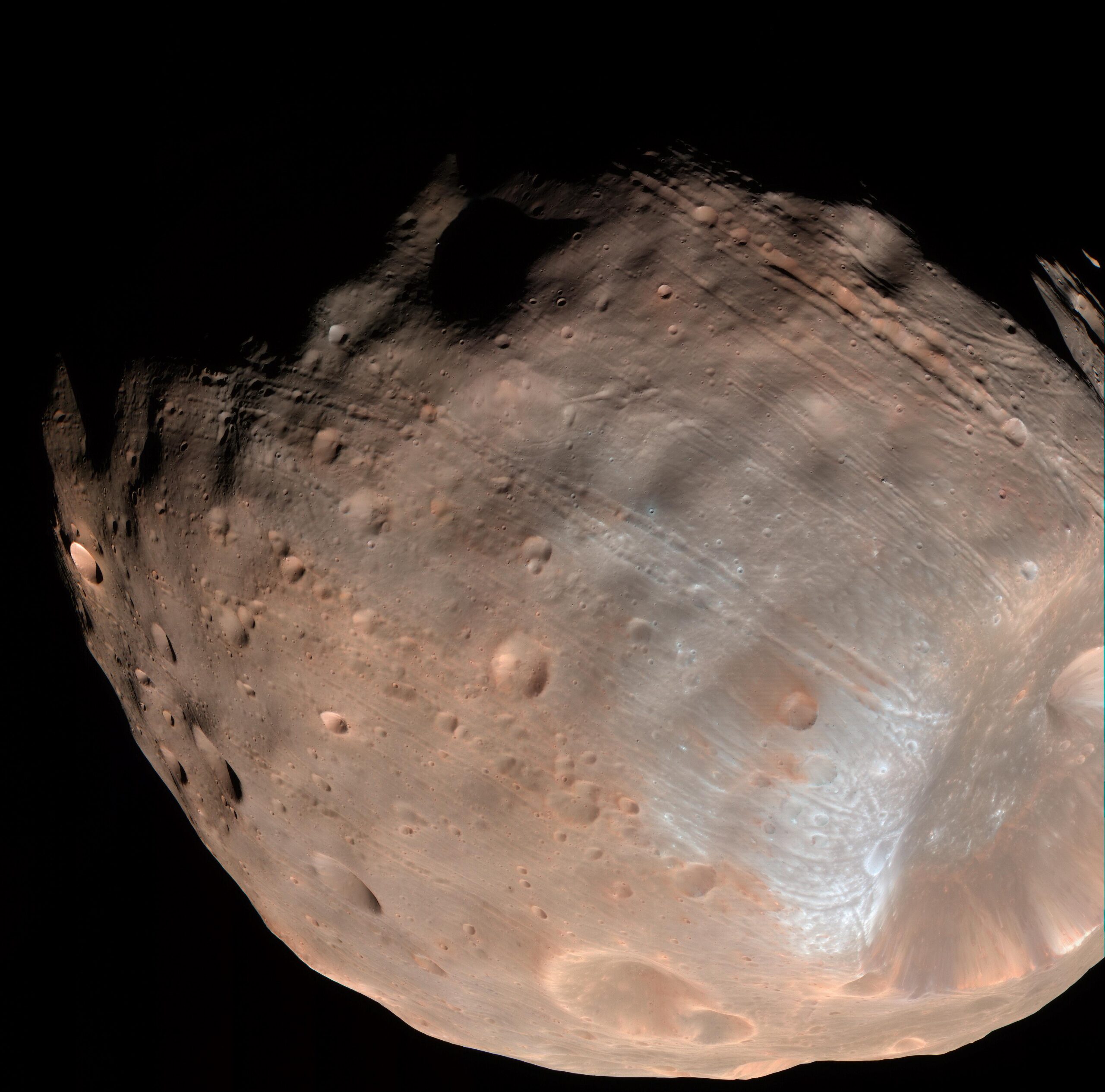
Japan’s next sample-return mission is approaching its scheduled departure for Mars. Martian Moons eXploration, or MMX, will investigate Phobos and Deimos, collect material from Phobos and aim to deliver it to laboratories on Earth in 2031.
JAXA’s published launch plan targets 4:41:03 a.m. Japan Standard Time on October 20 from Tanegashima Space Center. That is October 19 at 19:41:03 UTC. The spacecraft will fly on an H3 rocket, with a reserved launch period extending from October 21 through November 7 if the initial opportunity is missed.
NASA announced on October 8 that it will hold a mission briefing on October 15 to explain its contributions. The latest schedule calls for arrival at Mars in August 2027 and sample collection no earlier than December 2028. Those dates describe the current mission plan, with several demanding operations still ahead.
Two competing histories for the Martian moons
Phobos and Deimos are small, irregular bodies whose origins remain uncertain. One leading explanation is that they began as asteroids and were captured by Mars. Another is that they formed from material thrown into orbit after a large object collided with the planet.
The alternatives imply different histories for the moons’ ingredients. Identifying their composition could therefore help researchers reconstruct events in the early Mars system and understand how material moved between different regions of the young solar system.
JAXA’s mission overview describes a program combining measurements of surface shape, internal structure, composition and gravity with returned rock and sand. These observations will give scientists several independent ways to test an origin model. A successful explanation must account for both what the moons are made of and their physical properties.
Phobos is the sample target, but Deimos is also part of the survey. Studying both bodies will provide context for interpreting the material eventually delivered to Earth.
Reading the surface before collecting it
One of NASA’s principal contributions is MEGANE, the Mars-moon Exploration with Gamma-rays and Neutrons instrument. Developed by the Johns Hopkins Applied Physics Laboratory, it will measure radiation emerging from Phobos to help determine the elements present near the surface.
The NASA mission description explains that the energies of the detected neutrons and gamma rays carry information about elemental composition. That gives the spacecraft a chemical view that complements its images. A photograph can show a crater or a patch of different-looking terrain; compositional measurements can investigate whether the material itself differs.
NASA is also contributing a pneumatic sampling mechanism developed by Honeybee Robotics, communications and navigation support through the Deep Space Network, and funding for participating U.S. scientists. The mission is led by JAXA with international partners, bringing together different instruments and exploration systems around a shared sample-return objective.
JAXA’s plan also includes deploying the small IDEFIX rover to inspect the surface before the main spacecraft’s landing. Reconnaissance is particularly valuable when an operation must work on unfamiliar ground under very weak gravity.
Why the return journey matters
Orbital measurements reveal where a sample comes from and how its surroundings fit together. Bringing material home would add access to laboratory techniques that cannot all be carried on a spacecraft. Researchers could examine the same grains using different methods and compare their findings against the larger-scale maps gathered at Mars.
For now, the next milestone is departure. Reaching Mars, surveying the moons, selecting a suitable location, collecting material and completing the journey back are separate challenges. NASA’s October 15 briefing is scheduled for 4 p.m. EDT, with audio carried on NASA’s live-coverage page.
The scientific payoff would be a much firmer account of how two familiar but poorly understood moons came to orbit Mars. Their surfaces may preserve evidence that distant observations have so far been unable to resolve.
Image: Phobos observed by the HiRISE camera on Mars Reconnaissance Orbiter on March 23, 2008. Color combines blue-green, red and near-infrared measurements. Credit: NASA/JPL-Caltech/University of Arizona. Image source; usage information.
Leave a Reply