DARK FIRESORIGINS UNKNOWN

Author: Dark Fires

  • A Metal-Catalyzed Reaction Offers a Clue to Life’s First Energy Supply

    A Metal-Catalyzed Reaction Offers a Clue to Life’s First Energy Supply

    Before cells could build the machinery that powers life today, something simpler had to supply usable chemical energy. Researchers at Heinrich Heine University Düsseldorf and collaborating institutions have demonstrated a reaction that may help explain how that could have happened.

    The study, published in The FEBS Journal on September 29, 2026 and highlighted by the university on October 6, uses phosphite and a palladium catalyst to drive phosphorylation: the attachment of phosphate groups to other molecules.

    Borrowing a function from modern cells

    Modern life relies heavily on ATP, a molecule that couples energy-releasing reactions to processes that need an energy input. Cells make it with elaborate biological machinery. According to the university’s account of the research, the team looked for a simpler chemical predecessor by examining how some microbes use phosphite, a more reduced form of phosphorus.

    Those microbes employ an enzyme. In the laboratory, the researchers found that metals could carry out a related task, with palladium performing particularly well. A palladium alloy containing nickel and iron also worked. Such native metals are relevant because strongly reducing hydrothermal environments can deposit them in metallic form.

    That geological setting has long attracted origin-of-life research. NASA-supported studies of serpentinization, the interaction between water and certain rocks, have examined living microbes that use products of those reactions. Present-day ecosystems show how geology can supply biological energy, while experiments ask how the relationship might have begun.

    What the experiment establishes

    The new reactions ran in water at temperatures between 25 and 100 degrees Celsius. Products included phosphorylated sugars and glycerol, ADP, and acetyl phosphate. The last of these formed overnight at 25 degrees Celsius with a reported yield of eight percent. The energy came from oxidizing phosphite.

    Important gaps remain. The paper says the reactive intermediate has not been identified; metaphosphate is one possibility. It also notes that phosphite has not yet been reported in hydrothermal-vent effluent, although relevant evidence comes from serpentinized rocks and microbial genes. Demonstrating a laboratory pathway leaves open how reliably the necessary ingredients would have met in an ancient environment.

    The study therefore supplies a chemical possibility for the steps before metabolism became fully biological. It does not establish where life first arose or recreate a living cell. Its value is more focused: a testable connection between environmental chemistry and the phosphate-based reactions that cells depend on.

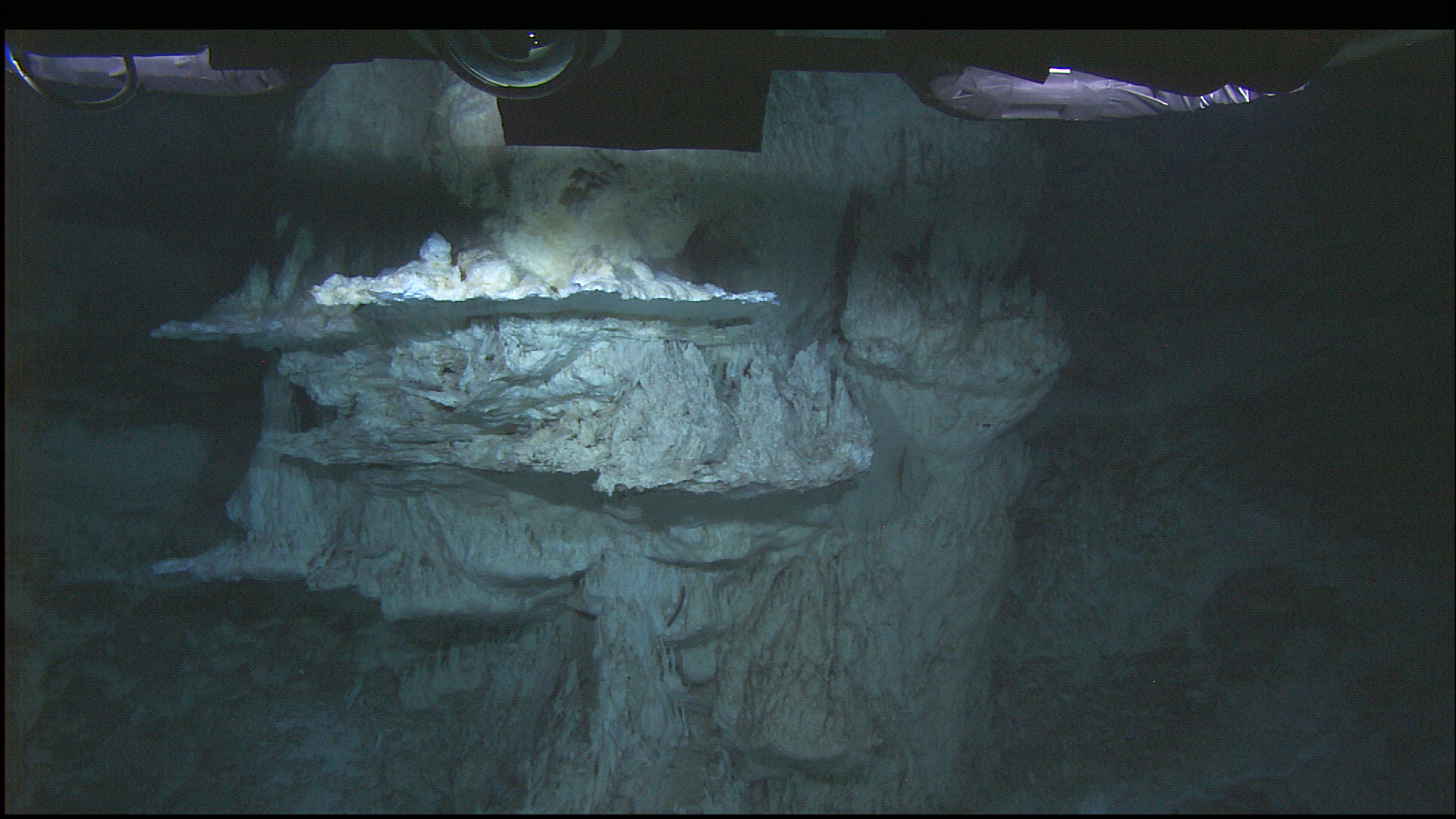
    Featured image: An archival view of mineral formations at the Lost City hydrothermal field, illustrating the type of setting studied in origin-of-life research. Image: NOAA / Lost City 2005 Exploration, public domain.
  • SETI Takes Aim at the Point Opposite the Sun

    SETI Takes Aim at the Point Opposite the Sun

    If another civilization wanted to attract our attention, where would it expect us to look? A new SETI progress report explores one answer: the point in our sky directly opposite the Sun. The idea turns the geometry of Earth’s orbit into a possible rendezvous for a signal.

    Isabel Gerrard and Sofia Sheikh describe the Allen Telescope Array’s anti-solar-point campaign in a report posted on October 5, 2026. It is an ongoing search, with follow-up observations still needed. No extraterrestrial transmission has been established.

    Seeing Earth from the other side

    The geometry has a useful symmetry. From a suitably aligned distant system, Earth can pass in front of the Sun, producing the kind of transit astronomers use to discover exoplanets. The observer’s direction then appears opposite the Sun in our sky.

    A 2021 study by Lisa Kaltenegger and Jackie Faherty showed that this viewing opportunity changes as stars move. Their reconstruction identified 1,715 stars within 100 parsecs that had occupied the right position during the preceding 5,000 years. That establishes an observable geometry. Whether anyone is there, has noticed Earth, or would choose that moment to transmit remains hypothetical.

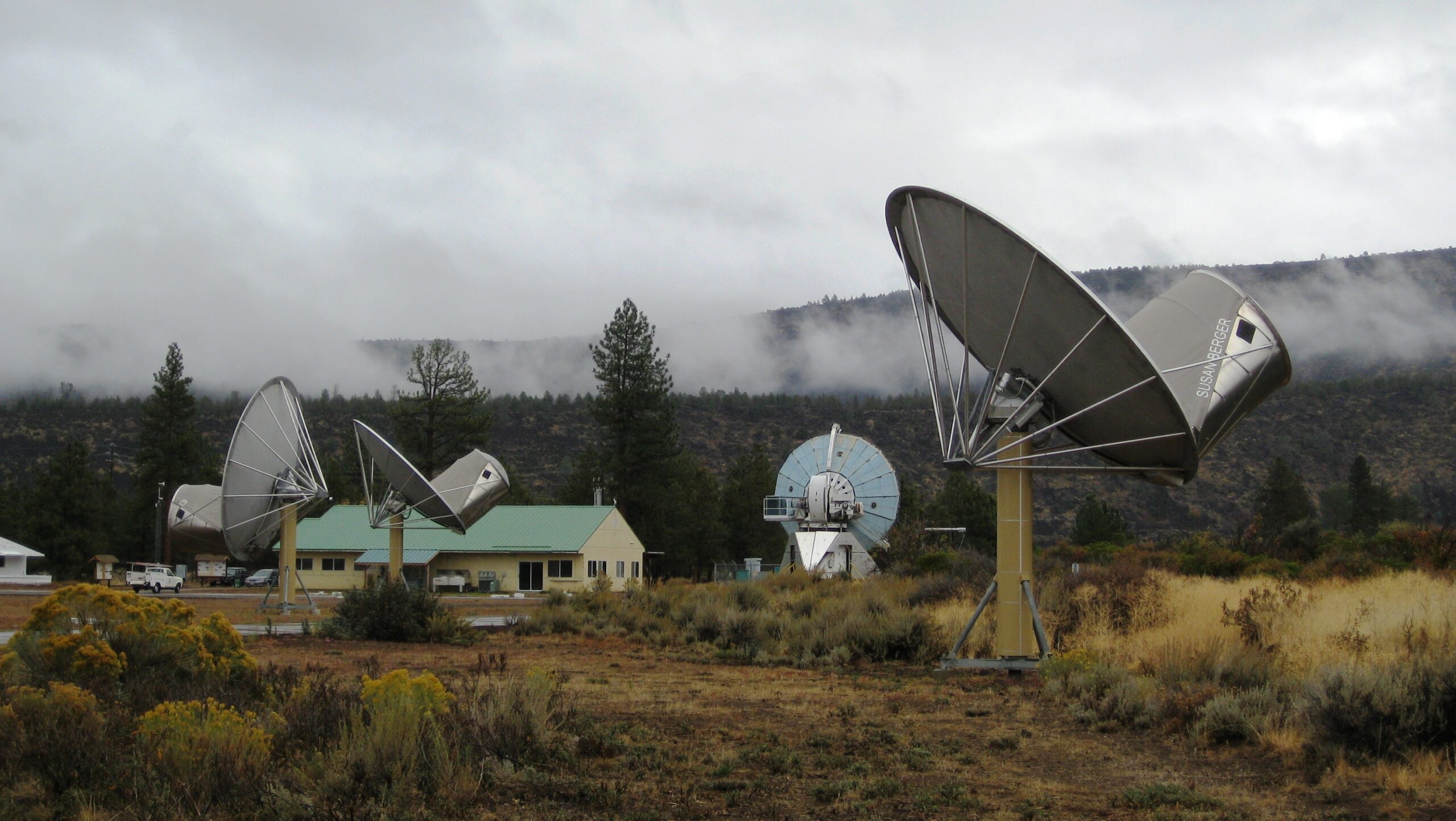
    The Allen Telescope Array at Hat Creek, California, combines signals from many small radio dishes. Its beamforming system can compare different directions, helping researchers investigate where a signal appears to originate. Dedicated observing time and flexible targeting make the facility useful for testing search strategies like this one.

    A shortlist for more observing

    The October report summarizes progress as of September 12, using observations from August 2024 through August 2026. About 12 percent of the planned coordinate coverage had been observed. The campaign listens between 2,356 and 3,700 megahertz and looks for narrow signals that drift in frequency.

    Among the inspected material, 25 signal plots associated with 10 sky coordinates met the team’s follow-up criteria. Those are screening results. Re-observing the positions is part of working out what produced them.

    That distinction matters in a crowded radio environment. As NRAO explains, human transmitters can overwhelm the faint emissions astronomers want to study. An interesting-looking trace needs careful checks before a distant technological origin becomes credible. Our report on LoFreq-SETI’s low-frequency search pipeline shows another approach to screening candidates and explains how terrestrial interference can imitate a promising signal.

    The appeal of the anti-solar strategy is its testability. It takes a specific assumption about how strangers might coordinate across space and gives telescopes a concrete place to listen.

    Featured image: The Allen Telescope Array in an archival photograph taken October 23, 2010. Photo: brewbooks, CC BY-SA 2.0. Image displayed at reduced size; homepage thumbnails may be cropped. Original image and license record.

  • NASA Opens Artemis II’s Lunar Science Archive for Public Study

    NASA Opens Artemis II’s Lunar Science Archive for Public Study

    Researchers and the public can now explore a much larger record of what the Artemis II crew saw during its April journey around the Moon. NASA announced the release of more than 800 gigabytes of lunar science data on October 7, 2026, opening the observations to further analysis.

    The collection includes more than 11,000 full-resolution images and video, 8.5 hours of recorded scientific observations, and pictures annotated by the crew. NASA also released a preliminary science report, an operations report and a data user guide alongside the archive.

    According to the release announcement, the combination preserves an important human contribution: astronauts could choose targets as events unfolded, describe subtle changes and record observations that complement their photographs.

    Following the observations

    The Planetary Data System’s Artemis II page provides a starting point. It links separate collections for handheld cameras, Orion’s cameras, mission audio and supporting documents. Search tools allow users to narrow imagery by criteria such as camera, observation time and processing level.

    The archive also contains measurements of temperature and humidity in Orion’s storage lockers. That material sits alongside the mission documentation at the PDS Geosciences Node; the imagery and audio are hosted by the Cartography and Imaging Sciences Node.

    This is the first delivery, with additions still pending. The archive page says the SPICE navigation and observation-geometry bundle is delayed. The user guide separately notes that iPhone imagery was still being prepared when the guide was released.

    A flyby preserved in detail

    The data user guide describes the main lunar observing window as approximately 6.75 hours around the April 6 flyby. Its science objectives include investigating impact flashes, variations in surface color and reflectivity, crater structures, and the broader setting of potential future landing sites.

    The guide matters because a photograph’s meaning depends on how and when it was taken. It explains the instruments, observation sequences, archive organization and processing needed to work with the files. Reading that context makes the collection more useful than treating every frame as a standalone picture.

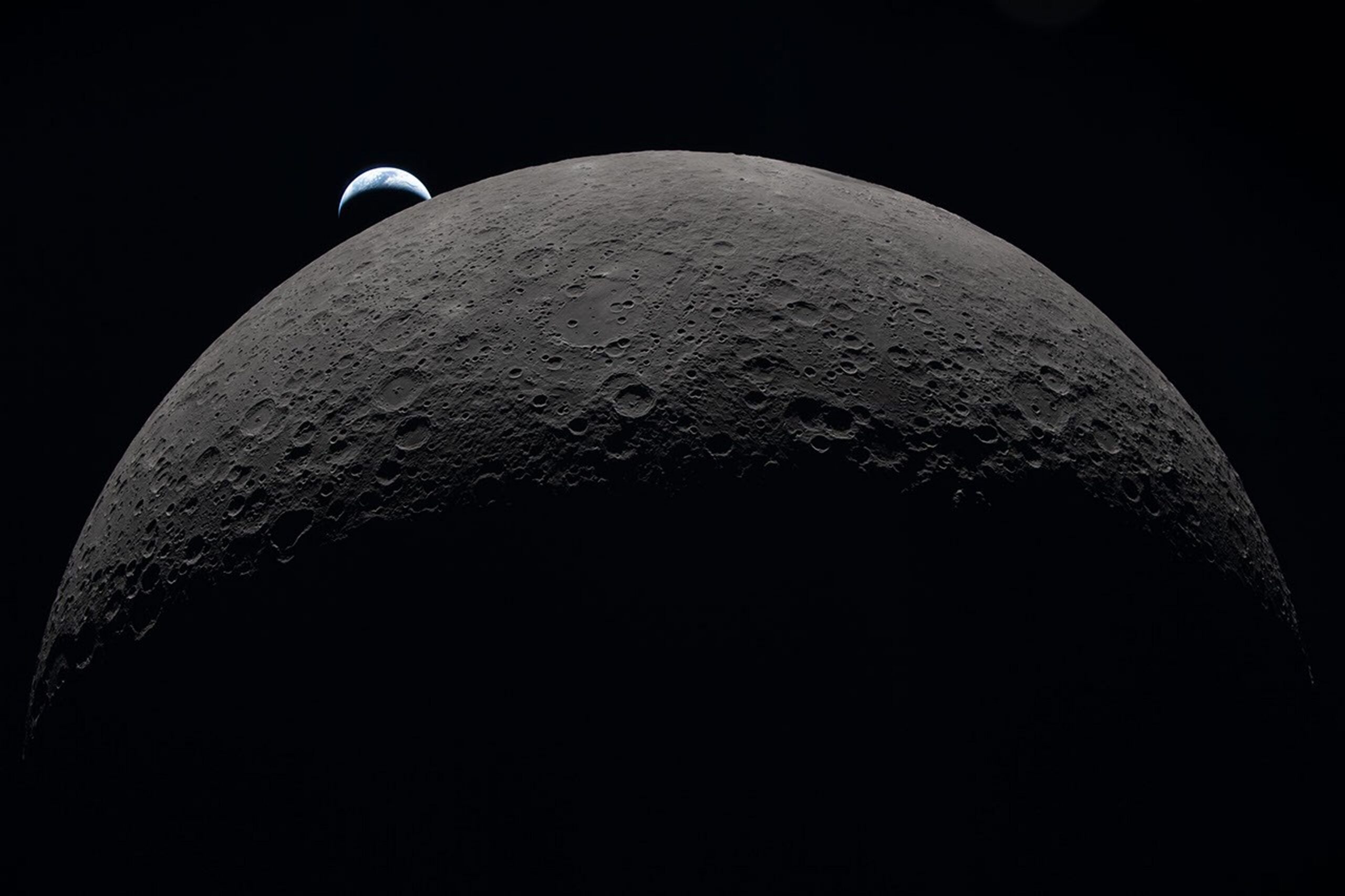
    One familiar example is the crew’s Earthset view, photographed on April 6 and published by NASA the following day. The lunar terrain in those images was also the subject of descriptions of craters, old lava flows, fractures and changes in brightness and texture. With the new archive, those observations can be examined together, preserving both the view and the record of what the astronauts noticed.

    Featured image: Earth appears beyond the Moon’s cratered surface in a view photographed by the Artemis II crew on April 6, 2026. Credit: NASA. Image source. NASA image usage terms.

  • Hera Prepares for Long Braking Burns Before Its Asteroid Rendezvous

    Hera Prepares for Long Braking Burns Before Its Asteroid Rendezvous

    After two years of travel, ESA’s Hera spacecraft is preparing for a sustained braking campaign near its destination. The mission is headed for Didymos and its smaller companion, Dimorphos, where NASA’s DART spacecraft deliberately struck an asteroid in 2022.

    In an October 7, 2026 mission update, ESA scheduled Hera’s first major braking burn for October 15. Three orbit-control thrusters are to fire together for 93 minutes, reducing the spacecraft’s speed relative to the asteroids by several hundred meters per second.

    A second burn, planned for October 22 and lasting about 31 minutes, should provide further braking and correct deviations from the first maneuver. Smaller adjustments are planned afterward. These remain scheduled operations as of October 11; the spacecraft has not yet completed its asteroid rendezvous.

    Navigation becomes part of the investigation

    ESA’s flight-dynamics account explains how the team will check Hera’s progress. Radio-signal travel times help establish distance, while Doppler shifts reveal motion toward or away from Earth. Images from the spacecraft become increasingly valuable as the asteroids resolve into recognizable terrain.

    The work also involves estimating the bodies’ motion, rotation and masses. During the early observing phase in November and December, Hera is expected to remain roughly 25 to 30 kilometers away. Later phases call for closer approaches, followed by deployment of two small companion spacecraft in early 2027.

    The cautious progression matters because the state of Dimorphos after DART’s impact remains uncertain. Navigation models must allow for a target whose shape and rotation may have changed.

    A return to the impact site

    Didymos is about 780 meters across, while ESA’s September 23 guide to the system gives Dimorphos a diameter of about 151 meters. Before the collision, DART’s images showed the smaller body covered with large boulders. Hera will find out what that landscape looks like now.

    That comparison has a practical purpose. As ESA’s mission overview accompanying its spacecraft illustration explains, a reliable measurement of Dimorphos’s mass is needed to understand the momentum transferred by DART. Surface mapping and measurements of the asteroid’s structure will help turn one successful deflection experiment into knowledge that can inform future planetary-defense missions.

    Before those measurements can begin at close range, Hera must arrive with its motion carefully matched to the system. The coming burns are the transition between crossing interplanetary space and working beside two small, weakly gravitating worlds.

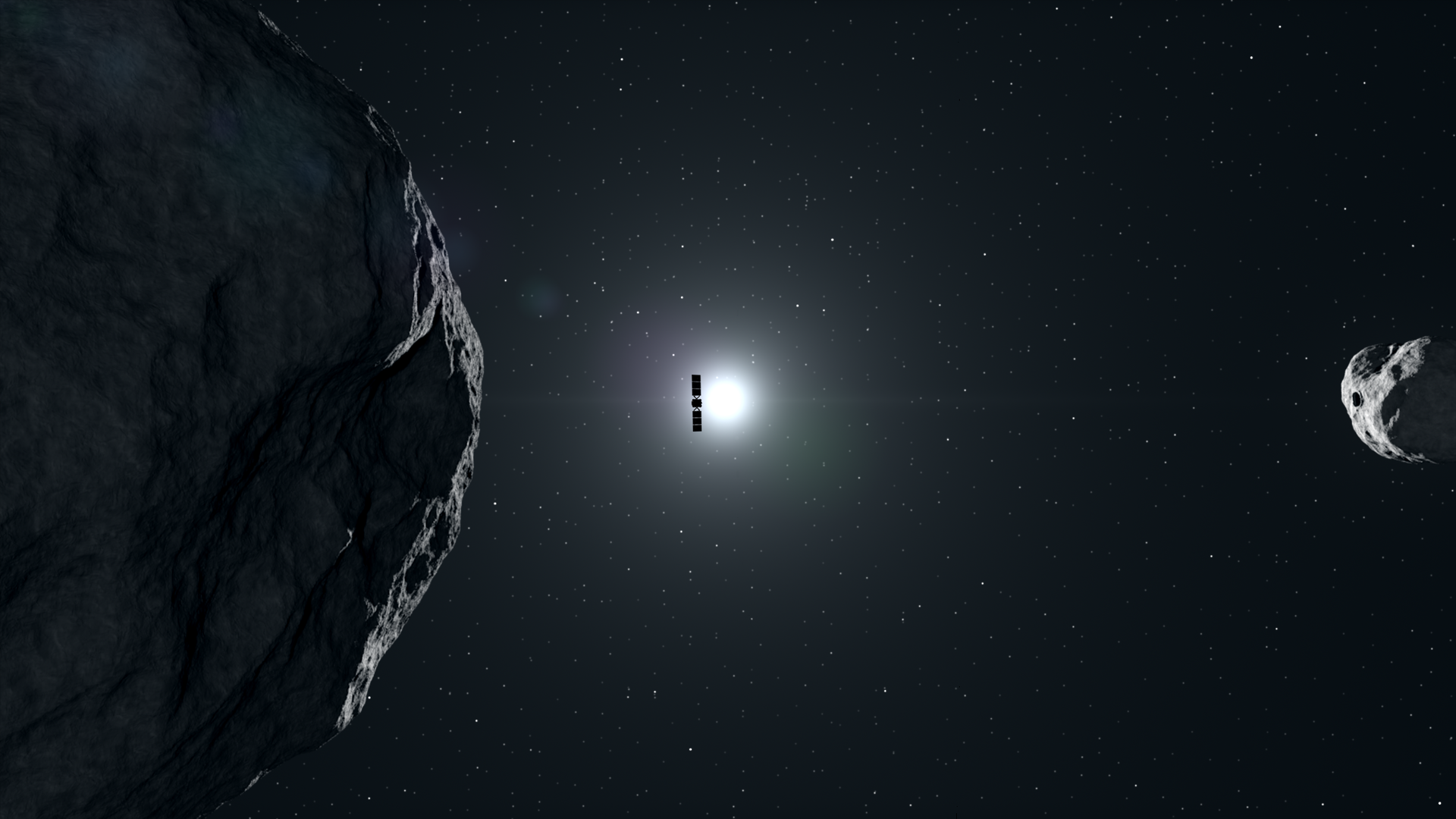
    Featured image: Artist’s illustration of Hera approaching the Didymos–Dimorphos system. This is mission artwork, not an image returned from the rendezvous. Credit: ©ESA. Image source. Image usage terms.

  • Webb Reveals Young Stars Reshaping the NGC 7129 Nebula

    Webb Reveals Young Stars Reshaping the NGC 7129 Nebula

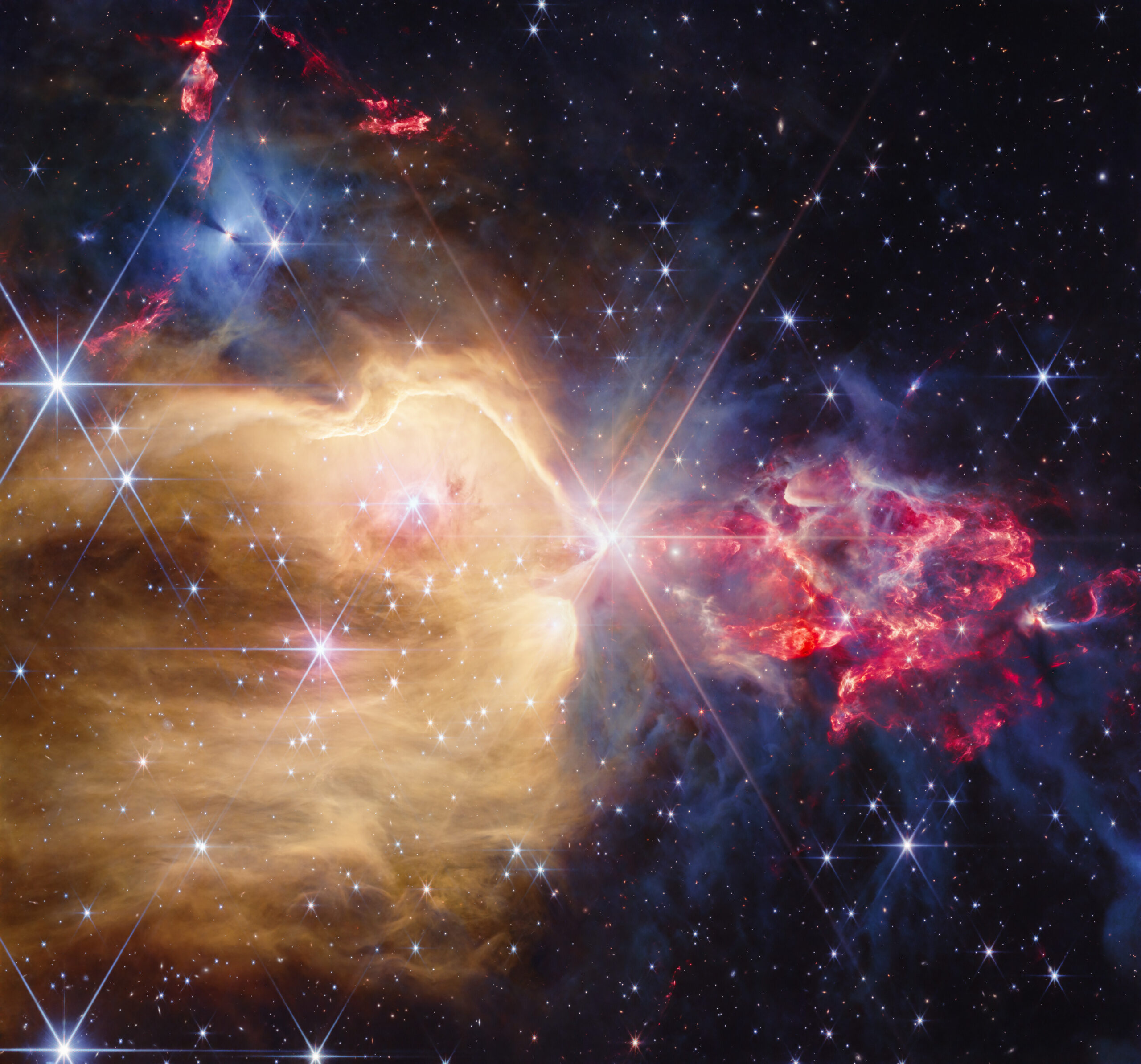
    A new James Webb Space Telescope image brings the busy interior of NGC 7129 into view. Released on October 6, 2026, the portrait shows a stellar nursery about 3,300 light-years away, where young stars are already changing the cloud that produced them.

    The central star, LkH(alpha) 234, contains roughly five to eight times the Sun’s mass. It is still contracting toward the stage when sustained hydrogen fusion will power it. To its left, a cavity about 3.5 light-years across records the effects of stellar outflows and radiation. Gas has been pushed aside, while some material has been compressed into conditions that can support further star formation.

    On the other side of the star, younger protostars are still collecting material. Their outflows collide with surrounding gas, producing shocks. Multiple overlapping flows contribute to the tangled appearance described in the ESA/Webb image release.

    Reading the colors

    The image’s colors distinguish different parts of this environment. Hot hydrogen atoms appear in the golden region. Cooler molecular hydrogen occupies much of the area to the right, where shocks from the embedded protostars create red features. The dense, cold material represented in gray includes places where protostars have not yet formed.

    These are infrared measurements translated into a visible image. The published image details list six NIRCam filters, spanning wavelengths from 1.15 to 4.7 micrometers. Several isolate emissions associated with particular material, including molecular hydrogen. The result lets viewers follow physical differences that would be difficult to separate in an ordinary visible-light photograph.

    Why infrared matters

    Stars begin forming inside dense clouds of gas and dust. Those surroundings obscure much of the visible light from the youngest objects, making a stellar nursery difficult to investigate from its outward appearance alone.

    As NASA’s overview of Webb’s star-formation research explains, infrared observations can reveal structures and stars hidden within dusty regions. Webb can also study material around growing stars through spectroscopy, which separates incoming light by wavelength to investigate its physical and chemical properties.

    NGC 7129 offers a particularly readable example: neighboring areas contain stars at different stages of development and gas responding in different ways. Comparing those regions helps astronomers examine how star formation changes its own surroundings. The newly released portrait is an invitation to study that process in detail, rather than a claim that every object or outflow in the scene has already been explained.

    Featured image: NGC 7129 in Webb’s near-infrared view, released October 6, 2026. Colors represent different infrared measurements. Credit: NASA, ESA, CSA, STScI; Image Processing: A. Pagan (STScI). Image source. CC BY 4.0 usage terms.

  • New UAP Metadata Opens a Clearer Trail Through the National Archives

    The National Archives’ UAP collection has become easier to examine at the record level. Its Record Group 615 index, marked as reviewed on September 21, 2026, now links agency-supplied metadata alongside the catalog entries. These spreadsheets provide a way to follow individual documents and videos through the archive, rather than relying on a headline count of UFO files.

    The September change was highlighted by researcher HM05UAP, who published a final FOIA response on September 24. In the response reproduced there, NARA says the requested metadata was already publicly available and closes the request as moot. That resolves the particular request for spreadsheets. It does not, by itself, establish that every federal agency has completed its search or transferred every relevant record.

    What the spreadsheets add

    NARA’s transfer guidance calls for identifiers, titles, creation dates, originating offices, file types, classification information, release status and other applicable details. Agencies are supposed to supply machine-readable CSV files and use record identifiers that allow the metadata to be matched to the digital items. The practical benefit is traceability: a reader can connect an entry to its source agency and compare its description with the actual file.

    The Customs and Border Protection spreadsheet illustrates that value. It contains 12 video entries, with identifiers running from 568UAP00001_released through 568UAP00012_released. Locations include Arizona, Aguadilla in Puerto Rico and Topowa Bruja. Several rows state that a location was unavailable in the original title. Durations and media formats are also recorded, helping distinguish similarly named clips.

    All 12 rows carry a January 31, 2023 review date, label their current and previous classification as unclassified, and note that the files are on CBP.gov. Their presence in this archive should therefore not automatically be presented as 12 newly declassified videos. The spreadsheet’s date field is explicitly a record-creation field; it should not be silently substituted for a verified encounter date.

    A finding aid, not a verdict

    There are details worth reading carefully. The CBP entries all use the release label “Released in Full,” while several titles retain the word “redacted.” The spreadsheet alone does not explain that combination. It is a reason to inspect the underlying files and their release history before making claims about completeness.

    The current index lists nine contributing agencies or departments, including the FAA, the intelligence director’s office, the Air Force and CBP. NARA explicitly describes transfers as an ongoing, rolling process. Its collection FAQ also distinguishes this statutory collection from UFO-related holdings that already existed elsewhere in the archive.

    For researchers, the September development is useful precisely because it is administrative. Identifiers and release fields make comparisons possible and can help turn a vague concern about missing information into a specific question about a particular record. They improve the evidence trail without deciding what any filmed object was, or certifying that the government’s entire UAP record is now online.

  • AARO Withholds UAP Records Linked to Five Cases on Luna’s List

    A newly published Pentagon response adds a precise, if limited, development to the effort to obtain records behind several congressional UAP inquiries. In a letter dated September 30, 2026, the department says the All-domain Anomaly Resolution Office located records responsive to a Freedom of Information Act request and withheld records under national-security exemptions. Researcher John Greenewald, who published the response on October 5, identifies the request with five cases appearing on Representative Anna Paulina Luna’s earlier list.

    The cases include the labels Wiley 2X Zinc, Cactus 1X and Jacker 2X, a Coast Guard infrared observation dated April 24, 2024, and a formation over the Persian Gulf. Those are descriptions used in the request and congressional correspondence. They are not independently established findings about the objects’ identities, flight performance or ability to move between water and air.

    What the reply actually says

    The reproduced response bears reference number 26-F-1892 and identifies an April 1, 2026 request. It says AARO searched its systems and found responsive records. The withholding explanation cites FOIA’s classified-information exemption and provisions of Executive Order 13526 concerning military plans, weapons or operations, and vulnerabilities or capabilities of systems and installations. It separately cites a statutory exemption involving certain sensitive information belonging to foreign governments and international organizations.

    An important qualification appears near the bottom of the displayed page: AARO also determined that responsive records are publicly available through the government’s UFO portal. The reply therefore cannot fairly be summarized as saying that every associated record or video remains secret. It describes withholding while directing the requester to public material. The reproduced page does not provide a document-by-document inventory that would let readers identify everything still being withheld.

    A congressional request and a public-records request

    Luna’s March 31 letter to Secretary Pete Hegseth sought videos under 46 numbered entries, with an April 14 delivery deadline. The five case labels Greenewald identifies appear within that broader list. The September response, however, answers Greenewald’s FOIA request. It is not a report on what the department supplied to the congressional task force, and it does not establish that Congress was denied access to the same material.

    The distinction matters because public disclosure, congressional access and an agency’s analysis of an incident are separate questions. A classification decision concerns access to information. By itself, it does not establish an extraordinary explanation for whatever was observed. Equally, acknowledging a public video does not demonstrate that the underlying reports, sensor details or analytical records have all been released.

    The next useful evidence would be the complete request, response and a clearer accounting of withheld material alongside public files. For now, the concrete development is narrower: a documented acknowledgment that responsive records exist, an explanation for withholding, and an explicit reminder within the same reply that part of the relevant record is already public.

  • SSPICY Launches to Test Close-Up Inspections of Inactive Satellites

    SSPICY Launches to Test Close-Up Inspections of Inactive Satellites

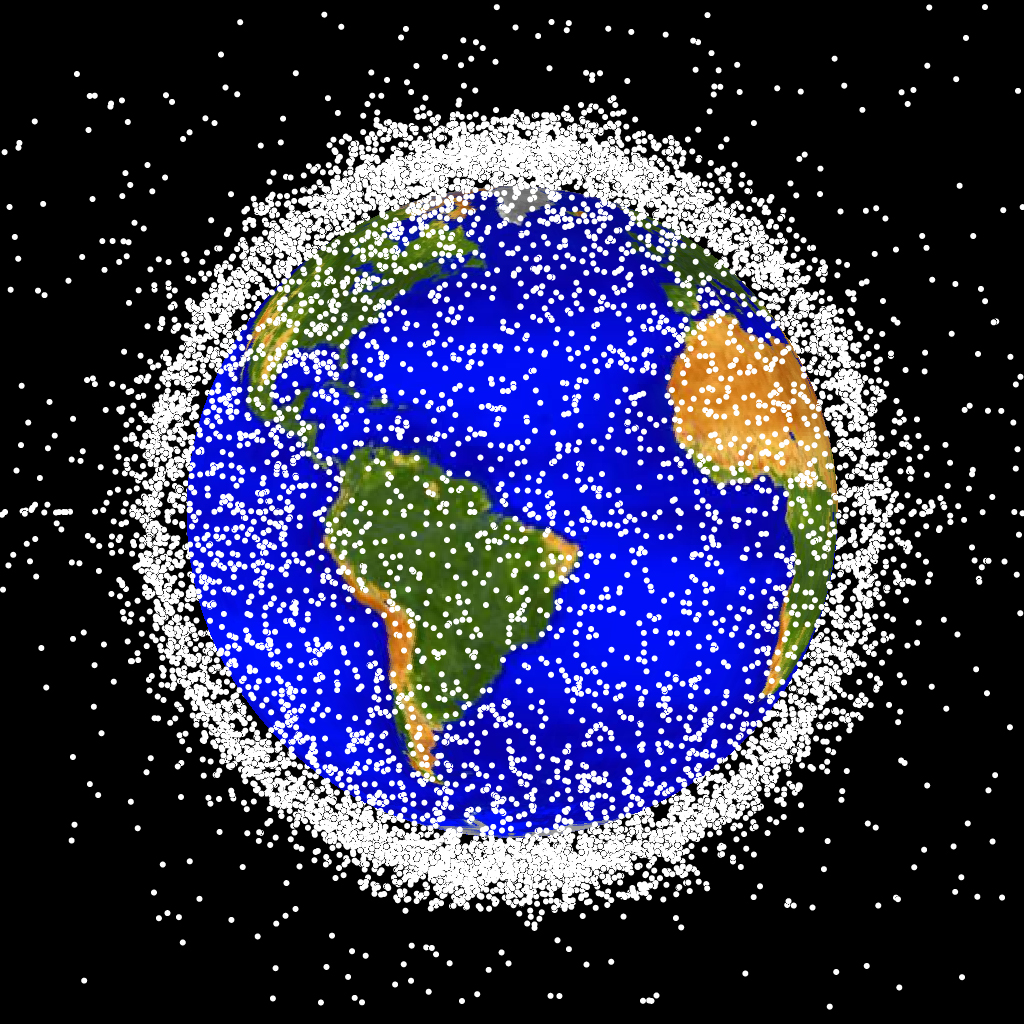
    NASA visualization of tracked objects in low Earth orbit as of January 1, 2019; dots are enlarged and not to scale. Credit: NASA Orbital Debris Program Office. Image source.

    A spacecraft launched on October 1 is preparing to examine satellites and rocket bodies that no longer function. NASA’s October 8 update describes SSPICY, the Small Spacecraft Propulsion and Inspection Capability mission, as a test of the technologies needed to approach and inspect such objects safely. Starfish Space’s Otter 24C spacecraft will attempt visits to as many as four inactive objects of U.S. origin in low Earth orbit, with inspections expected to begin in early 2027. The latest mission announcement sets out that timetable.

    Inspection comes before intervention

    SSPICY will observe each target’s rotation, orientation and surface condition. Those measurements could inform future decisions about servicing or disposal. For this demonstration, however, Otter will not touch or dock with the objects. Its job is to establish that a compact spacecraft can navigate between targets and collect useful close-range information using the integrated propulsion, sensing and control system.

    That boundary is important. Launching an inspector is a step toward more capable orbital maintenance, but it does not mean an operational debris-removal service has already been demonstrated. The work ahead concerns controlled approaches and reliable measurements.

    A spacecraft that makes approach decisions

    The mission’s technical overview describes a 335-kilogram spacecraft with several cooperating technologies. Its CETACEAN navigation software uses imagery and other sensor information to determine a target’s relative position and motion. CEPHALOPOD guidance and control software uses that information to decide how to approach in stages, including when an abort is necessary.

    An articulating robotic boom called Manta directs thrust, while electric propulsion allows the vehicle to move between orbits and carry out careful approaches. The same overview describes Nautilus, a docking mechanism intended for broader Otter capabilities, but explicitly excludes docking from SSPICY’s demonstration goals. Hardware that could support a future mission should not be confused with an action scheduled for this one.

    Testing an integrated system in orbit

    The October 1 launch report places Otter aboard SpaceX’s Transporter-18 rideshare mission from Vandenberg Space Force Base. SSPICY is expected to operate for about two years. It shared the launch with other NASA-supported technology and science spacecraft, illustrating how rideshares provide opportunities to test smaller missions in space.

    The most useful results will arrive after launch: whether the spacecraft’s navigation, propulsion and decision-making work together around real inactive objects, and how much its inspections reveal about their condition. An unresponsive target cannot help an approaching visitor by adjusting its attitude or presenting a convenient docking point. Characterizing those complications is part of what makes inspection valuable.

    For orbital-debris work, knowing what is there is only the beginning. Knowing how an object moves and what state it is in helps define what a later intervention could safely attempt. SSPICY’s contribution is to test that closer, more detailed view before future missions try to do more.

  • MEGATRON Connects the First Stars to Chemical Clues in Nearby Galaxies

    MEGATRON Connects the First Stars to Chemical Clues in Nearby Galaxies

    MEGATRON simulation of gas, oxygen and starlight in the first galaxies. Credit: Harley B. Katz, Martin P. Rey. Image source.

    Astronomers study the early universe in two very different ways: by observing distant galaxies as they were long ago, and by examining chemical traces preserved in old stars closer to home. A group of MEGATRON simulation studies, highlighted by the University of Bath on September 30, 2026, aims to connect those approaches within one physical model. The goal is to test how the earliest stars changed their surroundings and left evidence that survives today. Bath’s research announcement describes the collaboration.

    An iron clue in small galaxies

    One of the newly published papers tackles a specific puzzle: the relationship between the stellar mass of a dwarf galaxy and its iron abundance. Among very small systems, the observed relationship levels into a plateau rather than simply continuing downward. MEGATRON reproduces this feature and links it to enrichment by extremely energetic explosions of the first generation of stars.

    In the simulations, radiation influences where those early stars can form. Their explosions then occur in dark-matter haloes massive enough to retain the expelled material. That combination helps establish a characteristic iron abundance in later stellar populations. The model also predicts a minority population of more iron-deficient dwarf galaxies, offering an additional feature observers can investigate. This is a proposed physical explanation that matches important evidence, rather than proof that every small galaxy followed one identical history.

    Predicting what telescopes actually measure

    A companion MEGATRON study approaches the problem through galaxy spectra. It presents more than 175,000 simulated spectra and shows how the models can reproduce the variety of early-galaxy spectra observed by the James Webb Space Telescope within the standard cosmological framework.

    The simulations follow radiation alongside gas dynamics and chemical changes, instead of treating light as a simple afterthought. This allows researchers to compare predicted spectral signatures more directly with observations. It also provides a way to examine how assumptions used to infer a galaxy’s properties might influence the answer. A successful comparison must explain the light reaching a telescope, not merely produce a simulated galaxy that looks plausible.

    The surrounding gas matters too

    A third study follows the gas around a growing galaxy with a network of 81 ions and molecules. It finds that local radiation and chemistry that has not settled into equilibrium can substantially change the predicted absorption and emission signatures. Increasing resolution also reveals smaller cold structures and sharper chemical layering.

    Together, the papers make a practical case for more detailed modelling. The first stars cannot be judged only by a distant photograph or by a nearby chemical measurement in isolation. A stronger explanation has to connect both, while also accounting for the gas through which light travels. MEGATRON supplies testable predictions for that comparison; observations will determine which parts of the picture endure.

  • A Ten-Minute X-Ray Flash Reveals the Longer Life of a Stellar Collision

    A Ten-Minute X-Ray Flash Reveals the Longer Life of a Stellar Collision

    NASA illustration of two neutron stars approaching a merger; illustrative, not an image of EP250704a. Credit: NASA’s Goddard Space Flight Center/CI Lab. Image source.

    A cosmic explosion that looked almost instantaneous in gamma rays kept shining in soft X-rays for nearly ten minutes. Research highlighted on September 30, 2026, connects the event, EP250704a/GRB 250704B, to a compact-object merger and suggests that the collision may have left behind a powerful, rapidly spinning neutron star. The explosion reached Earth’s detectors on July 4, 2025; the recent development is the published analysis of what those detectors recorded. Nanjing University’s research account explains the coordinated observations.

    A second act in softer light

    The research paper reports a gamma-ray flash lasting roughly 0.4 seconds followed by approximately 560 seconds of soft X-ray emission. Einstein Probe supplied the crucial lower-energy coverage. The X-ray signal’s changing brightness and spectrum did not fit the simplest explanation of a brief initial explosion followed by an ordinary afterglow from a blast wave sweeping into surrounding material.

    Instead, the authors identify a distinct, longer episode associated with the explosion’s central engine. This distinction matters because an instrument sensitive only to the initial gamma rays would tell an incomplete story. The burst could be filed as short while a substantial part of its early activity went unseen. The finding therefore concerns both the physics of the source and the observational limits of earlier surveys.

    Building the case for a merger

    Follow-up observations supplied the context. Using the Very Large Telescope’s X-shooter instrument, researchers measured a redshift of 0.6610, placing the event more than six billion years of light-travel time away. Deep optical observations subsequently failed to reveal the bright supernova expected in the alternative scenario of a massive star’s collapse. The distance, burst properties and missing supernova collectively support a neutron-star-merger interpretation. These findings are detailed in the research team’s September 30 release.

    One possible remnant is a magnetar: a neutron star with an exceptionally strong magnetic field. A rapidly rotating magnetar could continue supplying energy after the initial collision, accounting for a longer-lived signal. That explanation remains an interpretation of the observations. The researchers are not presenting a direct photograph of the remnant, and this event was not announced as a joint detection of light and gravitational waves.

    Why watch for more?

    Conventional narrow-field X-ray telescopes often have to turn toward a burst after another instrument raises an alert. Einstein Probe’s wide-field monitoring can catch activity during the opening stages. Nanjing’s account argues that this capability could uncover other mergers hidden among fast X-ray transients.

    The next useful test is repetition: find comparable flashes, establish their distances and compare their signals across wavelengths. Pairing such a flash with a future gravitational-wave detection would offer an especially strong check. For now, the result is a reminder that the apparent length of an explosion depends partly on which kind of light an observatory can see.