DARK FIRESORIGINS UNKNOWN

Author: Dark Fires

  • Why “Moon-Sized” Does Not Tell Us How Big a UAP Is

    Why “Moon-Sized” Does Not Tell Us How Big a UAP Is

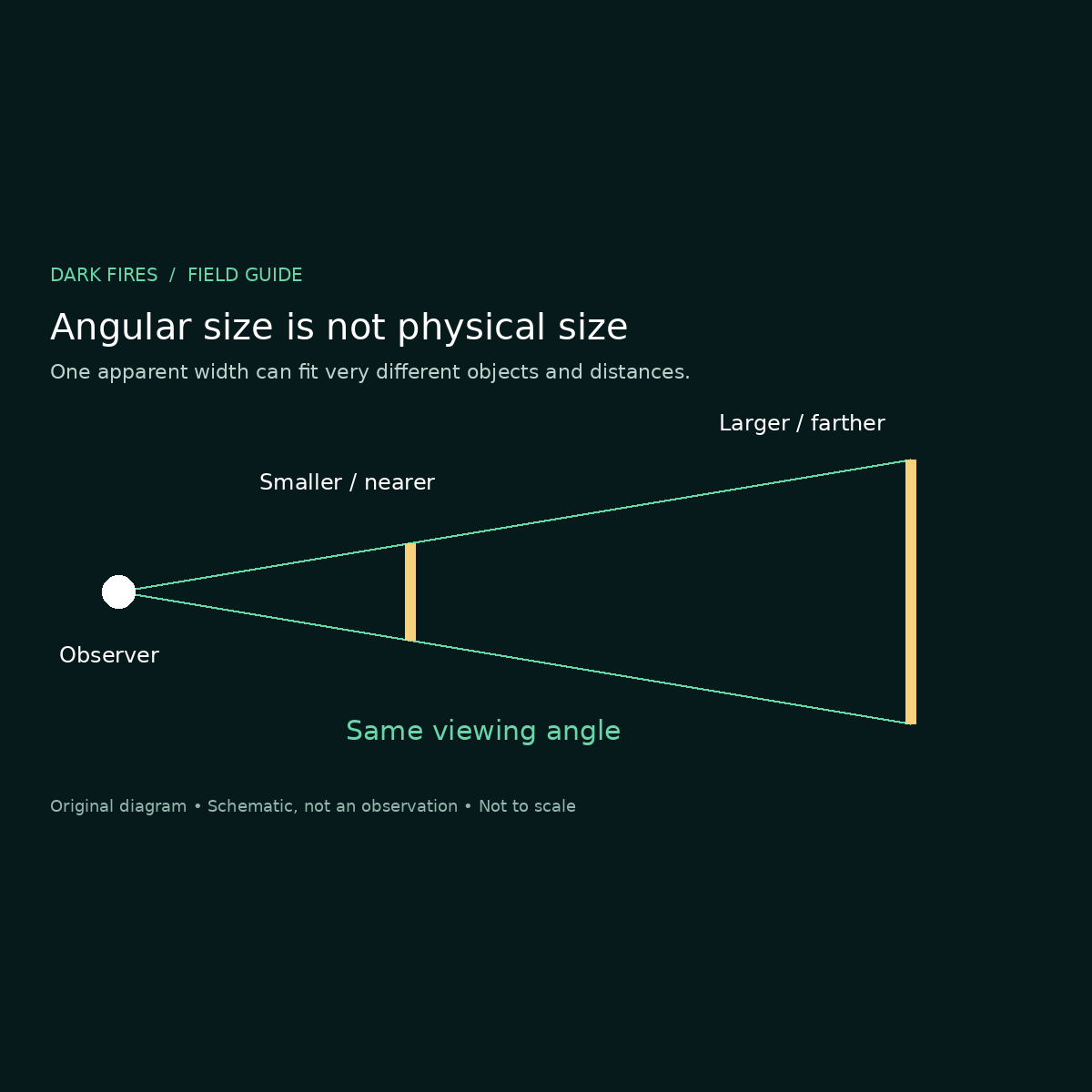
    A light described as “as big as the Moon” has not yet been measured in metres. That comparison describes how much of the observer’s view it occupies: its angular size. Confusing that with physical size can turn an uncertain sighting into an apparently enormous craft without adding any new evidence.

    The missing dimension

    The NASA-supported Chandra X-ray Center explains the familiar example: the Sun is roughly 400 times wider than the Moon and roughly 400 times farther away, so both span about half a degree in our sky. Similar apparent diameters do not imply similar objects. See its guide to angular measurement.

    For a small angle, physical width divided by distance gives angular width in radians. NASA’s Fermi classroom guide develops this small-angle relationship. Two quantities are needed to determine the third: an angular measurement alone cannot supply both size and range.

    A worked example, not a sighting

    Consider an idealized object one metre across, viewed from 100 metres. Its width-to-distance ratio is 0.01, corresponding to approximately 0.573 degrees. Now consider an object ten metres across at 1,000 metres. The ratio, and therefore the apparent width, is the same. These are illustrative calculations, not proposed identifications of a real event.

    If an analyst assumes the second distance when the first is correct, the inferred width becomes ten times too large. The arithmetic can be impeccable while the conclusion is wrong because the starting distance was guessed.

    This is why “it looked the size of a bus” needs clarification. Does the witness mean a nearby bus’s apparent width, or a literal estimate of dimensions? Those are different claims. A report can preserve both the visual impression and the uncertainty without treating either as a measurement.

    What an image can actually establish

    A calibrated image can provide an angular width when the camera’s field of view and image scale are known. A count of pixels without that calibration is not yet an angle. Cropping or digital enlargement also cannot turn an unknown range into a known one.

    The measured feature must actually represent the object’s edges. If it is only an unresolved light, an analyst should describe the recorded light patch rather than assume that patch traces a solid body. Establishing that distinction is a separate imaging problem; the geometric formula does not solve it.

    Useful independent range evidence might come from a properly associated radar measurement or simultaneous observations from separated, surveyed positions. A familiar-looking silhouette is weaker: using an assumed object type to estimate distance, then using that distance to “confirm” the object type, is circular.

    The better conclusion

    Report the angular measurement first, identify the range evidence separately, and label any physical-size calculation as conditional on that evidence. Where distance remains unknown, a family of possible sizes is more honest than one impressive number. This does not identify a UAP; it prevents an unsupported size estimate from masquerading as an identification.

    Image: Original diagram by Dark Fires; a geometric schematic, not an observation, and not to scale.
  • After 237 Days in Space, Brain Scans Track the Return to Gravity

    After 237 Days in Space, Brain Scans Track the Return to Gravity

    Coming home does not end a spaceflight experiment. For researchers studying the brain, landing starts a second, time-sensitive observation window: the return to gravity. An ESA update published October 30, 2026 describes that work following Sophie Adenot’s 237-day mission.

    Adenot underwent three MRI sessions at DLR’s :envihab facility in Cologne within her first two weeks back. Another scan is planned six months after her return. The aim is to measure the course of readaptation, rather than assume that all changes reverse at the same rate.

    Different scans answer different questions

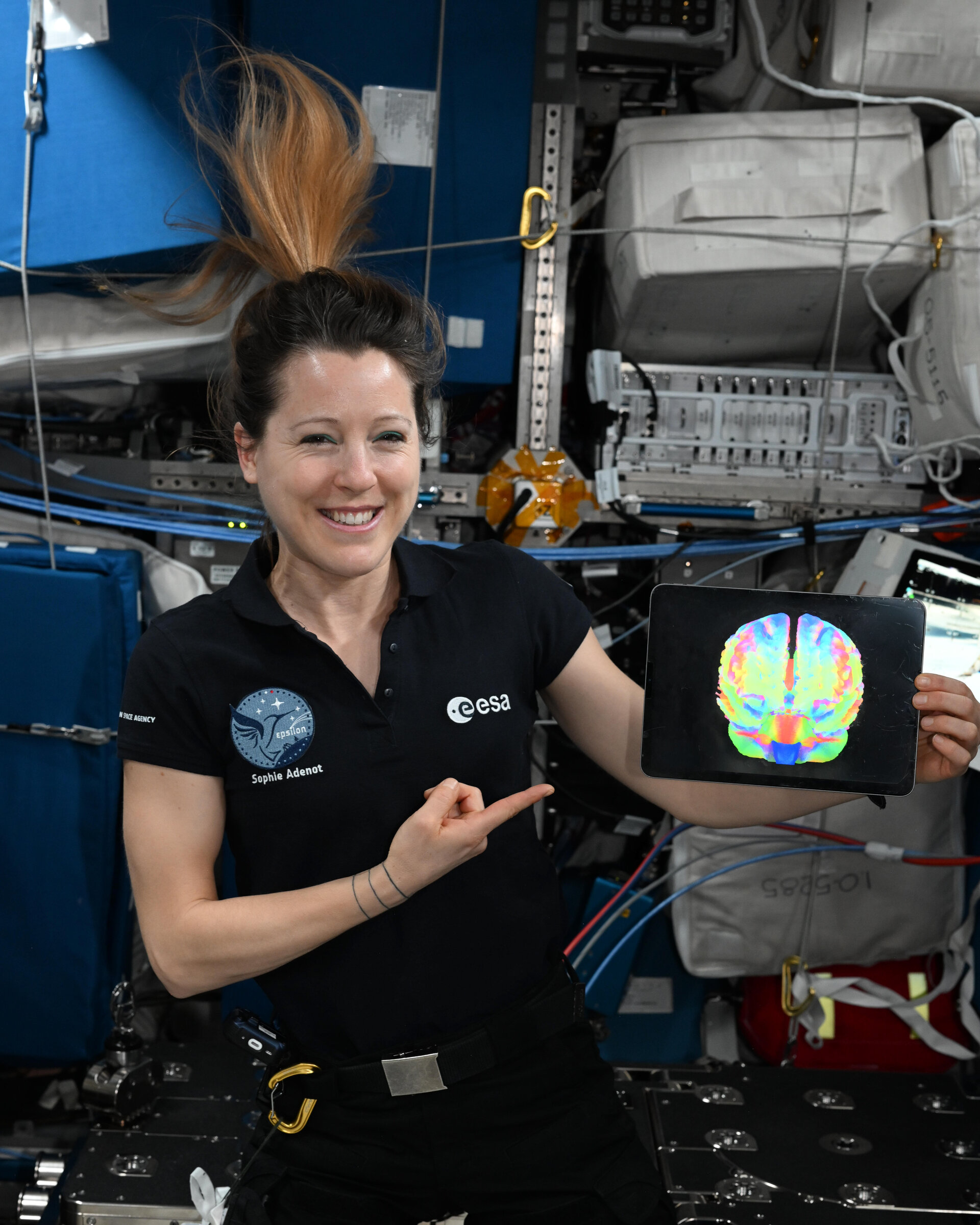
    Brain-DTI combines anatomical imaging with diffusion measurements, which track water movement through tissue, and resting-state functional MRI, which uses blood-oxygenation signals to investigate communication between brain regions. Together, these approaches can examine fluid redistribution, brain position and neural pathways. ESA says the project, which began collecting scans in 2013, now includes around 50 astronauts and cosmonauts.

    This is an account of ongoing measurements, not a published diagnosis of Adenot or a final result from her recovery scans. That distinction matters whenever an astronaut’s photograph is used to illustrate a health investigation.

    Why the time between flights matters

    A separate 2023 study in Scientific Reports helps explain why recovery timing is scientifically important. Researchers compared preflight and postflight MRI data from 30 astronauts whose missions ranged from roughly two weeks to a year. Longer missions were associated with greater expansion of some fluid-filled brain ventricles, with much of that expansion occurring during the first six months.

    The team also found an association with the interval between missions. Astronauts with less than three years between flights showed little or no additional enlargement in certain ventricles. The authors interpreted this as potentially reflecting incomplete recovery of their capacity to accommodate another flight—not proof that frequent flyers were unaffected.

    Those findings do not establish a universal three-year recovery deadline. The study examined structural measures in a limited astronaut sample; it did not turn every MRI change into evidence of injury, nor did it show that every person follows the same trajectory. Applying its group results to one named crew member would go beyond the evidence.

    The connection to vision

    NASA’s overview of spaceflight-associated neuro-ocular syndrome, or SANS, describes changes including optic-nerve swelling and flattening at the back of the eye. Headward movement of fluids in weightlessness is a major focus of investigation. NASA says the long-term health consequences remain under study, with outcomes ranging from mild changes to clinically significant effects.

    For future missions, the useful question is therefore more precise than whether space “changes the brain.” Researchers need to establish which changes represent adaptation, which affect function, and how quickly each resolves. Repeated scans paired with clinical observations can help separate those questions. A single before-and-after image cannot.

    Featured photograph: Sophie Adenot holding a Brain-DTI scan. ©ESA/NASA, used for editorial reporting under the ESA Standard Licence.

  • Lakenheath 1956: What “Genuine UFO” Meant in a Radar-Visual Investigation

    Lakenheath 1956: What “Genuine UFO” Meant in a Radar-Visual Investigation

    In the Lakenheath–Bentwaters case of August 13–14, 1956, the most arresting phrase may be the easiest to misread. An investigator could call something a “genuine UFO” without claiming to have identified an extraterrestrial vehicle. The distinction is central to understanding this radar-visual case.

    Two layers of the record

    Case 2 of the University of Colorado UFO study, available in an NCAS transcription, combines an account sent by a retired radar watch supervisor with material from the Air Force’s Blue Book files. The supervisor wrote roughly twelve years after the night he described; the researchers received the Blue Book material late in their project.

    The report describes ground-radar targets, visual sightings and an attempted interception by a British Venom fighter. In the accounts, a target appeared to follow the fighter despite evasive maneuvers. The study considered unusual radar propagation but thought that some reported movements were difficult to reconcile with that explanation. It did not exclude conventional causes.

    Those are findings about the available accounts. They are not a modern replay of the original radar signals, with independently synchronized timestamps and aircraft telemetry.

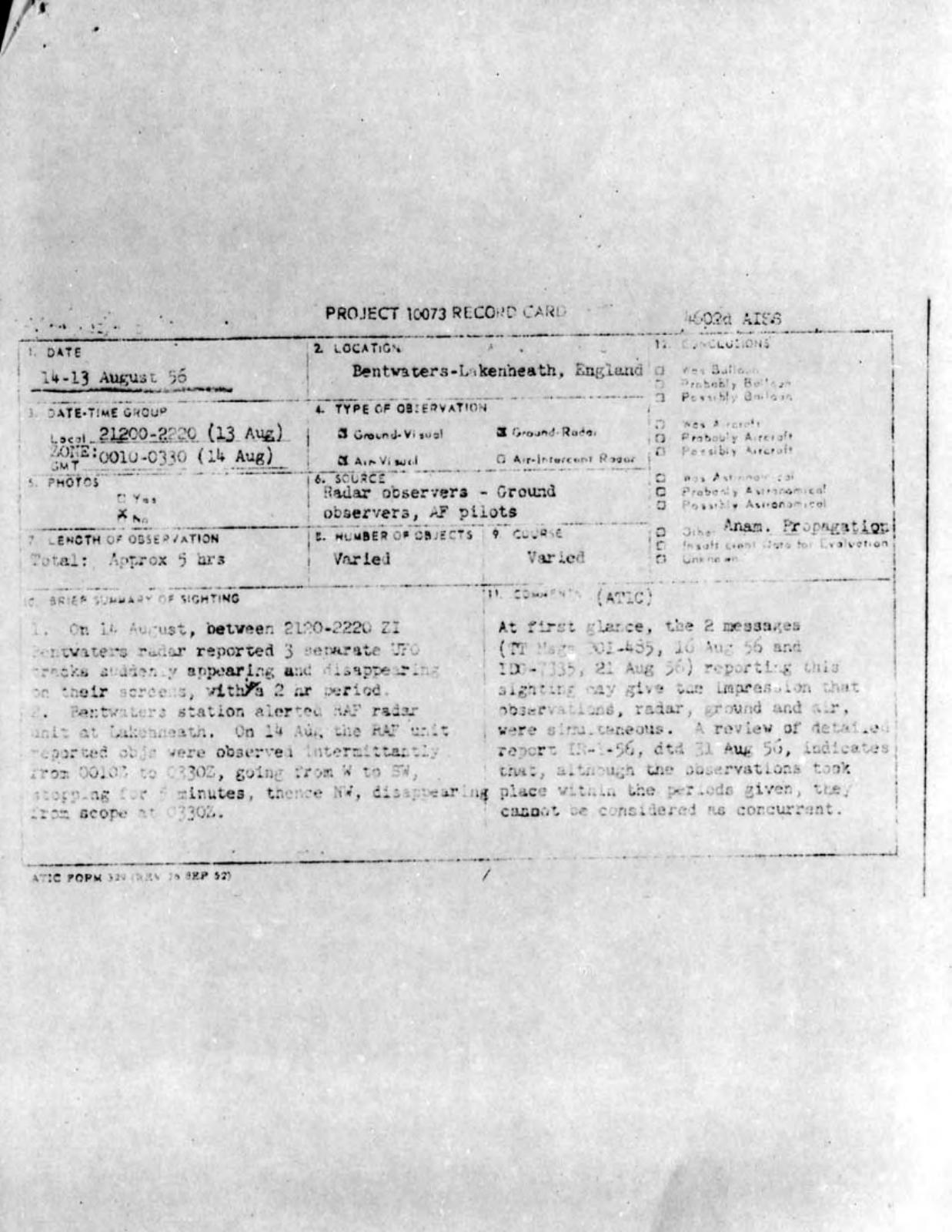
    The original Air Force record card, preserved in a NICAP scan, lists anomalous propagation as its explanation and questions whether the observations should be treated as concurrent. This matters: the later analysts’ favorable assessment was not the same as Blue Book’s administrative conclusion.

    What Thayer meant by “genuine”

    Gordon Thayer revisited the incident in a September 1971 Astronautics & Aeronautics paper, reproduced with page scans by RR0. He explicitly explained that the phrase referred to an unidentified material object moving through the air—not necessarily something extraterrestrial.

    Thayer organized the night into separate contacts rather than one uninterrupted chase. His table distinguishes early Bentwaters radar episodes without confirmed visual counterparts from later events with several reported observation channels. He also noted discrepancies between the supervisor’s account and Blue Book, including where the fighter first encountered a target.

    That separation is important. Thayer considered an atmospheric explanation plausible for one early group of echoes while arguing against its use as a blanket explanation for the entire night. Agreeing or disagreeing with his assessment requires examining those individual episodes, not merely repeating that radar was involved.

    Corroboration is a question to test

    Several instruments can strengthen a case when their records independently agree about the same place and time. But the existence of several reports alone does not demonstrate that agreement. A careful reconstruction must ask which observations were simultaneous, which were communicated between stations and which were linked only afterward.

    Likewise, an apparent stop on a display and a physical object abruptly halting are not interchangeable descriptions. To move from one to the other, the investigation needs to establish what the instrument measured and how tracks were associated. This is a demand for an evidentiary chain, not a claim that a particular radar fault explains Lakenheath.

    The case remains useful because the original studies expose their reasoning and their disagreements. Readers can compare a later witness narrative, contemporary reporting reproduced within the study and an analyst’s reconstruction. The unresolved question is not made smaller by resisting an alien conclusion; it is made more precise. An unidentified observation is a legitimate finding, but it is not yet an identified origin.

    Featured image: Air Force Project 10073 record card for Bentwaters–Lakenheath, August 1956. Archival record, not a photograph of a reported object. U.S. federal work, public domain; scan hosted by NICAP. Original file.

  • Curiosity’s Nazca Plan Turns Unusual Rock Shapes Into Testable Questions

    Curiosity’s Nazca Plan Turns Unusual Rock Shapes Into Testable Questions

    Strange shapes in a Mars photograph are a reason to collect more information, not a shortcut to identifying what made them. Curiosity’s investigation of a rock target called Nazca shows how that distinction becomes a working science plan: compare shape, surface chemistry and material beneath the exposed surface.

    A dated account of preparations

    NASA published its Nazca mission-team update on October 28, 2026, but the account explicitly identifies an Earth planning date of October 16. Its featured close-up was composed on October 18, mission sol 5048. Those dates should not be collapsed into a claim that drilling occurred on October 28.

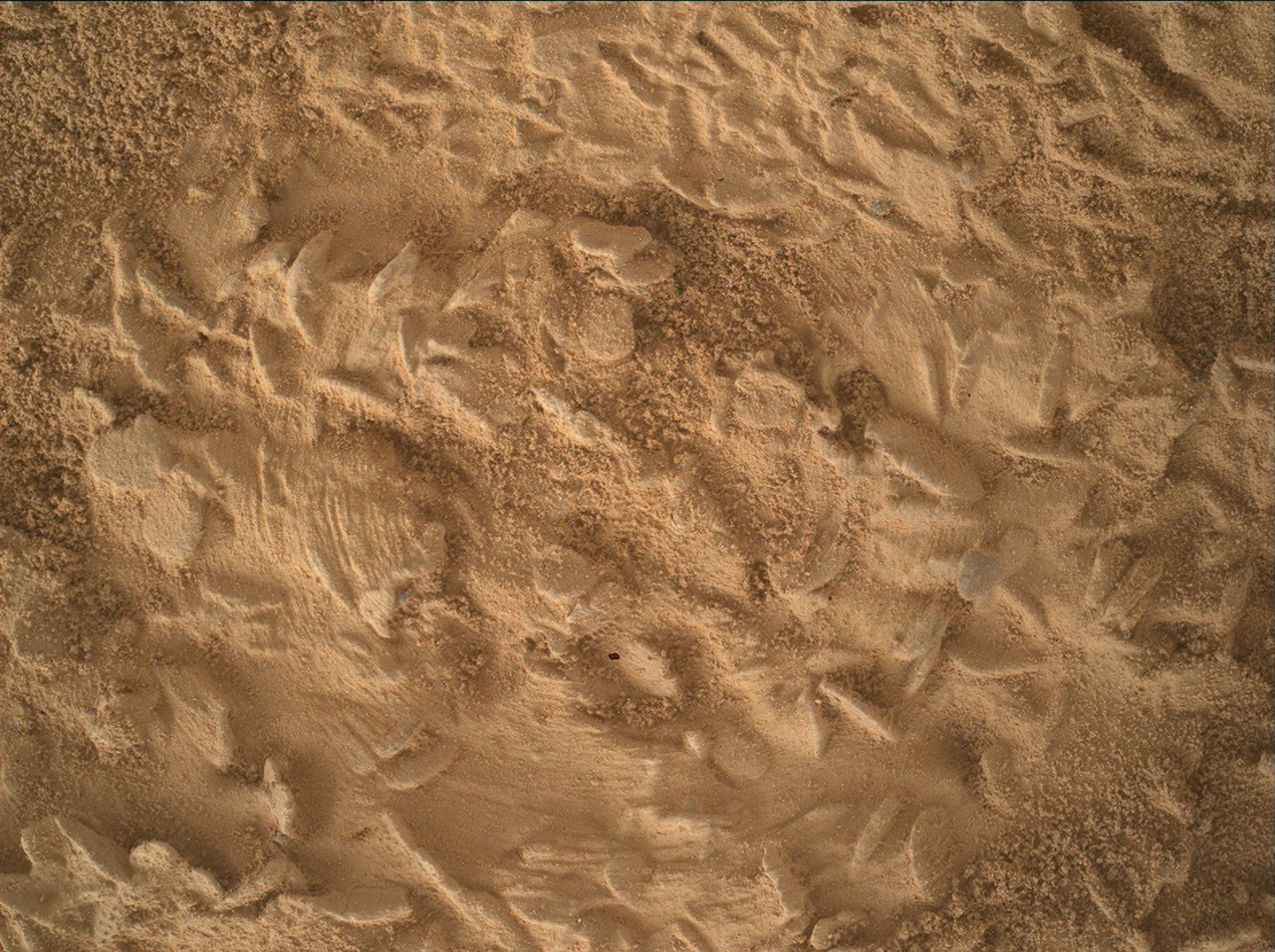
    The team selected Nazca after seeing abundant disc- and needle-shaped features resembling those on a nearby block. One hypothesis is that they preserve crystal-growth forms. The update cautions that a mineral’s original shape can survive even if another mineral later replaces it—a structure known as a pseudomorph.

    The plan included overlapping close-ups for a three-dimensional relief model and a ChemCam experiment concentrating 150 laser shots on one nearby spot, rather than distributing them across several points. Repeated pulses were intended to investigate composition beneath the outermost surface. These were preparations and planned tests, not a reported mineral identification or completed drilling result.

    Shape and chemistry answer different questions

    Curiosity carries complementary tools rather than a single instrument that can identify everything from a photograph. NASA’s instrument reference describes the Mars Hand Lens Imager, or MAHLI, as a close-up camera for rock textures, minerals and structures. Its location on the robotic arm lets the rover examine details at much smaller scales than a landscape panorama.

    ChemCam uses a laser to produce a tiny plasma, then examines its light with spectrographs to investigate elemental composition. The Alpha Particle X-Ray Spectrometer also measures chemical elements, using a different technique. CheMin, inside the rover, identifies minerals through X-ray diffraction. Their outputs are related, but a description of shape, a list of elements and a mineral identification are not interchangeable measurements.

    That is the logic behind looking at the same target in several ways. A geometric feature can suggest a formation process; chemistry can test whether the exposed material fits that suggestion. If different observations disagree, the disagreement becomes information about alteration, surface effects or the original hypothesis—not something to conceal.

    What would move the story forward?

    The useful follow-up is an account of which tests actually ran and what their measurements showed. A successful drilling operation would establish that a sample was obtained, not automatically settle the rock’s origin. Interpretation would still depend on the resulting data and their geological context.

    For now, the published planning account is a concrete example of how a rover team turns an intriguing image into testable questions. Nazca’s unusual features deserve attention because they may preserve a complicated mineral history, not because resemblance alone proves an exotic explanation.

    Featured image: Curiosity MAHLI focus-composite close-up of Nazca, composed October 18, 2026 (sol 5048); brush scratches are visible. Credit: NASA/JPL-Caltech/MSSS. Image source; news reporting use permitted by the MSSS image-use policy.

  • What Makes a UAP Report Useful to Air-Traffic Controllers

    What Makes a UAP Report Useful to Air-Traffic Controllers

    An unidentified light becomes a more useful aviation report when it is attached to a position, a time and a clear description of what was actually observed. The goal is not to make the account sound more extraordinary. It is to leave enough information for someone else to reconstruct it.

    Start with the reporting aircraft

    The FAA’s facility-order section 4-7-4 identifies five kinds of information to report when available: the aircraft call sign or identification of an air-traffic observer; the observer’s location and, for an aircraft, altitude and flight direction; the phenomenon’s relative location; its description and known movement information; and whether it appeared on ATC radar.

    Those fields separate two things that easily blur in a dramatic retelling: the known position of the observer and the uncertain position of the object. An aircraft’s reported altitude does not automatically become the altitude of a distant light seen through its window.

    Describe before interpreting

    A useful account distinguishes a visible feature from an inference. “Three steady white lights above the horizon” records an appearance. “A triangular craft flying at our altitude” adds conclusions about physical connection, shape and distance that may need separate support.

    Similarly, a direction relative to the aircraft should not be confused with a geographic heading. If the aircraft turns, its left and right change. Preserving the aircraft’s own direction helps a later reviewer understand what “off our left side” meant at that moment.

    These are editorial suggestions for clearer records, not additional mandatory FAA fields. Where an estimate is unavoidable, label it as an estimate. Where information was unavailable, say so rather than manufacturing a precise number.

    Preserve the sequence

    A practical personal note can keep the event in order: when the observation began, what first attracted attention, what changed, when contact ended, and whether the observer or aircraft moved during it. Record the time zone alongside any clock time. Precision is valuable only when its origin is known.

    Separate what the witness saw from what someone else said over the radio. If a controller mentioned a radar return, preserve that statement as such; do not silently upgrade it into a verified match between a particular return and the visible light. Matching those observations is an analytical step.

    Original notes also help keep a later narrative from absorbing details supplied by other witnesses or online discussion. A supplementary correction can be useful without overwriting the first account.

    Safety and reporting are not identification

    The FAA’s controller instruction in section 9-8-1 directs reported or observed UAP activity to the operations supervisor or controller-in-charge. The facility order specifies onward reporting to its security coordination team. These are information-handling procedures, not declarations that an object has an exotic origin.

    This guide is not a substitute for flight training, current operating procedures or instructions from air traffic control. Documentation should never distract from safely operating an aircraft. The lasting value of a report is its recoverable detail: who observed what, from where, and which parts remain uncertain.

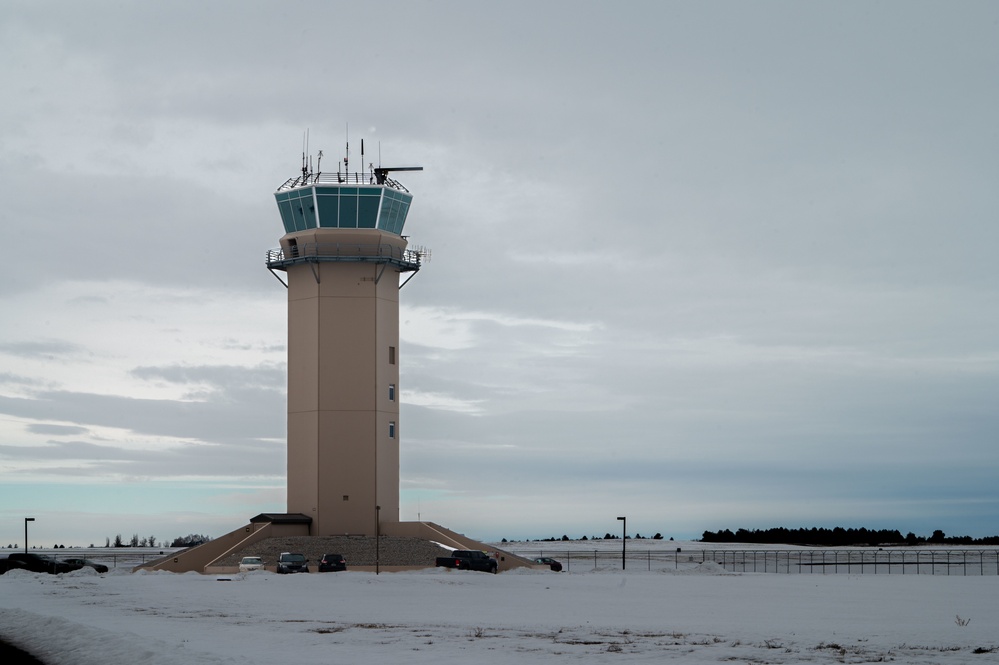
    Featured image: Fairchild Air Force Base air-traffic control tower, January 5, 2023. Archival context photograph, not a UAP event or an FAA facility. Credit: U.S. Air Force/Airman 1st Class Stassney Davis. Public-domain image source.

  • RB-47, 1957: The UFO Case That Was Searched Under the Wrong Date

    RB-47, 1957: The UFO Case That Was Searched Under the Wrong Date

    The RB-47 encounter of July 17, 1957 is often presented as a case in which people, radar and electronic equipment all detected the same unexplained presence. Before weighing that claim, there is a more basic historical problem to resolve: an influential investigation initially searched under the wrong date.

    What the Colorado investigators had

    Case 5 of the University of Colorado UFO study, preserved in an NCAS transcription, labels the event “Fall 1957.” Investigator Roy Craig described interviews conducted roughly a decade after a training flight. Crew members recalled an unusual light, electronic signals and reported ground-radar contact.

    The account also recorded a disagreement that matters. The pilot remembered intelligence personnel removing recorded material after landing. Two other officers said no film or recording wire had been taken aboard. The investigation could not find the contemporary paperwork and therefore based its evaluation on later recollections. That was a limitation of the inquiry as conducted, not proof that no report had ever been created.

    The later paper changed the documentary picture

    The introduction to James McDonald’s July 1971 article in Astronautics & Aeronautics, reproduced by NICAP, says the Colorado team had used September 19 instead of July 17, 1957. McDonald subsequently located case files and combined them with his own crew interviews.

    He identified a contemporary intelligence summary, a message from the Duncanville radar unit and an observer’s data sheet. His account also distinguishes passive direction-finding equipment—which received radio emissions—from an aircraft radar transmitting pulses and receiving echoes. Calling both simply “radar” obscures what each instrument could actually establish.

    McDonald reported that Blue Book carried an airliner identification, which he challenged by arguing that the cited near-collision concerned a different location. His paper is an investigator’s argument, not a newly performed sensor experiment or an institutional finding of extraterrestrial technology.

    What a corrected date can—and cannot—do

    This is a useful example of why an archival search needs to be reproducible. A reader should be able to identify the date searched, the records consulted and which version of an account supplied each detail. Otherwise, a failed search can harden into a misleading claim that evidence never existed.

    Finding paperwork is a genuine improvement, but it does not make every reported measurement independently testable. A narrative written soon after an event and an original instrument recording are different products. Later interviews can clarify terminology while also introducing disagreement about sequence, timing or equipment use.

    The strongest assessment would align the aircraft’s track, the receiving equipment’s bearings, ground-radar observations and visual reports on one timeline, retaining uncertainties rather than forcing every observation into one continuous object. Agreement would strengthen a common-source interpretation; gaps would remain gaps, not evidence of impossible motion.

    RB-47 deserves attention because its documentary history changed after the Colorado inquiry. The correction is important without being a verdict on the object. Neither “the records were missing” nor “multiple sensors were involved” is a substitute for showing exactly what survived and how the observations fit together.

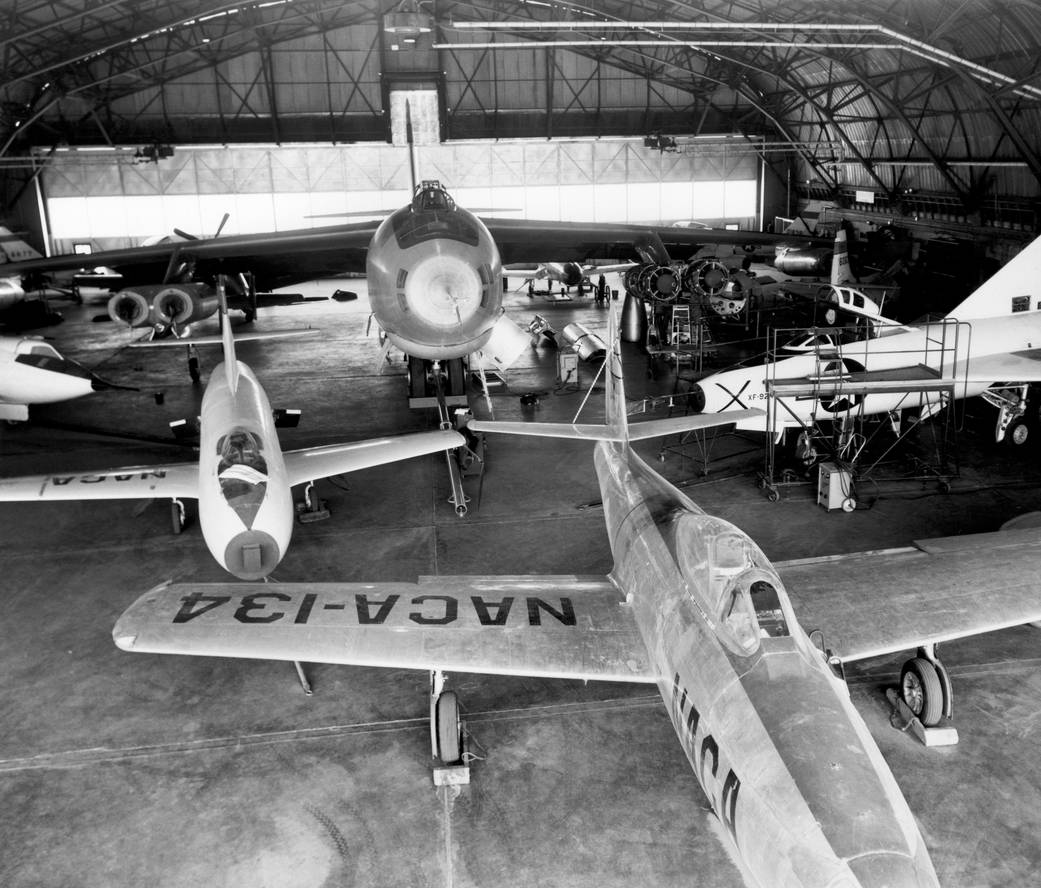
    Featured image: B-47A at the center of a NACA research-aircraft hangar photograph, April 27, 1953. Archival aircraft context, not the RB-47 or the 1957 encounter. Credit: NASA/NACA; public domain. Image source.

  • Teghaza 001 Opens a Rare Window Into Mars’s Ancient Crust and Water

    Teghaza 001 Opens a Rare Window Into Mars’s Ancient Crust and Water

    A small meteorite can preserve a long sequence of events: rock formation, chemical alteration, ejection from a planet and eventual discovery on Earth. New work on Teghaza 001 makes separating those stages especially important. Its scientific value is not simply that it is old, but that its minerals retain clues to early Mars that researchers can examine in terrestrial laboratories.

    Ancient crust, newly characterized

    NASA’s October 29, 2026 account of the study describes an approximately 800-gram meteorite found in Mali in 2022. Researchers identified evidence of water-related alteration around 4.1 billion years ago, implying that the original rock formed earlier. The new characterization appeared in Science on October 29; a separate water-focused paper appeared in Science Advances in June.

    The rock’s mixture of igneous minerals provides a different kind of record from ancient meteorites dominated by one mineral or assembled from fragments. NASA reports that zircon crystals and in-situ rubidium-strontium dating helped establish its history. The latter method examined individual mineral grains on a small slice, preserving more material than an analysis that dissolves the entire sample.

    What the specimen adds

    The Maine Mineral & Gem Museum, which holds Teghaza 001, describes distinctive composition, texture and mineralogy, a geochemically distinct mantle source, and reactions with water-rich fluids before the meteorite left Mars. Its account emphasizes the scarcity of samples representing the planet’s very ancient crust.

    That scarcity is why a single stone can matter without representing the entire planet. A sample can establish that particular materials and processes existed at one place and time. It cannot, by itself, show how widespread those conditions were, how long they lasted everywhere or whether other regions followed the same history.

    Three questions the age does not answer

    First, the age of a mineral record is not the date the meteorite arrived on Earth. The 2022 date marks its discovery, not the formation of Mars or the moment the stone was blasted into space.

    Second, matching a specimen to possible source terrain is not the same as locating its exact original outcrop. NASA identifies several candidate areas compatible with its properties, rather than one securely established birthplace. A geological match narrows a question; it does not erase uncertainty.

    Third, interaction with water is not evidence of organisms. Water-rock chemistry can reconstruct environments relevant to habitability, but the presence of water alone does not establish that life began or persisted there. The reported results concern geological history, not a biological detection.

    The next useful questions are therefore specific: which minerals preserve the oldest information, which record later alteration, and how well do their signatures agree with other Martian samples? Teghaza 001 expands the evidence available for those comparisons. It does not need to settle every question about ancient Mars to be an important addition.

    Featured image: A slice of Teghaza 001 used to examine its mineralogy and chemistry, released October 29, 2026. Credit: NASA/JPL-Caltech. Image source; JPL image-use policy. This is the laboratory slice image, not the separately copyrighted whole-rock photograph.

  • Autokinesis: Why a Stationary Night Light Can Seem to Move

    Autokinesis: Why a Stationary Night Light Can Seem to Move

    A light appears to wander against a dark sky. The witness is sincere, the light is real, and its apparent motion may still be misleading. Autokinesis is one reason those statements can all be true at once.

    When a fixed light appears to move

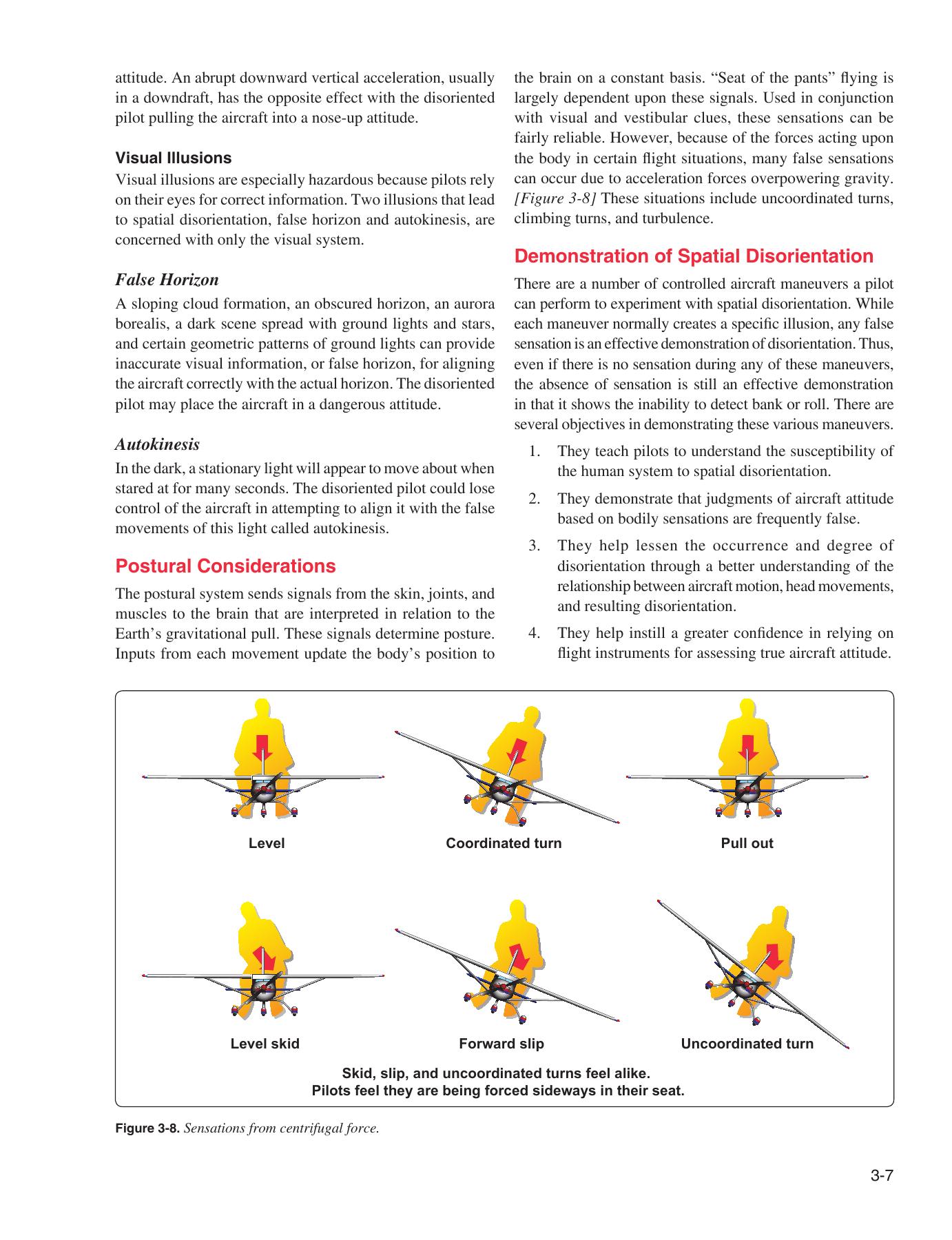
    The FAA’s Aeronautical Information Manual describes autokinesis as the apparent movement of a stationary light after prolonged staring in darkness. It includes the effect among illusions that can contribute to disorientation. This is an established concern in aviation training, not a claim invented to dismiss UFO witnesses.

    The FAA Instrument Flying Handbook, on printed page 3-7, makes the operational danger clear: a pilot who tries to follow the light’s illusory movement can misjudge aircraft control. The same chapter discusses the wider difficulty of interpreting orientation when visual and bodily cues are unreliable.

    What this changes in a sighting account

    For a reader evaluating an unusual-light report, the key question is not simply whether the observer saw motion. It is what that motion was measured against. “It moved to my left” and “it crossed behind the same fixed tower twice” contain different kinds of information.

    Neither statement should be silently rewritten into a measured speed. To calculate physical velocity, apparent displacement needs a timescale and a defensible distance or geometry. A vivid impression of acceleration is not, by itself, a record of acceleration in metres per second squared.

    This is also why a description such as “erratic” deserves unpacking. Did the light change position relative to a building, move within the observer’s field of vision, brighten and dim, or disappear when the observer looked away? Those are different observations, and collapsing them into one dramatic adjective loses useful evidence.

    A better set of follow-up questions

    • What references were visible? Record whether the scene included a horizon, buildings, trees, stars or only a light against darkness. Do not add a reference point that was not actually visible.
    • How was the light watched? Ask whether the observer stared continuously, scanned around or looked through an optical device. Preserve the answer even if its significance is not yet clear.
    • What changed when attention shifted? Note whether the impression persisted after looking elsewhere. A retrospective account may not contain this information; missing detail should stay missing.
    • Was displacement recorded independently? A stable reference in a continuous recording can help, but camera shake and tracking must be considered separately. Video and naked-eye perception are not interchangeable measurements.

    A possible mechanism is not a verdict

    Autokinesis cannot be diagnosed from the mere fact that a sighting happened at night. Nor does describing the illusion identify the light’s source. A complete explanation still has to fit the actual record.

    The point is to preserve an important distinction: an observer can report an experience accurately without having measured the external motion that seemed to cause it. Taking that distinction seriously makes an investigation more respectful and more useful—not less.

    Featured image: Page 3-7 of the FAA Instrument Flying Handbook, including its autokinesis discussion. Archival training document, not an illustration of a reported encounter. Source: FAA; U.S. federal work, public domain.

  • Mantell 1948: Why the Crash and the Sighting Are Different Questions

    Mantell 1948: Why the Crash and the Sighting Are Different Questions

    Captain Thomas Mantell’s death on January 7, 1948 poses two questions that should not be merged: why his Mustang crashed, and what prompted the climb that preceded it. The documents preserve evidence about both, but they do not support treating every explanation of one as an answer to the other.

    The climb, in a fellow pilot’s account

    In his January 9 statement, Lieutenant Albert Clements described a flight returning from Marietta, Georgia, toward Louisville. Near Godman Field, Mantell began climbing and continued southwest. Clements said he eventually saw a distant bright object, but could not identify its size, shape or color. His statement, transcribed from the accident-report documents and hosted by NICAP, describes breaking away at about 22,500 feet while Mantell continued upward.

    Clements also distinguished the aircraft’s oxygen arrangements: he used oxygen, while Mantell and the other accompanying pilot did not have oxygen equipment. That detail matters more than an unsupported assertion that every aircraft in the flight had identical equipment.

    Captain Richard Tyler’s January 12 report proposed that Mantell lost consciousness from lack of oxygen and subsequently crashed. Tyler explicitly presented his reconstruction as an opinion assembled from accounts and affidavits, with the formal investigating board’s work still pending. It should be cited as that document—not silently promoted into a verbatim final accident-board determination.

    The object was a separate investigation

    A surviving Air Materiel Command routing sheet, reproduced by NICAP from the Project Sign archive, carries a November 10, 1948 comment by A. B. Deyarmond. He concluded that the January 7 Godman object was not Venus and that the sighting remained unexplained. The November 8 date higher on the page belongs to an earlier routing entry, not Deyarmond’s response.

    Decades later, the Congressional Research Service’s March 9, 1976 UFO survey, at printed page CRS-102, described a Skyhook balloon as the accepted explanation. This is a later synthesis, not a balloon launch log or a contemporaneous identification by the pilots.

    Reading the layers without flattening them

    The useful comparison is between different kinds of evidence: a participant’s statement, an investigator’s provisional reconstruction, an internal assessment and a later survey. They answer different questions and were produced with different information available. Their dates are part of the evidence.

    A rejection of Venus in one memorandum does not establish an exotic craft. Equally, a later summary favoring a balloon does not erase the earlier uncertainty or supply every missing operational detail. A stronger reconstruction would connect the sighting geometry and timeline to independently documented balloon movements, while separately testing the crash sequence against the accident evidence.

    The human loss deserves the same care as the mystery. Mantell should neither disappear behind a sensational claim that a UFO attacked him nor become a shortcut for dismissing every witness report. The responsible historical conclusion is narrower: the pursuit and fatal crash are documented, while arguments about the target require their own evidentiary chain.

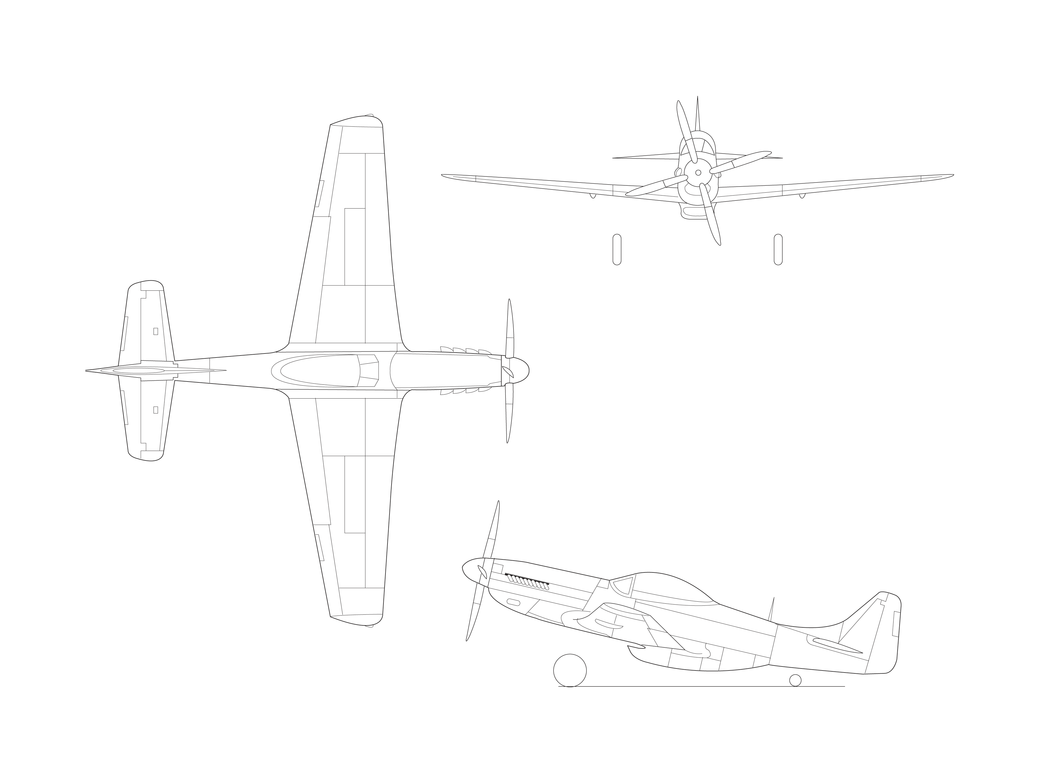
    Featured image: NASA three-view line drawing of the P-51D Mustang. Technical illustration, not Mantell’s aircraft or an encounter image. Credit: NASA; public domain. Image source and aircraft context.

  • The Cat’s Head Nebula Shows Why Hubble and Webb See Different Skies

    The Cat’s Head Nebula Shows Why Hubble and Webb See Different Skies

    A dark pillar can hide stars in one telescope image and reveal them in another without anything in the sky having moved. The newly released views of the Cat’s Head Nebula offer a particularly clear example: changing the wavelength changes which parts of a star-forming cloud become visible.

    One cloud, complementary views

    In an October 29, 2026 release, NASA presented Hubble and Webb observations of a small region within the Carina Nebula, roughly 7,500 light-years away. Its nickname comes from a silhouette resembling a seated cat whose head turns to one side.

    Hubble’s visible-light image shows a largely opaque dust pillar bordered by glowing gas. Webb’s near-infrared view exposes more of the pillar’s structure and additional stars. The apparent eye is a possible embedded young star, not a confirmed identification based on appearance alone. NASA describes radiation and winds from massive stars as the likely sculptors of the pillar.

    The comparison matters because a dark patch need not be an empty patch. It can be material obstructing light from objects behind it. Conversely, a bright rim is not simply the edge of a solid object: it can trace gas responding to nearby stars.

    What the colors mean

    These are processed observations, not artist’s concepts. That distinction does not mean the displayed colors reproduce what an astronaut’s eyes would see. NASA’s Hubble image-processing explanation describes how grayscale exposures through different filters are combined into color composites. Assigning colors can make particular emissions or otherwise invisible wavelengths distinguishable.

    For Webb, the translation is unavoidable because human vision does not detect infrared light. Its image-production guide explains how specialists map filtered observations into visible colors, remove detector artifacts and work with scientists on the final presentation. A striking palette is therefore a way of displaying measurements, not evidence that the underlying cloud was painted into existence.

    How to read the comparison

    Start with structures rather than colors. Ask which outlines persist, which stars emerge, and which regions become more transparent. Then consult the instrument and filter descriptions before interpreting a change in brightness. Two images can emphasize different physical components even when both accurately represent the same field.

    The cat resemblance is an invitation to look, not a scientific classification. The useful questions concern how dust shelters forming stars, how radiation reshapes their surroundings and which wavelengths can probe those processes. Keeping the nickname separate from the evidence makes the scene more interesting, not less: the picture becomes a map of what light can reveal—and what it still cannot penetrate.

    Featured image: Hubble’s processed visible-light observation of the Cat’s Head Nebula, released October 29, 2026. Image: NASA, ESA, STScI; Image Processing: Joseph DePasquale (STScI). Image source; used for informational reporting under NASA media guidelines.