The RB-47 encounter of July 17, 1957 is often presented as a case in which people, radar and electronic equipment all detected the same unexplained presence. Before weighing that claim, there is a more basic historical problem to resolve: an influential investigation initially searched under the wrong date.
What the Colorado investigators had
Case 5 of the University of Colorado UFO study, preserved in an NCAS transcription, labels the event “Fall 1957.” Investigator Roy Craig described interviews conducted roughly a decade after a training flight. Crew members recalled an unusual light, electronic signals and reported ground-radar contact.
The account also recorded a disagreement that matters. The pilot remembered intelligence personnel removing recorded material after landing. Two other officers said no film or recording wire had been taken aboard. The investigation could not find the contemporary paperwork and therefore based its evaluation on later recollections. That was a limitation of the inquiry as conducted, not proof that no report had ever been created.
The later paper changed the documentary picture
The introduction to James McDonald’s July 1971 article in Astronautics & Aeronautics, reproduced by NICAP, says the Colorado team had used September 19 instead of July 17, 1957. McDonald subsequently located case files and combined them with his own crew interviews.
He identified a contemporary intelligence summary, a message from the Duncanville radar unit and an observer’s data sheet. His account also distinguishes passive direction-finding equipment—which received radio emissions—from an aircraft radar transmitting pulses and receiving echoes. Calling both simply “radar” obscures what each instrument could actually establish.
McDonald reported that Blue Book carried an airliner identification, which he challenged by arguing that the cited near-collision concerned a different location. His paper is an investigator’s argument, not a newly performed sensor experiment or an institutional finding of extraterrestrial technology.
What a corrected date can—and cannot—do
This is a useful example of why an archival search needs to be reproducible. A reader should be able to identify the date searched, the records consulted and which version of an account supplied each detail. Otherwise, a failed search can harden into a misleading claim that evidence never existed.
Finding paperwork is a genuine improvement, but it does not make every reported measurement independently testable. A narrative written soon after an event and an original instrument recording are different products. Later interviews can clarify terminology while also introducing disagreement about sequence, timing or equipment use.
The strongest assessment would align the aircraft’s track, the receiving equipment’s bearings, ground-radar observations and visual reports on one timeline, retaining uncertainties rather than forcing every observation into one continuous object. Agreement would strengthen a common-source interpretation; gaps would remain gaps, not evidence of impossible motion.
RB-47 deserves attention because its documentary history changed after the Colorado inquiry. The correction is important without being a verdict on the object. Neither “the records were missing” nor “multiple sensors were involved” is a substitute for showing exactly what survived and how the observations fit together.
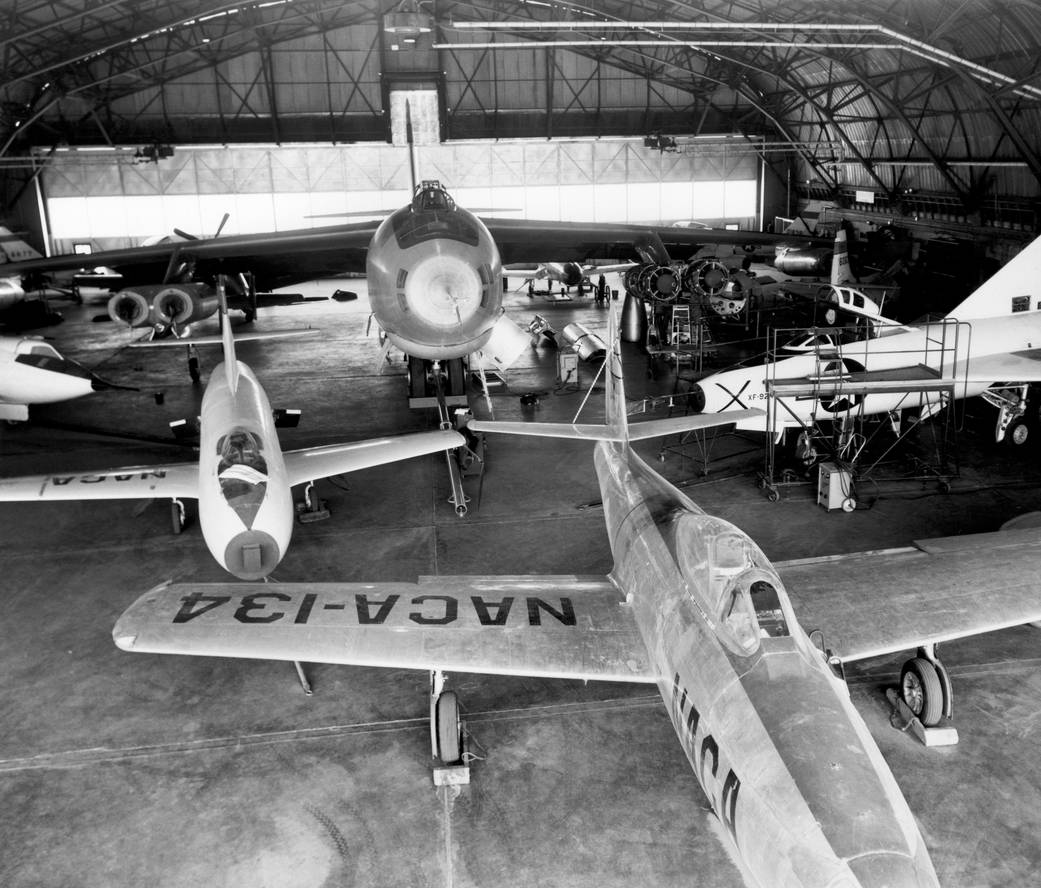
Featured image: B-47A at the center of a NACA research-aircraft hangar photograph, April 27, 1953. Archival aircraft context, not the RB-47 or the 1957 encounter. Credit: NASA/NACA; public domain. Image source.
Leave a Reply