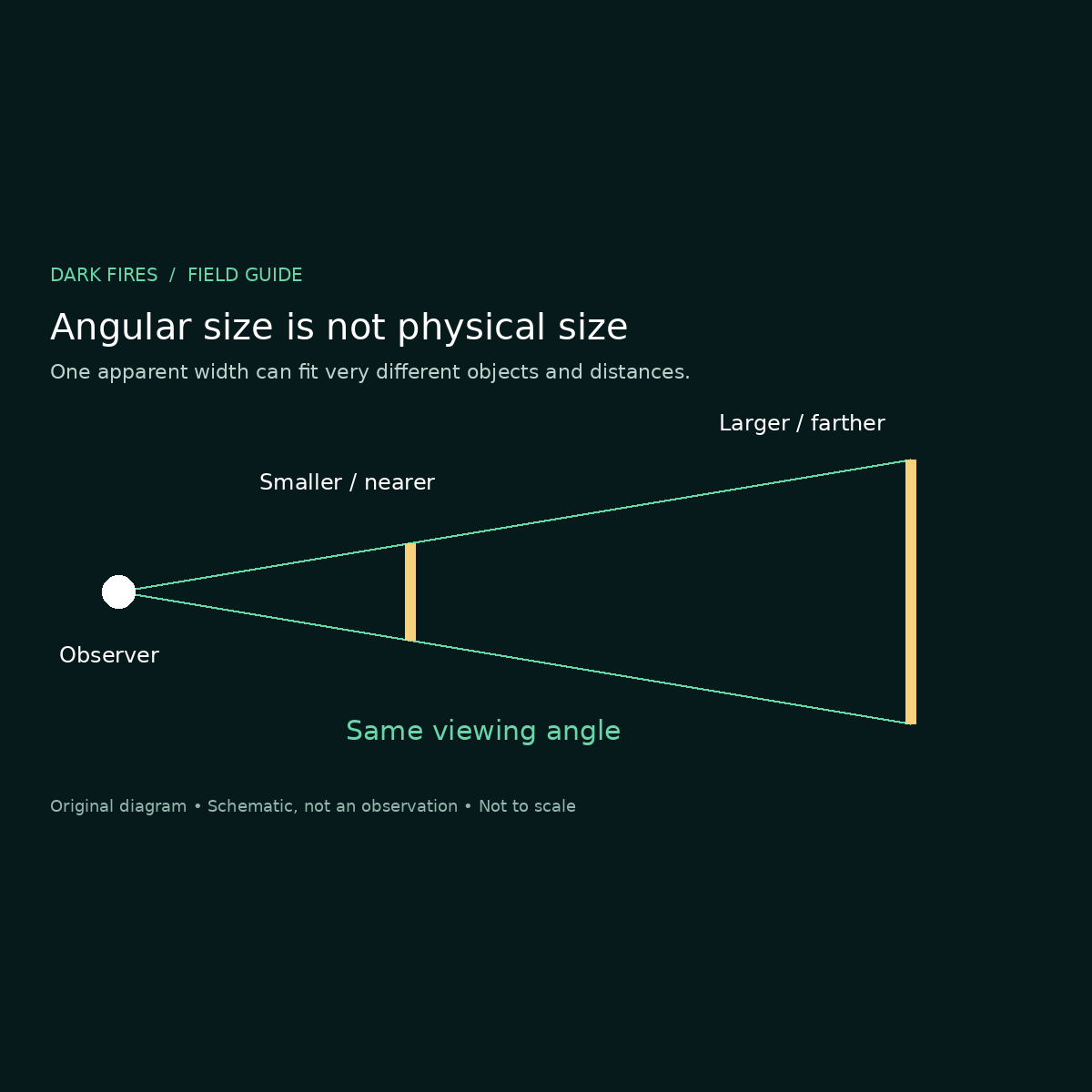
A light described as “as big as the Moon” has not yet been measured in metres. That comparison describes how much of the observer’s view it occupies: its angular size. Confusing that with physical size can turn an uncertain sighting into an apparently enormous craft without adding any new evidence.
The missing dimension
The NASA-supported Chandra X-ray Center explains the familiar example: the Sun is roughly 400 times wider than the Moon and roughly 400 times farther away, so both span about half a degree in our sky. Similar apparent diameters do not imply similar objects. See its guide to angular measurement.
For a small angle, physical width divided by distance gives angular width in radians. NASA’s Fermi classroom guide develops this small-angle relationship. Two quantities are needed to determine the third: an angular measurement alone cannot supply both size and range.
A worked example, not a sighting
Consider an idealized object one metre across, viewed from 100 metres. Its width-to-distance ratio is 0.01, corresponding to approximately 0.573 degrees. Now consider an object ten metres across at 1,000 metres. The ratio, and therefore the apparent width, is the same. These are illustrative calculations, not proposed identifications of a real event.
If an analyst assumes the second distance when the first is correct, the inferred width becomes ten times too large. The arithmetic can be impeccable while the conclusion is wrong because the starting distance was guessed.
This is why “it looked the size of a bus” needs clarification. Does the witness mean a nearby bus’s apparent width, or a literal estimate of dimensions? Those are different claims. A report can preserve both the visual impression and the uncertainty without treating either as a measurement.
What an image can actually establish
A calibrated image can provide an angular width when the camera’s field of view and image scale are known. A count of pixels without that calibration is not yet an angle. Cropping or digital enlargement also cannot turn an unknown range into a known one.
The measured feature must actually represent the object’s edges. If it is only an unresolved light, an analyst should describe the recorded light patch rather than assume that patch traces a solid body. Establishing that distinction is a separate imaging problem; the geometric formula does not solve it.
Useful independent range evidence might come from a properly associated radar measurement or simultaneous observations from separated, surveyed positions. A familiar-looking silhouette is weaker: using an assumed object type to estimate distance, then using that distance to “confirm” the object type, is circular.
The better conclusion
Report the angular measurement first, identify the range evidence separately, and label any physical-size calculation as conditional on that evidence. Where distance remains unknown, a family of possible sizes is more honest than one impressive number. This does not identify a UAP; it prevents an unsupported size estimate from masquerading as an identification.
Image: Original diagram by Dark Fires; a geometric schematic, not an observation, and not to scale.
Leave a Reply