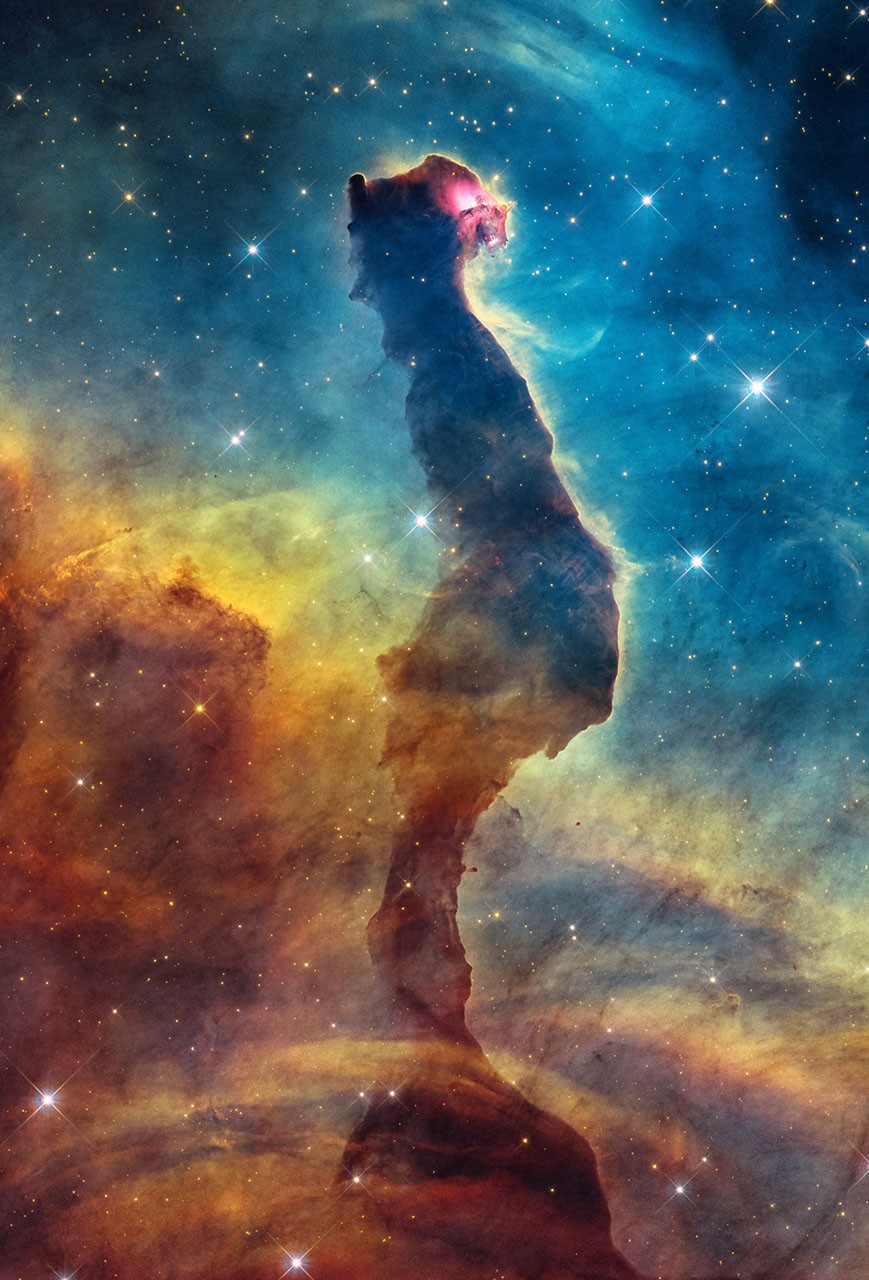
A dark pillar can hide stars in one telescope image and reveal them in another without anything in the sky having moved. The newly released views of the Cat’s Head Nebula offer a particularly clear example: changing the wavelength changes which parts of a star-forming cloud become visible.
One cloud, complementary views
In an October 29, 2026 release, NASA presented Hubble and Webb observations of a small region within the Carina Nebula, roughly 7,500 light-years away. Its nickname comes from a silhouette resembling a seated cat whose head turns to one side.
Hubble’s visible-light image shows a largely opaque dust pillar bordered by glowing gas. Webb’s near-infrared view exposes more of the pillar’s structure and additional stars. The apparent eye is a possible embedded young star, not a confirmed identification based on appearance alone. NASA describes radiation and winds from massive stars as the likely sculptors of the pillar.
The comparison matters because a dark patch need not be an empty patch. It can be material obstructing light from objects behind it. Conversely, a bright rim is not simply the edge of a solid object: it can trace gas responding to nearby stars.
What the colors mean
These are processed observations, not artist’s concepts. That distinction does not mean the displayed colors reproduce what an astronaut’s eyes would see. NASA’s Hubble image-processing explanation describes how grayscale exposures through different filters are combined into color composites. Assigning colors can make particular emissions or otherwise invisible wavelengths distinguishable.
For Webb, the translation is unavoidable because human vision does not detect infrared light. Its image-production guide explains how specialists map filtered observations into visible colors, remove detector artifacts and work with scientists on the final presentation. A striking palette is therefore a way of displaying measurements, not evidence that the underlying cloud was painted into existence.
How to read the comparison
Start with structures rather than colors. Ask which outlines persist, which stars emerge, and which regions become more transparent. Then consult the instrument and filter descriptions before interpreting a change in brightness. Two images can emphasize different physical components even when both accurately represent the same field.
The cat resemblance is an invitation to look, not a scientific classification. The useful questions concern how dust shelters forming stars, how radiation reshapes their surroundings and which wavelengths can probe those processes. Keeping the nickname separate from the evidence makes the scene more interesting, not less: the picture becomes a map of what light can reveal—and what it still cannot penetrate.
Featured image: Hubble’s processed visible-light observation of the Cat’s Head Nebula, released October 29, 2026. Image: NASA, ESA, STScI; Image Processing: Joseph DePasquale (STScI). Image source; used for informational reporting under NASA media guidelines.
Leave a Reply