Captain Thomas Mantell’s death on January 7, 1948 poses two questions that should not be merged: why his Mustang crashed, and what prompted the climb that preceded it. The documents preserve evidence about both, but they do not support treating every explanation of one as an answer to the other.
The climb, in a fellow pilot’s account
In his January 9 statement, Lieutenant Albert Clements described a flight returning from Marietta, Georgia, toward Louisville. Near Godman Field, Mantell began climbing and continued southwest. Clements said he eventually saw a distant bright object, but could not identify its size, shape or color. His statement, transcribed from the accident-report documents and hosted by NICAP, describes breaking away at about 22,500 feet while Mantell continued upward.
Clements also distinguished the aircraft’s oxygen arrangements: he used oxygen, while Mantell and the other accompanying pilot did not have oxygen equipment. That detail matters more than an unsupported assertion that every aircraft in the flight had identical equipment.
Captain Richard Tyler’s January 12 report proposed that Mantell lost consciousness from lack of oxygen and subsequently crashed. Tyler explicitly presented his reconstruction as an opinion assembled from accounts and affidavits, with the formal investigating board’s work still pending. It should be cited as that document—not silently promoted into a verbatim final accident-board determination.
The object was a separate investigation
A surviving Air Materiel Command routing sheet, reproduced by NICAP from the Project Sign archive, carries a November 10, 1948 comment by A. B. Deyarmond. He concluded that the January 7 Godman object was not Venus and that the sighting remained unexplained. The November 8 date higher on the page belongs to an earlier routing entry, not Deyarmond’s response.

Decades later, the Congressional Research Service’s March 9, 1976 UFO survey, at printed page CRS-102, described a Skyhook balloon as the accepted explanation. This is a later synthesis, not a balloon launch log or a contemporaneous identification by the pilots.
Reading the layers without flattening them
The useful comparison is between different kinds of evidence: a participant’s statement, an investigator’s provisional reconstruction, an internal assessment and a later survey. They answer different questions and were produced with different information available. Their dates are part of the evidence.
A rejection of Venus in one memorandum does not establish an exotic craft. Equally, a later summary favoring a balloon does not erase the earlier uncertainty or supply every missing operational detail. A stronger reconstruction would connect the sighting geometry and timeline to independently documented balloon movements, while separately testing the crash sequence against the accident evidence.
The human loss deserves the same care as the mystery. Mantell should neither disappear behind a sensational claim that a UFO attacked him nor become a shortcut for dismissing every witness report. The responsible historical conclusion is narrower: the pursuit and fatal crash are documented, while arguments about the target require their own evidentiary chain.
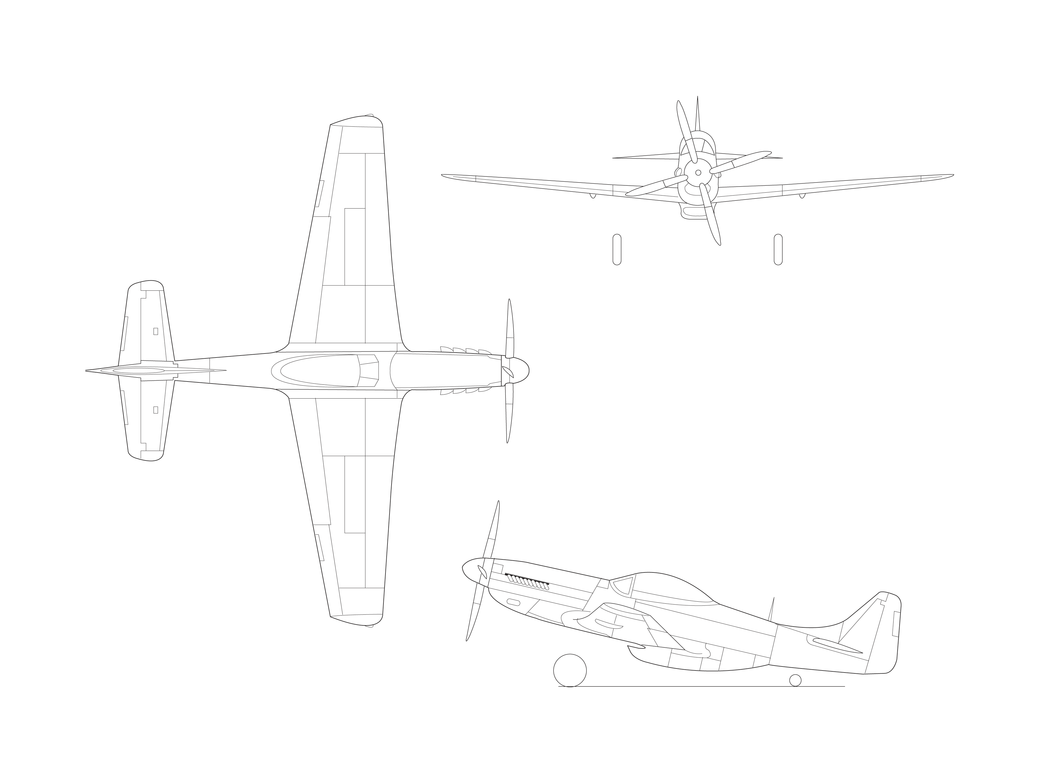
Featured image: NASA three-view line drawing of the P-51D Mustang. Technical illustration, not Mantell’s aircraft or an encounter image. Credit: NASA; public domain. Image source and aircraft context.
Leave a Reply