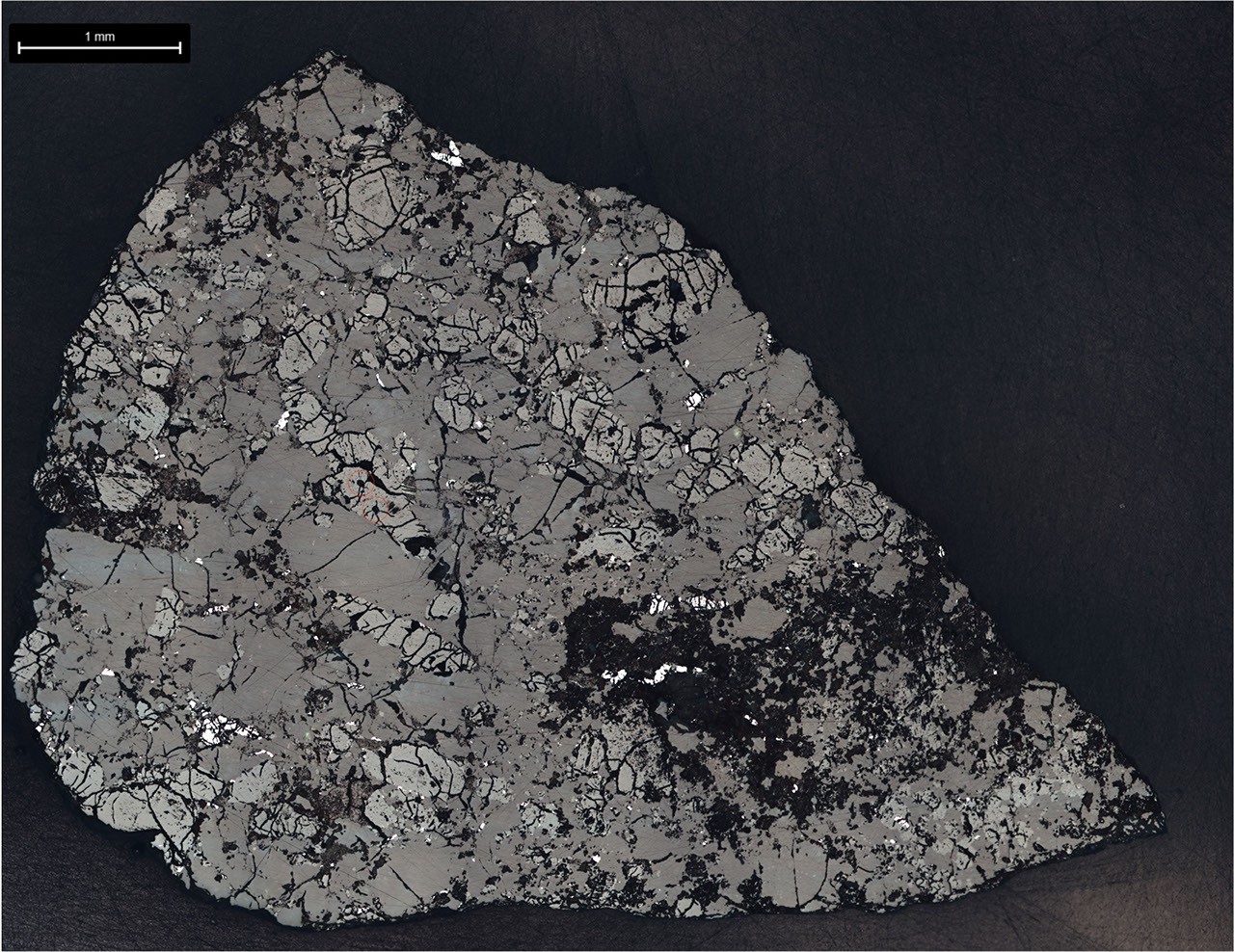
A small meteorite can preserve a long sequence of events: rock formation, chemical alteration, ejection from a planet and eventual discovery on Earth. New work on Teghaza 001 makes separating those stages especially important. Its scientific value is not simply that it is old, but that its minerals retain clues to early Mars that researchers can examine in terrestrial laboratories.
Ancient crust, newly characterized
NASA’s October 29, 2026 account of the study describes an approximately 800-gram meteorite found in Mali in 2022. Researchers identified evidence of water-related alteration around 4.1 billion years ago, implying that the original rock formed earlier. The new characterization appeared in Science on October 29; a separate water-focused paper appeared in Science Advances in June.
The rock’s mixture of igneous minerals provides a different kind of record from ancient meteorites dominated by one mineral or assembled from fragments. NASA reports that zircon crystals and in-situ rubidium-strontium dating helped establish its history. The latter method examined individual mineral grains on a small slice, preserving more material than an analysis that dissolves the entire sample.
What the specimen adds
The Maine Mineral & Gem Museum, which holds Teghaza 001, describes distinctive composition, texture and mineralogy, a geochemically distinct mantle source, and reactions with water-rich fluids before the meteorite left Mars. Its account emphasizes the scarcity of samples representing the planet’s very ancient crust.
That scarcity is why a single stone can matter without representing the entire planet. A sample can establish that particular materials and processes existed at one place and time. It cannot, by itself, show how widespread those conditions were, how long they lasted everywhere or whether other regions followed the same history.
Three questions the age does not answer
First, the age of a mineral record is not the date the meteorite arrived on Earth. The 2022 date marks its discovery, not the formation of Mars or the moment the stone was blasted into space.
Second, matching a specimen to possible source terrain is not the same as locating its exact original outcrop. NASA identifies several candidate areas compatible with its properties, rather than one securely established birthplace. A geological match narrows a question; it does not erase uncertainty.
Third, interaction with water is not evidence of organisms. Water-rock chemistry can reconstruct environments relevant to habitability, but the presence of water alone does not establish that life began or persisted there. The reported results concern geological history, not a biological detection.
The next useful questions are therefore specific: which minerals preserve the oldest information, which record later alteration, and how well do their signatures agree with other Martian samples? Teghaza 001 expands the evidence available for those comparisons. It does not need to settle every question about ancient Mars to be an important addition.
Featured image: A slice of Teghaza 001 used to examine its mineralogy and chemistry, released October 29, 2026. Credit: NASA/JPL-Caltech. Image source; JPL image-use policy. This is the laboratory slice image, not the separately copyrighted whole-rock photograph.
Leave a Reply