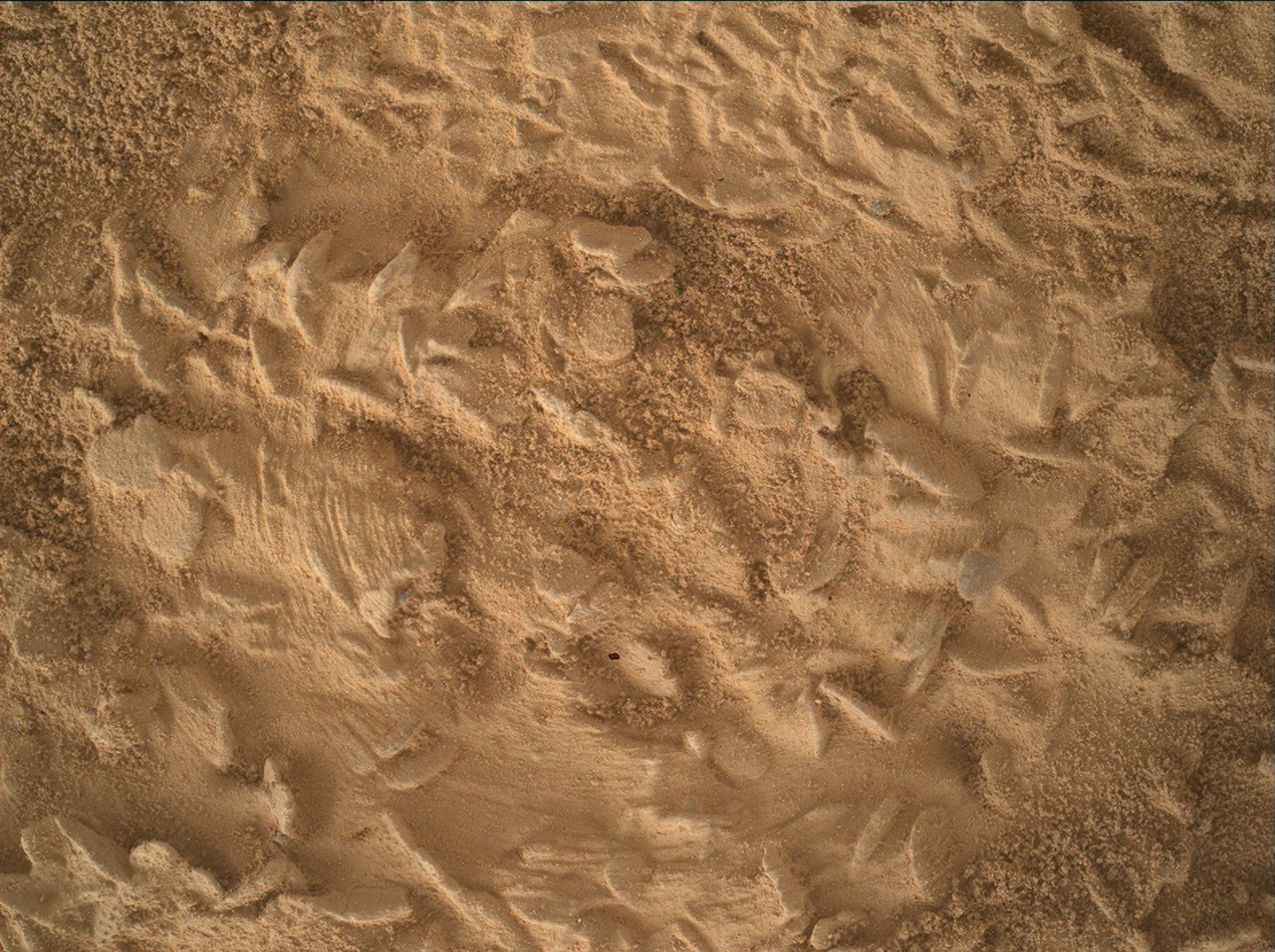
Strange shapes in a Mars photograph are a reason to collect more information, not a shortcut to identifying what made them. Curiosity’s investigation of a rock target called Nazca shows how that distinction becomes a working science plan: compare shape, surface chemistry and material beneath the exposed surface.
A dated account of preparations
NASA published its Nazca mission-team update on October 28, 2026, but the account explicitly identifies an Earth planning date of October 16. Its featured close-up was composed on October 18, mission sol 5048. Those dates should not be collapsed into a claim that drilling occurred on October 28.
The team selected Nazca after seeing abundant disc- and needle-shaped features resembling those on a nearby block. One hypothesis is that they preserve crystal-growth forms. The update cautions that a mineral’s original shape can survive even if another mineral later replaces it—a structure known as a pseudomorph.
The plan included overlapping close-ups for a three-dimensional relief model and a ChemCam experiment concentrating 150 laser shots on one nearby spot, rather than distributing them across several points. Repeated pulses were intended to investigate composition beneath the outermost surface. These were preparations and planned tests, not a reported mineral identification or completed drilling result.
Shape and chemistry answer different questions
Curiosity carries complementary tools rather than a single instrument that can identify everything from a photograph. NASA’s instrument reference describes the Mars Hand Lens Imager, or MAHLI, as a close-up camera for rock textures, minerals and structures. Its location on the robotic arm lets the rover examine details at much smaller scales than a landscape panorama.
ChemCam uses a laser to produce a tiny plasma, then examines its light with spectrographs to investigate elemental composition. The Alpha Particle X-Ray Spectrometer also measures chemical elements, using a different technique. CheMin, inside the rover, identifies minerals through X-ray diffraction. Their outputs are related, but a description of shape, a list of elements and a mineral identification are not interchangeable measurements.
That is the logic behind looking at the same target in several ways. A geometric feature can suggest a formation process; chemistry can test whether the exposed material fits that suggestion. If different observations disagree, the disagreement becomes information about alteration, surface effects or the original hypothesis—not something to conceal.
What would move the story forward?
The useful follow-up is an account of which tests actually ran and what their measurements showed. A successful drilling operation would establish that a sample was obtained, not automatically settle the rock’s origin. Interpretation would still depend on the resulting data and their geological context.
For now, the published planning account is a concrete example of how a rover team turns an intriguing image into testable questions. Nazca’s unusual features deserve attention because they may preserve a complicated mineral history, not because resemblance alone proves an exotic explanation.
Featured image: Curiosity MAHLI focus-composite close-up of Nazca, composed October 18, 2026 (sol 5048); brush scratches are visible. Credit: NASA/JPL-Caltech/MSSS. Image source; news reporting use permitted by the MSSS image-use policy.
Leave a Reply