In the Lakenheath–Bentwaters case of August 13–14, 1956, the most arresting phrase may be the easiest to misread. An investigator could call something a “genuine UFO” without claiming to have identified an extraterrestrial vehicle. The distinction is central to understanding this radar-visual case.
Two layers of the record
Case 2 of the University of Colorado UFO study, available in an NCAS transcription, combines an account sent by a retired radar watch supervisor with material from the Air Force’s Blue Book files. The supervisor wrote roughly twelve years after the night he described; the researchers received the Blue Book material late in their project.
The report describes ground-radar targets, visual sightings and an attempted interception by a British Venom fighter. In the accounts, a target appeared to follow the fighter despite evasive maneuvers. The study considered unusual radar propagation but thought that some reported movements were difficult to reconcile with that explanation. It did not exclude conventional causes.
Those are findings about the available accounts. They are not a modern replay of the original radar signals, with independently synchronized timestamps and aircraft telemetry.
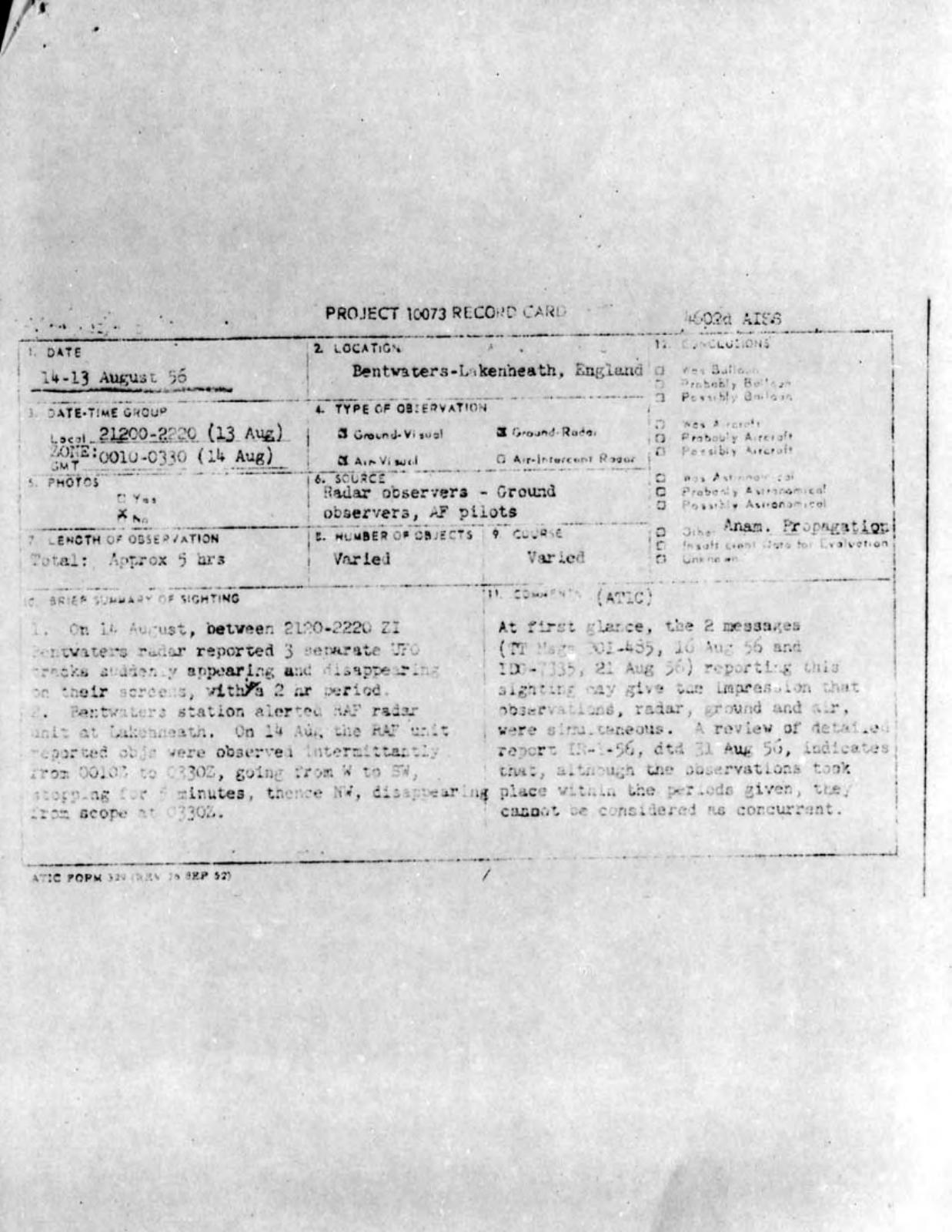
The original Air Force record card, preserved in a NICAP scan, lists anomalous propagation as its explanation and questions whether the observations should be treated as concurrent. This matters: the later analysts’ favorable assessment was not the same as Blue Book’s administrative conclusion.
What Thayer meant by “genuine”
Gordon Thayer revisited the incident in a September 1971 Astronautics & Aeronautics paper, reproduced with page scans by RR0. He explicitly explained that the phrase referred to an unidentified material object moving through the air—not necessarily something extraterrestrial.
Thayer organized the night into separate contacts rather than one uninterrupted chase. His table distinguishes early Bentwaters radar episodes without confirmed visual counterparts from later events with several reported observation channels. He also noted discrepancies between the supervisor’s account and Blue Book, including where the fighter first encountered a target.
That separation is important. Thayer considered an atmospheric explanation plausible for one early group of echoes while arguing against its use as a blanket explanation for the entire night. Agreeing or disagreeing with his assessment requires examining those individual episodes, not merely repeating that radar was involved.
Corroboration is a question to test
Several instruments can strengthen a case when their records independently agree about the same place and time. But the existence of several reports alone does not demonstrate that agreement. A careful reconstruction must ask which observations were simultaneous, which were communicated between stations and which were linked only afterward.
Likewise, an apparent stop on a display and a physical object abruptly halting are not interchangeable descriptions. To move from one to the other, the investigation needs to establish what the instrument measured and how tracks were associated. This is a demand for an evidentiary chain, not a claim that a particular radar fault explains Lakenheath.
The case remains useful because the original studies expose their reasoning and their disagreements. Readers can compare a later witness narrative, contemporary reporting reproduced within the study and an analyst’s reconstruction. The unresolved question is not made smaller by resisting an alien conclusion; it is made more precise. An unidentified observation is a legitimate finding, but it is not yet an identified origin.
Featured image: Air Force Project 10073 record card for Bentwaters–Lakenheath, August 1956. Archival record, not a photograph of a reported object. U.S. federal work, public domain; scan hosted by NICAP. Original file.
Leave a Reply