DARK FIRESORIGINS UNKNOWN

Author: Dark Fires

  • Radar Echoes Are Not Automatically Aircraft: How Anomalous Propagation Works

    Radar Echoes Are Not Automatically Aircraft: How Anomalous Propagation Works

    A radar return is a measurement, not an identification. That distinction matters whenever an unfamiliar track enters a UFO discussion: before asking what the target was, an analyst must establish what the instrument was detecting and how the signal reached it.

    The atmosphere is part of the instrument

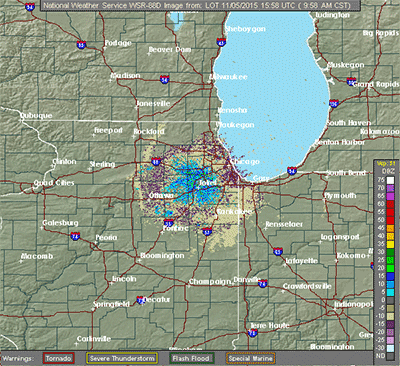
    NOAA’s JetStream explanation of anomalous propagation describes a familiar weather-radar problem. Under some atmospheric conditions, the beam bends downward more strongly than expected. This superrefraction can bring terrain into the beam and produce returns that do not represent rain.

    A low-level temperature inversion—warmer air above cooler air—can favor this behavior, especially with moist air below and much drier air above. Ground clutter can then become unusually conspicuous. The radio energy and the return are real; the mistake would be interpreting them as the wrong kind of target.

    Why one bright patch is not enough

    The National Weather Service’s Melbourne radar guide explains that anomalous propagation often affects the lowest elevation scans and can disappear in higher ones. Its occurrence can change as morning heating weakens an inversion. That gives analysts testable comparisons rather than a label to attach after the fact.

    NOAA illustrates another check with simultaneous Amarillo and Lubbock radar images. Each showed nearby echoes the other did not support, while visible satellite imagery showed clear skies. Together, those observations helped distinguish anomalous propagation from precipitation. The useful principle is independent comparison, not simply distrust of a surprising display.

    Four questions for a claimed radar anomaly

    • Which radar and product? A weather reflectivity image is not the same thing as an air-traffic surveillance track. A screenshot without its product label can invite the wrong interpretation.
    • Which time and scan angle? Preserve timestamps and the sequence of scans. A single frame cannot reveal whether a feature persisted, changed with elevation or remained fixed relative to terrain.
    • What did other instruments record? Look for appropriately timed neighboring coverage and atmospheric observations. Independent evidence must actually overlap the event, rather than merely come from the same general region.
    • What alternatives were tested? A credible explanation should connect the proposed mechanism to the observed geometry and conditions. “An inversion existed” is a starting point, not a complete reconstruction.

    A limit, not a universal answer

    These weather-radar examples explain why radar evidence requires interpretation. They do not demonstrate that every unexplained military or aviation track was anomalous propagation. Different instruments, processing systems and observing geometries need their own analysis.

    Nor does a visual sighting automatically settle the radar question. The task is to show that the visual object and the radar return correspond in time and position, not simply that both were reported. Conversely, a plausible clutter explanation should not erase observations it has not addressed.

    The strongest account therefore preserves both the measurement and its uncertainty: what appeared on the display, what the atmosphere could do to the beam, what independent checks were available, and which conclusions remain unsupported.

    Featured image: NOAA/National Weather Service example of ground-clutter echoes near Joliet, Illinois. Educational archival radar display, not a UAP detection. Image source; public-domain use information.
  • Michigan’s 1966 “Swamp Gas” Dispute Was Also a Fight Over Public Evidence

    Michigan’s 1966 “Swamp Gas” Dispute Was Also a Fight Over Public Evidence

    The phrase “swamp gas” can make Michigan’s 1966 UFO controversy sound like a simple argument between believers and skeptics. The surviving record shows another dispute running underneath it: whether the public had received a sufficiently careful explanation.

    What Hynek proposed

    NASA’s Astronautics and Aeronautics chronology for 1966, on printed page 116, records J. Allen Hynek’s March 25 press conference about reported sightings at Dexter and Hillsdale. Hynek was an astrophysicist and scientific consultant to the Air Force’s Project Blue Book.

    The chronology describes his suggestion that localized lights in swampy areas could result from marsh gas released during a thaw. It also records his suggestion that flares might have contributed to the Hillsdale reports—and notes that some witnesses disputed his conclusions. This is a record of a proposed explanation and its reception, not a laboratory demonstration of what produced each light.

    Ford wanted a different process

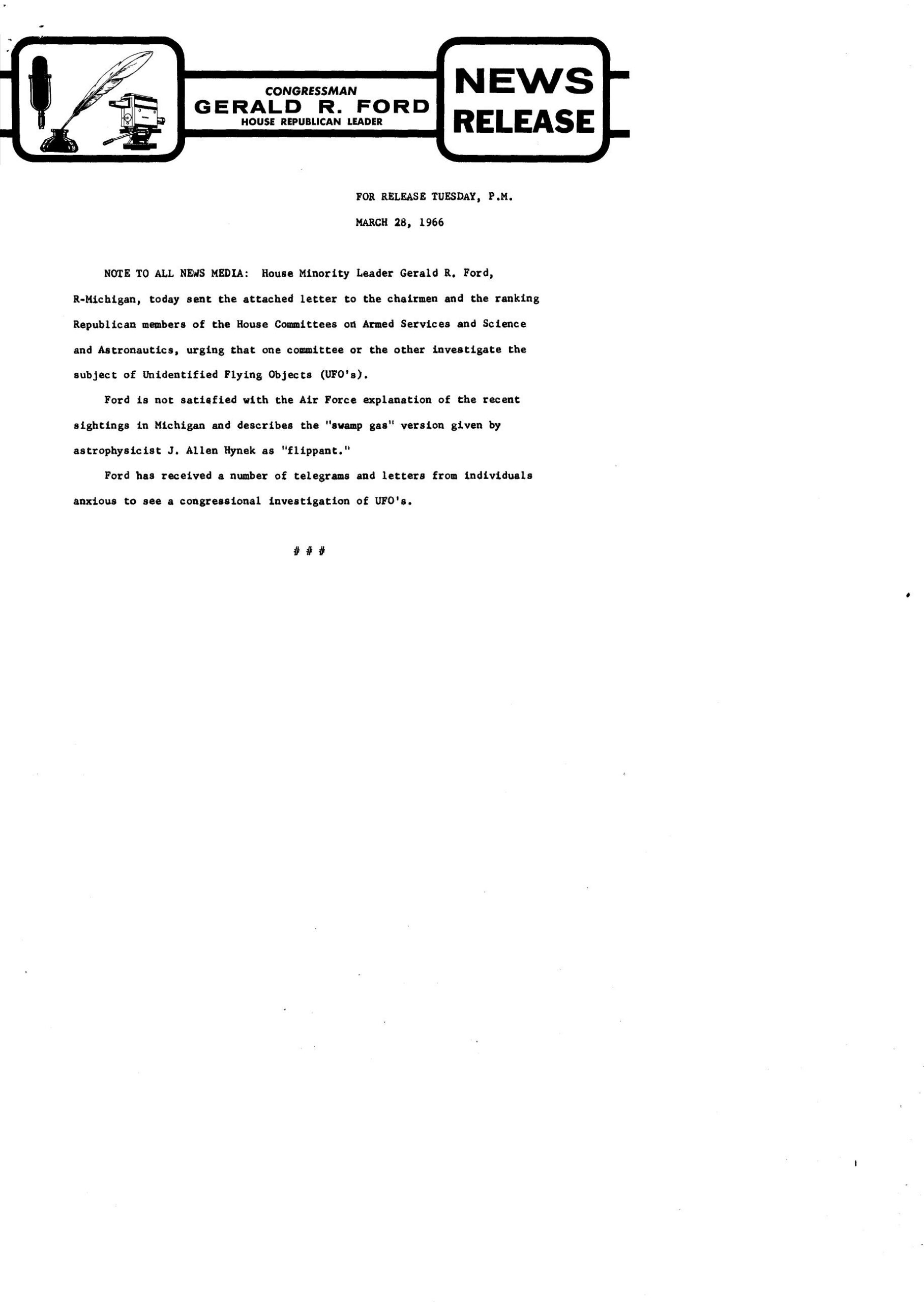
    Gerald Ford, then House Minority Leader and a Michigan congressman, pressed for congressional attention. His March 25 news release and March 28 correspondence survive in the Ford Presidential Library’s congressional papers.

    In the March 28 letter, Ford asked the chairmen of the House Science and Astronautics and Armed Services committees to arrange hearings. He wanted testimony from government representatives and people who reported seeing UFOs. His accompanying release called Hynek’s explanation “flippant.”

    Those documents establish Ford’s dissatisfaction and his proposed remedy. They do not establish that the lights were spacecraft. A request for investigation is evidence of a political response, not proof of the phenomenon’s origin.

    Why the distinction still matters

    The useful lesson is methodological. A proposed natural explanation should be tested against the particular observations it is meant to explain. Conversely, disagreement with that explanation does not make an extraordinary alternative correct by default.

    Readers should also distinguish the voices inside an archive. Ford’s account of the Air Force’s response is Ford’s argument; Hynek’s reported explanation is Hynek’s hypothesis. Neither becomes a neutral verdict simply because a presidential library or federal agency preserves it.

    Michigan’s enduring significance lies partly in that gap between explanation and persuasion. Public confidence requires more than a memorable label. It requires a clear account of which observations were examined, what evidence supports a conclusion and what uncertainty remains. The 1966 documents make that disagreement visible without requiring us to pretend they resolve every sighting.

    Featured image: Gerald Ford’s March 28, 1966 news release calling for congressional investigation of UFO reports. Courtesy Gerald R. Ford Presidential Library. U.S. federal work, public domain.

  • Tehran 1976: What the Military Report Records—and What It Cannot Prove

    Tehran 1976: What the Military Report Records—and What It Cannot Prove

    The Tehran encounter begins with an important distinction: an authentic military document can preserve an extraordinary report without independently establishing everything described in it. The surviving record of 19 September 1976 is valuable precisely because readers can examine that distinction for themselves.

    Two intercepts, one remarkable account

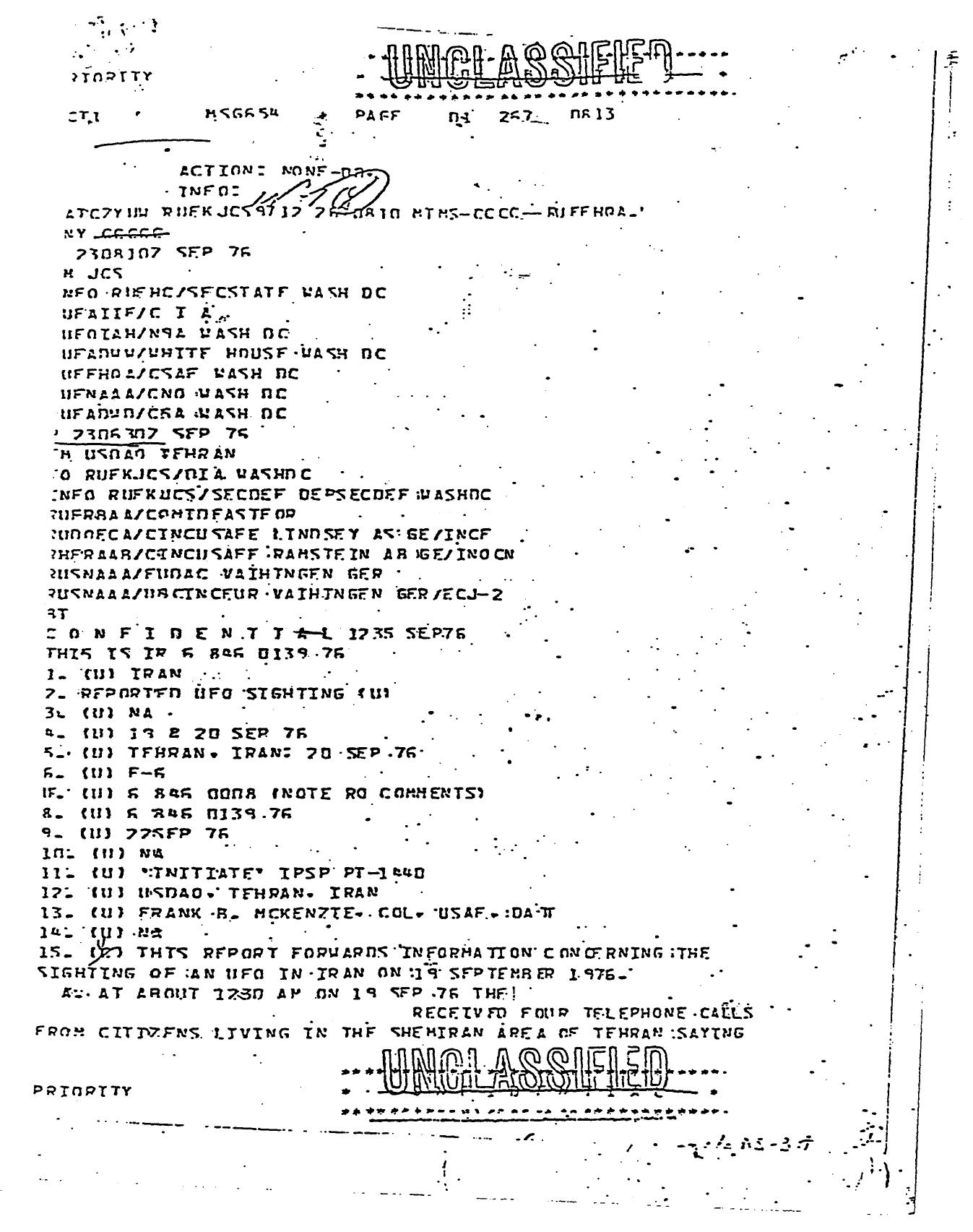
    A U.S. Defense Attaché report, preserved in the NSA’s collection as a Joint Chiefs of Staff message, describes civilian calls about unusual lights near Tehran and the dispatch of Iranian F-4 fighters.

    According to the account, the first aircraft lost instrumentation and communications while approaching the light, then recovered them after turning away. A second crew reportedly obtained a radar lock and observed rapidly changing colored lights. The report also describes a weapons-control interruption when the pilot attempted to fire a missile at another apparent object.

    These are reported observations, not measurements reproduced for independent analysis. The three-page message contains no raw radar recording or aircraft maintenance log. Its narrative also says a daylight helicopter visit found nothing at the presumed landing location, while further checks were planned. It does not supply their results.

    A file has more than one date

    A separate routing packet preserved by the NSA includes a cover dated 8 December 1978, identifying Louis E. Foster of the Defense Intelligence Agency. That administrative date should not replace the September 1976 encounter date.

    The distinction matters when historical records circulate online. A sighting date, a transmission date and a later archival upload describe different events. Confusing them can make old material appear newly discovered—or make separate layers of paperwork look like separate encounters.

    Keep the questions separate

    For a reader assessing the case, three questions are useful: Was this account genuinely recorded? How accurately does it describe what the crews experienced? What caused those experiences? Answering the first does not automatically answer the other two.

    Instrument trouble occurring during an unusual sighting warrants investigation. Establishing that an external object caused it, however, would require additional evidence capable of excluding competing explanations. Likewise, the presence of radar language in a narrative is not a substitute for access to the underlying radar data.

    The strongest reason to revisit Tehran is not that the file settles the UFO question. It is that the surviving documents let readers separate a serious historical report from conclusions the available evidence cannot securely carry.

    Featured image: First page of the U.S. military message reporting the September 19, 1976 Tehran encounter. Archival document, not a photograph of the reported object. Source: National Security Agency; U.S. federal work, public domain.

  • NASA Looks to Commercial Spacecraft for Hubble’s Next Chapter

    NASA Looks to Commercial Spacecraft for Hubble’s Next Chapter

    NASA is asking whether commercial spacecraft could give Hubble another lease on life. In an October 30 update, the agency announced an information request covering a possible orbital boost, servicing work and options for safely ending the telescope’s mission. It is an investigation of available capabilities, not an announcement that a rescue flight has been approved.

    The request was issued on October 29, with responses due at 3 p.m. EST on November 30. NASA wants to hear from industry about raising Hubble’s orbit, improving its capabilities, or arranging controlled atmospheric re-entry or orbital disposal when its work ends.

    A deadline set by atmospheric drag

    Hubble cannot maintain its altitude with onboard propulsion. Atmospheric drag gradually pulls its orbit lower, and NASA’s current analysis places likely re-entry in 2033–2034. The agency therefore anticipates that an intervention would need to happen by 2032. Those dates are planning estimates rather than a scheduled shutdown. NASA describes the effort as a way to examine opportunities for extending the observatory’s science lifetime. Read NASA’s October 30 announcement.

    Servicing changed Hubble before

    The telescope’s history shows why maintenance in orbit can matter. During the February 1997 servicing mission, astronauts aboard Discovery exchanged two scientific instruments for the Space Telescope Imaging Spectrograph and the Near Infrared Camera and Multi-Object Spectrometer. They also improved recording hardware and repaired insulation. Discovery’s thrusters raised Hubble’s orbit by nearly six miles before the telescope resumed observations. That flight combined scientific upgrades with practical work on an aging spacecraft. NASA’s historical account documents those changes.

    Another major overhaul followed in May 2009. Atlantis carried seven astronauts on the fifth and final shuttle servicing visit. Across five spacewalks, the crew installed Wide Field Camera 3 and the Cosmic Origins Spectrograph, replaced gyroscope units and batteries, and repaired existing instruments. The astronauts restored the Space Telescope Imaging Spectrograph by replacing an electronics card during the fourth spacewalk. They also renewed thermal protection and installed a refurbished Fine Guidance Sensor.

    That mission included preparation for Hubble’s eventual retirement: a mechanism intended to help a future spacecraft or propulsion module capture the telescope for de-orbit was activated. Hubble was released from Atlantis on May 19, and the shuttle returned to Earth on May 24. NASA’s mission timeline records the work.

    The new inquiry opens a different chapter. The question now is not whether servicing has helped Hubble before, but what today’s commercial spacecraft could realistically offer.

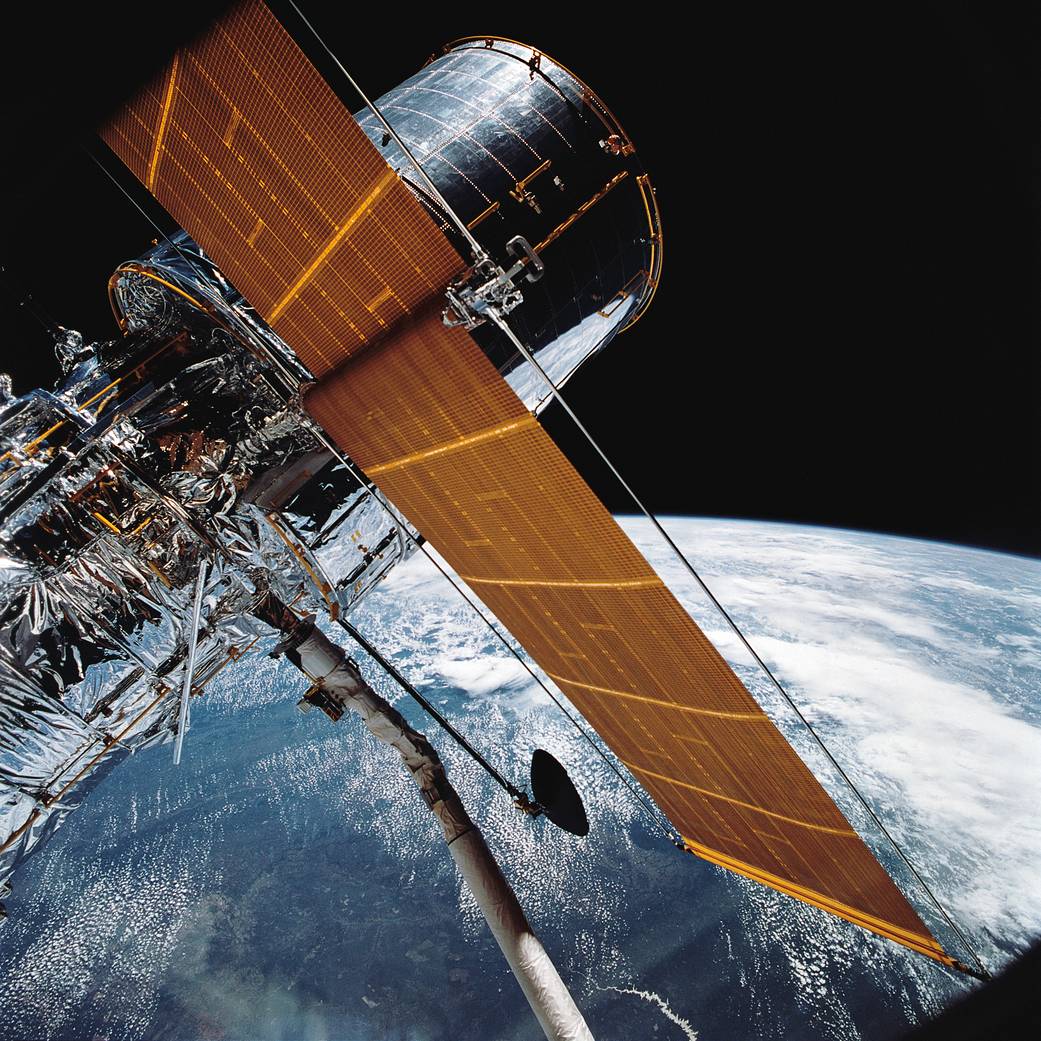
    Featured image: Hubble during deployment from Discovery, April 25, 1990. Archival photograph, not a new servicing mission. Credit: NASA. Image source.

  • Australia’s UAP Media File Shows a Reporting-Policy Gap, Not an Empty Sky

    Australia’s UAP Media File Shows a Reporting-Policy Gap, Not an Empty Sky

    An Australian Defence email release answers a narrow but important question: what was the department prepared to tell a television journalist about UAP reporting in May 2026? The answer was that Defence had no dedicated protocol for reporting or recording UAP or UFOs. That is a statement about an administrative process, not a finding that Australian skies contain no unexplained observations.

    A May response, released in July

    The five-page FOI release 1842/25/26 contains correspondence dated May 28, 2026, concerning an A Current Affair enquiry. An internal message calls for the standard background response. Another records that the Office of the Deputy Prime Minister provided final clearance. The response itself says Defence lacks a UAP/UFO reporting or recording protocol.

    The department’s disclosure log dates publication to July 31, 2026. These are previously released records being examined here, not a new October policy announcement. The disclosed chain establishes the wording and clearance of a media response; it does not supply a nationwide census of sightings.

    Dedicated UAP reporting and flight safety are different questions

    An earlier Defence release, 852/25/26, adds useful context. In its reproduced parliamentary answers, the Defence Aviation Safety Authority says it has no UAP-specific protocol. It nevertheless describes a flight-safety issue as an incident, malfunction, defect or exceedance that could endanger aircraft operation.

    Other answers in that older bundle describe routing unusual airborne events through air-traffic control or military reporting agencies, with normal safety procedures applying when a safety issue arises. The distinction matters: lacking a separate UAP channel is not equivalent to lacking all channels for hazardous or unidentified airborne events.

    What the records leave open

    Reading the releases together exposes an unresolved practical question: how consistently would an unusual observation that poses no immediate safety risk be retained for later analysis? The documents do not answer that question with a complete dataset. Nor do they establish that every relevant report is lost, that a secret programme exists, or that a particular sighting has an exotic explanation.

    The evidence supports scrutiny of reporting policy. Claims about the nature or frequency of the objects require separate observational evidence.

    Featured image: RAAF Base Williamtown entrance, 2012. Archival context photograph, not a UAP sighting or evidence of an incident discussed in this article. Credit: AussieLegend, public domain, via Wikimedia Commons.

  • Robertson Panel: Why a 1953 UFO Review Turned Toward Public Persuasion

    Robertson Panel: Why a 1953 UFO Review Turned Toward Public Persuasion

    The Robertson Panel is often invoked as either the moment science dismissed flying saucers or proof that officials decided to hide them. Its surviving records tell a more specific story: a short intelligence review that combined judgments about sightings with recommendations for changing how the public and military personnel responded to them.

    A security review with a wider agenda

    According to CIA historian Gerald K. Haines’s institutional history, physicist H. P. Robertson chaired a scientific panel in January 1953. The group examined Air Force case material and films. Haines describes meetings from January 14–17 and approximately twelve hours studying the phenomena.

    The panel found no evidence that the sightings constituted a direct national-security threat or demonstrated extraterrestrial visitors. But it worried that excessive reporting, public alarm and possible hostile exploitation could disrupt air defence. Its concern therefore extended beyond the identity of individual lights in the sky.

    What the recommendations actually proposed

    The declassified meeting report, preserved in this Commons-hosted government scan, carries a February 16, 1953 memorandum date and labels its subject January 14–18. It distinguishes its meeting history and supplementary comments from the formal panel conclusions.

    The supplementary discussion proposes two educational aims: training observers to recognize familiar objects and phenomena, and reducing public fascination through explanations of previously puzzling cases. It considers films, television and other media. It also recommends watching civilian UFO organizations because of their potential influence on public thinking.

    These are documented recommendations. They should not be silently converted into proof that every suggested activity was implemented, or that the panel possessed concealed physical evidence of alien technology.

    Secrecy created its own problem

    Haines’s account describes CIA reluctance to acknowledge its sponsorship and resistance to releasing the complete report. It notes that a sanitized version removed references to the agency and psychological-warfare concerns. That history helps explain distrust without requiring an extraterrestrial explanation.

    The useful distinction is between a scientific claim, an institutional recommendation and an action demonstrably carried out. A reader can question the breadth of the panel’s conclusions while also recognizing that its records document a Cold War concern about information and public behaviour. Neither accepting nor rejecting its conclusions settles later UAP cases. Those require their own evidence.

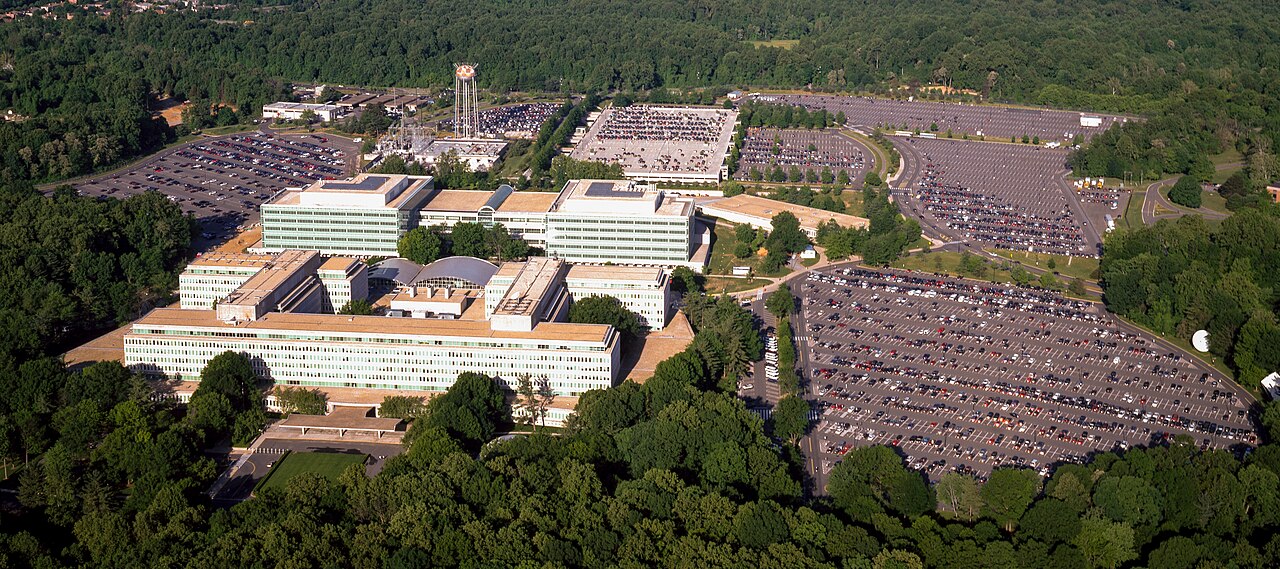
    Featured image: archival aerial photograph of CIA headquarters in Langley, Virginia, dated between 1980 and 2006, not the 1953 panel meeting. Carol M. Highsmith Archive, Library of Congress; public domain. Image source and credit.

  • Lucy Enters the Trojan Asteroid Region Ahead of Its First 2027 Flyby

    Lucy Enters the Trojan Asteroid Region Ahead of Its First 2027 Flyby

    NASA’s Lucy spacecraft has reached the broad region occupied by Jupiter’s Trojan asteroids, opening a new phase of a mission designed to investigate leftovers from the early solar system. The milestone was announced in an October 28, 2026 mission update, five years after launch.

    This is an arrival in a region of space, not a completed close encounter. NASA says Lucy’s first Trojan flyby, of Eurybates, remains scheduled for August 11, 2027. Engineers determine the spacecraft’s position from radio tracking and star images; there is no physical boundary marking entry into the swarm.

    Sharing Jupiter’s orbit, not circling Jupiter

    Trojan asteroids travel around the Sun in two populations associated with stable locations ahead of and behind Jupiter. Lucy is approaching the leading group near the L4 Lagrange point. These bodies are widely separated, so entering their region does not produce a crowded asteroid-field view. NASA reports that the spacecraft and its instruments continue operating as expected in the colder, dimmer environment.

    Why visit several different worlds?

    The mission’s value lies in comparison. NASA’s science objectives include mapping surface shapes, craters, colors and composition, investigating internal properties, and looking for satellites or rings. Differences among the Trojans may help test how material was redistributed while the giant planets formed and moved.

    That is a scientific question rather than a discovery already made by this arrival. Reaching the region puts Lucy on the path to the measurements; it does not yet reveal what its target surfaces contain.

    The encounters ahead

    The current mission schedule pairs Eurybates with its small satellite Queta. Polymele follows in September 2027, then Leucus and Orus in 2028. The later itinerary reaches Patroclus and Menoetius in March 2033, allowing observations of the trailing Trojan population as well.

    Lucy already visited the main-belt asteroid Dinkinesh and its satellite Selam in November 2023, and Donaldjohanson in April 2025. Those earlier encounters should not be confused with the still-upcoming first Trojan flyby.

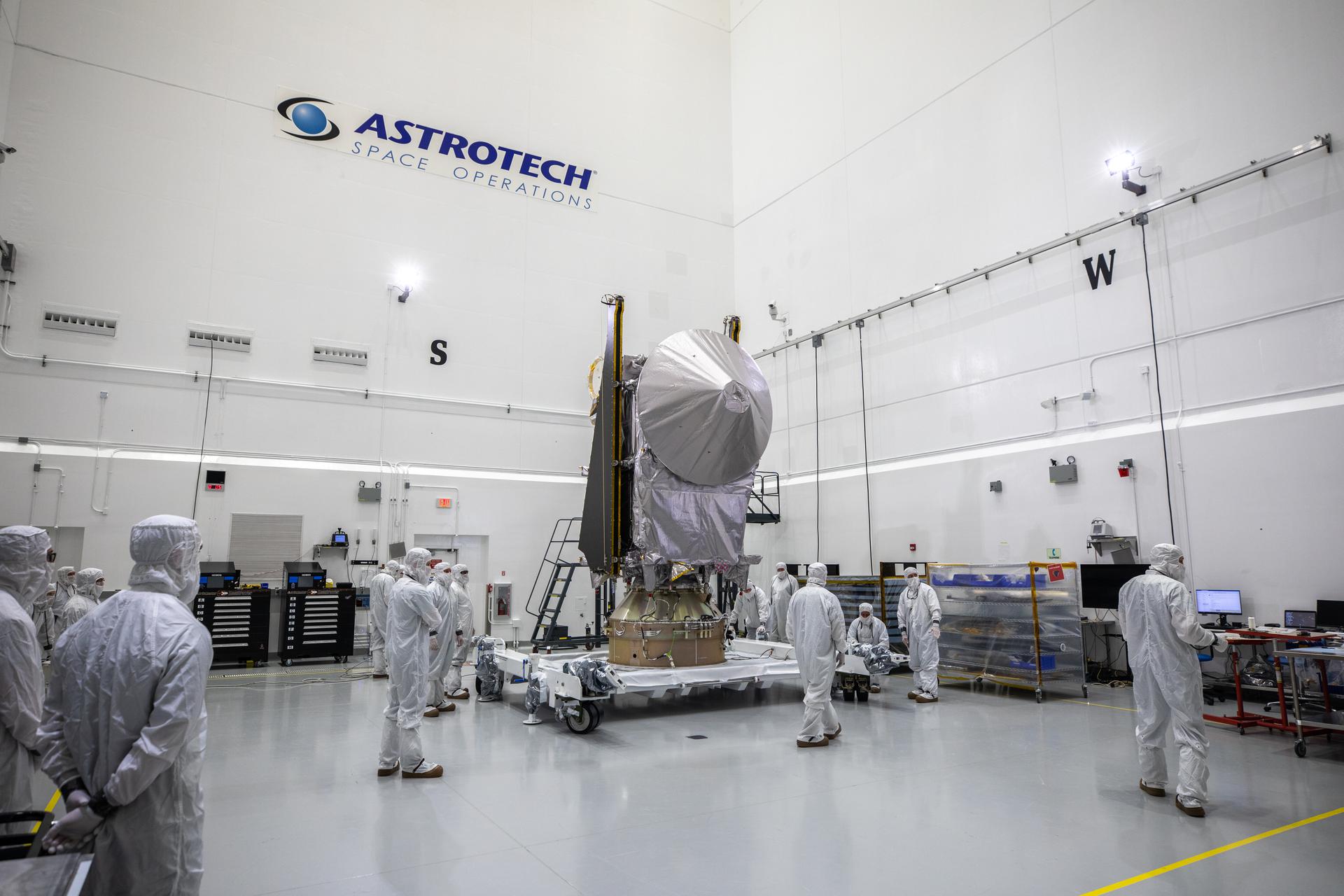
    Featured image: NASA’s Lucy spacecraft during prelaunch processing in Titusville, Florida, on September 29, 2021. Archival photograph, not a view from the Trojan region. Credit: NASA/Ben Smegelsky. Image source.

  • Socorro 1964: What the FBI Records Actually Document

    Socorro 1964: What the FBI Records Actually Document

    On April 24, 1964, Socorro police officer Lonnie Zamora reported an extraordinary encounter outside the New Mexico town. The most useful way to revisit it is to keep two evidence streams separate: what Zamora said he saw, and what other people subsequently observed on the ground.

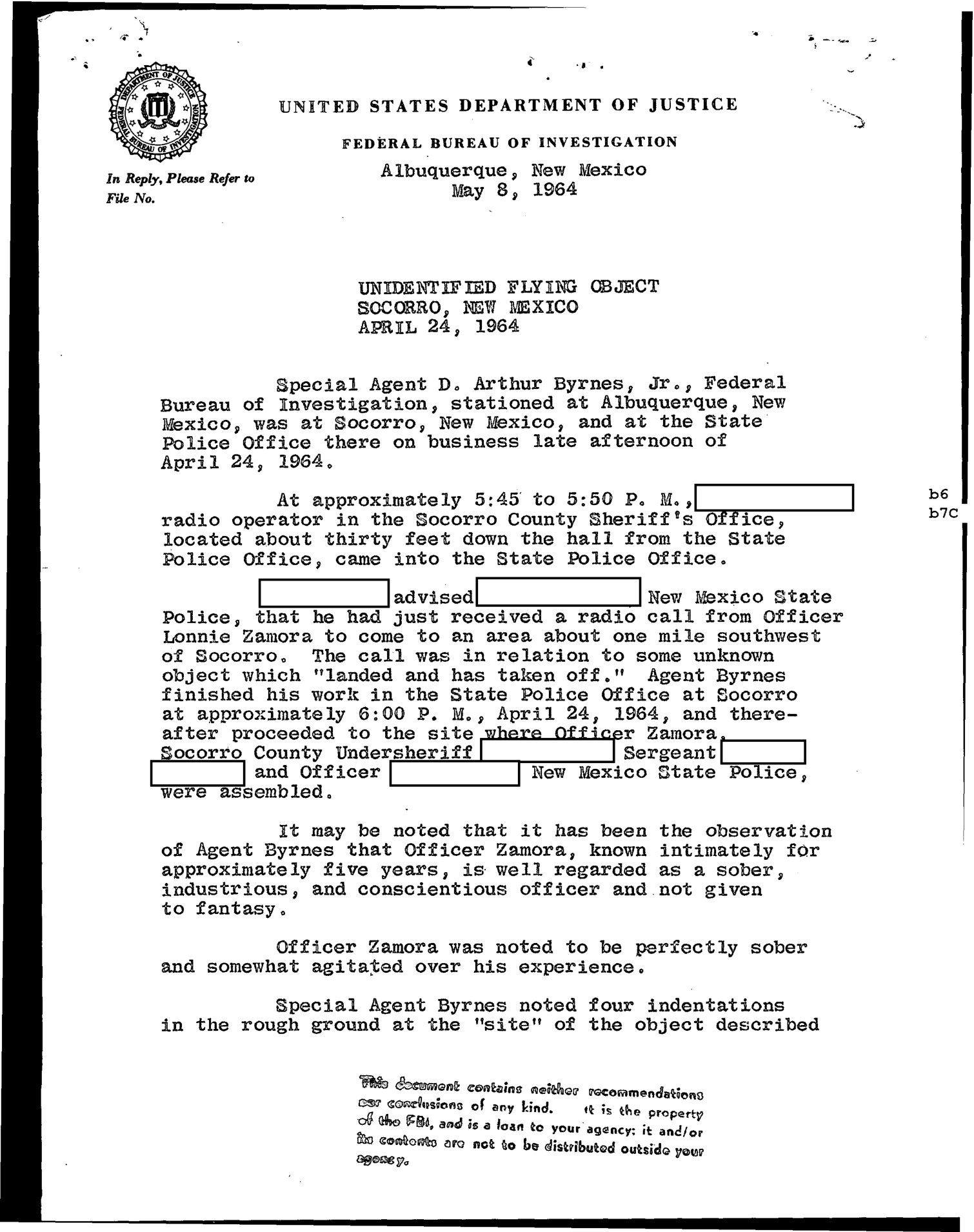
    The contemporary FBI records, preserved in this released document collection, make that distinction possible. They contain early communications, Zamora’s account and a May 8, 1964 memorandum describing Special Agent D. Arthur Byrnes Jr.’s own observations.

    The encounter in the early report

    An Albuquerque teletype recorded Zamora’s report of a flame southwest of town at about 5:50 p.m. He initially wondered whether a dynamite shack had exploded. Approaching the area, he described a whitish object that first looked like an overturned automobile, with two people apparently wearing white coveralls nearby.

    According to that account, the object rose with a roar and bluish-orange flame, then departed after the noise and flame stopped. Zamora described an oval shape and a red insignia. These are reported perceptions, not details independently established by a photograph or a second close observer.

    The same early teletype expressly stated that no other witnesses were then known to the noise, flame or object. That contemporary limitation is important even when later discussions introduce additional claims.

    What Byrnes observed

    Byrnes was already in Socorro on other business. His May 8 account places the radio report at approximately 5:45–5:50 p.m.; he went to the site after finishing his work around 6 p.m.

    He described four ground depressions, approximately rectangular, roughly sixteen by six inches and about two inches deep. He also recorded burned clumps of grass inside their arrangement and another burned area outside it. Those observations provide documentation of conditions at the site, independently of Zamora’s description of the departing object.

    They do not, by themselves, establish what made the marks. Calling them confirmed spacecraft landing traces would add a causal conclusion that the agent’s observations cannot supply.

    A credible witness is one part of the evidence

    Byrnes described Zamora as sober and conscientious, based on years of acquaintance. Such assessments help explain why officials took the report seriously. They cannot turn every detail of a startling, brief encounter into a measurement.

    The FBI correspondence also clarifies institutional roles: the Bureau’s stated policy was to ensure the Air Force knew of the report, while maintaining liaison rather than undertaking its own full UFO investigation.

    Socorro remains compelling because testimony and documented ground conditions can be examined together. A careful reading preserves both, without treating unexplained marks as proof of an extraterrestrial visitor or dismissing the entire record because its central event lacked independent close-range confirmation.

    Archive note: the linked file contains 1964 records released in a later FOIA package. This article reviews historical evidence, not a new sighting.

    Featured image: First page of the FBI memorandum dated May 8, 1964, recording Special Agent D. Arthur Byrnes Jr.’s observations after the Socorro report. This is an archival document, not a photograph of the reported object. Credit: FBI; public domain; scan via The Black Vault. Original document collection.

  • Washington’s 1952 Radar Mystery: What the CAA Actually Tested

    Washington’s 1952 Radar Mystery: What the CAA Actually Tested

    The radar mystery that gripped Washington in the summer of 1952 left behind more than newspaper headlines. It also prompted a technical investigation into a practical problem: what should air traffic controllers make of moving returns that did not behave like familiar aircraft?

    A useful starting point is the Civil Aeronautics Administration’s Technical Development Report 180, written by Richard C. Borden and Tirey K. Vickers and issued in May 1953. Reading its methods alongside its conclusions reveals both the strength of the atmospheric explanation and the limits of applying it to the entire Washington episode.

    What the investigators measured

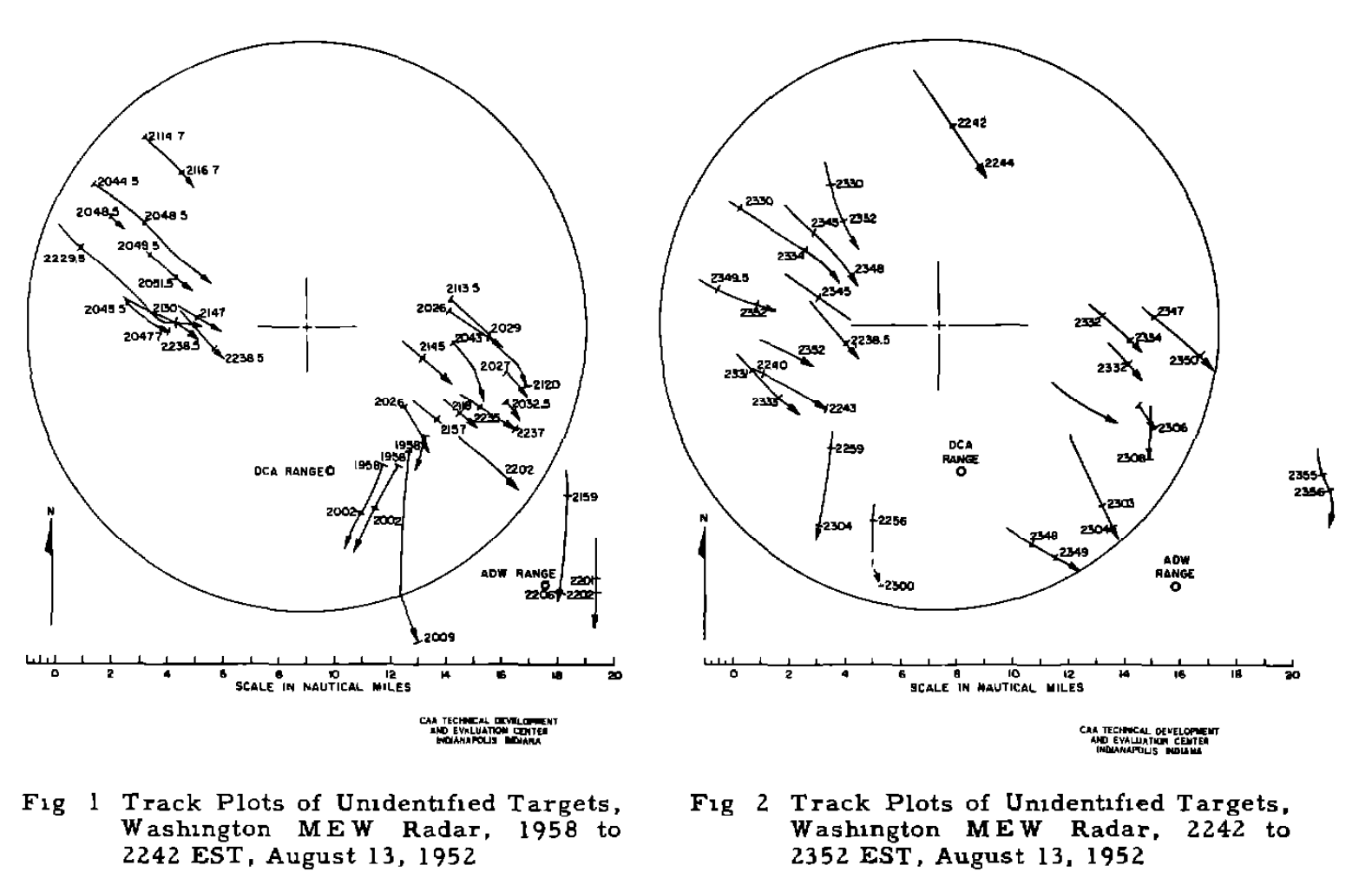
    The researchers combined controller interviews, official records, weather information and their own observations of Washington and Indianapolis radar equipment. Their Washington field session began on August 13, 1952, and continued into August 14. Additional tracks were recorded on August 15–16.

    Those dates matter. The figures reproduced here document August observations, not a recovered recording of every much-publicized July encounter. The study investigated a recurring class of radar targets rather than reconstructing each reported sighting individually.

    During the first session, investigators plotted returns on the radar display and transferred the tracks and times to acetate. The average continuously tracked distance was approximately 2.1 nautical miles. Many returns were weak and fuzzy, with their intensity changing between sweeps. Switching between high and low radar beams could make targets disappear and return.

    An atmospheric explanation, with qualifications

    Comparing reports with Weather Bureau records, the authors found temperature inversions associated with almost every logged occurrence. Their analysis of 80 targets suggested that many were secondary reflections: radar energy redirected by moving regions of refracting air, producing apparent targets from ground returns.

    The report did not claim to have measured every property of those regions. Their precise size, shape and composition remained unknown; atmospheric eddies and a lens-like focusing effect were proposed explanations. That distinction between observation and interpretation should survive any modern retelling.

    Why the report still matters

    The operational concern was straightforward. Spurious returns could complicate busy air traffic control, particularly when small helicopters could produce similarly weak, slow-moving signatures. Investigators needed to understand the display before deciding what occupied the sky.

    For readers weighing the Washington mystery today, the report supplies a concrete atmospheric mechanism and documented tests. It does not justify treating every radar blip as an extraordinary vehicle, or claiming that one study individually resolved every July report. The strongest historical conclusion is narrower: investigators reproduced and studied a relevant radar phenomenon, then explained how it could mislead observers.

    Archive note: the U.S. Department of Transportation repository identifies the report as public domain. This is a historical case review, not a newly released finding.

    Featured image: Washington MEW radar track plots from August 13, 1952, reproduced in CAA Technical Development Report 180 (May 1953), figures 1–2. These are August study observations, not recordings of the July incidents. Credit: Civil Aeronautics Administration; public domain. Original report.

  • Rubin Finds Its First Dwarf-Planet Candidate, 2026 ED138

    Rubin Finds Its First Dwarf-Planet Candidate, 2026 ED138

    A large object hidden against a crowded stellar background has become Vera C. Rubin Observatory’s first dwarf-planet candidate. Announced on October 27, 2026, the discovery carries the provisional designation 2026 ED138. It is a promising new world to investigate, not a confirmed addition to the officially recognized dwarf planets.

    According to Rubin’s announcement, Matthew Holman identified the object on October 13 while processing earlier observations with software developed with Kevin Napier. Its brightness at such a great distance immediately made it interesting. ED138 is currently about 46 times farther from the Sun than Earth is.

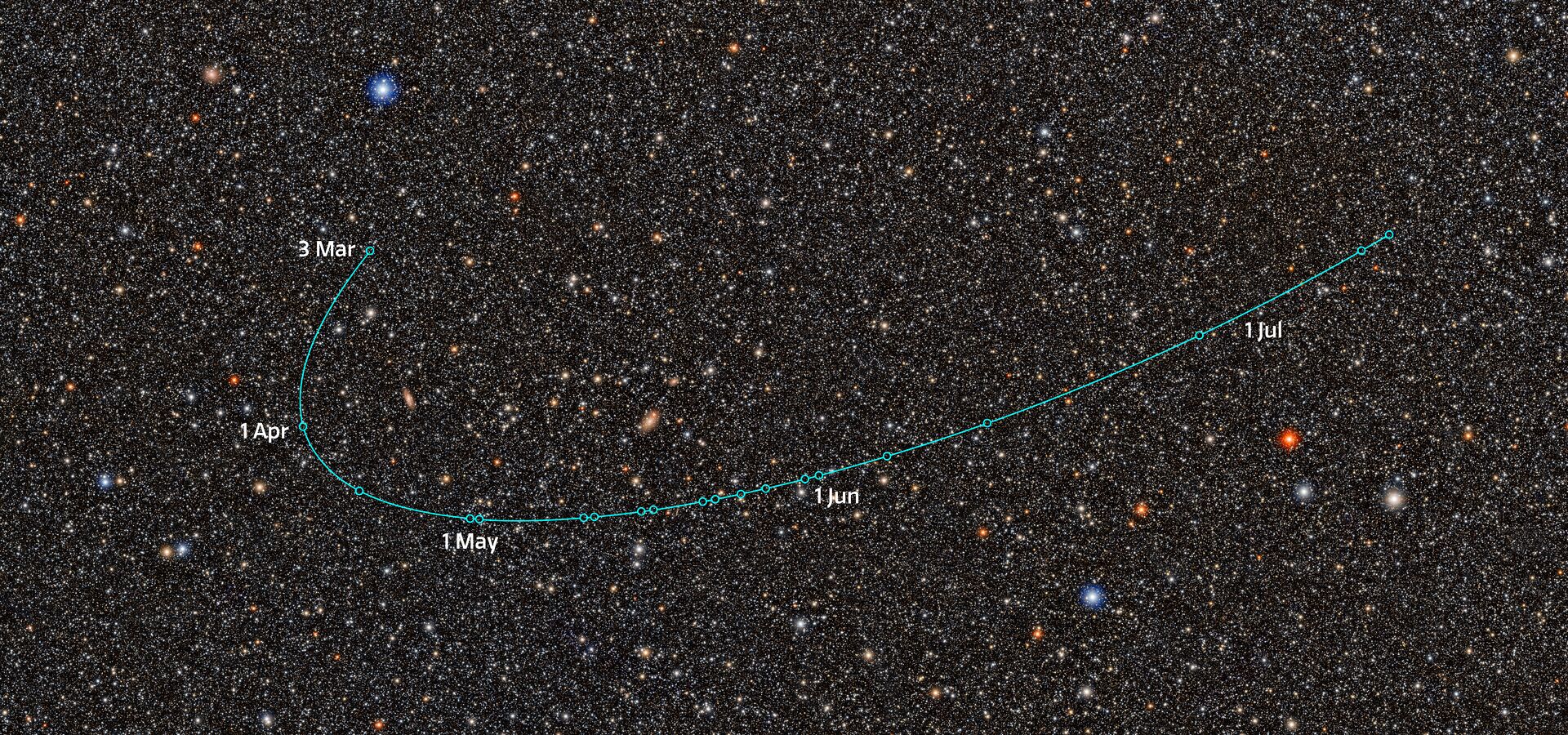
    Rubin recorded it 30 times across 20 nights between March 4 and July 11. Archival Dark Energy Camera images extended the observational history back to 2016, helping establish its orbit. The crowded field near the Milky Way helps explain why an otherwise conspicuous distant object escaped earlier searches. Rubin’s repeated observations and moving-object analysis brought it into view.

    How large is it?

    The answer depends on an important unknown: how efficiently its surface reflects sunlight. In a technical account of the discovery, Rubin Solar System Lead Scientist Mario Jurić gives a diameter range of roughly 610 to 1,530 kilometers for the assumed range of reflectivities. An intermediate assumption produces a diameter near 970 kilometers. These are estimates, not a direct measurement of the object’s dimensions.

    Jurić reports that only nine known trans-Neptunian objects are intrinsically brighter. He also describes a tilted orbit, inclined by about 24.4 degrees, and a possible relationship with Neptune’s 12:7 orbital resonance. That relationship remains unresolved: roughly half of the modeled orbits compatible with the observations show the relevant resonant behavior. Its color is also redder than objects belonging to the Haumea family, arguing against membership in that group.

    A candidate, not a verdict

    A measurement of reflectivity or a stellar occultation would help narrow the size estimate, Jurić notes. The object is bright enough for ground-based spectroscopy and studies of brightness changes as it rotates. For now, the strongest conclusion is also the most useful one: Rubin has supplied an unusually promising target, with follow-up observations needed before its physical character is settled.

    Featured image: Rubin observations trace 2026 ED138 across a dense star field. Credit: NSF–DOE Vera C. Rubin Observatory/NOIRLab/SLAC/AURA. Image processing: M. Jurić (UW), D. de Martin & M. Zamani (NSF NOIRLab). CC BY 4.0. Image source; license.