DARK FIRESORIGINS UNKNOWN

Author: Dark Fires

  • TRACERS Finds Spatial Variation Dominates Its First Cusp Survey

    TRACERS Finds Spatial Variation Dominates Its First Cusp Survey

    NASA’s twin TRACERS satellites have delivered an early answer to a deceptively difficult question: when the magnetic connection between the Sun and Earth changes, is the spacecraft crossing a spatial pattern, or observing a process change with time? The initial results favor spatial variability, while also finding temporal changes within many events.

    NASA highlighted the findings on October 29, 2026. The distinction matters because one spacecraft alone can have trouble separating movement through an environment from changes in that environment. A second satellite following behind supplies a comparison rather than just another isolated measurement. NASA’s results announcement describes the work as an initial step, not a completed account of space weather.

    A natural particle funnel

    TRACERS launched on July 23, 2025, to investigate magnetic reconnection: the rearrangement of magnetic fields that transfers energy and accelerates charged particles. Earth’s magnetic environment does not form an impenetrable shell. Near the poles, funnel-shaped regions called cusps allow researchers to sample particles connected to processes occurring much farther away at the magnetopause.

    The mission uses two spacecraft in low Earth orbit to examine these particle signatures in succession. Its observations complement NASA’s Magnetospheric Multiscale mission, which studies reconnection farther out in space. These are different vantage points on a connected system, rather than competing pictures of the same location. NASA’s mission overview explains how the paired measurements help distinguish evolving structures from repeated encounters with similar ones.

    What the first sample says

    The research paper analyzes 207 tandem cusp encounters collected from November 2025 through February 2026. Encounters classified as spatially dominated outnumbered temporally dominated encounters by at least two to one across the solar-wind categories examined. However, nearly all encounters assigned to the spatial category also contained some temporal variability.

    That qualification prevents a misleading either-or reading. “Spatially dominated” does not mean completely unchanging: similar structures can persist at similar locations while some features appear or disappear between passes. The value of the paired satellites is their ability to constrain which contribution is larger in the sampled encounters.

    Why more passes matter

    The researchers emphasize that the available sample is smaller than originally planned. Operational constraints reduced the number of usable tandem encounters, and additional measurements are needed to establish how robust the early pattern remains. The result therefore should not be presented as a universal rule for every reconnection event.

    NASA reports that the spacecraft now routinely observe the southern cusp and that a September mission extension supports observations into spring 2027. More data will test whether the first pattern persists across a broader range of conditions. For now, the achievement is methodological as well as physical: two moving observers are beginning to disentangle where a magnetic process happens from how rapidly it changes.

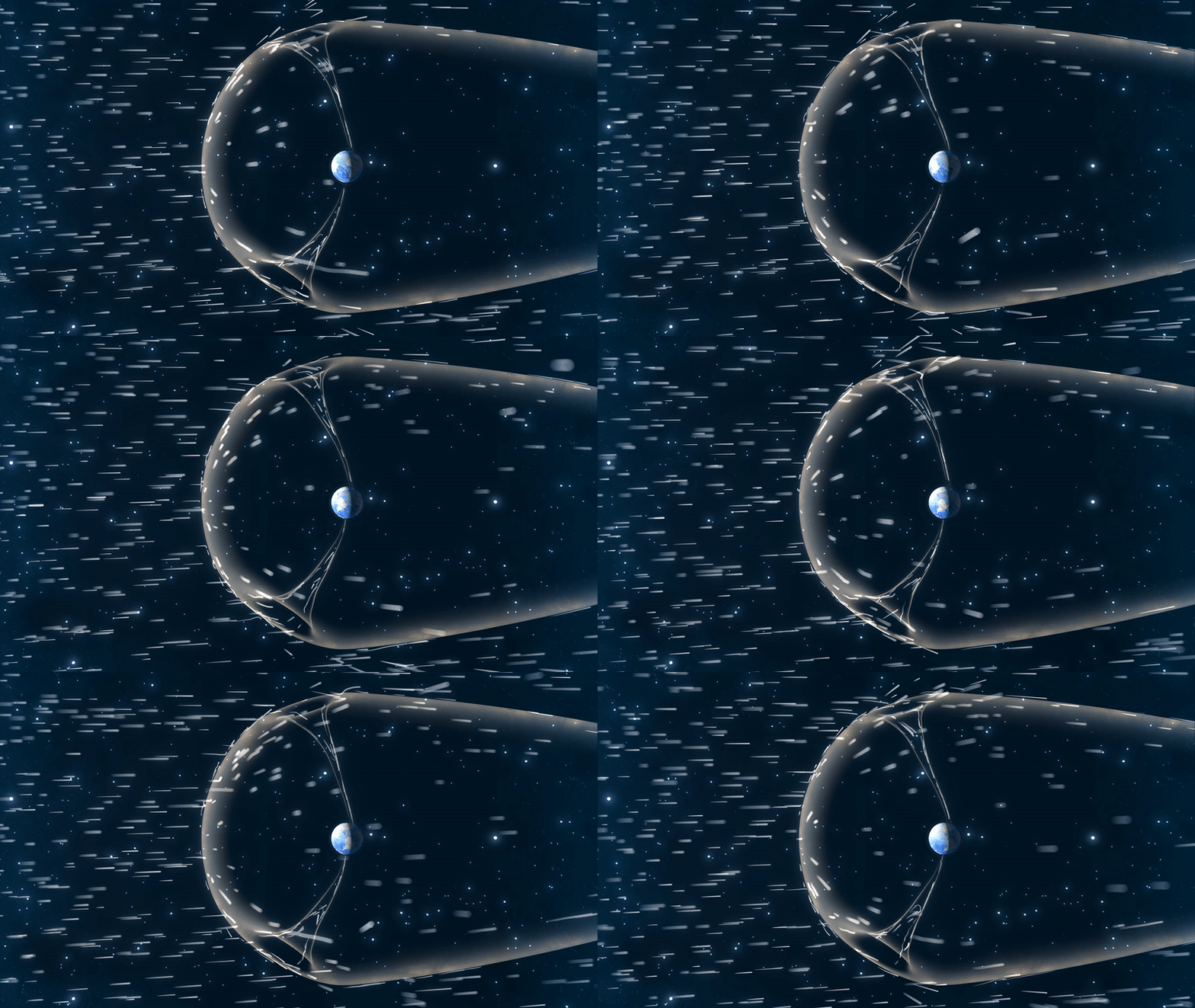
    Featured image: Illustration of solar wind interacting with Earth’s magnetic environment; not a photograph of visible magnetic field lines. Credit: NASA/CILab/Josh Masters.
  • Fort Monmouth 1951: A Radar Mystery That Changed the UFO Investigation

    Fort Monmouth 1951: A Radar Mystery That Changed the UFO Investigation

    The Fort Monmouth UFO reports mattered even beyond the question of what produced the radar returns. In September 1951, they drew senior attention to how the Air Force handled unusual sightings and helped revive its investigation. That institutional consequence should be distinguished from a finding that an extraordinary aircraft had been tracked.

    Two days, different technical questions

    The University of Colorado’s historical review reproduces passages from a December 28, 1951, report. On September 10, an operator demonstrating radar equipment reported a target he could not follow using aided tracking. He inferred exceptional speed from that difficulty. Investigators instead used his reported tracking interval and ground track to calculate roughly 400 mph. The original passage acknowledged that accurate data were insufficient for a definite conclusion. Read the reproduced Project Grudge account.

    A September 11 report involved another radar and apparently unusual changes in elevation. The investigation favored anomalous propagation for that episode, while describing the previous day’s weather as unfavorable for that explanation. The same history says the reports attracted Air Force intelligence director Charles Cabell’s attention and preceded an expanded Project Grudge under Edward Ruppelt. The project became Blue Book in March 1952. The chronology keeps the separate events in context.

    An Army history published September 24, 2019, also describes a nearby T-33 crew’s visual report and the investigation’s balloon explanation. That retrospective is useful institutional context, but its compressed account should not replace the qualifications preserved in the earlier investigative text. Read the Army historian’s account.

    Tracking difficulty is not a speedometer

    The central technical distinction is straightforward. An instrument’s failure to follow a target does not independently measure the target’s velocity. The observation could involve the target, the equipment, the operator or some combination. Investigators need the actual geometry and timing before deciding which explanation fits.

    Radar information can be powerful precisely because range and angle can constrain a reconstruction. But those measurements still require provenance: which radar, which mode, which operator, what times, and what was retained? A later summary that combines separate detections into one continuous pursuit may erase the very details needed to test the story.

    The visual report needs its own treatment too. To show that a pilot and a radar operator observed the same object, investigators must connect their times, locations and directions. Proximity alone does not provide that connection. Multiple reports can be mutually relevant without automatically becoming independent confirmation of one physical target.

    A lasting consequence without a settled extraordinary object

    Fort Monmouth illustrates how uncertainty can produce a significant administrative response. Officials may reasonably demand better collection and analysis because a report is poorly understood. That decision says something important about the reporting system, but it cannot substitute for identification evidence. The case’s enduring value is the opportunity to examine both tracks: what the instruments and witnesses reported, and what the government changed in response.

    Featured image: Generated illustration. Original Dark Fires explanatory artwork, not an actual radar display or official record.

  • Great Falls 1950: Why the Date Matters to the UFO Film

    Great Falls 1950: Why the Date Matters to the UFO Film

    A famous UFO film can appear to offer unusually firm evidence: a place, a date and moving images that anyone can examine. The Great Falls case shows how one uncertain item in that list can affect the rest of an investigation. Before deciding what crossed the Montana sky, researchers had to ask whether they were looking at the right day.

    An unsettled calendar entry

    The film, made by the manager of the Great Falls baseball team in August 1950, shows two bright images. The University of Colorado’s case study lists August 15 but immediately qualifies the date. It cites a January 9, 1953, Air Force letter recording the witness’s uncertainty between August 5 and August 15. Newspaper research also found no home game scheduled for August 15, despite the account linking the stadium visit to preparations for a game. Read the original Colorado case analysis.

    Investigator William Hartmann left the case unexplained, finding difficulties with familiar explanations while not entirely excluding aircraft. He also distinguished what the surviving film shows from claims about missing opening frames. The filmed lights progress steadily; descriptions of hovering or more detailed structures cannot simply be read back into the available sequence. The background and analysis sections set out those distinctions.

    Why ten days can change a hypothesis

    A date is part of an observation’s calibration. Weather records, flight movements and the position of the Sun all belong to a particular time. If the date changes, a proposed match must be checked again. A conclusion based on the wind blowing against a photographed object, for example, depends on having selected the appropriate weather observations.

    That principle applies equally to explanations that favor ordinary aircraft and arguments that exclude them. A precise match to a flight on the wrong date is not a match. A confident rejection based on the wrong day’s conditions is no stronger. Uncertainty should travel through the analysis rather than disappearing after the introductory paragraph.

    There is a practical way to handle this: build separate reconstructions for each plausible date, record which evidence supports each one, and identify conclusions that survive both. Results that depend entirely on one calendar choice should remain conditional. This approach can narrow a problem without pretending to solve information gaps that the surviving material cannot resolve.

    Keep the surviving evidence separate

    Claims about missing footage create a related boundary. If an image is unavailable, an investigator can document testimony about it and look for records of its handling. The claimed detail cannot be measured as if the frame were still present. Nor does a dispute over custody automatically determine what the surviving images represent.

    Great Falls remains useful precisely because a serious investigation could acknowledge a real film, examine conventional explanations and still leave its subject unidentified. The responsible conclusion is bounded by the record: an unresolved image sequence, with timing and interpretation questions that matter. “Unexplained” describes that state of knowledge. It does not supply the missing distance, construction details or origin of the objects.

    Featured image: Generated illustration. Original Dark Fires explanatory artwork, not an original film frame or sighting reconstruction.

  • Tremonton 1952: The Assumed Distance Behind a Famous UFO Speed

    Tremonton 1952: The Assumed Distance Behind a Famous UFO Speed

    The Tremonton UFO film offers a useful lesson in how a precise-looking number can inherit a very uncertain assumption. Motion across a strip of film can be measured. Turning that movement into miles per hour requires knowing how far away the subject was. Those are different kinds of information, and the distinction sits at the center of the Utah case.

    What the early account said

    On July 2, 1952, a family travelling near Tremonton observed a group of bright objects, and the father filmed them. In his August 11 account to the Air Force, reproduced in the University of Colorado investigation, he explicitly said he could not estimate their distance, altitude, size or speed. The film recorded small, unresolved images rather than detailed vehicle structures. William Hartmann’s Case 49 preserves the account and analysis.

    The same review examined a Navy analysis that calculated motion using an assumed distance of five miles. A frequently discussed figure of 3,780 mph referred to a hypothetical image displacement; the measured average displacement yielded about 653.5 mph at that assumed distance. Hartmann considered the film consistent with birds and reported observations of birds in the area supporting that interpretation. His conclusion did not establish extraordinary aircraft. See the investigation and angular-motion sections.

    How an assumption becomes a headline

    Imagine filming two objects crossing the same angle in the same time: one nearby, the other ten times farther away. If both move sideways relative to the camera, the farther object must travel ten times the physical distance. Its inferred speed is therefore ten times greater. The film can look similar in both cases.

    This is why a calculation should retain its condition every time it is repeated. “At five miles, the inferred speed would be…” conveys a model. Removing the opening words makes the same number sound like an instrument reading. Additional decimal places cannot repair an unmeasured distance.

    Camera movement introduces another question. A handheld camera can follow an object, remain approximately fixed, or shift between those behaviors. Before measuring a subject’s angular motion, an analyst needs to establish how much motion came from the camera itself. Background landmarks can help, but a sequence dominated by empty sky provides fewer reference points.

    What a film can settle

    A recording can support the claim that something appeared in the scene while leaving its identity unresolved. It can also preserve details that challenge a witness’s later interpretation. Neither function diminishes its value. The point is to ask the film questions that its resolution and geometry can actually answer.

    For readers revisiting Tremonton, the most productive comparison is between the early statement, the film measurements and the assumptions used to translate those measurements into a physical trajectory. A persuasive identification must explain the visible behavior. A persuasive extraordinary-speed claim must additionally establish scale. Confusing those tasks makes a historical mystery sound more technically settled than its evidence allows.

    Featured image: Generated illustration. Original Dark Fires explanatory artwork, not an original film frame or sighting reconstruction.

  • Levelland 1957: What the Engine-Stalling Reports Actually Establish

    Levelland 1957: What the Engine-Stalling Reports Actually Establish

    On the night of November 2–3, 1957, reports of unusual lights around Levelland, Texas, acquired a particularly compelling feature: motorists said their vehicles had stopped working during the encounters. A light in the sky can be difficult to interpret. An engine failure seems to offer something more tangible. The surviving record shows why the connection still needs careful examination.

    The proposed explanation and its missing pieces

    An Air Force case summary described several reports of vehicle stoppages and favored ball lightning for the November 2 sightings. It proposed moisture on distributor components as a possible explanation for the engine trouble, and said one failure had been attributed to a faulty distributor. These were the service’s conclusions, not measurements of an electromagnetic field around an unidentified object. The summary also separated a November 4 observation, which it attributed to a weather balloon and its safety light. Read the Air Force case-summary collection.

    The larger file is more revealing than a verdict alone. A request for scientific review asks colleagues to examine unresolved elements of the proposed explanation, including electrical effects and whether airborne oil vapor could produce a flash. Another note, dated February 19, 1958, says investigators had been unable to locate the truck driver described as the case’s prime source. It says he lived outside Levelland and could not be contacted through the county sheriff. The original Blue Book file preserves both documents.

    Why the sequence matters

    These distinctions change the question a reader should ask. The strongest version of the claim would require independently established vehicle failures, reliable timing, and a physical mechanism connecting them to the observed lights. A witness’s report that two events occurred together is valuable evidence about an experience. It does not, by itself, establish what caused either event.

    Consider the information a modern investigation would want: the condition of each vehicle before and after the encounter, whether its headlights failed along with its engine, whether repairs were required, and exactly how the vehicle restarted. Different answers could point toward different mechanisms. Grouping every description under “electrical interference” too early would conceal those differences.

    There is a similar danger in treating a proposed natural explanation as a completed laboratory demonstration. A physical process can be possible without having been shown to account for the timing, location and details of a particular report. Conversely, a weakness in the official explanation does not independently establish a technological cause.

    A case worth keeping specific

    Levelland is best approached as a collection of reports to be compared, rather than a single perfectly documented event. The archive invites two parallel checks: how well each witness account was established, and how well each proposed explanation fits that particular account. Keeping those tests separate preserves the genuinely interesting part of the case without turning either an official classification or a disputed interpretation into proof.

    Featured image: Generated illustration. Original Dark Fires explanatory artwork, not an official document or sighting reconstruction.

  • What a UFO Hotspot Map Measures Before It Measures Mystery

    What a UFO Hotspot Map Measures Before It Measures Mystery

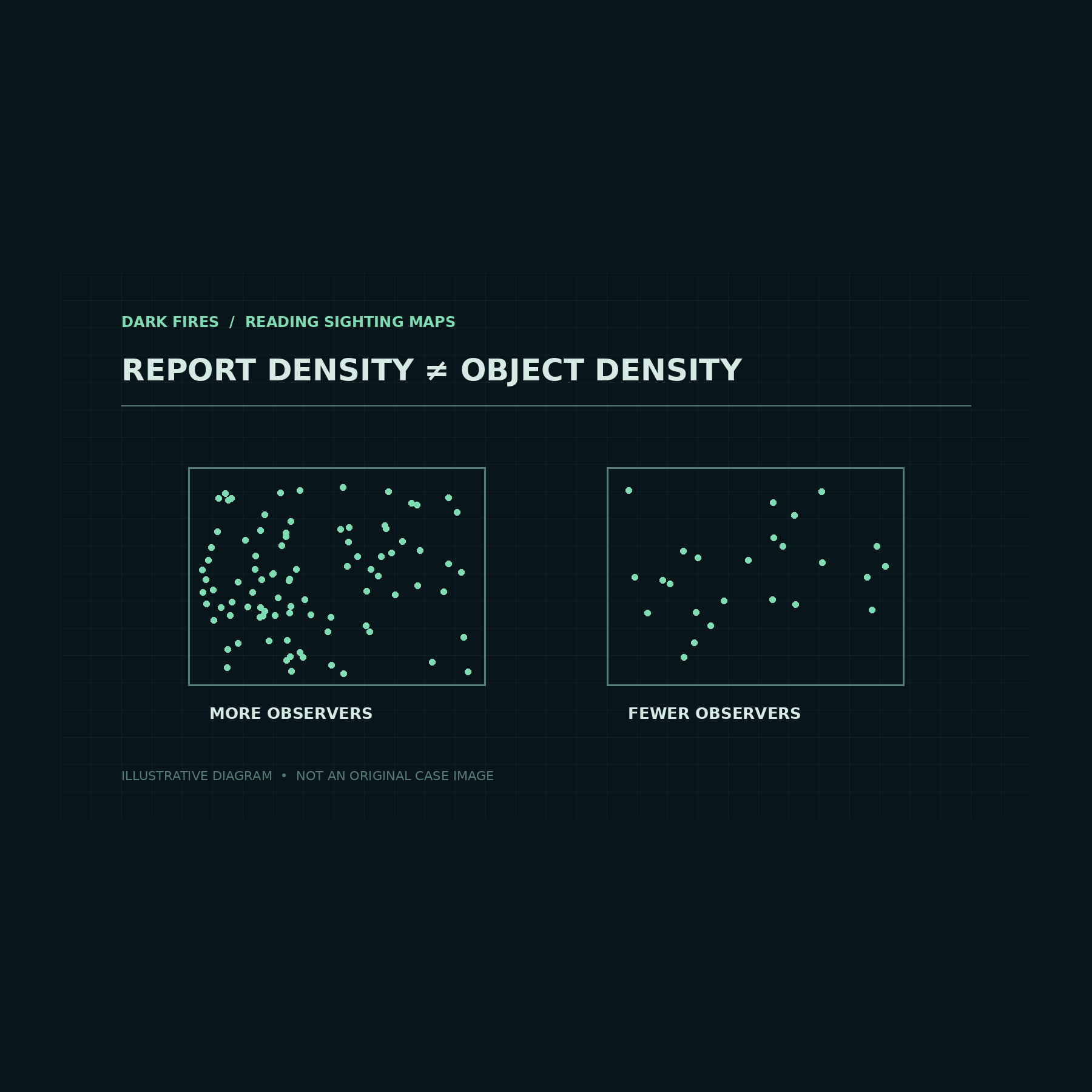
    A map covered in UFO reports can make some places look unusually active. But the dots mark reports made by people under particular conditions. Before treating a concentration as evidence about unfamiliar objects, an analyst needs to ask who could see the sky, what was visible there, and how reports entered the database.

    A geographical test of opportunity

    A study published in Scientific Reports on December 14, 2023 examined more than 98,000 public UAP reports from the contiguous United States over 2001–2020. Richard Medina, Simon Brewer and Sean Kirkpatrick compared county-level reporting with variables describing sky visibility and airborne activity.

    Their model found a clear positive association with air traffic and a negative one with light pollution. Other results were less decisive: cloud cover did not show a credible relationship, while tree canopy and military-area measures carried greater uncertainty. The study supports investigating observing conditions; it does not justify saying that every environmental variable explained the pattern equally well.

    Most importantly, an association across counties cannot identify the object in one report. A relationship with air traffic makes aircraft-related explanations worth examining. It does not establish that a particular witness saw an aircraft, still less which flight it was.

    The denominator changes the question

    Consider a hypothetical comparison, not a result from that study. Town A produces 100 reports in a year and Town B produces 20. If A has ten times as many residents, B has twice as many reports per resident. Neither calculation tells us the rate per hour actually spent observing the sky.

    Suppose residents of B spend much more time outdoors after dark, or a local reporting campaign makes them more likely to submit an account. The per-resident rate would then combine differences in opportunity with differences in submission behavior. Dividing by population solves one comparison problem while leaving others open.

    The same issue applies to a changing total over time. A new reporting website could collect more accounts without any increase in the underlying number of unusual observations. Conversely, a genuine increase in airborne activity could coexist with declining reports if fewer people knew where to send them. These are alternative possibilities an analysis should test, rather than facts to assume about a particular archive.

    What would strengthen a hotspot claim?

    A useful map should identify the reporting period, geographical unit, duplicate-handling rules and denominator. It should explain whether locations refer to observers or estimated object positions. Reports of one widely visible event should not automatically be treated as many independent objects.

    For an observing network, a stronger comparison would track exposure directly: usable camera-hours, monitored sky area, weather interruptions and detection thresholds. Two sites could then be compared on a more consistent basis. Human reports remain valuable for finding events and reconstructing experiences, but their collection process belongs in the analysis.

    The practical lesson is to treat a hotspot as a question generator. It can suggest where to examine air traffic, visibility, reporting practices or individual cases more closely. Establishing an unusual population of objects requires additional measurements beyond a dense patch of dots.

    Featured image: Generated illustration. Original Dark Fires explanatory diagram; dots are illustrative, not an observed dataset.

  • How to Interview a UAP Witness Without Supplying the Story

    How to Interview a UAP Witness Without Supplying the Story

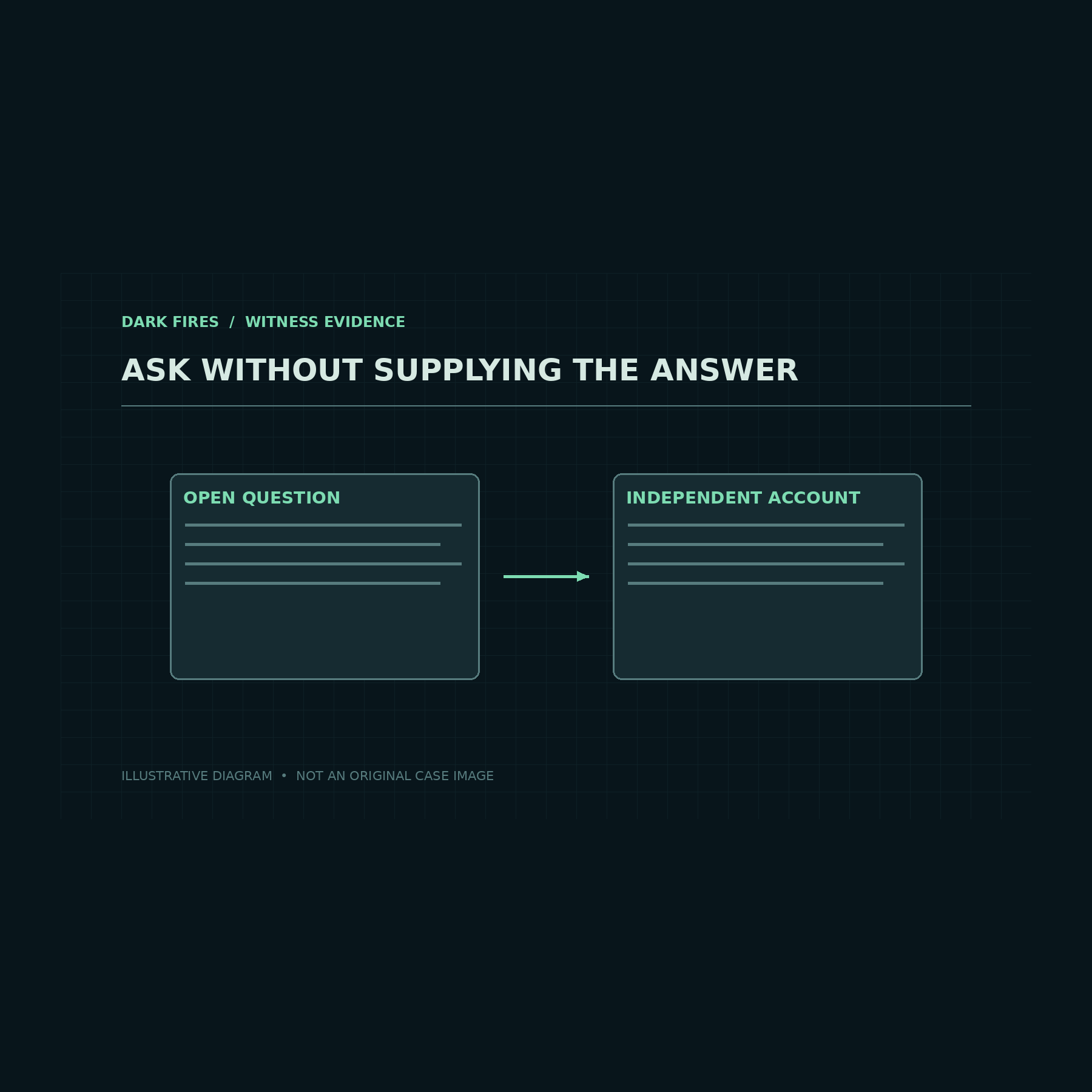
    A useful UAP interview begins before anyone decides what the witness saw. The questions themselves can influence the account. Asking someone to describe an unfamiliar light is different from asking how fast a craft accelerated, because the second formulation supplies both an object category and a behavior that may still be uncertain.

    A classic experiment with a narrow lesson

    In their 1974 paper on automobile-accident recollection, Elizabeth Loftus and John Palmer showed participants films of crashes and varied the wording of subsequent questions. Speed estimates differed depending on the verb used. In a second experiment, participants who had received the more forceful wording were more likely, a week later, to report broken glass that the film did not contain.

    Those experiments concerned filmed traffic accidents, not UAP encounters. They cannot establish that a particular aerial witness remembered incorrectly. Their relevance is methodological: information introduced after an observation can affect what people report. Investigators should avoid creating an avoidable source of uncertainty while trying to collect evidence.

    Let the account arrive in the witness’s words

    The College of Policing’s guidance on initial accounts, published in November 2020, recommends open questions and the witness’s own wording. Its evidence summary also warns that pressing people to give more specific answers can reduce accuracy compared with letting them choose their level of precision.

    For a sky observation, an opening such as “Describe what you noticed, from the beginning” leaves room for information the interviewer did not anticipate. Follow-up questions can then clarify where the person stood, what landmarks were visible, and which details they directly observed. An admission of uncertainty belongs in the record; it should not be edited into a firm number.

    A useful distinction is between observation and interpretation. “Three lights maintained their spacing” preserves a different claim from “a triangular vehicle passed overhead.” Both statements may matter, but the account should show which was originally seen and which was inferred. A sketch can likewise preserve the witness’s arrangement of lights without requiring an interviewer to supply an outline.

    Preserve the first account and later changes

    The US National Institute of Justice’s October 1999 eyewitness-evidence guide advises avoiding leading questions, cautioning witnesses against guessing, and accurately recording their recollections. It also recommends keeping witnesses from discussing incident details with one another. These are criminal-investigation procedures, not a UAP-specific validation system, but they provide concrete safeguards worth adapting.

    In practice, keep the original notes or recording, date each follow-up, and distinguish a newly recalled detail from information learned through another witness, news coverage or a video replay. Interviewing people separately before comparing their accounts helps preserve what agreement actually means.

    Careful interviewing is respectful precisely because it does not require a witness to defend a preferred explanation. It preserves the strongest available account while leaving identification to evidence that can be checked independently. The goal is a record that remains useful even if the eventual explanation differs from everyone’s first impression.

    Featured image: Generated illustration. Original Dark Fires explanatory diagram, not sighting imagery.

  • Two Sensors, One Event? The Clock Problem in UAP Evidence

    Two Sensors, One Event? The Clock Problem in UAP Evidence

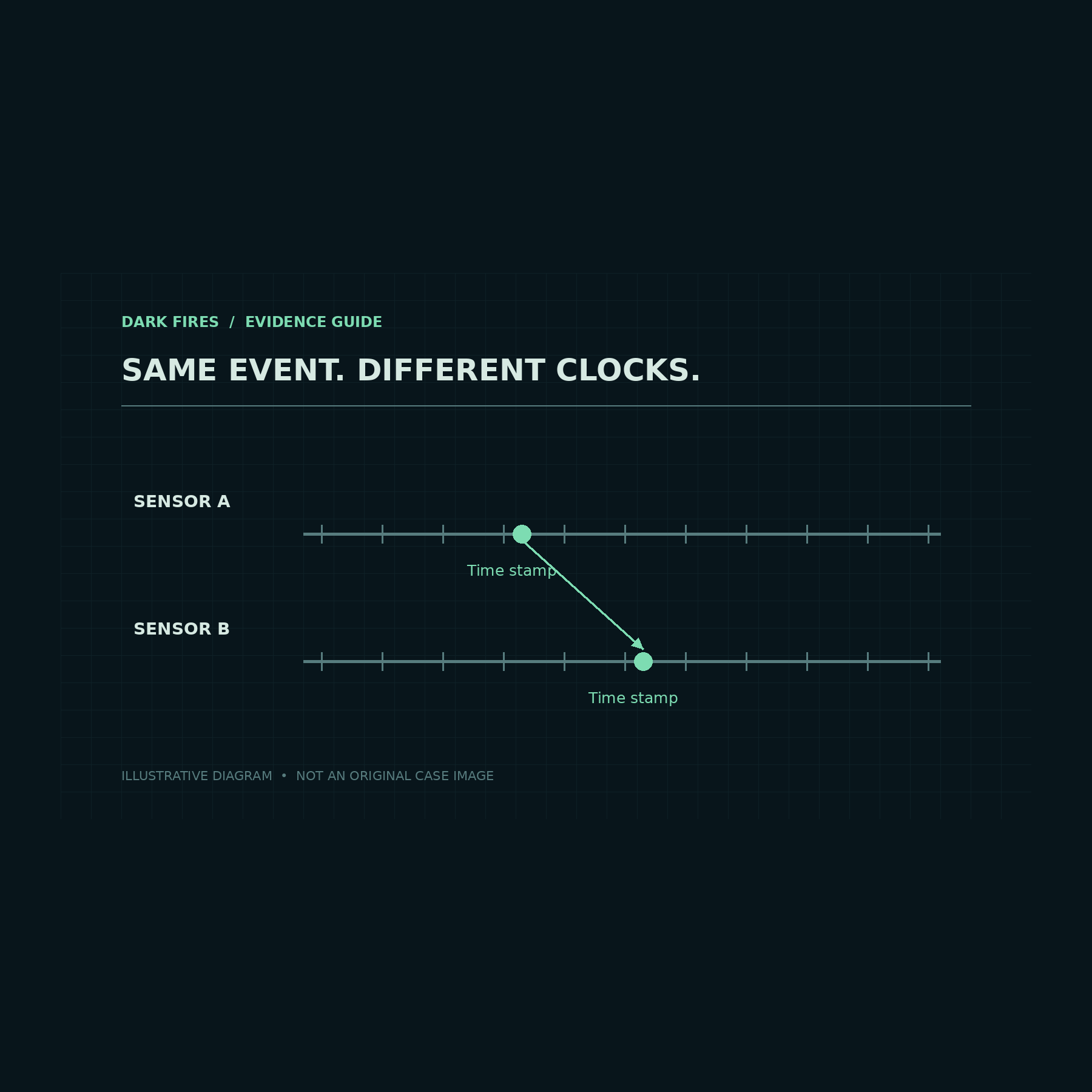
    Two instruments recording something unusual can provide stronger evidence than one. First, however, investigators must establish that their records concern the same event at the same time. A timestamp that looks precise on screen does not, by itself, establish that two sensors were synchronized.

    Three times can hide inside one record

    There is the time light reached a camera, the time its software attached a timestamp, and the time a receiving computer saved the data. Delays between those stages matter when comparing a moving target across instruments. A NIST-hosted presentation on data quality and synchronization recommends timestamps that reflect when measurements were taken, with transmission and application delays identified and accounted for.

    Applied to UAP analysis, the practical question is therefore specific: what physical or software event does this timestamp label? An upload time, file-modification time or edited video counter is not interchangeable with a documented exposure time. More decimal places cannot repair an unknown delay.

    Matching clocks does not always match exposures

    Camera researchers have demonstrated this distinction directly. In Wireless Software Synchronization of Multiple Distributed Cameras, first submitted in December 2018 and revised in June 2019, Sameer Ansari and colleagues describe a two-stage method. They synchronize device clocks, then align the timing of the image streams. Their smartphone-camera implementation achieved synchronization accuracy below 250 microseconds in their tests.

    That result is evidence for a tested engineering method, not a specification that can be assigned to unrelated UAP recordings. Its broader lesson is that a shared clock and simultaneous image capture are separate properties. An investigation needs evidence for whichever property its calculations require.

    A small timing error can become a spatial error

    Consider an illustrative target moving at a known, constant 100 meters per second. If two records are offset by one tenth of a second, they describe positions 10 meters apart. That follows simply from speed multiplied by elapsed time. It is not an estimate for any reported UAP.

    The example explains why an apparent mismatch between sensors might not indicate two objects, and why a visually neat match might be misleading if someone shifted clips until they agreed. Timing corrections should be derived from independent information or a documented method, then reported. Selecting the shift that makes a preferred explanation look best reverses that order.

    The 2017 Cyber-Physical Systems Timing Annex, published by NIST for its public working group, treats clock error, synchronization and latency as distinct engineering concerns. For a UAP observing network, that suggests keeping synchronization logs and uncertainty estimates alongside the images rather than treating timing as administrative metadata.

    A defensible comparison should say how the clocks were checked, what each timestamp represents, whether dropped frames or processing delays were investigated, and how large the remaining offset could be. Independent sensors become most valuable when those uncertainties are explicit. Without that work, “recorded by two systems” may be a promising lead rather than a completed correlation.

    Featured image: Generated illustration. Original Dark Fires explanatory diagram, not sighting imagery.

  • Why a Bright Infrared UAP Is Not a Temperature Reading

    Why a Bright Infrared UAP Is Not a Temperature Reading

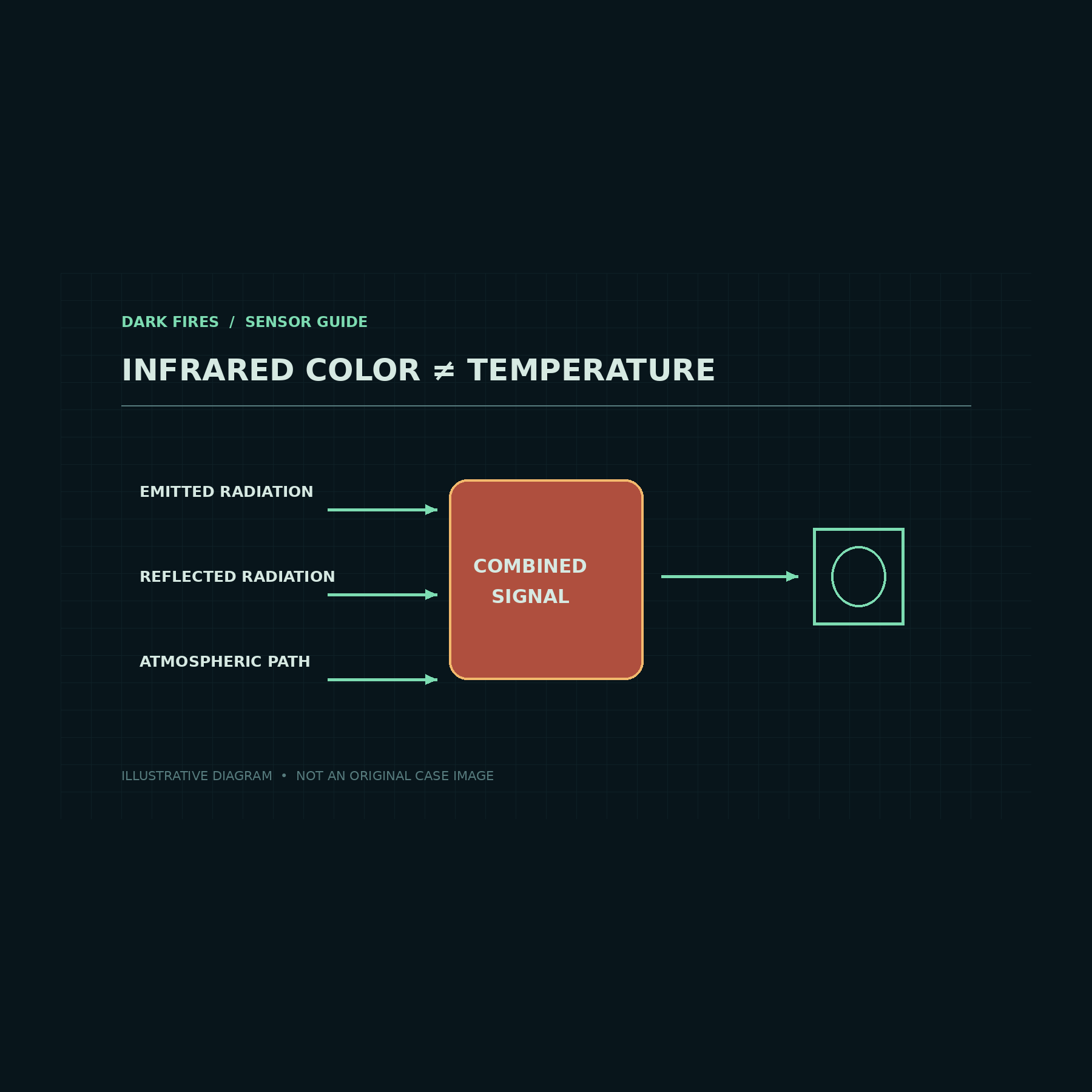
    A bright shape in infrared footage invites an apparently simple question: how hot is it? The answer depends on what the camera recorded, how the surface interacts with infrared radiation, and how the image was displayed. A video can show a real contrast without supplying enough information to turn that contrast into a reliable surface temperature.

    The camera receives more than the object’s own emission

    Emissivity describes how effectively a surface emits thermal radiation compared with an ideal emitter at the same temperature. A surface with low emissivity can contribute a substantial reflected signal from its surroundings. The temperature assigned by a radiometric camera therefore depends on assumptions about both the surface and the reflected background. FLIR’s manufacturer explanation of emissivity describes why these settings matter.

    This creates an important problem for unidentified targets: the material and surface finish may be precisely what investigators do not know. An apparent temperature calculated with an assumed emissivity is conditional on that assumption. It is not automatically a measurement of an object’s interior, engine or energy source.

    The path to the camera also matters. Radiation can be absorbed along the line of sight, and the atmosphere contributes radiation of its own. FLIR’s thermographic measurement guidance identifies object distance and atmospheric conditions among the parameters relevant to compensation. A nearby laboratory measurement with known settings and a distant target observed through an uncertain air column are different measurement situations.

    A display is another layer

    The visible black, white or colored pixels are a representation of the infrared signal. They are not the object’s visible color. Camera software can change the palette and contrast treatment; FLIR’s FC-Series installation manual, for example, documents separate controls for automatic gain and display polarity or palette. The options of one camera should not be assumed to describe an unidentified military system, but the distinction between measurement and rendering remains essential.

    Consider a deliberately simplified comparison. Two exported clips show the same target as pale gray. One export maps a narrow signal range onto the full display, while the other maps a much wider range. Matching shades would not establish matching temperatures. Conversely, a change in shade would need to be checked against display settings before being described as heating or cooling.

    What would make a thermal claim testable?

    A useful analysis should state whether the original file contains radiometric measurements or only rendered video, identify the camera and spectral band where available, and preserve the settings used during capture and export. It should explain the assumed emissivity, reflected background and atmospheric correction rather than hiding them inside a confident temperature claim.

    These requirements do not make infrared footage uninformative. Such footage can reveal contrast and motion that visible cameras miss. They define the narrower conclusion the public image can support: an object stood out in that sensor’s recorded signal. Establishing how hot it was, or what powered it, requires additional evidence.

    Featured image: Generated illustration. Original Dark Fires explanatory diagram, not sighting imagery.

  • Dark Fires Weekly: UAP Archives, Hubble Options and New ISS Power | October 25–31, 2026

    Dark Fires Weekly: UAP Archives, Hubble Options and New ISS Power | October 25–31, 2026

    Original narrated animation. Illustrative graphics—not actual sighting footage.

    This week’s Dark Fires briefing brings together two historical UFO record reviews and two current space developments. The connecting question is simple: what does the available evidence actually establish? An account preserved in an archive, a request for commercial information and a completed hardware installation each support different kinds of conclusions.

    The reporting window is October 25–31, 2026. These four selections emphasize the most useful distinctions in our coverage rather than treating every headline as equally conclusive. The Tehran and Michigan sections revisit older events covered on the site this week; they are not announcements of new sightings or newly released files. The Hubble and International Space Station items concern developments announced during the current week.

    Video note: The accompanying narrated animation uses original illustrative motion graphics, captions and background music. Its diagrams are not actual sighting footage, official document reproductions or a simulation of measured flight paths.

    Tehran: a serious report, with limits

    The encounter described in the military message preserved by the NSA occurred on September 19, 1976. The account describes Iranian F-4 crews investigating unusual lights and reporting interruptions to instruments, communications and weapons-control equipment.

    Its archival provenance makes the message worth reading. It does not make every observation an independently confirmed measurement. The three-page report contains no raw radar recording or aircraft maintenance log with which a reader could test the claimed relationship between the lights and the equipment problems.

    Our review separates the existence of the report from the cause of the encounter. That distinction leaves room for investigation without turning a remarkable account into a conclusion it cannot support alone.

    Michigan: the argument over investigation

    Gerald Ford’s March 1966 releases and correspondence show his dissatisfaction with the handling of Michigan UFO reports. After the “swamp gas” controversy, Ford urged congressional hearings and wanted testimony from government representatives and witnesses.

    The papers are direct evidence of his position and the process he sought. They do not establish that the reported lights were spacecraft. Nor does political dissatisfaction demonstrate that a particular natural explanation was wrong.

    This week’s archival review asks readers to notice who is speaking inside each document. A library preserves arguments as well as findings. Keeping those voices distinct is essential when public discussion treats an archive as a single official verdict.

    Hubble: NASA asks what industry could offer

    NASA’s October 30 announcement describes an information request issued October 29. It explores commercial capabilities for boosting Hubble’s orbit, servicing the telescope or arranging its eventual controlled re-entry or orbital disposal. Responses are due November 30 at 3 p.m. EST.

    This is an inquiry, not approval of a servicing flight. NASA is collecting information about available options before any such mission decision. The distinction matters because an attractive concept and an operational commitment have different implications for cost, schedule and risk.

    For readers following Hubble’s future, the useful next developments will be concrete decisions about scope and implementation. This week’s supported milestone is the opening of that inquiry.

    ISS: a deployed array is already producing electricity

    The station’s latest power update is further along. NASA’s October 30 report says the new roll-out solar array is generating power after Anil Menon and Joshua Kutryk installed it during the October 29 spacewalk. It is the seventh array in the augmentation campaign.

    The eighth installation remains planned for November 5. The seventh array’s deployment therefore should not be described as completion of the entire program. It is a completed and useful step within work that still has another milestone ahead.

    Across this briefing, the same reporting habit applies: keep historical accounts, future options and demonstrated results clearly labeled. The linked primary sources let readers check those boundaries for themselves.