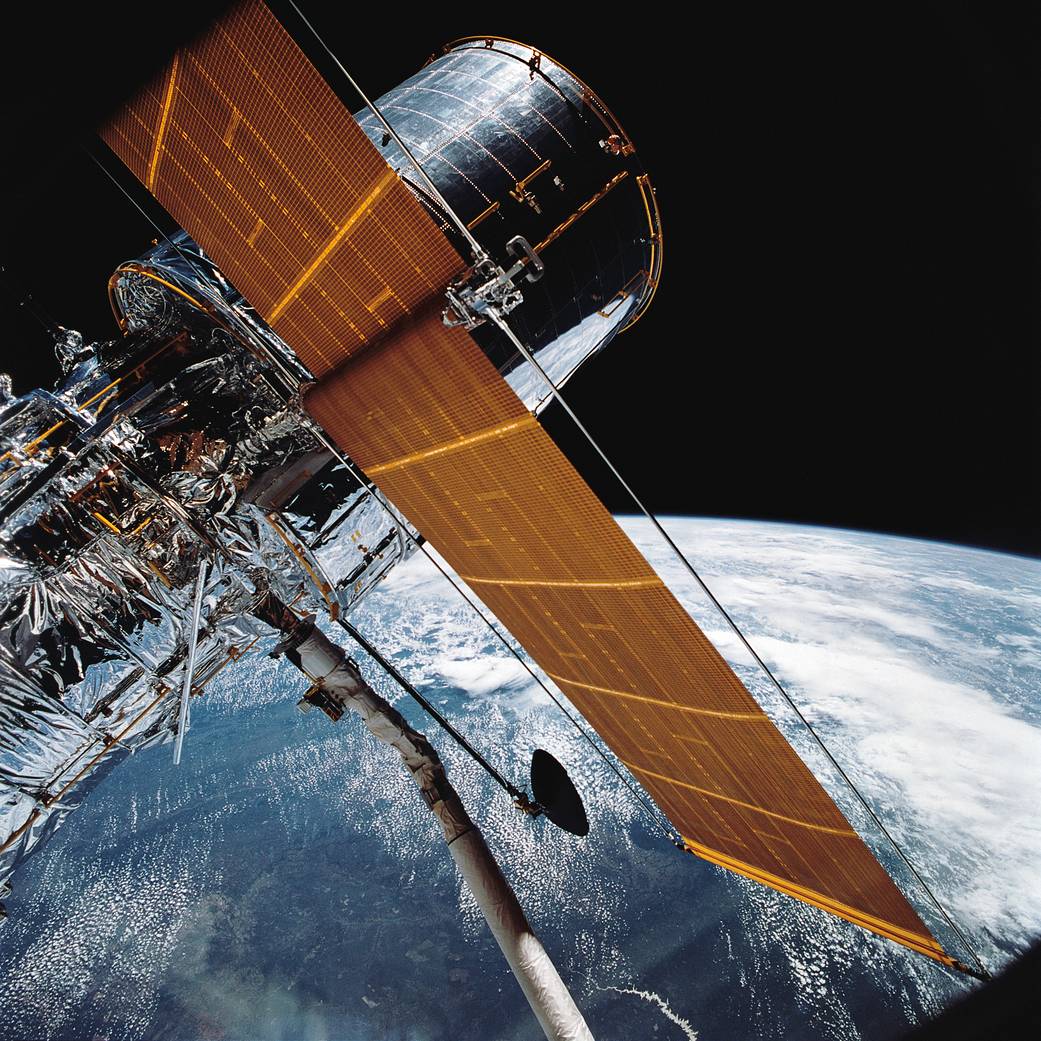
NASA is asking whether commercial spacecraft could give Hubble another lease on life. In an October 30 update, the agency announced an information request covering a possible orbital boost, servicing work and options for safely ending the telescope’s mission. It is an investigation of available capabilities, not an announcement that a rescue flight has been approved.
The request was issued on October 29, with responses due at 3 p.m. EST on November 30. NASA wants to hear from industry about raising Hubble’s orbit, improving its capabilities, or arranging controlled atmospheric re-entry or orbital disposal when its work ends.
A deadline set by atmospheric drag
Hubble cannot maintain its altitude with onboard propulsion. Atmospheric drag gradually pulls its orbit lower, and NASA’s current analysis places likely re-entry in 2033–2034. The agency therefore anticipates that an intervention would need to happen by 2032. Those dates are planning estimates rather than a scheduled shutdown. NASA describes the effort as a way to examine opportunities for extending the observatory’s science lifetime. Read NASA’s October 30 announcement.
Servicing changed Hubble before
The telescope’s history shows why maintenance in orbit can matter. During the February 1997 servicing mission, astronauts aboard Discovery exchanged two scientific instruments for the Space Telescope Imaging Spectrograph and the Near Infrared Camera and Multi-Object Spectrometer. They also improved recording hardware and repaired insulation. Discovery’s thrusters raised Hubble’s orbit by nearly six miles before the telescope resumed observations. That flight combined scientific upgrades with practical work on an aging spacecraft. NASA’s historical account documents those changes.
Another major overhaul followed in May 2009. Atlantis carried seven astronauts on the fifth and final shuttle servicing visit. Across five spacewalks, the crew installed Wide Field Camera 3 and the Cosmic Origins Spectrograph, replaced gyroscope units and batteries, and repaired existing instruments. The astronauts restored the Space Telescope Imaging Spectrograph by replacing an electronics card during the fourth spacewalk. They also renewed thermal protection and installed a refurbished Fine Guidance Sensor.
That mission included preparation for Hubble’s eventual retirement: a mechanism intended to help a future spacecraft or propulsion module capture the telescope for de-orbit was activated. Hubble was released from Atlantis on May 19, and the shuttle returned to Earth on May 24. NASA’s mission timeline records the work.
The new inquiry opens a different chapter. The question now is not whether servicing has helped Hubble before, but what today’s commercial spacecraft could realistically offer.
Featured image: Hubble during deployment from Discovery, April 25, 1990. Archival photograph, not a new servicing mission. Credit: NASA. Image source.
Leave a Reply