NASA’s Lucy spacecraft has reached the broad region occupied by Jupiter’s Trojan asteroids, opening a new phase of a mission designed to investigate leftovers from the early solar system. The milestone was announced in an October 28, 2026 mission update, five years after launch.
This is an arrival in a region of space, not a completed close encounter. NASA says Lucy’s first Trojan flyby, of Eurybates, remains scheduled for August 11, 2027. Engineers determine the spacecraft’s position from radio tracking and star images; there is no physical boundary marking entry into the swarm.
Sharing Jupiter’s orbit, not circling Jupiter
Trojan asteroids travel around the Sun in two populations associated with stable locations ahead of and behind Jupiter. Lucy is approaching the leading group near the L4 Lagrange point. These bodies are widely separated, so entering their region does not produce a crowded asteroid-field view. NASA reports that the spacecraft and its instruments continue operating as expected in the colder, dimmer environment.
Why visit several different worlds?
The mission’s value lies in comparison. NASA’s science objectives include mapping surface shapes, craters, colors and composition, investigating internal properties, and looking for satellites or rings. Differences among the Trojans may help test how material was redistributed while the giant planets formed and moved.
That is a scientific question rather than a discovery already made by this arrival. Reaching the region puts Lucy on the path to the measurements; it does not yet reveal what its target surfaces contain.
The encounters ahead
The current mission schedule pairs Eurybates with its small satellite Queta. Polymele follows in September 2027, then Leucus and Orus in 2028. The later itinerary reaches Patroclus and Menoetius in March 2033, allowing observations of the trailing Trojan population as well.
Lucy already visited the main-belt asteroid Dinkinesh and its satellite Selam in November 2023, and Donaldjohanson in April 2025. Those earlier encounters should not be confused with the still-upcoming first Trojan flyby.
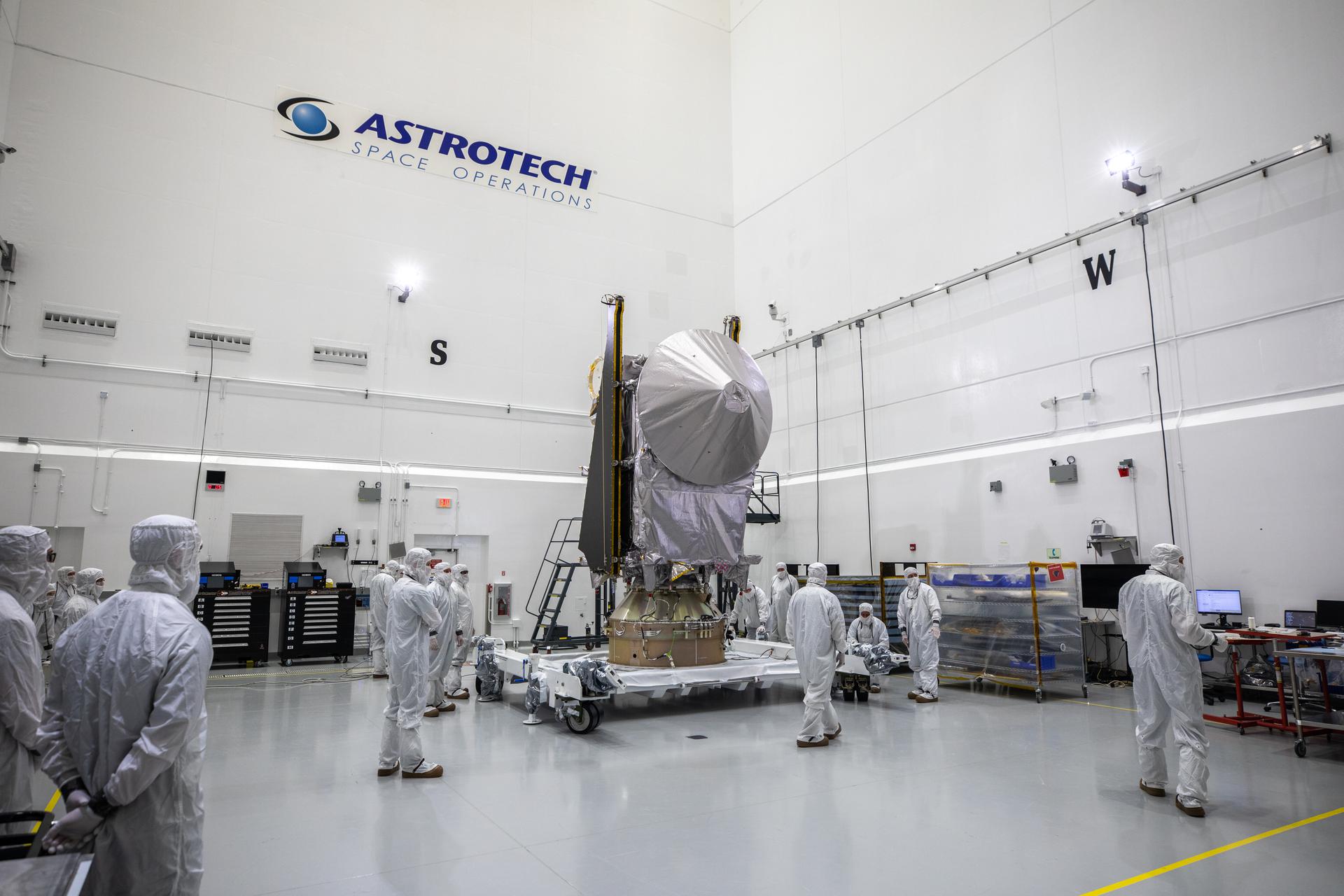
Featured image: NASA’s Lucy spacecraft during prelaunch processing in Titusville, Florida, on September 29, 2021. Archival photograph, not a view from the Trojan region. Credit: NASA/Ben Smegelsky. Image source.
Leave a Reply