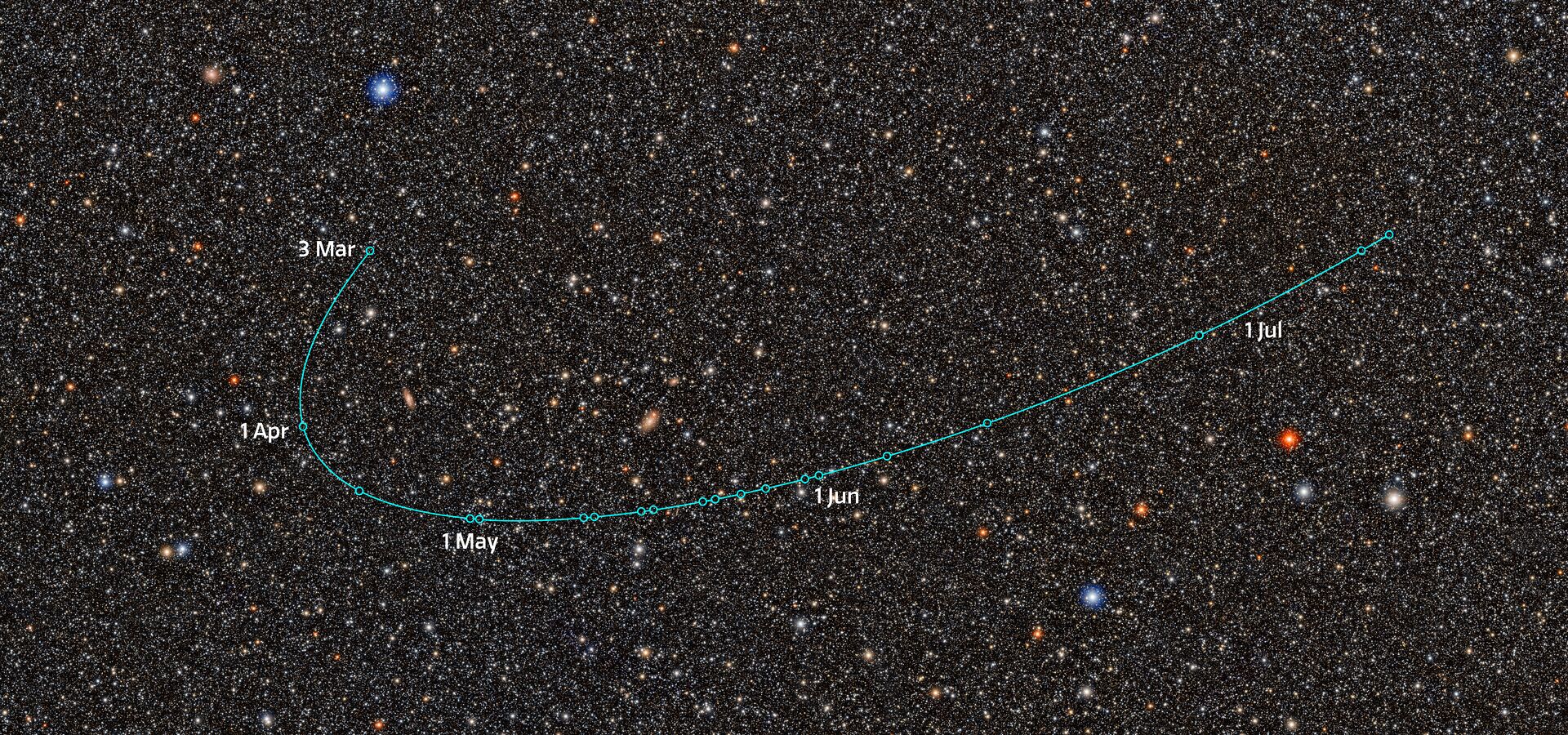
A large object hidden against a crowded stellar background has become Vera C. Rubin Observatory’s first dwarf-planet candidate. Announced on October 27, 2026, the discovery carries the provisional designation 2026 ED138. It is a promising new world to investigate, not a confirmed addition to the officially recognized dwarf planets.
According to Rubin’s announcement, Matthew Holman identified the object on October 13 while processing earlier observations with software developed with Kevin Napier. Its brightness at such a great distance immediately made it interesting. ED138 is currently about 46 times farther from the Sun than Earth is.
Rubin recorded it 30 times across 20 nights between March 4 and July 11. Archival Dark Energy Camera images extended the observational history back to 2016, helping establish its orbit. The crowded field near the Milky Way helps explain why an otherwise conspicuous distant object escaped earlier searches. Rubin’s repeated observations and moving-object analysis brought it into view.
How large is it?
The answer depends on an important unknown: how efficiently its surface reflects sunlight. In a technical account of the discovery, Rubin Solar System Lead Scientist Mario Jurić gives a diameter range of roughly 610 to 1,530 kilometers for the assumed range of reflectivities. An intermediate assumption produces a diameter near 970 kilometers. These are estimates, not a direct measurement of the object’s dimensions.
Jurić reports that only nine known trans-Neptunian objects are intrinsically brighter. He also describes a tilted orbit, inclined by about 24.4 degrees, and a possible relationship with Neptune’s 12:7 orbital resonance. That relationship remains unresolved: roughly half of the modeled orbits compatible with the observations show the relevant resonant behavior. Its color is also redder than objects belonging to the Haumea family, arguing against membership in that group.
A candidate, not a verdict
A measurement of reflectivity or a stellar occultation would help narrow the size estimate, Jurić notes. The object is bright enough for ground-based spectroscopy and studies of brightness changes as it rotates. For now, the strongest conclusion is also the most useful one: Rubin has supplied an unusually promising target, with follow-up observations needed before its physical character is settled.
Featured image: Rubin observations trace 2026 ED138 across a dense star field. Credit: NSF–DOE Vera C. Rubin Observatory/NOIRLab/SLAC/AURA. Image processing: M. Jurić (UW), D. de Martin & M. Zamani (NSF NOIRLab). CC BY 4.0. Image source; license.
Leave a Reply