The radar mystery that gripped Washington in the summer of 1952 left behind more than newspaper headlines. It also prompted a technical investigation into a practical problem: what should air traffic controllers make of moving returns that did not behave like familiar aircraft?
A useful starting point is the Civil Aeronautics Administration’s Technical Development Report 180, written by Richard C. Borden and Tirey K. Vickers and issued in May 1953. Reading its methods alongside its conclusions reveals both the strength of the atmospheric explanation and the limits of applying it to the entire Washington episode.
What the investigators measured
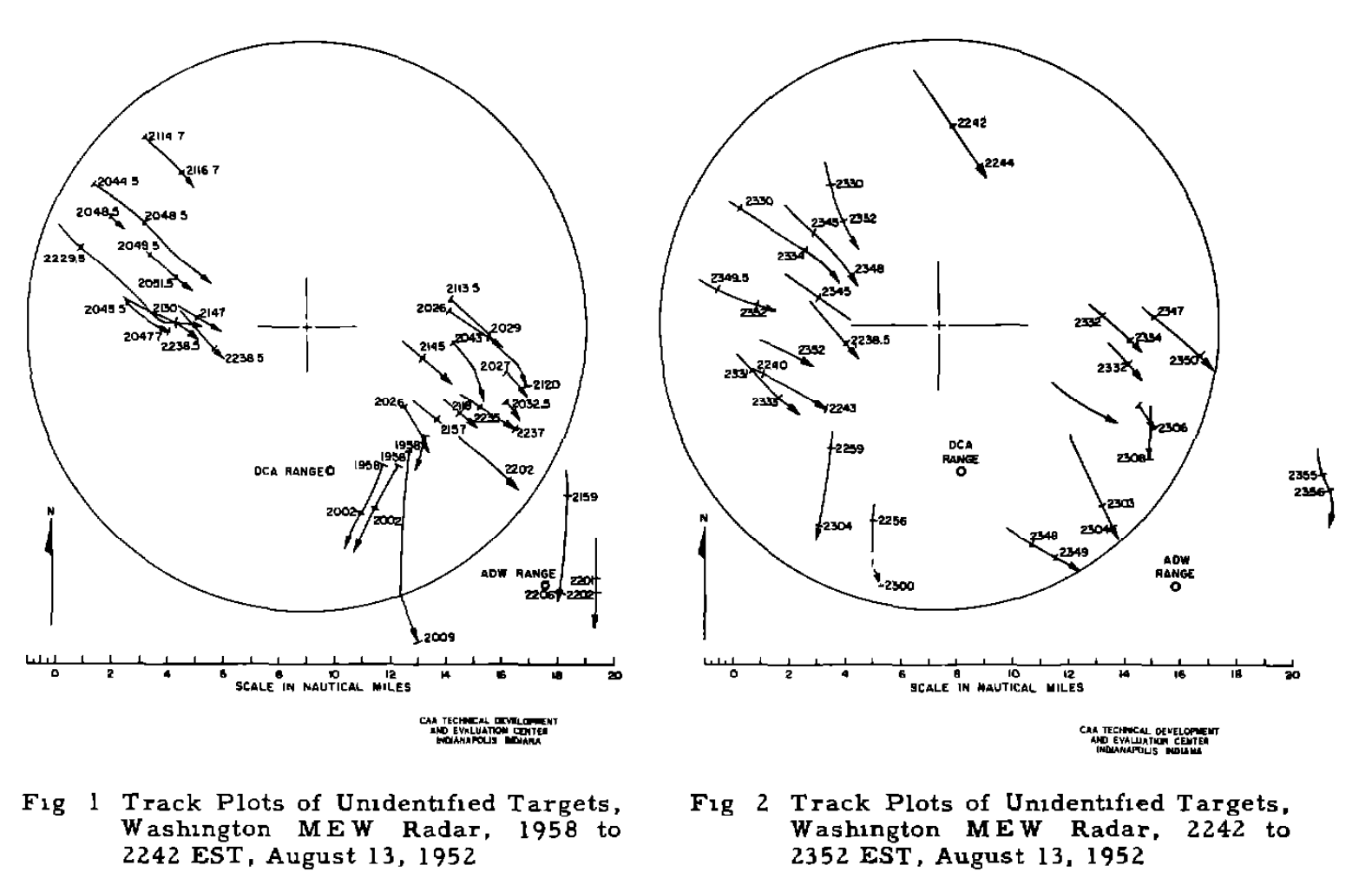
The researchers combined controller interviews, official records, weather information and their own observations of Washington and Indianapolis radar equipment. Their Washington field session began on August 13, 1952, and continued into August 14. Additional tracks were recorded on August 15–16.
Those dates matter. The figures reproduced here document August observations, not a recovered recording of every much-publicized July encounter. The study investigated a recurring class of radar targets rather than reconstructing each reported sighting individually.
During the first session, investigators plotted returns on the radar display and transferred the tracks and times to acetate. The average continuously tracked distance was approximately 2.1 nautical miles. Many returns were weak and fuzzy, with their intensity changing between sweeps. Switching between high and low radar beams could make targets disappear and return.
An atmospheric explanation, with qualifications
Comparing reports with Weather Bureau records, the authors found temperature inversions associated with almost every logged occurrence. Their analysis of 80 targets suggested that many were secondary reflections: radar energy redirected by moving regions of refracting air, producing apparent targets from ground returns.
The report did not claim to have measured every property of those regions. Their precise size, shape and composition remained unknown; atmospheric eddies and a lens-like focusing effect were proposed explanations. That distinction between observation and interpretation should survive any modern retelling.
Why the report still matters
The operational concern was straightforward. Spurious returns could complicate busy air traffic control, particularly when small helicopters could produce similarly weak, slow-moving signatures. Investigators needed to understand the display before deciding what occupied the sky.
For readers weighing the Washington mystery today, the report supplies a concrete atmospheric mechanism and documented tests. It does not justify treating every radar blip as an extraordinary vehicle, or claiming that one study individually resolved every July report. The strongest historical conclusion is narrower: investigators reproduced and studied a relevant radar phenomenon, then explained how it could mislead observers.
Archive note: the U.S. Department of Transportation repository identifies the report as public domain. This is a historical case review, not a newly released finding.
Featured image: Washington MEW radar track plots from August 13, 1952, reproduced in CAA Technical Development Report 180 (May 1953), figures 1–2. These are August study observations, not recordings of the July incidents. Credit: Civil Aeronautics Administration; public domain. Original report.
Leave a Reply