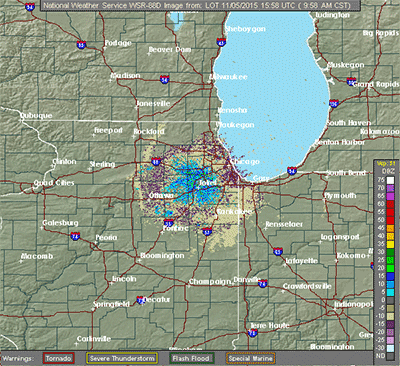
A radar return is a measurement, not an identification. That distinction matters whenever an unfamiliar track enters a UFO discussion: before asking what the target was, an analyst must establish what the instrument was detecting and how the signal reached it.
The atmosphere is part of the instrument
NOAA’s JetStream explanation of anomalous propagation describes a familiar weather-radar problem. Under some atmospheric conditions, the beam bends downward more strongly than expected. This superrefraction can bring terrain into the beam and produce returns that do not represent rain.
A low-level temperature inversion—warmer air above cooler air—can favor this behavior, especially with moist air below and much drier air above. Ground clutter can then become unusually conspicuous. The radio energy and the return are real; the mistake would be interpreting them as the wrong kind of target.
Why one bright patch is not enough
The National Weather Service’s Melbourne radar guide explains that anomalous propagation often affects the lowest elevation scans and can disappear in higher ones. Its occurrence can change as morning heating weakens an inversion. That gives analysts testable comparisons rather than a label to attach after the fact.
NOAA illustrates another check with simultaneous Amarillo and Lubbock radar images. Each showed nearby echoes the other did not support, while visible satellite imagery showed clear skies. Together, those observations helped distinguish anomalous propagation from precipitation. The useful principle is independent comparison, not simply distrust of a surprising display.
Four questions for a claimed radar anomaly
- Which radar and product? A weather reflectivity image is not the same thing as an air-traffic surveillance track. A screenshot without its product label can invite the wrong interpretation.
- Which time and scan angle? Preserve timestamps and the sequence of scans. A single frame cannot reveal whether a feature persisted, changed with elevation or remained fixed relative to terrain.
- What did other instruments record? Look for appropriately timed neighboring coverage and atmospheric observations. Independent evidence must actually overlap the event, rather than merely come from the same general region.
- What alternatives were tested? A credible explanation should connect the proposed mechanism to the observed geometry and conditions. “An inversion existed” is a starting point, not a complete reconstruction.
A limit, not a universal answer
These weather-radar examples explain why radar evidence requires interpretation. They do not demonstrate that every unexplained military or aviation track was anomalous propagation. Different instruments, processing systems and observing geometries need their own analysis.
Nor does a visual sighting automatically settle the radar question. The task is to show that the visual object and the radar return correspond in time and position, not simply that both were reported. Conversely, a plausible clutter explanation should not erase observations it has not addressed.
The strongest account therefore preserves both the measurement and its uncertainty: what appeared on the display, what the atmosphere could do to the beam, what independent checks were available, and which conclusions remain unsupported.
Featured image: NOAA/National Weather Service example of ground-clutter echoes near Joliet, Illinois. Educational archival radar display, not a UAP detection. Image source; public-domain use information.
Leave a Reply