The phrase “swamp gas” can make Michigan’s 1966 UFO controversy sound like a simple argument between believers and skeptics. The surviving record shows another dispute running underneath it: whether the public had received a sufficiently careful explanation.
What Hynek proposed
NASA’s Astronautics and Aeronautics chronology for 1966, on printed page 116, records J. Allen Hynek’s March 25 press conference about reported sightings at Dexter and Hillsdale. Hynek was an astrophysicist and scientific consultant to the Air Force’s Project Blue Book.
The chronology describes his suggestion that localized lights in swampy areas could result from marsh gas released during a thaw. It also records his suggestion that flares might have contributed to the Hillsdale reports—and notes that some witnesses disputed his conclusions. This is a record of a proposed explanation and its reception, not a laboratory demonstration of what produced each light.
Ford wanted a different process
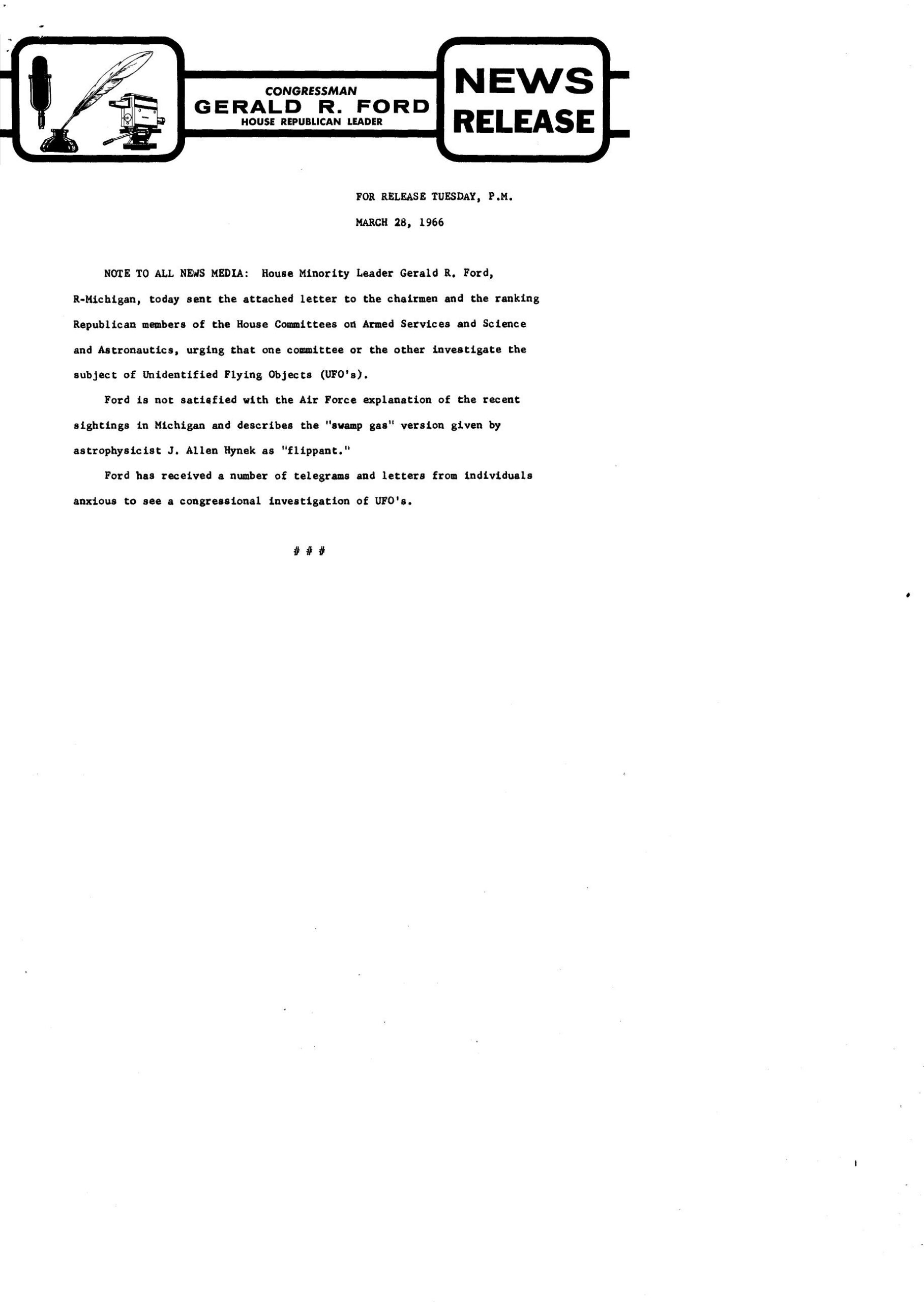
Gerald Ford, then House Minority Leader and a Michigan congressman, pressed for congressional attention. His March 25 news release and March 28 correspondence survive in the Ford Presidential Library’s congressional papers.
In the March 28 letter, Ford asked the chairmen of the House Science and Astronautics and Armed Services committees to arrange hearings. He wanted testimony from government representatives and people who reported seeing UFOs. His accompanying release called Hynek’s explanation “flippant.”
Those documents establish Ford’s dissatisfaction and his proposed remedy. They do not establish that the lights were spacecraft. A request for investigation is evidence of a political response, not proof of the phenomenon’s origin.
Why the distinction still matters
The useful lesson is methodological. A proposed natural explanation should be tested against the particular observations it is meant to explain. Conversely, disagreement with that explanation does not make an extraordinary alternative correct by default.
Readers should also distinguish the voices inside an archive. Ford’s account of the Air Force’s response is Ford’s argument; Hynek’s reported explanation is Hynek’s hypothesis. Neither becomes a neutral verdict simply because a presidential library or federal agency preserves it.
Michigan’s enduring significance lies partly in that gap between explanation and persuasion. Public confidence requires more than a memorable label. It requires a clear account of which observations were examined, what evidence supports a conclusion and what uncertainty remains. The 1966 documents make that disagreement visible without requiring us to pretend they resolve every sighting.
Featured image: Gerald Ford’s March 28, 1966 news release calling for congressional investigation of UFO reports. Courtesy Gerald R. Ford Presidential Library. U.S. federal work, public domain.
Leave a Reply