On April 24, 1964, Socorro police officer Lonnie Zamora reported an extraordinary encounter outside the New Mexico town. The most useful way to revisit it is to keep two evidence streams separate: what Zamora said he saw, and what other people subsequently observed on the ground.
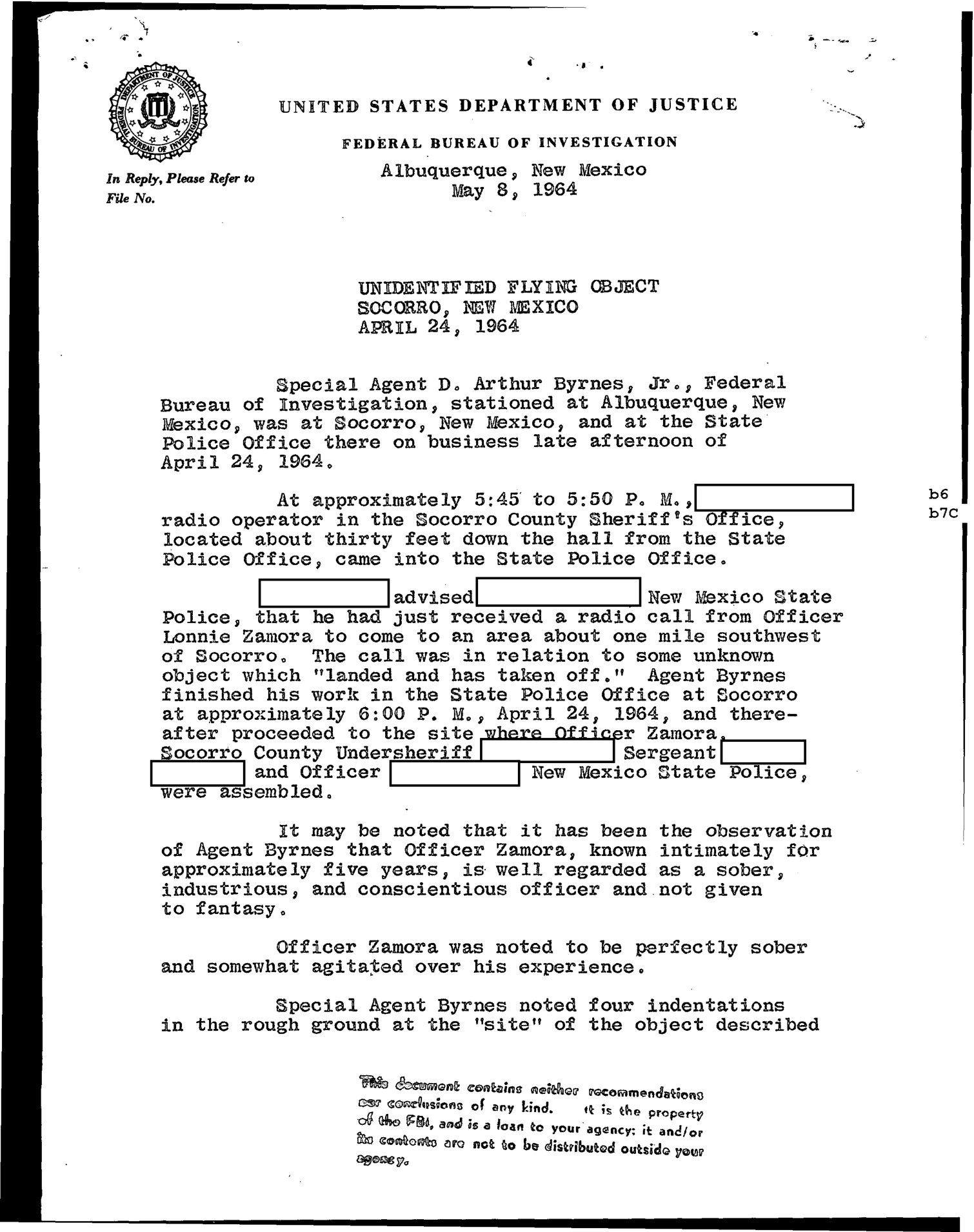
The contemporary FBI records, preserved in this released document collection, make that distinction possible. They contain early communications, Zamora’s account and a May 8, 1964 memorandum describing Special Agent D. Arthur Byrnes Jr.’s own observations.
The encounter in the early report
An Albuquerque teletype recorded Zamora’s report of a flame southwest of town at about 5:50 p.m. He initially wondered whether a dynamite shack had exploded. Approaching the area, he described a whitish object that first looked like an overturned automobile, with two people apparently wearing white coveralls nearby.
According to that account, the object rose with a roar and bluish-orange flame, then departed after the noise and flame stopped. Zamora described an oval shape and a red insignia. These are reported perceptions, not details independently established by a photograph or a second close observer.
The same early teletype expressly stated that no other witnesses were then known to the noise, flame or object. That contemporary limitation is important even when later discussions introduce additional claims.
What Byrnes observed
Byrnes was already in Socorro on other business. His May 8 account places the radio report at approximately 5:45–5:50 p.m.; he went to the site after finishing his work around 6 p.m.
He described four ground depressions, approximately rectangular, roughly sixteen by six inches and about two inches deep. He also recorded burned clumps of grass inside their arrangement and another burned area outside it. Those observations provide documentation of conditions at the site, independently of Zamora’s description of the departing object.
They do not, by themselves, establish what made the marks. Calling them confirmed spacecraft landing traces would add a causal conclusion that the agent’s observations cannot supply.
A credible witness is one part of the evidence
Byrnes described Zamora as sober and conscientious, based on years of acquaintance. Such assessments help explain why officials took the report seriously. They cannot turn every detail of a startling, brief encounter into a measurement.
The FBI correspondence also clarifies institutional roles: the Bureau’s stated policy was to ensure the Air Force knew of the report, while maintaining liaison rather than undertaking its own full UFO investigation.
Socorro remains compelling because testimony and documented ground conditions can be examined together. A careful reading preserves both, without treating unexplained marks as proof of an extraterrestrial visitor or dismissing the entire record because its central event lacked independent close-range confirmation.
Archive note: the linked file contains 1964 records released in a later FOIA package. This article reviews historical evidence, not a new sighting.
Featured image: First page of the FBI memorandum dated May 8, 1964, recording Special Agent D. Arthur Byrnes Jr.’s observations after the Socorro report. This is an archival document, not a photograph of the reported object. Credit: FBI; public domain; scan via The Black Vault. Original document collection.
Leave a Reply