DARK FIRESORIGINS UNKNOWN

Author: Dark Fires

  • Inside Blue Book’s 1952 Questionnaire: How the Air Force Recorded Uncertainty

    Inside Blue Book’s 1952 Questionnaire: How the Air Force Recorded Uncertainty

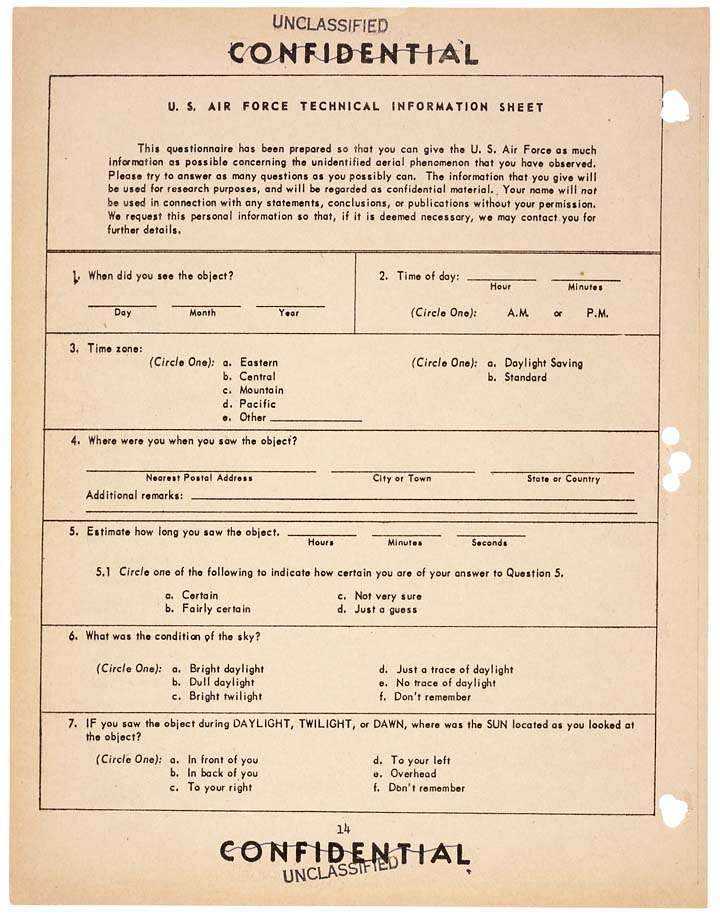
    A three-page questionnaire preserved in Project Blue Book’s eighth status report shows how the Air Force tried to turn a fleeting sighting into information that could be compared and investigated. The interesting details are ordinary ones: time zones, confidence in a duration estimate, clouds and the glass through which a witness looked.

    The National Archives record, identifier 595507, dates the report material to December 31, 1952. The displayed sheets carry printed page numbers 14–16 and questions 1–19. They are a blank collection instrument, not a completed account of an encounter. Their design reveals what investigators wanted to ask; it cannot show how consistently witnesses answered or analysts used the results.

    Recording time without hiding uncertainty

    The first sheet separates the date, hour and minute, morning or afternoon, time zone, and daylight-saving or standard time. Location receives its own address, town and state-or-country fields. Together, these entries could help an investigator distinguish reports that merely sounded similar from observations potentially made at the same time and place.

    Duration is followed by a separate confidence question. Its four choices run from certainty to “Just a guess.” That distinction is easy to lose when an estimate becomes a number in a later narrative. Here, the form gives the uncertainty its own recorded answer rather than requiring readers to infer it.

    The surroundings were part of the observation

    Lighting questions cover daylight, twilight and darkness, followed by the Sun’s position relative to the witness. The second sheet asks about stars, moonlight and brightness against the sky. A car-headlight comparison offers familiar reference points, although it remains a subjective comparison rather than a calibrated light measurement.

    Several questions explicitly permit “Don’t Know” or “Don’t remember.” Those choices matter: failure to recall a detail need not become a confident negative. The form also asks whether the object passed behind or in front of something, especially a cloud. Such relationships can constrain an interpretation, but only if the witness actually observed the overlap.

    A separate checklist records eyeglasses, sunglasses, a windshield, window glass, binoculars, a telescope or a theodolite. This keeps the viewing conditions attached to the report instead of treating every account as an unaided view of an unobstructed sky.

    Drawing relationships rather than supplying measurements

    The third sheet provides room for labelled sketches, movement arrows and the arrangement of multiple objects. It also distinguishes blurred edges, a star-like appearance and sharp outlines. These prompts preserve perceived shape and relative motion without turning the drawing into a measured distance, physical size or trajectory.

    Read as a historical intelligence-collection instrument, the questionnaire combines standardized answers with space for details that resist a checkbox. Its enduring value lies in seeing those categories together: an observation, its surroundings and the observer’s uncertainty. None substitutes for independent evidence, but preserving all three makes the original report harder to flatten into a more definite story than its author could support.

    Featured image: Original questionnaire page, not a completed sighting report. U.S. Air Force / National Archives, public domain.
  • West Freugh 1957: The Radar Mystery Behind Parliament’s UFO Questions

    West Freugh 1957: The Radar Mystery Behind Parliament’s UFO Questions

    When radar operators near West Freugh reported unexplained returns in April 1957, the resulting paper trail reached beyond a Scottish bombing range. It drew questions about how the Air Ministry investigated strange objects, what it told Parliament and how radar alarms should be handled in the nuclear age.

    The surviving record contains an unusually direct technical conclusion. It also contains public answers that need to be read carefully, because they discuss several incidents rather than offering a single explanation for West Freugh.

    The conclusion preserved in the archive

    The National Archives’ guide to its UFO records describes trailer-mounted radar units tracking unidentified objects at the range. Press coverage brought the episode to Parliament and the Joint Intelligence Committee. The guide points researchers to several files, including AIR 20/9321, and reproduces the technical assessment’s conclusion.

    The Air Ministry’s Deputy Directorate of Intelligence (Technical) attributed the incident to five reflecting objects whose type and origin were unidentified. It considered conventional aircraft, weather balloons and charged clouds unlikely explanations. This is an official assessment preserved in an archival guide, not a fresh identification made here.

    The wording leaves an important boundary intact. Investigators judged particular explanations unlikely; they did not establish the objects’ construction, operator or place of origin. The quoted conclusion supplies no basis for converting “unidentified” into a positive claim of extraterrestrial technology.

    What the minister actually said

    On 17 April 1957, MP Stan Awbery asked what recent UFO investigations had been undertaken, what photographs existed and what reports had been made. Air Secretary George Ward replied that reports arrived continually and were investigated when sufficient detail was available. He said most objects proved to be balloons or meteors and that a recently publicized photograph was fake.

    That answer does not name West Freugh. Treating the photograph remark as a dismissal of the radar incident would merge two different kinds of evidence without support from the answer itself.

    A 15 May exchange provides a further warning against mixing cases. Ward said five objects reported that year remained unidentified, compared with six in 1956, none in 1955 and six in 1954. Separately, he explained that the 29 April Dover Straits radar incident involved two Hunter aircraft on a training exercise. He also disputed reported speeds and emphasized that current investigations could yield later identifications.

    Why an unresolved return mattered

    The May debate soon turned to the consequences of false alarms. Frank Beswick asked about identification when nuclear deterrents left little time to decide whether an attack was underway. Ward said uncertainty about whether the objects were friendly was precisely why the radar reporting system had sent aircraft to investigate.

    That exchange places the period’s UFO problem in a practical defence setting. A puzzling radar report demanded attention even before anyone could explain it. West Freugh’s lasting interest lies in the record of that uncertainty: an internal assessment rejecting several familiar candidates, alongside public discussion of investigation, misidentification and the risks of acting on an ambiguous track.

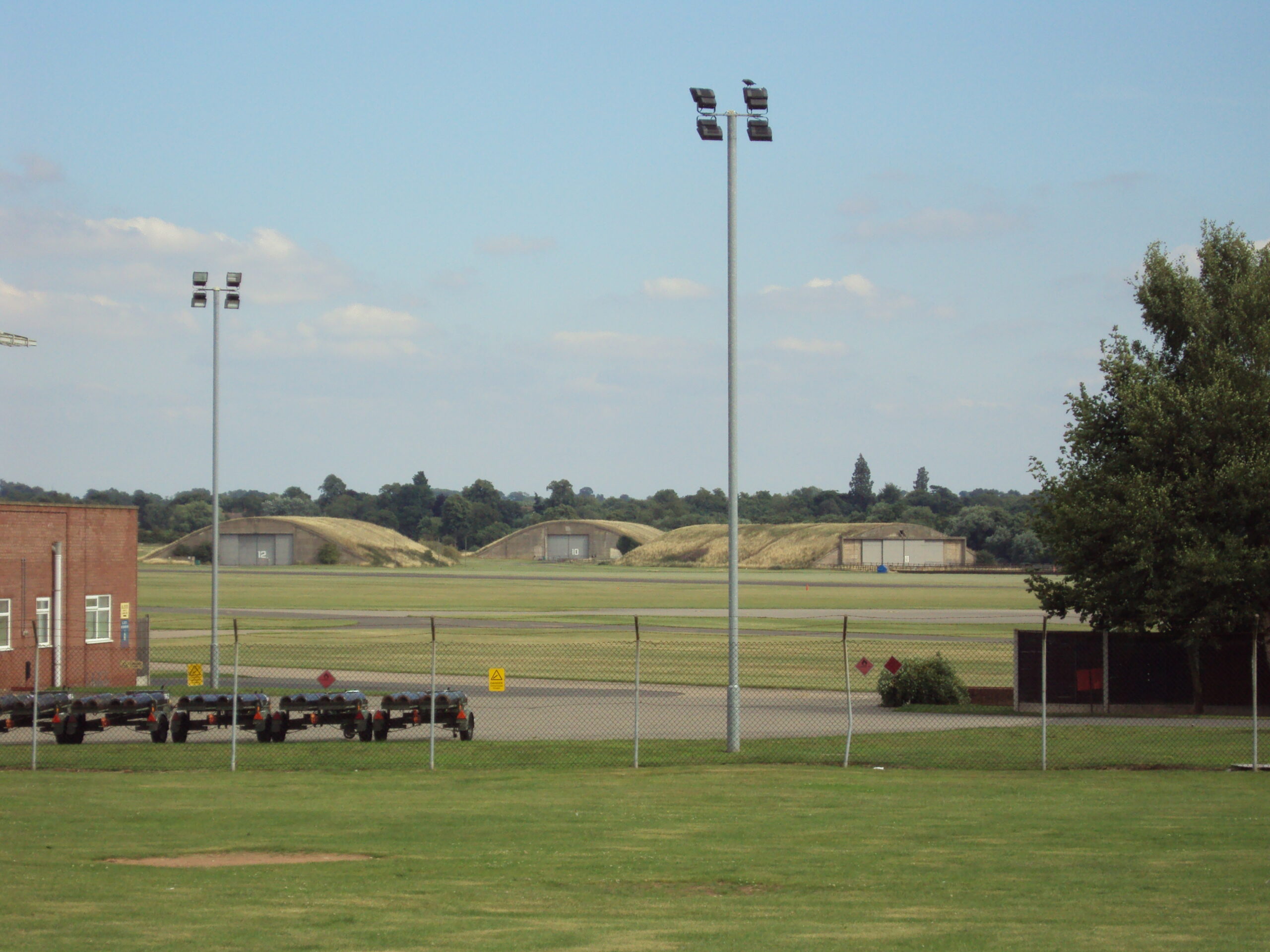
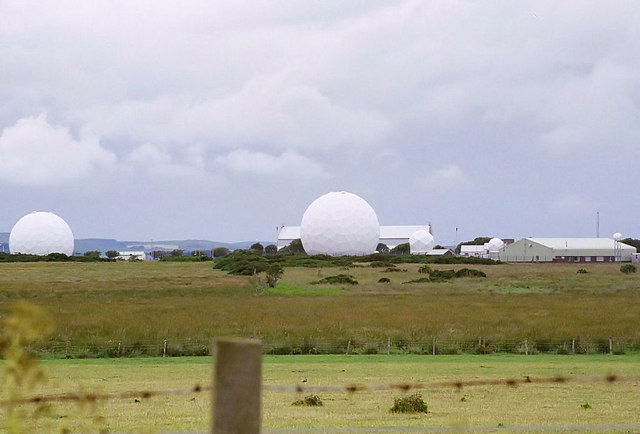
    Featured image: West Freugh Airfield, June 18, 2005. A later view, not a photograph of the 1957 incident. John McLeish / West Freugh Airfield / Geograph, CC BY-SA 2.0 Image licence.

  • JAL Flight 1628 and the FAA’s Split-Radar Explanation

    JAL Flight 1628 and the FAA’s Split-Radar Explanation

    The official record of Japan Air Lines Flight 1628 contains a technical explanation that is often overshadowed by the crew’s visual account. After the November 17, 1986 Alaska sighting, the Federal Aviation Administration examined whether an additional radar indication represented another aircraft. Its surviving paperwork explains why the agency concluded that the display could show two returns from the same Boeing 747.

    What the FAA set out to establish

    The agency’s March 5, 1987 news release, preserved in this scan of FAA documents, states that its purpose was to investigate a possible unreported aircraft and resulting safety hazard. It released pilot-controller communications, interviews, radar plots and other material, while saying it could not confirm the reported UFO event.

    The release attributes the nearby second target to an uncorrelated primary and beacon return. It also says a United Air Lines aircraft directed toward the JAL flight saw the freighter but nothing else. The FAA concluded that air-traffic-control safety had not been compromised and announced no further investigation. Those are the agency’s stated findings, not independent observations made by the later archive hosting the scans.

    Two signals from one aircraft

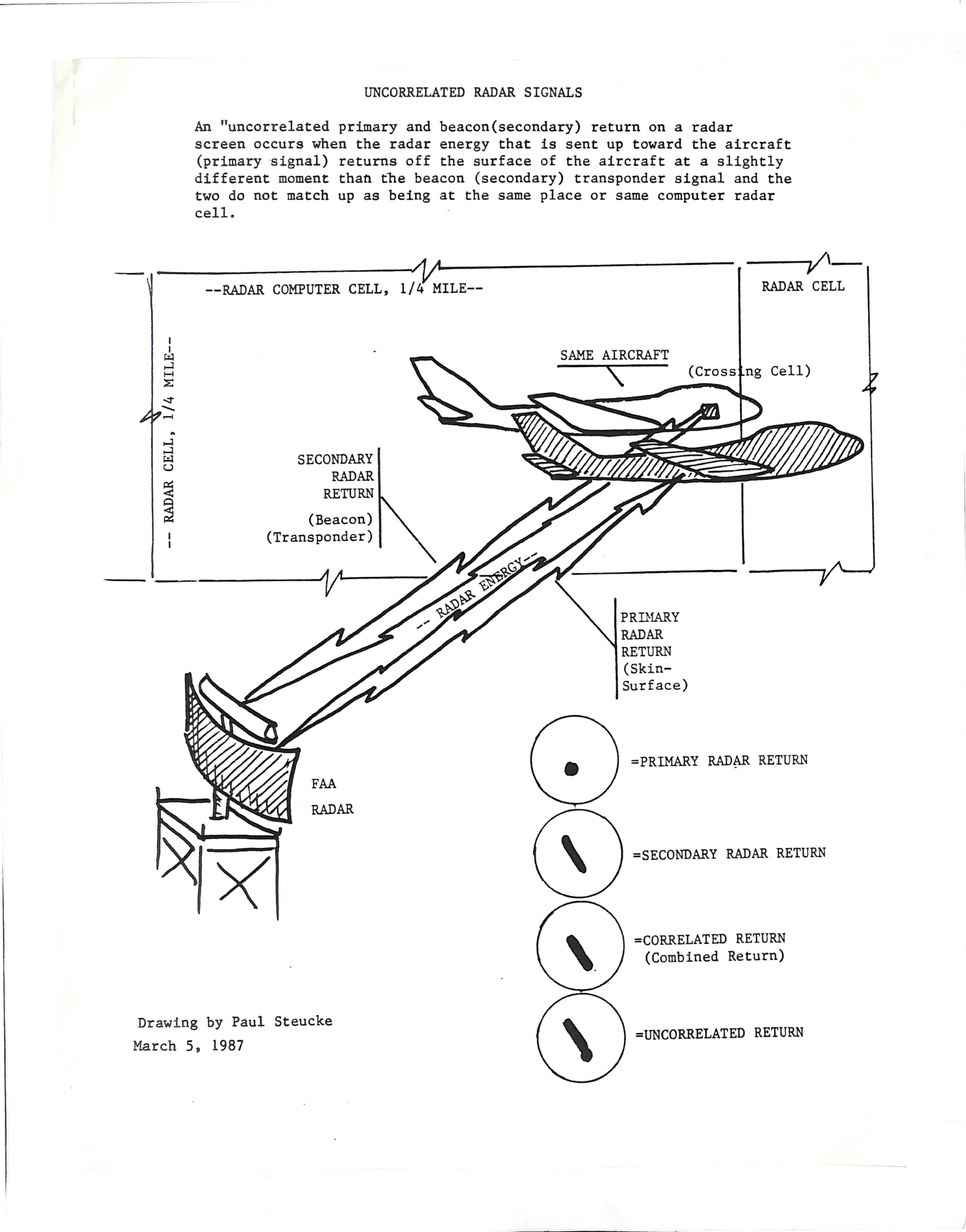
    The accompanying technical packet makes the explanation more concrete. Primary radar receives energy reflected from an aircraft’s surface. A beacon return comes from its transponder. The system has to associate those signals with the same position; a mismatch can leave separate indications.

    Dennis R. Simantel’s analysis, dated February 25, 1987, describes approximately 61 minutes of extracted data. It says 72 percent of replies had primary and beacon returns in the same quarter-mile range cell. Approximately 25 percent registered as beacon-only; within that subset, 90 percent had a primary-only return within one-eighth of a mile ahead or behind.

    The analysis connects these separations to timing and correlation circuitry, and says comparable data from another aircraft in the area were considered normal. A February 27 memorandum forwards the analysis. A March 5 explanatory drawing then shows how one aircraft crossing between cells could produce separated display symbols.

    What the explanation can settle

    A radar interpretation must be evaluated against the radar claim it addresses. Showing a mechanism for two display indications weakens the inference that two physical aircraft were necessarily present. It does not, by itself, identify every light reported through a cockpit window. Those are different observations requiring their own comparisons.

    The distinction also protects the controllers’ work from unfair hindsight. An operator responding to possible traffic must act on available information. A later analyst can review a longer sequence and compare patterns that were harder to evaluate during the encounter. Operational caution and subsequent technical reassessment can both be reasonable.

    The National Archives lists the JAL records under FAA Record Group 237, giving researchers a route beyond quotations repeated in popular accounts. For this part of the case, the most useful starting point is the dated analysis and its diagram: they identify the mechanism the FAA proposed, the data it summarized and the limited question its conclusion addressed.

    Featured image: Paul Steucke / Federal Aviation Administration, March 5, 1987. Original FAA explanatory diagram, preserved by The Black Vault; rendered from PDF page 3.

  • Cosford 1993 and the Limits of a No-Threat Finding

    Cosford 1993 and the Limits of a No-Threat Finding

    The Cosford UFO story contains two questions that are easy to merge: what people saw, and whether the sightings indicated a military threat. A parliamentary answer about March 31, 1993, shows why those questions could receive different answers. An unexplained observation did not automatically meet the Ministry of Defence’s threshold for further action.

    The question Parliament asked

    On July 15, 1998, Lord Hill-Norton asked how many military personnel had witnessed the reported craft over RAF Cosford and RAF Shawbury. He also challenged the assessment of its defence significance. In the published Hansard answer, Lord Gilbert said the ministry knew of one report from two military personnel concerning an alleged West Midlands sighting on March 31, 1993.

    Gilbert said the reported facts had been examined, that no firm identification had been reached, and that the events had not been judged significant for defence. This records the government’s stated position five years later. It is not a transcript of the original observation.

    The surrounding answers explain the remit: the ministry looked for evidence of hostile or unauthorized foreign military activity. It did not routinely seek a precise identification when there was no indication of a potential threat. That limited purpose helps explain how an unresolved report could be administratively closed.

    The wider night of sightings

    A separate source describes a broader reporting episode. In the National Archives’ August 2009 release commentary, consultant David Clarke describes more than 30 reports across the south and west of the British Isles during six hours. Witnesses included a police patrol at RAF Cosford.

    Clarke says the UFO desk requested a replay of RAF radar tapes and that nothing unusual was found. He attributes the majority of sightings to the atmospheric re-entry of the rocket that had launched the Russian Cosmos 2238 satellite. This is retrospective commentary accompanying an archival release, rather than the original radar record or a fresh measurement.

    Keeping the reports separate

    The difference in scope matters. A minister answering a question about military witnesses and an archivist summarizing a regional wave need not be counting the same things. Neither account, by itself, warrants treating every reported light as one object travelling between named locations.

    Likewise, an explanation for a majority leaves an important checking task. To apply a re-entry explanation to any particular report, researchers would need to compare its timing, viewing direction, duration and appearance with the predicted event. Extending the explanation solely because another witness reported lights that night would skip that work.

    A negative radar review also has limits. Without the operating details, coverage and original records, it cannot be turned into a measurement of an object’s size or performance. Nor does a missing radar detection establish that a witness saw nothing.

    The useful historical finding is narrower and more durable: the official record distinguishes identification from threat assessment, while the later archive account places the reports within a wider episode with a substantial conventional explanation. Reading those sources together preserves both the government’s stated reasoning and the limits of what these particular documents can settle.

    Featured image: RAF Cosford airfield, August 16, 2010, by Rept0n1x / Wikimedia Commons, CC BY-SA 3.0. Location photograph, displayed crop, not an image of the 1993 sighting.

  • The 1968 Moscow Airgram That Questioned Soviet UFO Coverage

    The 1968 Moscow Airgram That Questioned Soviet UFO Coverage

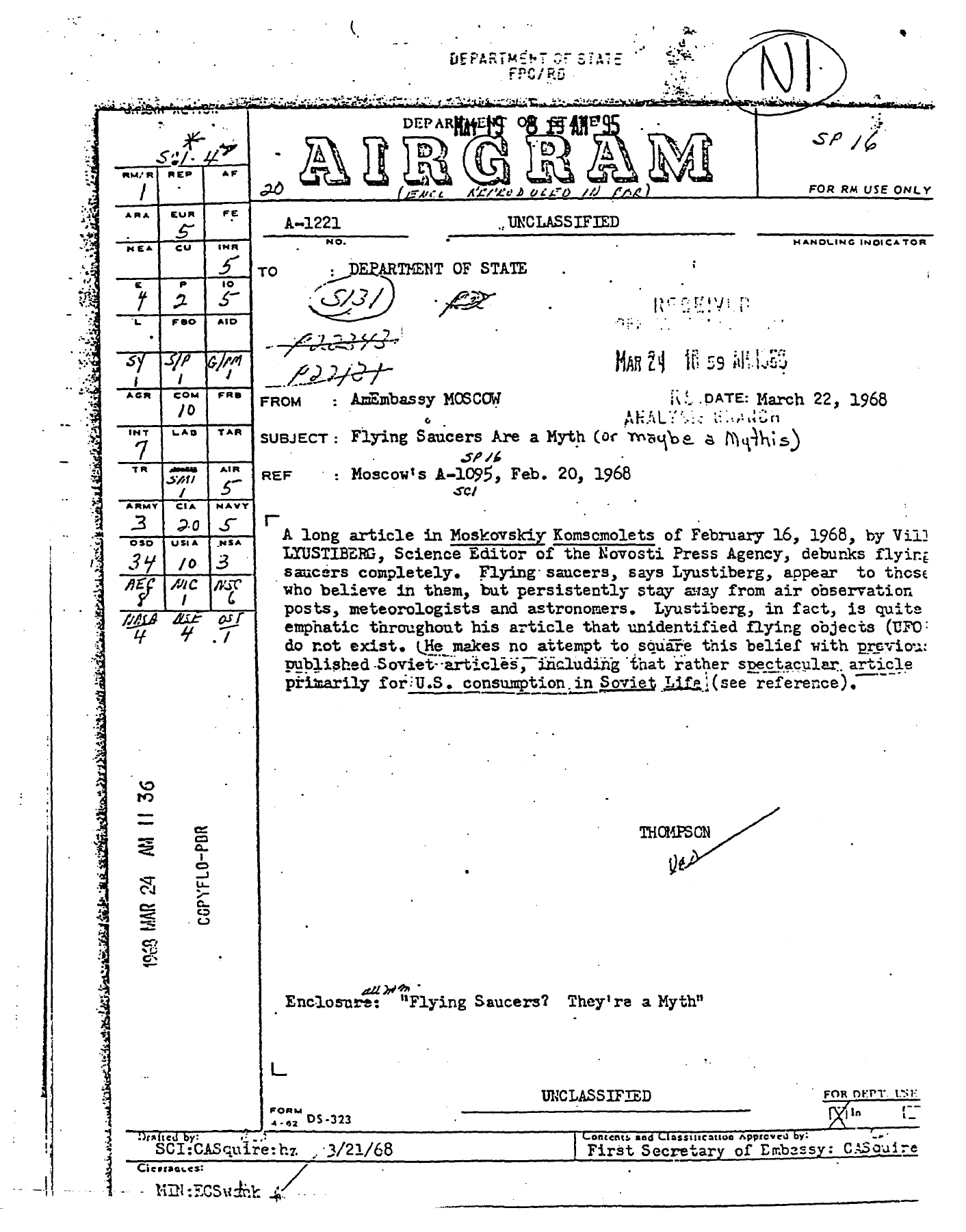
    A short diplomatic dispatch from Moscow offers an unusually clear view of how UFO claims travelled through government files. Dated March 22, 1968, it records an American embassy officer reading Soviet press coverage and noticing an inconsistency. The surviving document is valuable for that exchange, without needing to turn it into evidence of a secret encounter.

    The embassy’s observation

    The original airgram, A-1221, was sent from the American Embassy in Moscow to the Department of State. Its cover sheet is marked unclassified. It summarizes an article published in Moskovskiy Komsomolets on February 16, 1968, by a science editor associated with the Novosti Press Agency.

    According to the embassy summary, the writer dismissed flying saucers and argued that they appeared to believers while evading professional observers. The American comment then points to earlier Soviet articles, including one in Soviet Life intended primarily for American readers, which the writer had not reconciled with that position. The dispatch references an earlier Moscow airgram dated February 20.

    This is the document’s strongest historical detail: a contemporary diplomat explicitly noticed conflicting presentations of the subject. Establishing why those presentations differed would require the earlier publications and their editorial context. The discrepancy alone cannot tell us whether the cause was disagreement, audience selection or a coordinated policy.

    Three dates and three kinds of evidence

    The file contains more than one date. February 16 identifies the newspaper article discussed on the cover. March 22 dates the embassy dispatch. The enclosed English-language text carries a March 12 date. These should remain separate in a citation rather than being compressed into a single supposed UFO-event date. No encounter on March 22 is being reported here.

    There are also separate authorship layers. A press writer makes an argument. An embassy summarizes and comments on it. A modern archive makes the surviving paperwork accessible. Each layer answers a different research question. The press text can show what readers were being told; the cover note can show what American officials found worth forwarding.

    Why the archive location matters

    The PDF is available through the National Security Agency’s website, but the visible cover identifies the Department of State and the Moscow embassy. Describing its contents simply as an NSA conclusion would erase that distinction. A repository’s name is useful provenance, not a substitute for reading the document’s sender and purpose.

    The same caution applies to the distribution markings. A routed copy establishes that material entered an administrative channel. It does not establish agreement with every statement in an enclosure. A research file may preserve contradictory positions precisely because officials wanted to understand a debate.

    For readers tracing UFO history, this modest airgram supports a specific conclusion: Soviet public commentary about flying saucers drew American diplomatic attention, including criticism of its consistency. It supplies a starting point for comparing publications, dates and audiences. Any larger claim about hidden knowledge must bring additional evidence to that comparison.

    Featured image: U.S. Department of State, Moscow airgram A-1221, March 22, 1968. Public-domain federal cover sheet, hosted by NSA.

  • Hubble’s Dwarf-Galaxy Oxygen Census Finds a Budget That Does Not Balance

    Hubble’s Dwarf-Galaxy Oxygen Census Finds a Budget That Does Not Balance

    Nearby dwarf galaxies appear to retain much less oxygen than their stars have manufactured. A NASA announcement published November 2, 2026 describes the GLOW project’s census of 37 systems and a persistent question: where did the missing material end up?

    The new journal publication is not the first public appearance of the research. The authors posted GLOW II on arXiv on August 7 and revised it on August 13. NASA’s November report marks the publication milestone and explains the result for a wider audience.

    Counting production and retention

    The study combines reconstructed star-formation histories with measurements of gas and chemical abundance. It estimates how much oxygen stars produced over time, then compares that total with the oxygen retained in the galaxies.

    The reported retention range is 4 to 25 percent, averaging about 11 percent. Nearly all of the retained oxygen is in gas. The preprint also reports environmental differences, suggesting that nearby galaxies and the surrounding setting can influence retention, recycling or accretion.

    These are inferred budgets with physical models behind them, not a count of individually tagged atoms. Their importance is that computer simulations can reproduce a familiar relation between galaxy mass and chemical abundance yet still predict too much retained oxygen. Matching one observable does not guarantee the underlying material flows are correct.

    Why nearby stars make the experiment possible

    The companion GLOW I data paper describes the observational foundation: resolved stars in Hubble imaging, hydrogen measurements from radio observations, Spitzer infrared imaging, ground-based optical data and additional compiled measurements. Processing these data together allows a galaxy-by-galaxy comparison rather than relying on a single picture.

    Resolving stars matters because a galaxy’s present brightness blends populations of different ages. Reconstructing its history helps estimate how much material earlier generations produced. The sample’s proximity makes that detailed work possible, while also limiting how directly the result can be extended to the much larger population of distant dwarf galaxies.

    Missing from the galaxy does not mean missing from the universe

    Rutgers’ account of the work describes stellar winds and supernova-driven outflows as the likely means of removal. The remaining uncertainty is the destination. Some oxygen is detected in gas surrounding dwarf galaxies, but the team cannot yet say whether that reservoir holds most of the deficit or whether much of it traveled farther outward.

    That is a meaningful distinction. Material lingering near a galaxy may have a different future from material dispersed well beyond it. The result connects the life cycles of stars to the chemical enrichment of space between galaxies, rather than treating a galaxy as a sealed container.

    The next step is to strengthen the inventory and test the physical mechanisms, including observations of still smaller systems and the massive stars that drive outflows. The oxygen shortfall is evidence of an incomplete accounting of galactic evolution, not disappearing matter or a new type of cosmic object.

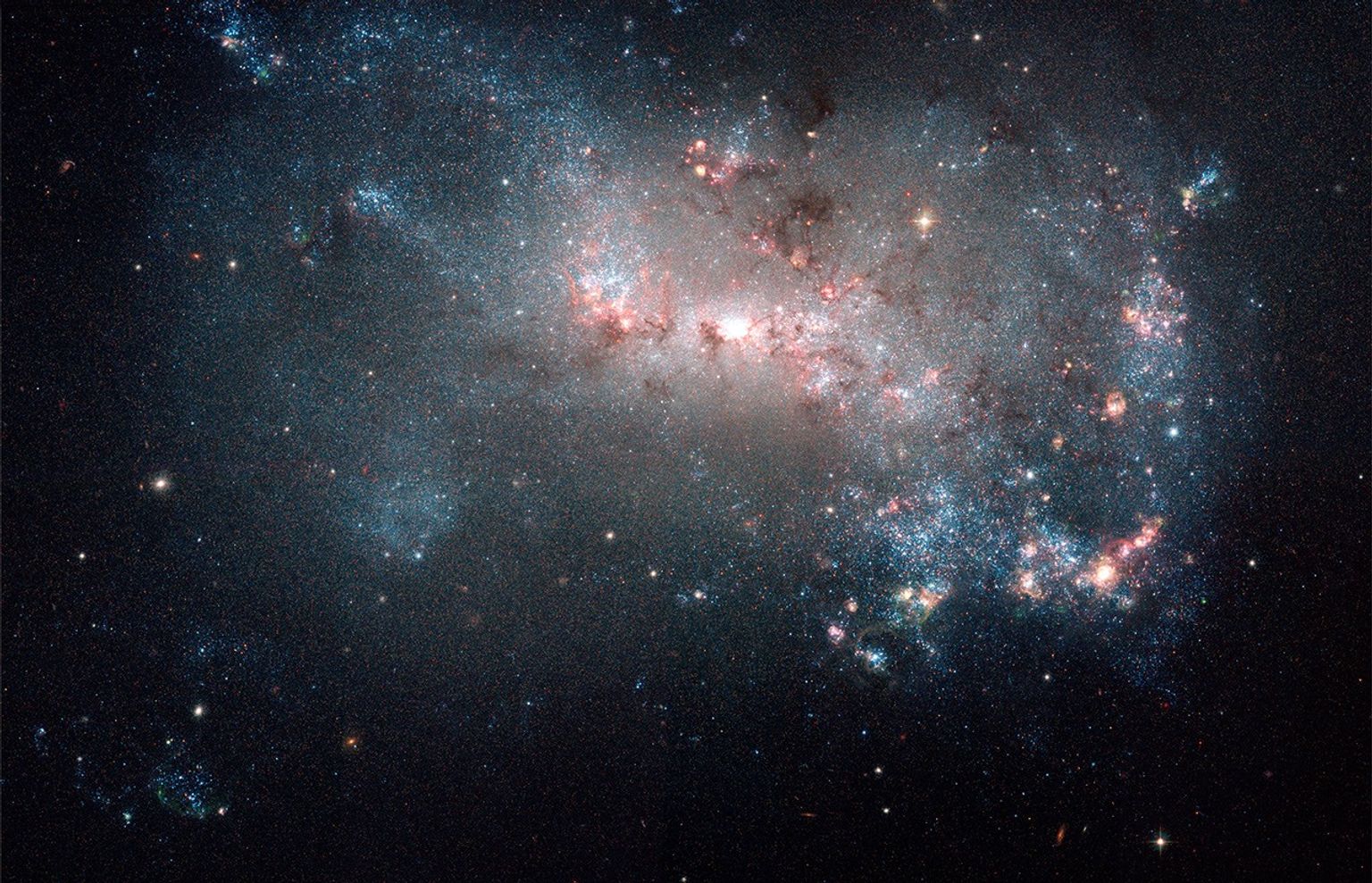
    Featured image: NASA, ESA, Hubble Heritage–ESA/Hubble Collaboration, Alessandra Aloisi (STScI, ESA). Hubble image of NGC 4449, one of the GLOW sample galaxies.

  • Comets Carry Life’s Ingredients, but Delivering Them Intact Is Another Test

    Comets Carry Life’s Ingredients, but Delivering Them Intact Is Another Test

    Finding organic molecules inside a comet does not show that those molecules reached early Earth in a usable form. A study published in Scientific Reports on October 28, 2026 tests that missing step and finds that successful delivery of concentrated chemical feedstock was rare in its modeled histories.

    The paper, led by Richard Anslow, focuses on hydrogen cyanide, or HCN, a molecule used in proposed prebiotic reaction pathways. Its conclusion concerns the efficiency of a delivery mechanism. It is not an observation of how life actually began.

    Survival is only the first hurdle

    The researchers combined models of comet populations, passage through the atmosphere and impact chemistry. A comet must arrive with suitable size, speed and angle, preserve enough HCN, and deposit it where dilution will not immediately defeat the required concentration. Those conditions make a much narrower test than simply asking whether a comet struck the planet.

    The simulations considered 100,000 histories. In 54 percent, no qualifying impact delivered HCN at the study’s specified concentration threshold. The authors deliberately adopted favorable assumptions for uncertain early-Earth conditions. Their result therefore challenges a dependable cometary supply rather than claiming every conceivable delivery event was impossible.

    The ingredients are real

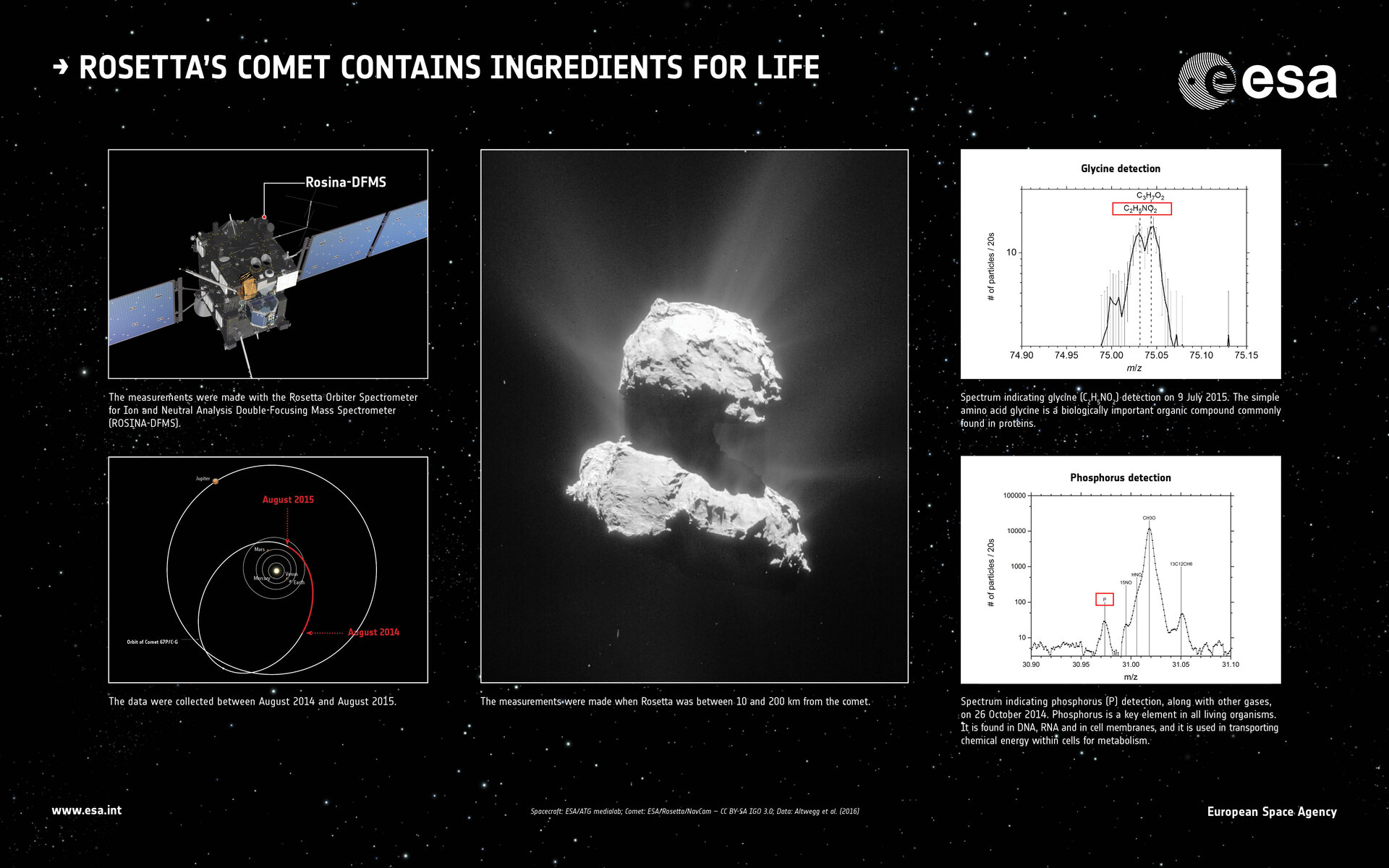
    The chemical evidence motivating this idea has not disappeared. In May 2016, ESA reported Rosetta’s detection of glycine and phosphorus at comet 67P/Churyumov–Gerasimenko. Glycine is an amino acid associated with proteins, and phosphorus participates in essential biological structures and chemistry.

    Those detections establish that a comet can contain substances relevant to prebiotic chemistry. They do not establish that a comet carried organisms, that the ingredients survived a later terrestrial impact, or that their presence alone produced life. Composition, delivery and subsequent chemistry are separate evidentiary steps.

    That distinction also changes how to read an illustration of a comet containing biological ingredients: it represents measured chemistry and a possible pathway, not evidence for biological activity on the comet.

    Why timing and dilution matter

    The University of Cambridge’s account of the study emphasizes two practical problems. The comet bombardment rate dropped rapidly during Earth’s early history, limiting opportunities. Any surviving material also had to remain sufficiently concentrated long enough for subsequent reactions to proceed.

    In other words, an inventory of delivered molecules is not enough. A chemical pathway needs the right local conditions over a useful interval. A large total mass spread through an ocean can be less helpful than a smaller amount confined in a suitable setting.

    This is why headlines saying comets “didn’t seed life” need a narrower reading. The work tests a particular concentrated-feedstock route using models, with uncertain ancient environmental inputs. It neither identifies the actual origin of life nor eliminates every extraterrestrial contribution to Earth’s chemistry. Its value is to make one appealing scenario meet the physical demands of getting from space to a reaction site.

    Featured image: ©ESA. Spacecraft: ESA/ATG medialab; comet: ESA/Rosetta/NavCam, CC BY-SA IGO 3.0; data: Altwegg et al. (2016). Composite scientific illustration of measured comet chemistry, not evidence of life. Source image and credits.

  • ERMIS-3’s Laser Link Shows Why Pointing Matters as Much as Data Rate

    ERMIS-3’s Laser Link Shows Why Pointing Matters as Much as Data Rate

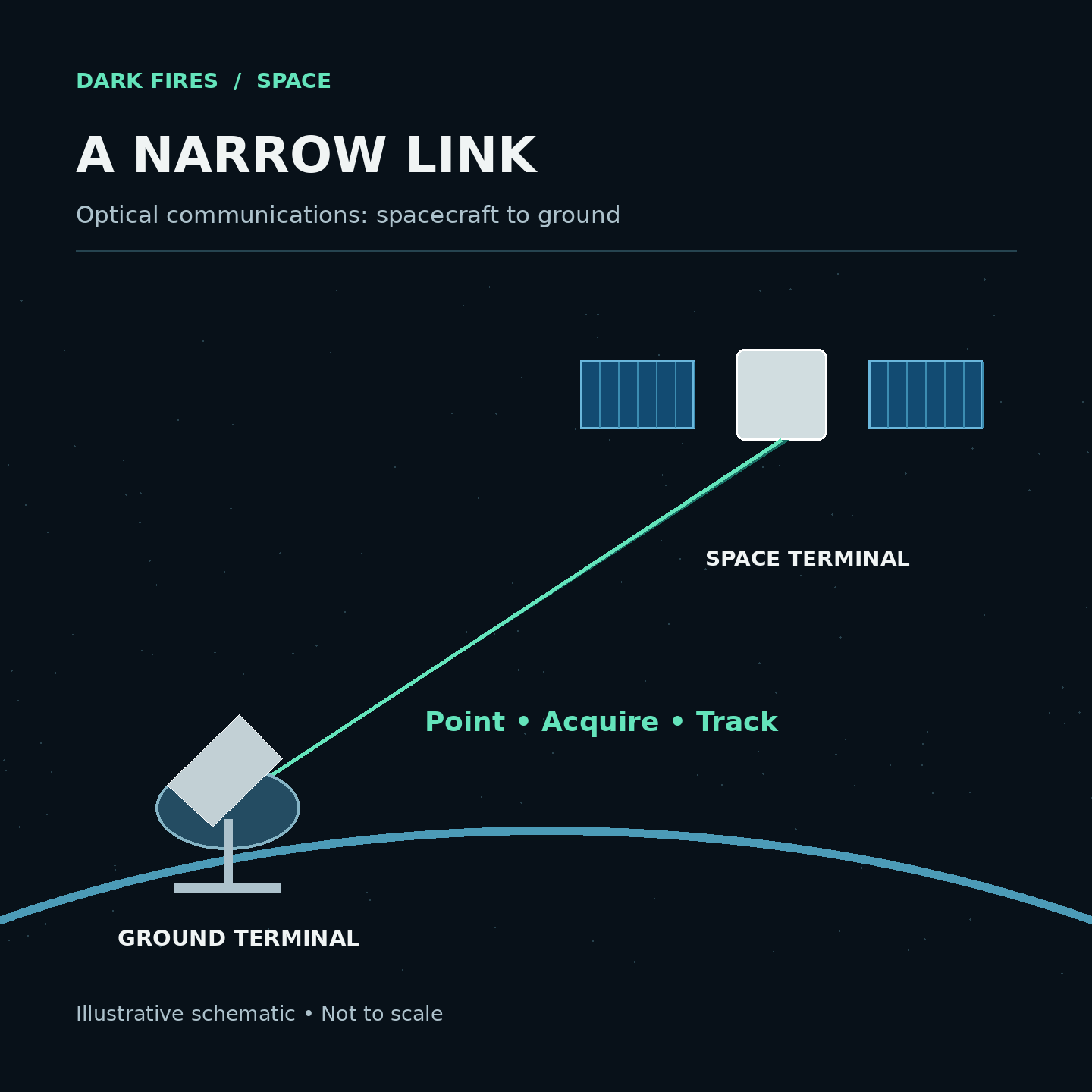
    A small Greek satellite has demonstrated a demanding part of optical space communications: finding a ground terminal and keeping a narrow laser link aligned while moving through orbit. ESA highlighted the ERMIS-3 result on November 2, 2026. The achievement had already been announced by terminal manufacturer Astrolight on October 8, so the new agency account should not be mistaken for the date of first contact.

    ERMIS-3 is an eight-unit CubeSat developed by the National and Kapodistrian University of Athens. Its ATLAS-1 optical terminal communicated with the Holomondas station developed by Aristotle University of Thessaloniki in Greece. ESA supported testing and optical alignment before flight.

    What the operator actually reported

    In its October 8 technical announcement, Astrolight reported routine links at one gigabit per second, with two scheduled passes a day and remote operation from Lithuania. The company said operations moved from first contact to routine use within a week.

    It also reported more than 85 percent availability during passes above 15 degrees elevation following calibration, and reacquisition of interrupted links in under ten milliseconds. These are the supplier’s reported operating results, not an independent performance audit supplied by Dark Fires.

    A separate figure in the announcement needs care: ten gigabits per second was described as a rate supported by calculated link-budget margins. It was not the one-gigabit rate reported for routine transmission. Projected capability and demonstrated operation answer different questions.

    The narrow-beam bargain

    NASA’s small-spacecraft communications reference explains the engineering trade. Optical wavelengths can offer large bandwidth and compact terminals, but the narrow beams demand precise pointing. Many designs divide this work into coarse spacecraft alignment and finer control inside the terminal.

    A useful analogy is the difference between illuminating a room and aiming a flashlight at a small distant mark. Concentrating the light can make communication efficient, but only while the receiver stays inside the beam. In orbit, that mark is moving continuously relative to the transmitter.

    Weather remains part of the system. Clouds can attenuate or block optical signals, and turbulence can degrade them. Quickly recovering a link after an intermittent obstruction is valuable; it does not establish that a laser can communicate through every cloud layer. A published availability figure also needs its conditions and denominator attached.

    What this changes

    For missions producing large images or other heavy data sets, reliable downlink can be as important as collecting the observations. ERMIS-3 provides a concrete small-satellite demonstration of the acquisition, tracking and recovery work needed to make that downlink practical.

    The next useful evidence is sustained operation across more conditions, with comparable measurements of delivered data and downtime. The current result is substantial without turning it into a claim that optical links have eliminated radio systems or weather limitations.

    Featured image: Generated illustration. Conceptual satellite-to-ground optical link, not actual ERMIS-3 imagery.

  • ESCAPADE’s November Earth Flybys Offer a Telescope Challenge Before Mars

    ESCAPADE’s November Earth Flybys Offer a Telescope Challenge Before Mars

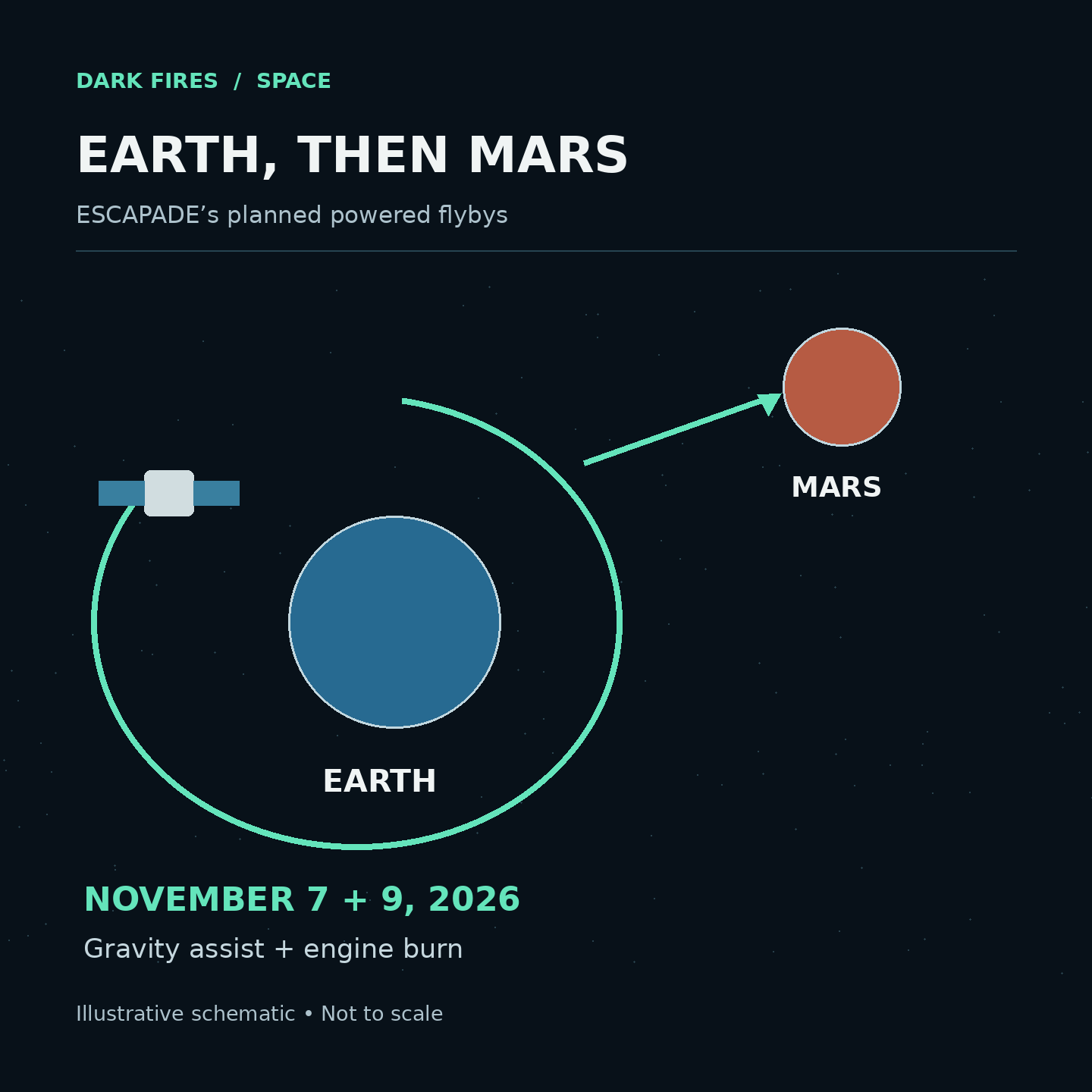
    Two spacecraft headed for Mars are about to return close enough to Earth to become an unusual observing target. NASA released ESCAPADE flyby star charts on November 2, 2026, ahead of separate powered Earth encounters planned for November 7 and 9.

    This is an observing opportunity for prepared telescope users, not a prediction of two brilliant objects sweeping across everyone’s sky. NASA expects the spacecraft to appear as faint moving points, and says a telescope will probably be necessary.

    The encounter times are not the best viewing times

    The first spacecraft’s closest approach and engine burn are scheduled around 5 a.m. Eastern Standard Time on November 7, equivalent to 4 a.m. Central or 10:00 UTC. The second is planned around 6 a.m. Eastern on November 9, or 5 a.m. Central and 11:00 UTC. Each maneuver combines Earth’s gravity with an engine burn lasting approximately nine minutes.

    NASA says both spacecraft will be below the horizon for U.S. observers at closest approach. Its practical advice is to look toward the western sky an hour or two earlier; some locations also get an eastern-sky opportunity afterward. Those are broad planning windows, not a substitute for a location-specific prediction.

    Use the right coordinates for your observing site

    The agency’s chart collection gives selected locations a starting point. For other sites, JPL’s Horizons service can calculate spacecraft ephemerides. An ephemeris is a timetable of predicted positions, rather than a photograph of where an object has already appeared.

    JPL supplies a web interface, tutorial and reference manual. Before relying on an output, check the observing location, target spacecraft, date range and time convention. An accurately calculated position for a different city or the wrong day is still the wrong instruction for a telescope. Save the output and its settings together so the prediction can be checked later.

    Why return to Earth on the way to Mars?

    According to NASA’s mission overview, ESCAPADE launched on November 13, 2025, when the planets were not aligned for its direct trip. The probes instead followed a loitering trajectory around the region of Earth’s second Lagrange point. The coming flybys are the planned transition into the Mars-bound journey.

    At Mars, the pair will investigate atmospheric escape and the planet’s response to the solar wind. One science configuration places the spacecraft along similar paths, sampling a region at different times. Another separates their orbits so they can measure different regions simultaneously. That comparison helps disentangle changes with time from changes with location.

    The November dates remain scheduled operations as of this publication, not completed maneuvers. A successful Earth sighting would document a known spacecraft against the stars. It would not verify the later Mars science results, which still depend on arrival, orbital adjustments and scientific observations.

    Featured image: Generated illustration. Conceptual flyby route, not to scale and not a telescope image.

  • Maury Island 1947: A Fatal Crash Does Not Authenticate the UFO Debris Claim

    Maury Island 1947: A Fatal Crash Does Not Authenticate the UFO Debris Claim

    The Maury Island story combines a disputed claim about flying-disc fragments with a real fatal aircraft accident. Reading the FBI’s records carefully keeps those two strands from becoming a single, self-confirming mystery.

    What the August investigation recorded

    The FBI’s UFO file, Part 5, contains an August 19, 1947 investigative report about the Tacoma affair. It records the August 1 crash near Kelso, Washington, of a B-25 carrying two Army intelligence officers. It also reports anonymous calls to newspapers alleging that the aircraft had been sabotaged or shot down because it carried disc fragments. The report says military intelligence officers had found no indication of sabotage.

    The same file records statements that material associated with the story had come from a gravel pit and had no connection with a flying disc. It preserves a competing history of how the material was described, passed along and discussed. The distinction matters: possessing a real sample is not the same as establishing the sample’s claimed origin.

    A correction inside the record

    There is also a caution against making the confession story too simple. An August 14, 1947 Seattle teletype, available in a transcription of the FBI records, corrects an earlier characterization. It says the person concerned had not admitted the story was a hoax to the cited interlocutor, but had said he would call it one if questioned to avoid further trouble.

    That qualification does not authenticate the alleged debris. It establishes that one reported admission was more conditional than an abbreviated summary suggested. The teletype also discusses suspicion that anonymous publicity was intended to help sell the story. Suspicion about the caller’s identity is not the same as a demonstrated identification.

    Separate the claims before judging them

    A useful review asks three independent questions. Did an aircraft crash? Did somebody supply material described as fragments of a flying disc? Is there a reliable chain connecting that material to an observed object? Confirmation of the first question cannot answer the third. The emotional weight of a fatal accident must not substitute for evidence about a sample.

    The same rule applies to the anonymous calls. A caller knowing a real detail does not establish that every accompanying allegation is true. Each claim needs its own support. Otherwise, a correct name or time can become an accidental credential for a much larger story.

    Maury Island is worth revisiting because the official paperwork contains both skeptical findings and corrections to how those findings were described. Neither should be edited away to produce a cleaner narrative. The available record gives strong reasons to reject a confident claim of authenticated UFO debris; it also rewards precision about which statement was made, by whom, and at what stage of the inquiry.

    Featured image: Generated illustration. Conceptual archival artwork, not an official document or actual case evidence.