When radar operators near West Freugh reported unexplained returns in April 1957, the resulting paper trail reached beyond a Scottish bombing range. It drew questions about how the Air Ministry investigated strange objects, what it told Parliament and how radar alarms should be handled in the nuclear age.
The surviving record contains an unusually direct technical conclusion. It also contains public answers that need to be read carefully, because they discuss several incidents rather than offering a single explanation for West Freugh.
The conclusion preserved in the archive
The National Archives’ guide to its UFO records describes trailer-mounted radar units tracking unidentified objects at the range. Press coverage brought the episode to Parliament and the Joint Intelligence Committee. The guide points researchers to several files, including AIR 20/9321, and reproduces the technical assessment’s conclusion.
The Air Ministry’s Deputy Directorate of Intelligence (Technical) attributed the incident to five reflecting objects whose type and origin were unidentified. It considered conventional aircraft, weather balloons and charged clouds unlikely explanations. This is an official assessment preserved in an archival guide, not a fresh identification made here.
The wording leaves an important boundary intact. Investigators judged particular explanations unlikely; they did not establish the objects’ construction, operator or place of origin. The quoted conclusion supplies no basis for converting “unidentified” into a positive claim of extraterrestrial technology.
What the minister actually said
On 17 April 1957, MP Stan Awbery asked what recent UFO investigations had been undertaken, what photographs existed and what reports had been made. Air Secretary George Ward replied that reports arrived continually and were investigated when sufficient detail was available. He said most objects proved to be balloons or meteors and that a recently publicized photograph was fake.
That answer does not name West Freugh. Treating the photograph remark as a dismissal of the radar incident would merge two different kinds of evidence without support from the answer itself.
A 15 May exchange provides a further warning against mixing cases. Ward said five objects reported that year remained unidentified, compared with six in 1956, none in 1955 and six in 1954. Separately, he explained that the 29 April Dover Straits radar incident involved two Hunter aircraft on a training exercise. He also disputed reported speeds and emphasized that current investigations could yield later identifications.
Why an unresolved return mattered
The May debate soon turned to the consequences of false alarms. Frank Beswick asked about identification when nuclear deterrents left little time to decide whether an attack was underway. Ward said uncertainty about whether the objects were friendly was precisely why the radar reporting system had sent aircraft to investigate.
That exchange places the period’s UFO problem in a practical defence setting. A puzzling radar report demanded attention even before anyone could explain it. West Freugh’s lasting interest lies in the record of that uncertainty: an internal assessment rejecting several familiar candidates, alongside public discussion of investigation, misidentification and the risks of acting on an ambiguous track.
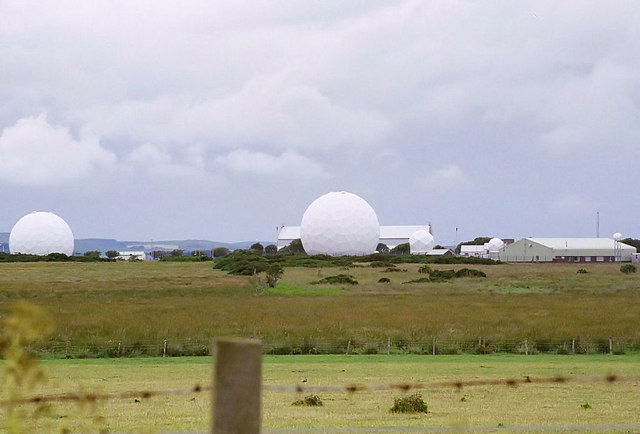
Featured image: West Freugh Airfield, June 18, 2005. A later view, not a photograph of the 1957 incident. John McLeish / West Freugh Airfield / Geograph, CC BY-SA 2.0 Image licence.

Leave a Reply