Finding organic molecules inside a comet does not show that those molecules reached early Earth in a usable form. A study published in Scientific Reports on October 28, 2026 tests that missing step and finds that successful delivery of concentrated chemical feedstock was rare in its modeled histories.
The paper, led by Richard Anslow, focuses on hydrogen cyanide, or HCN, a molecule used in proposed prebiotic reaction pathways. Its conclusion concerns the efficiency of a delivery mechanism. It is not an observation of how life actually began.
Survival is only the first hurdle
The researchers combined models of comet populations, passage through the atmosphere and impact chemistry. A comet must arrive with suitable size, speed and angle, preserve enough HCN, and deposit it where dilution will not immediately defeat the required concentration. Those conditions make a much narrower test than simply asking whether a comet struck the planet.
The simulations considered 100,000 histories. In 54 percent, no qualifying impact delivered HCN at the study’s specified concentration threshold. The authors deliberately adopted favorable assumptions for uncertain early-Earth conditions. Their result therefore challenges a dependable cometary supply rather than claiming every conceivable delivery event was impossible.
The ingredients are real
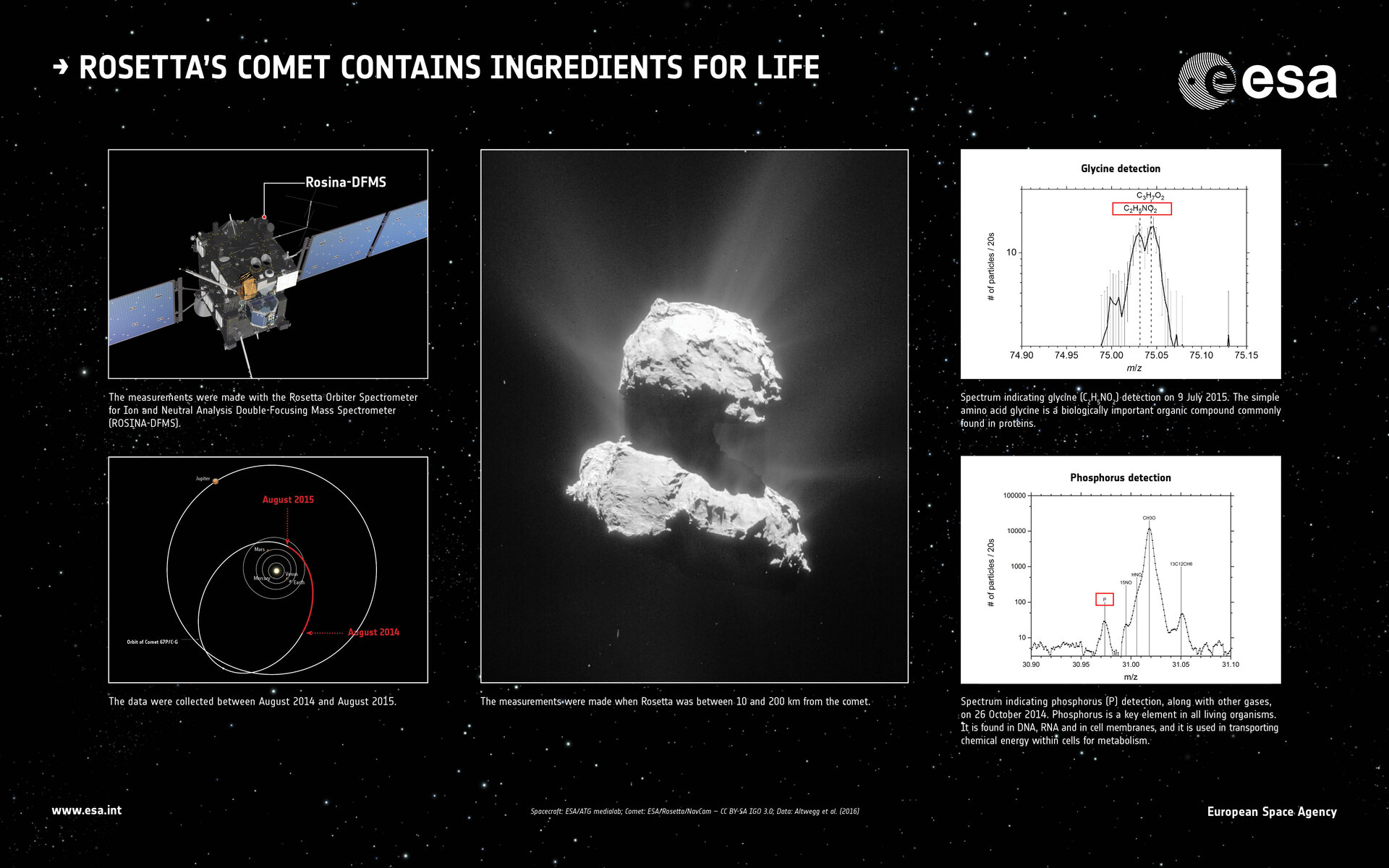
The chemical evidence motivating this idea has not disappeared. In May 2016, ESA reported Rosetta’s detection of glycine and phosphorus at comet 67P/Churyumov–Gerasimenko. Glycine is an amino acid associated with proteins, and phosphorus participates in essential biological structures and chemistry.
Those detections establish that a comet can contain substances relevant to prebiotic chemistry. They do not establish that a comet carried organisms, that the ingredients survived a later terrestrial impact, or that their presence alone produced life. Composition, delivery and subsequent chemistry are separate evidentiary steps.
That distinction also changes how to read an illustration of a comet containing biological ingredients: it represents measured chemistry and a possible pathway, not evidence for biological activity on the comet.
Why timing and dilution matter
The University of Cambridge’s account of the study emphasizes two practical problems. The comet bombardment rate dropped rapidly during Earth’s early history, limiting opportunities. Any surviving material also had to remain sufficiently concentrated long enough for subsequent reactions to proceed.
In other words, an inventory of delivered molecules is not enough. A chemical pathway needs the right local conditions over a useful interval. A large total mass spread through an ocean can be less helpful than a smaller amount confined in a suitable setting.
This is why headlines saying comets “didn’t seed life” need a narrower reading. The work tests a particular concentrated-feedstock route using models, with uncertain ancient environmental inputs. It neither identifies the actual origin of life nor eliminates every extraterrestrial contribution to Earth’s chemistry. Its value is to make one appealing scenario meet the physical demands of getting from space to a reaction site.
Featured image: ©ESA. Spacecraft: ESA/ATG medialab; comet: ESA/Rosetta/NavCam, CC BY-SA IGO 3.0; data: Altwegg et al. (2016). Composite scientific illustration of measured comet chemistry, not evidence of life. Source image and credits.
Leave a Reply