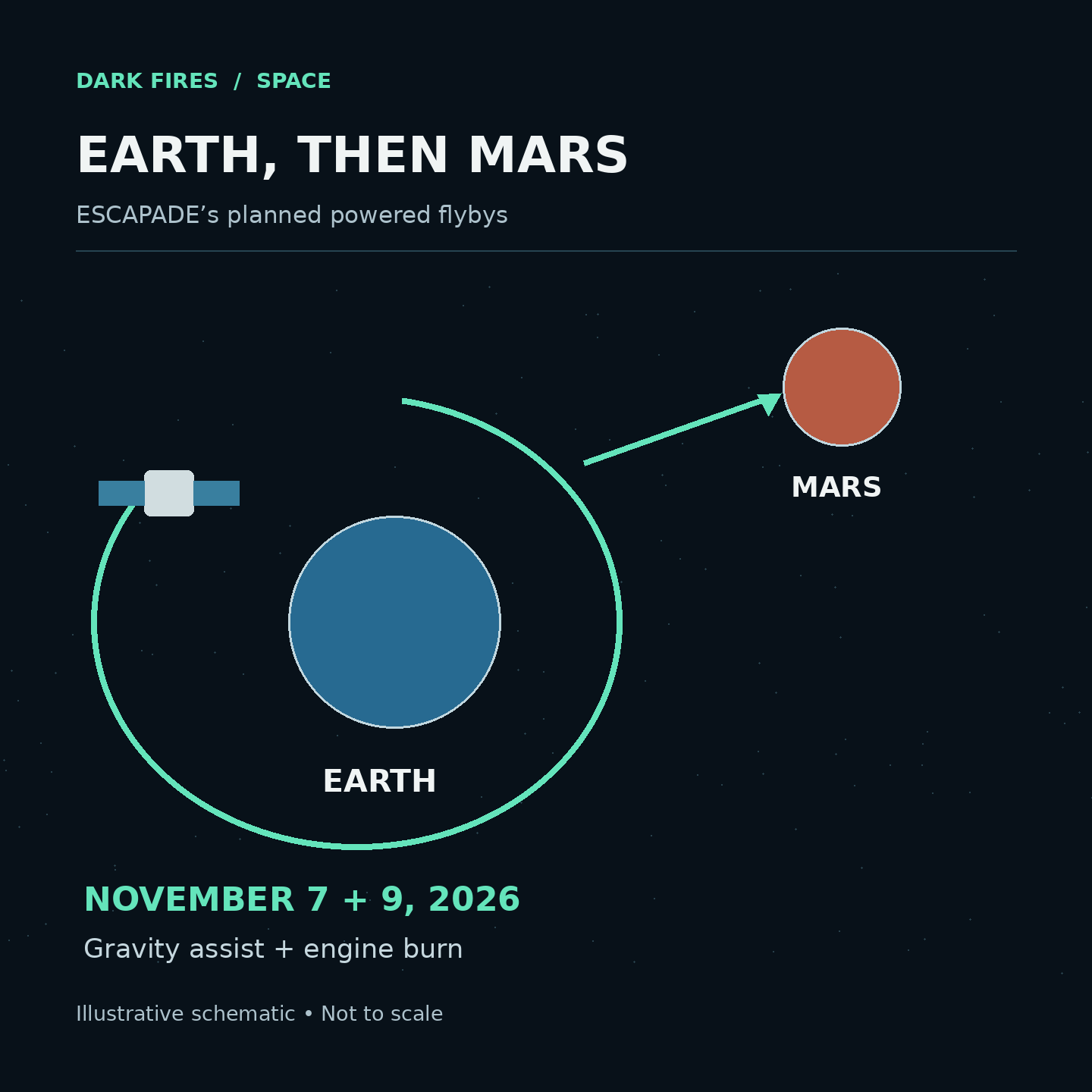
Two spacecraft headed for Mars are about to return close enough to Earth to become an unusual observing target. NASA released ESCAPADE flyby star charts on November 2, 2026, ahead of separate powered Earth encounters planned for November 7 and 9.
This is an observing opportunity for prepared telescope users, not a prediction of two brilliant objects sweeping across everyone’s sky. NASA expects the spacecraft to appear as faint moving points, and says a telescope will probably be necessary.
The encounter times are not the best viewing times
The first spacecraft’s closest approach and engine burn are scheduled around 5 a.m. Eastern Standard Time on November 7, equivalent to 4 a.m. Central or 10:00 UTC. The second is planned around 6 a.m. Eastern on November 9, or 5 a.m. Central and 11:00 UTC. Each maneuver combines Earth’s gravity with an engine burn lasting approximately nine minutes.
NASA says both spacecraft will be below the horizon for U.S. observers at closest approach. Its practical advice is to look toward the western sky an hour or two earlier; some locations also get an eastern-sky opportunity afterward. Those are broad planning windows, not a substitute for a location-specific prediction.
Use the right coordinates for your observing site
The agency’s chart collection gives selected locations a starting point. For other sites, JPL’s Horizons service can calculate spacecraft ephemerides. An ephemeris is a timetable of predicted positions, rather than a photograph of where an object has already appeared.
JPL supplies a web interface, tutorial and reference manual. Before relying on an output, check the observing location, target spacecraft, date range and time convention. An accurately calculated position for a different city or the wrong day is still the wrong instruction for a telescope. Save the output and its settings together so the prediction can be checked later.
Why return to Earth on the way to Mars?
According to NASA’s mission overview, ESCAPADE launched on November 13, 2025, when the planets were not aligned for its direct trip. The probes instead followed a loitering trajectory around the region of Earth’s second Lagrange point. The coming flybys are the planned transition into the Mars-bound journey.
At Mars, the pair will investigate atmospheric escape and the planet’s response to the solar wind. One science configuration places the spacecraft along similar paths, sampling a region at different times. Another separates their orbits so they can measure different regions simultaneously. That comparison helps disentangle changes with time from changes with location.
The November dates remain scheduled operations as of this publication, not completed maneuvers. A successful Earth sighting would document a known spacecraft against the stars. It would not verify the later Mars science results, which still depend on arrival, orbital adjustments and scientific observations.
Featured image: Generated illustration. Conceptual flyby route, not to scale and not a telescope image.
Leave a Reply