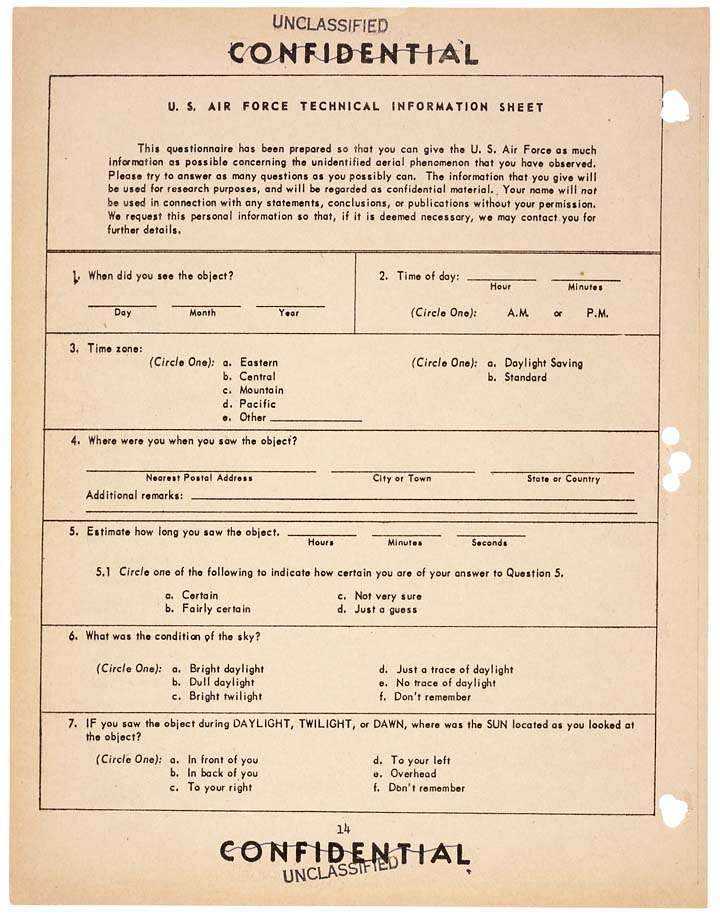
A three-page questionnaire preserved in Project Blue Book’s eighth status report shows how the Air Force tried to turn a fleeting sighting into information that could be compared and investigated. The interesting details are ordinary ones: time zones, confidence in a duration estimate, clouds and the glass through which a witness looked.
The National Archives record, identifier 595507, dates the report material to December 31, 1952. The displayed sheets carry printed page numbers 14–16 and questions 1–19. They are a blank collection instrument, not a completed account of an encounter. Their design reveals what investigators wanted to ask; it cannot show how consistently witnesses answered or analysts used the results.
Recording time without hiding uncertainty
The first sheet separates the date, hour and minute, morning or afternoon, time zone, and daylight-saving or standard time. Location receives its own address, town and state-or-country fields. Together, these entries could help an investigator distinguish reports that merely sounded similar from observations potentially made at the same time and place.

Duration is followed by a separate confidence question. Its four choices run from certainty to “Just a guess.” That distinction is easy to lose when an estimate becomes a number in a later narrative. Here, the form gives the uncertainty its own recorded answer rather than requiring readers to infer it.
The surroundings were part of the observation
Lighting questions cover daylight, twilight and darkness, followed by the Sun’s position relative to the witness. The second sheet asks about stars, moonlight and brightness against the sky. A car-headlight comparison offers familiar reference points, although it remains a subjective comparison rather than a calibrated light measurement.

Several questions explicitly permit “Don’t Know” or “Don’t remember.” Those choices matter: failure to recall a detail need not become a confident negative. The form also asks whether the object passed behind or in front of something, especially a cloud. Such relationships can constrain an interpretation, but only if the witness actually observed the overlap.
A separate checklist records eyeglasses, sunglasses, a windshield, window glass, binoculars, a telescope or a theodolite. This keeps the viewing conditions attached to the report instead of treating every account as an unaided view of an unobstructed sky.
Drawing relationships rather than supplying measurements
The third sheet provides room for labelled sketches, movement arrows and the arrangement of multiple objects. It also distinguishes blurred edges, a star-like appearance and sharp outlines. These prompts preserve perceived shape and relative motion without turning the drawing into a measured distance, physical size or trajectory.

Read as a historical intelligence-collection instrument, the questionnaire combines standardized answers with space for details that resist a checkbox. Its enduring value lies in seeing those categories together: an observation, its surroundings and the observer’s uncertainty. None substitutes for independent evidence, but preserving all three makes the original report harder to flatten into a more definite story than its author could support.
Featured image: Original questionnaire page, not a completed sighting report. U.S. Air Force / National Archives, public domain.
Leave a Reply