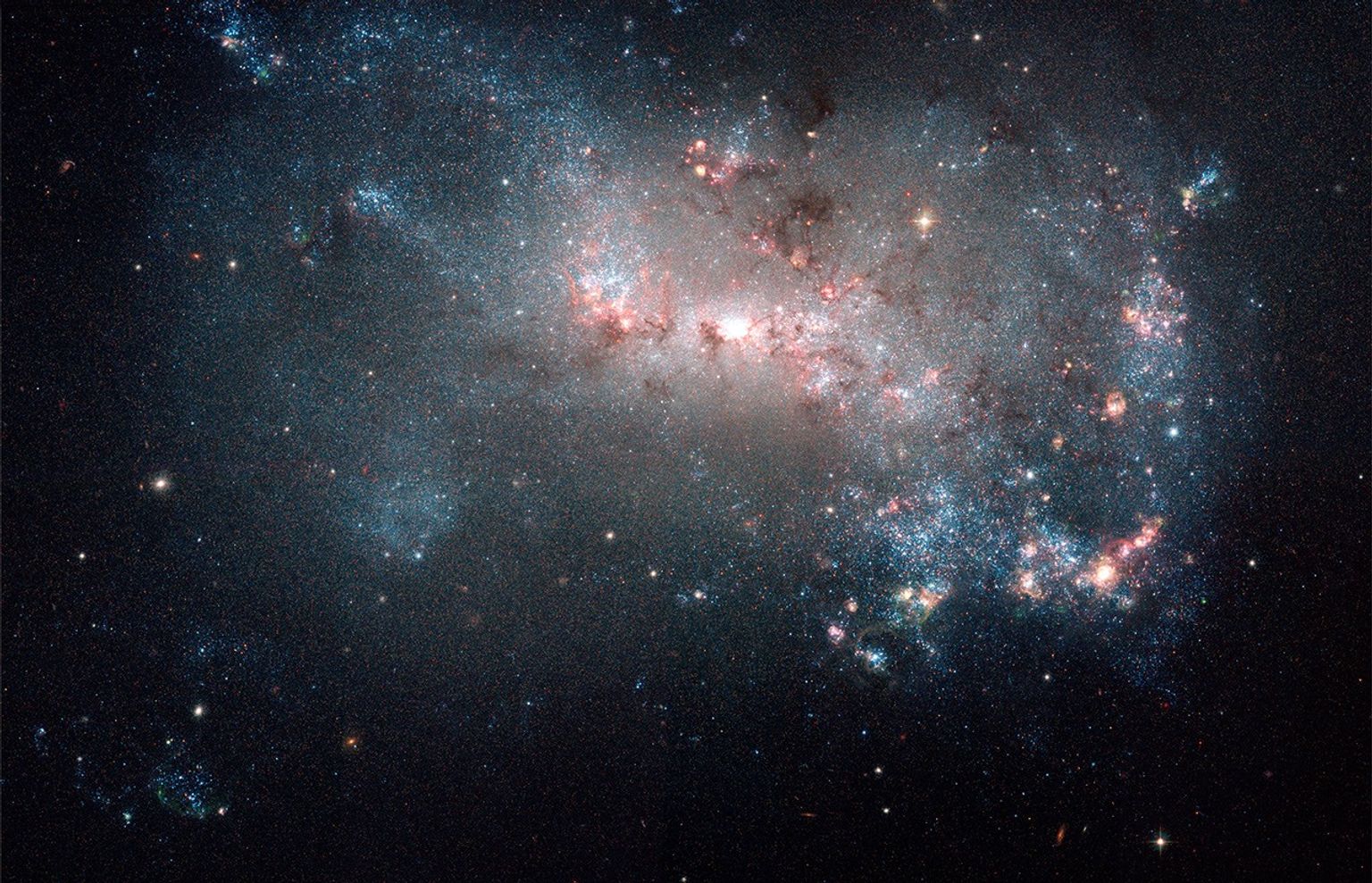
Nearby dwarf galaxies appear to retain much less oxygen than their stars have manufactured. A NASA announcement published November 2, 2026 describes the GLOW project’s census of 37 systems and a persistent question: where did the missing material end up?
The new journal publication is not the first public appearance of the research. The authors posted GLOW II on arXiv on August 7 and revised it on August 13. NASA’s November report marks the publication milestone and explains the result for a wider audience.
Counting production and retention
The study combines reconstructed star-formation histories with measurements of gas and chemical abundance. It estimates how much oxygen stars produced over time, then compares that total with the oxygen retained in the galaxies.
The reported retention range is 4 to 25 percent, averaging about 11 percent. Nearly all of the retained oxygen is in gas. The preprint also reports environmental differences, suggesting that nearby galaxies and the surrounding setting can influence retention, recycling or accretion.
These are inferred budgets with physical models behind them, not a count of individually tagged atoms. Their importance is that computer simulations can reproduce a familiar relation between galaxy mass and chemical abundance yet still predict too much retained oxygen. Matching one observable does not guarantee the underlying material flows are correct.
Why nearby stars make the experiment possible
The companion GLOW I data paper describes the observational foundation: resolved stars in Hubble imaging, hydrogen measurements from radio observations, Spitzer infrared imaging, ground-based optical data and additional compiled measurements. Processing these data together allows a galaxy-by-galaxy comparison rather than relying on a single picture.
Resolving stars matters because a galaxy’s present brightness blends populations of different ages. Reconstructing its history helps estimate how much material earlier generations produced. The sample’s proximity makes that detailed work possible, while also limiting how directly the result can be extended to the much larger population of distant dwarf galaxies.
Missing from the galaxy does not mean missing from the universe
Rutgers’ account of the work describes stellar winds and supernova-driven outflows as the likely means of removal. The remaining uncertainty is the destination. Some oxygen is detected in gas surrounding dwarf galaxies, but the team cannot yet say whether that reservoir holds most of the deficit or whether much of it traveled farther outward.
That is a meaningful distinction. Material lingering near a galaxy may have a different future from material dispersed well beyond it. The result connects the life cycles of stars to the chemical enrichment of space between galaxies, rather than treating a galaxy as a sealed container.
The next step is to strengthen the inventory and test the physical mechanisms, including observations of still smaller systems and the massive stars that drive outflows. The oxygen shortfall is evidence of an incomplete accounting of galactic evolution, not disappearing matter or a new type of cosmic object.
Featured image: NASA, ESA, Hubble Heritage–ESA/Hubble Collaboration, Alessandra Aloisi (STScI, ESA). Hubble image of NGC 4449, one of the GLOW sample galaxies.
Leave a Reply