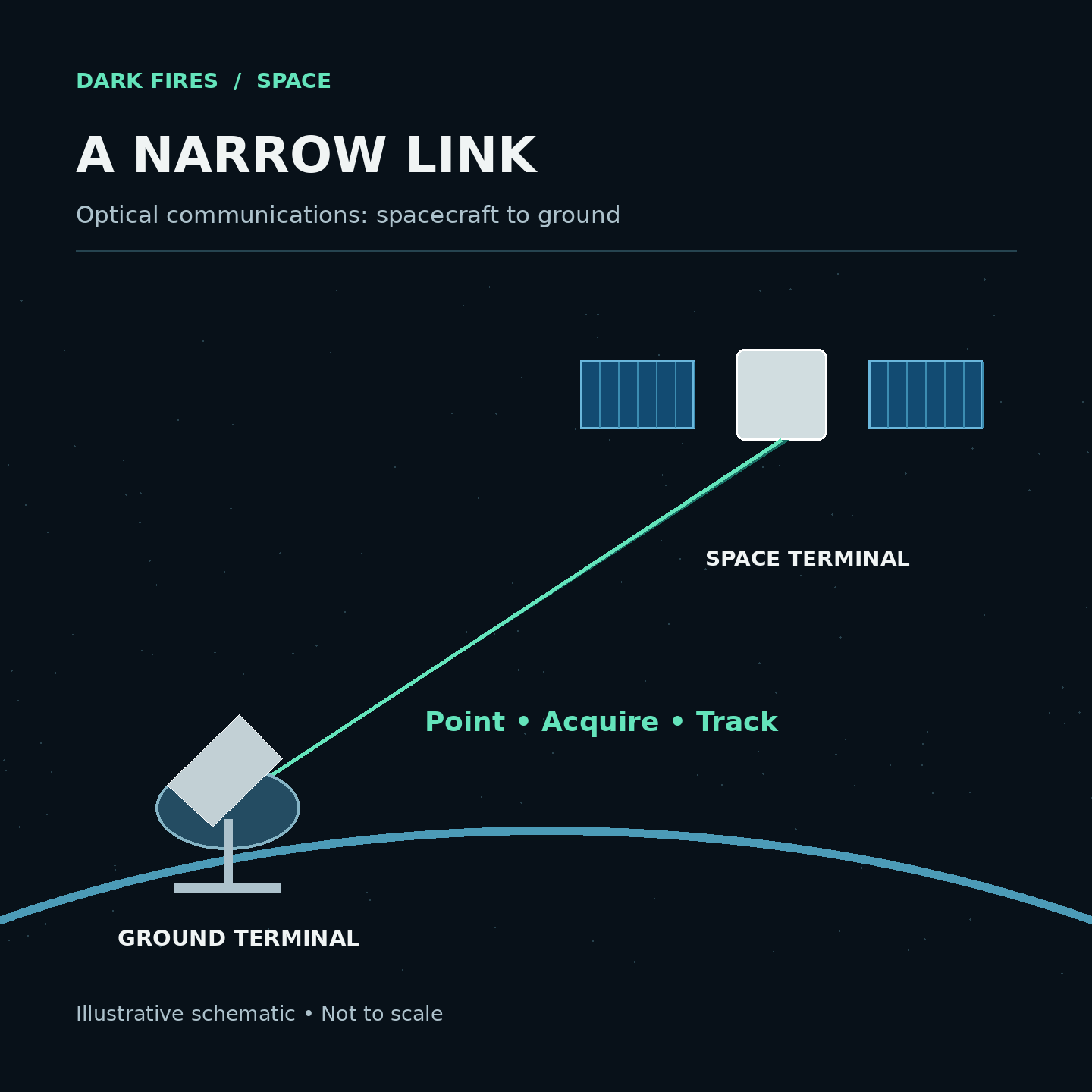
A small Greek satellite has demonstrated a demanding part of optical space communications: finding a ground terminal and keeping a narrow laser link aligned while moving through orbit. ESA highlighted the ERMIS-3 result on November 2, 2026. The achievement had already been announced by terminal manufacturer Astrolight on October 8, so the new agency account should not be mistaken for the date of first contact.
ERMIS-3 is an eight-unit CubeSat developed by the National and Kapodistrian University of Athens. Its ATLAS-1 optical terminal communicated with the Holomondas station developed by Aristotle University of Thessaloniki in Greece. ESA supported testing and optical alignment before flight.
What the operator actually reported
In its October 8 technical announcement, Astrolight reported routine links at one gigabit per second, with two scheduled passes a day and remote operation from Lithuania. The company said operations moved from first contact to routine use within a week.
It also reported more than 85 percent availability during passes above 15 degrees elevation following calibration, and reacquisition of interrupted links in under ten milliseconds. These are the supplier’s reported operating results, not an independent performance audit supplied by Dark Fires.
A separate figure in the announcement needs care: ten gigabits per second was described as a rate supported by calculated link-budget margins. It was not the one-gigabit rate reported for routine transmission. Projected capability and demonstrated operation answer different questions.
The narrow-beam bargain
NASA’s small-spacecraft communications reference explains the engineering trade. Optical wavelengths can offer large bandwidth and compact terminals, but the narrow beams demand precise pointing. Many designs divide this work into coarse spacecraft alignment and finer control inside the terminal.
A useful analogy is the difference between illuminating a room and aiming a flashlight at a small distant mark. Concentrating the light can make communication efficient, but only while the receiver stays inside the beam. In orbit, that mark is moving continuously relative to the transmitter.
Weather remains part of the system. Clouds can attenuate or block optical signals, and turbulence can degrade them. Quickly recovering a link after an intermittent obstruction is valuable; it does not establish that a laser can communicate through every cloud layer. A published availability figure also needs its conditions and denominator attached.
What this changes
For missions producing large images or other heavy data sets, reliable downlink can be as important as collecting the observations. ERMIS-3 provides a concrete small-satellite demonstration of the acquisition, tracking and recovery work needed to make that downlink practical.
The next useful evidence is sustained operation across more conditions, with comparable measurements of delivered data and downtime. The current result is substantial without turning it into a claim that optical links have eliminated radio systems or weather limitations.
Featured image: Generated illustration. Conceptual satellite-to-ground optical link, not actual ERMIS-3 imagery.
Leave a Reply