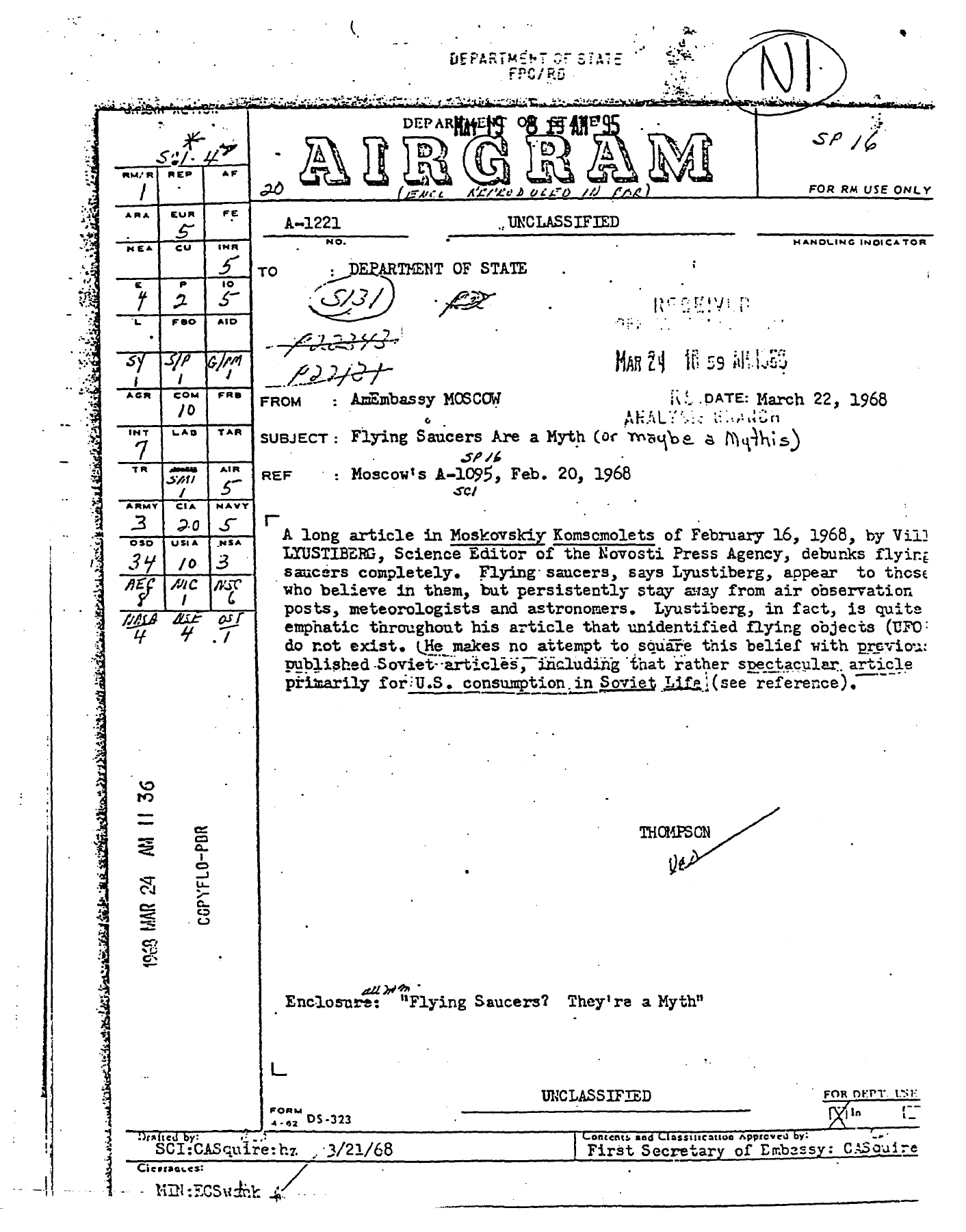
A short diplomatic dispatch from Moscow offers an unusually clear view of how UFO claims travelled through government files. Dated March 22, 1968, it records an American embassy officer reading Soviet press coverage and noticing an inconsistency. The surviving document is valuable for that exchange, without needing to turn it into evidence of a secret encounter.
The embassy’s observation
The original airgram, A-1221, was sent from the American Embassy in Moscow to the Department of State. Its cover sheet is marked unclassified. It summarizes an article published in Moskovskiy Komsomolets on February 16, 1968, by a science editor associated with the Novosti Press Agency.
According to the embassy summary, the writer dismissed flying saucers and argued that they appeared to believers while evading professional observers. The American comment then points to earlier Soviet articles, including one in Soviet Life intended primarily for American readers, which the writer had not reconciled with that position. The dispatch references an earlier Moscow airgram dated February 20.
This is the document’s strongest historical detail: a contemporary diplomat explicitly noticed conflicting presentations of the subject. Establishing why those presentations differed would require the earlier publications and their editorial context. The discrepancy alone cannot tell us whether the cause was disagreement, audience selection or a coordinated policy.
Three dates and three kinds of evidence
The file contains more than one date. February 16 identifies the newspaper article discussed on the cover. March 22 dates the embassy dispatch. The enclosed English-language text carries a March 12 date. These should remain separate in a citation rather than being compressed into a single supposed UFO-event date. No encounter on March 22 is being reported here.
There are also separate authorship layers. A press writer makes an argument. An embassy summarizes and comments on it. A modern archive makes the surviving paperwork accessible. Each layer answers a different research question. The press text can show what readers were being told; the cover note can show what American officials found worth forwarding.
Why the archive location matters
The PDF is available through the National Security Agency’s website, but the visible cover identifies the Department of State and the Moscow embassy. Describing its contents simply as an NSA conclusion would erase that distinction. A repository’s name is useful provenance, not a substitute for reading the document’s sender and purpose.
The same caution applies to the distribution markings. A routed copy establishes that material entered an administrative channel. It does not establish agreement with every statement in an enclosure. A research file may preserve contradictory positions precisely because officials wanted to understand a debate.
For readers tracing UFO history, this modest airgram supports a specific conclusion: Soviet public commentary about flying saucers drew American diplomatic attention, including criticism of its consistency. It supplies a starting point for comparing publications, dates and audiences. Any larger claim about hidden knowledge must bring additional evidence to that comparison.
Featured image: U.S. Department of State, Moscow airgram A-1221, March 22, 1968. Public-domain federal cover sheet, hosted by NSA.
Leave a Reply