DARK FIRESORIGINS UNKNOWN

Author: Dark Fires

  • Ghost Rockets of 1946: Two Hypotheses in Britain’s Intelligence Record

    Ghost Rockets of 1946: Two Hypotheses in Britain’s Intelligence Record

    The name “ghost rockets” sounds like a conclusion. In the British archival account of the Scandinavian sightings, however, the central story is a disagreement over what the reports meant. A suspected missile was not the same thing as a demonstrated missile.

    Rockets or meteors?

    The National Archives’ published briefing guide, pages 2–3, says the War Office and Air Ministry investigated Scandinavian reports in 1946–47. Some intelligence officers initially suspected Soviet launches of modified V-2s from Peenemünde. R. V. Jones instead favored bright meteors and the influence of fears of Soviet expansion.

    These are competing historical assessments. The guide is evidence that the assessments existed, not a dataset proving that one explanation fits every sighting. The distinction prevents two opposite mistakes: presenting the Soviet-rocket suspicion as a confirmed weapons program, or treating Jones’s interpretation as an individual solution to every account.

    Where the paper trail leads

    The same guide identifies Foreign Office files FO 371/56988 and FO 371/56951 for correspondence involving British officials and the air attaché in Stockholm, and AIR 40/2843 for a 1946 air-intelligence report. Those references provide a concrete route beyond repeated summaries of the episode.

    This article reviews that official archival guide; it does not claim to have examined every page of those three files. The events are from 1946–47, not a new sighting wave in 2026.

    What would distinguish the explanations?

    To test a particular rocket claim, researchers would need more than a rocket-like description: independent observations with compatible times and directions, a defensible trajectory, and physical or operational evidence connecting the event to a launch. To test a meteor explanation, they would need the individual report’s timing, duration, apparent motion and any independently recorded fireball.

    Missing information is not a vote for either side. Nor does a familiar explanation become established simply because it is plausible. The useful unit of analysis is the individual event, not the dramatic collective label.

    Why revisit it? Ghost rockets show how national-security concerns can shape the first explanation attached to an unfamiliar observation. Keeping the observation, the contemporary hypothesis and the later archival summary separate makes the history more informative, not less mysterious.

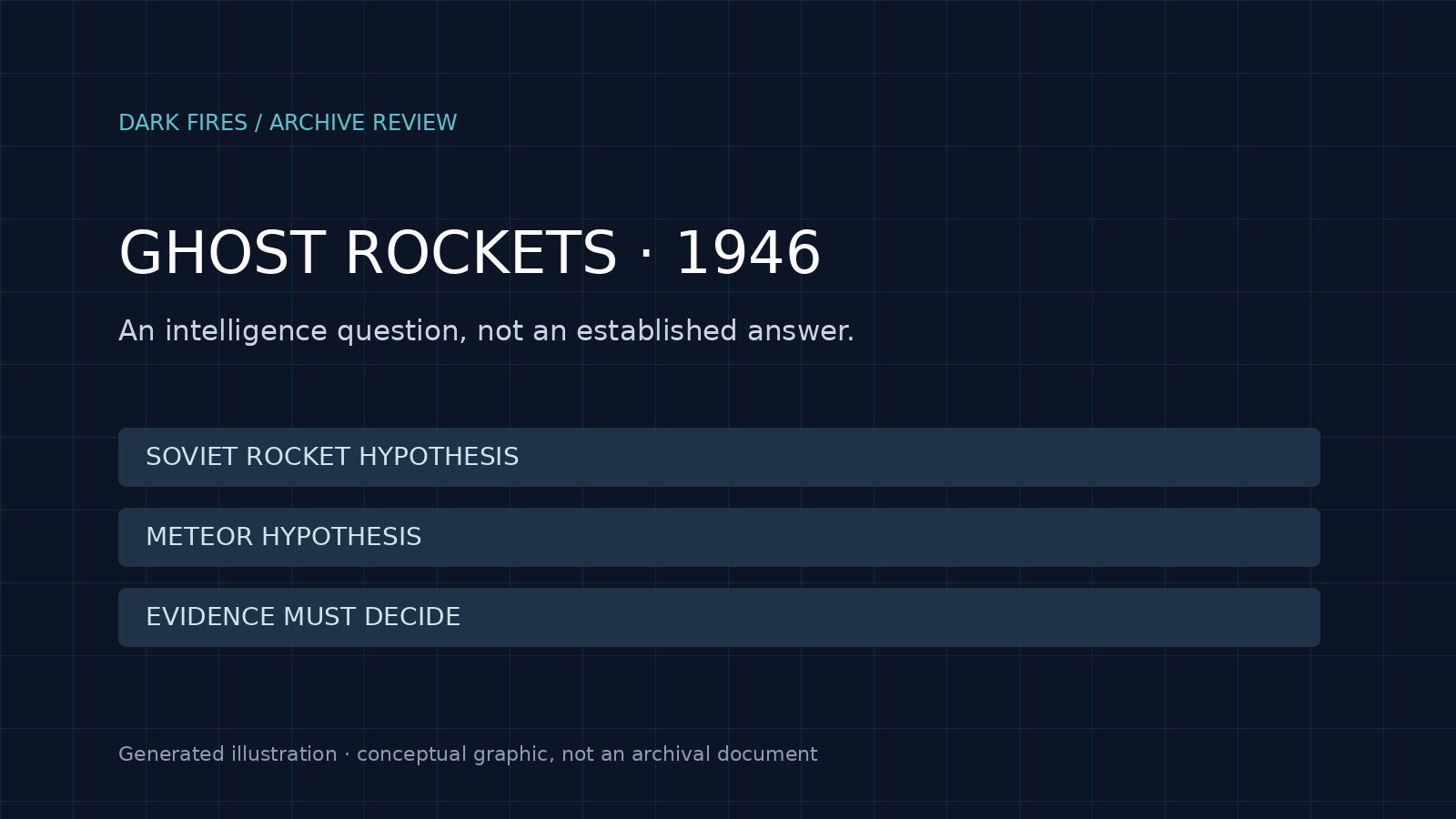
    Featured image: Generated illustration. Original Dark Fires conceptual graphic, not a historical document or reconstruction of a reported object.
  • Sheerness, 1912: What Churchill Actually Said About the Unknown Aircraft

    Sheerness, 1912: What Churchill Actually Said About the Unknown Aircraft

    An unidentified aircraft near a naval establishment prompted questions in Parliament more than three decades before the flying-saucer era. The Sheerness episode is often retold as an early UFO sighting, but the most useful starting point is narrower: what did the government actually say it had established?

    This is a historical record review, not a new sighting or a newly released investigation. The reported event was on 14 October 1912; the parliamentary exchanges followed in November and December.

    A question is not a finding

    On 18 November, an MP framed his question around a Zeppelin passing Sheerness at about 8 p.m. Colonel Seely said the authorities lacked definite information. Churchill said inquiries would be made. The wording of the question therefore should not be recycled as an official identification of a German airship.

    In a 21 November written answer, Churchill gave a more specific account: an unknown aircraft had been heard over Sheerness at about 7 p.m. on 14 October. Flares were lit at Eastchurch, but it did not land. He said the evidence did not establish nationality.

    The important follow-up

    The 27 November exchange repeated that answer. Asked whether he knew where Britain’s own airships were, Churchill said the aircraft was not one of them. That excludes one proposed category in his account; it does not provide an identification, a flight track or a technical description.

    A 5 December question again treated foreign nationality as established. Churchill’s short reply concerned precautions, not a newly presented identification. Reading only the question would make the record sound more conclusive than the earlier answer supports.

    Why the distinction matters

    The National Archives’ historical research briefing places the episode within prewar airship fears and points researchers to files AIR 1/2455 and AIR 1/2456. Those catalogue references are leads for further study, not additional witness testimony reproduced here.

    For a modern reader, three boundaries matter. A report of something heard is not automatically a detailed visual observation. An official inquiry confirms that officials investigated, not that every premise in a parliamentary question was correct. And an unidentified aircraft is not evidence of extraordinary technology merely because its nationality remained uncertain.

    The strongest claim these exchanges sustain is historically interesting enough: a report near a sensitive British installation reached Parliament, drew a stated inquiry and remained publicly unidentified in the answers reviewed here. Stronger claims require stronger records.

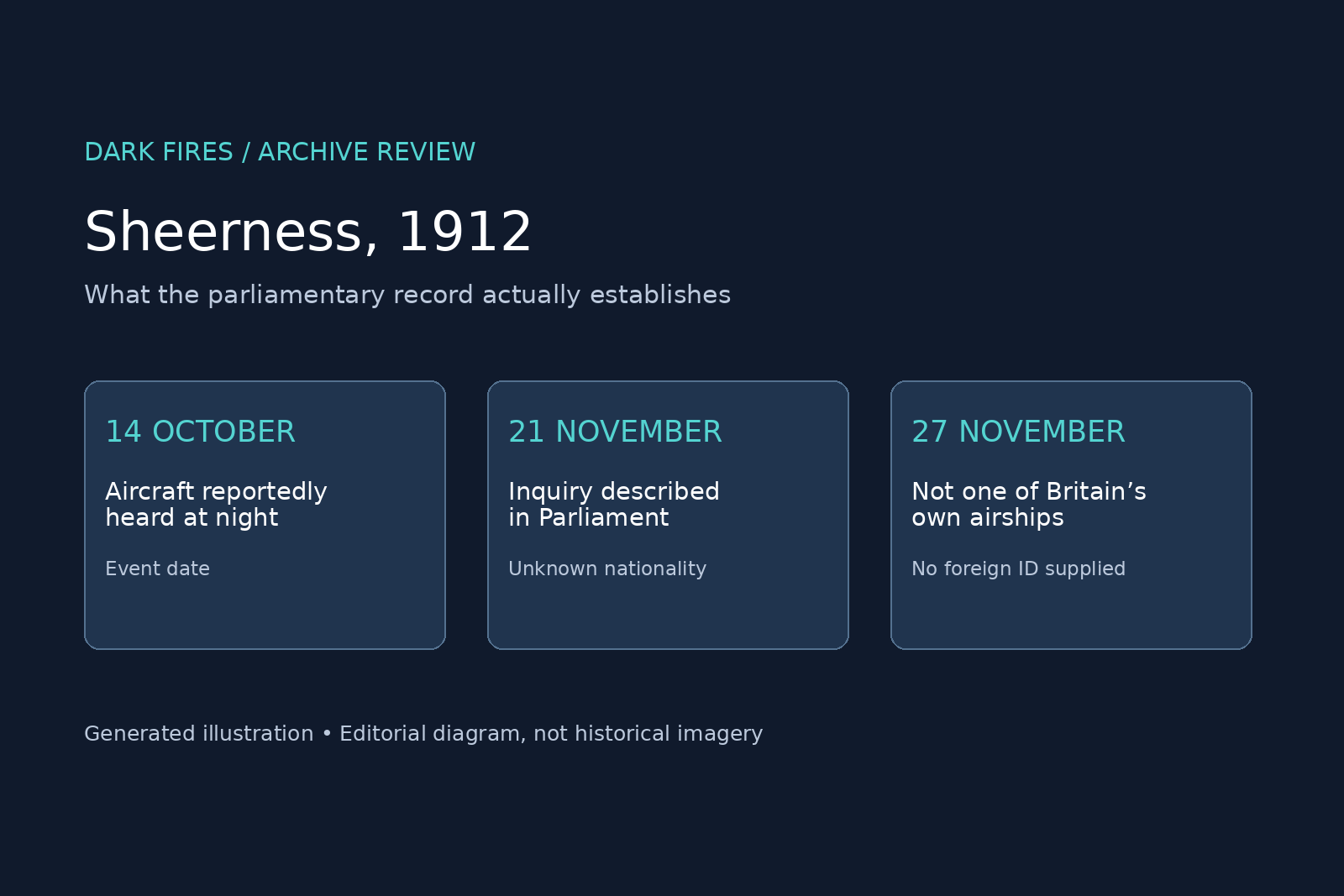
    Featured image: original Dark Fires editorial diagram, AI-authored; Generated illustration. It depicts a chronology, not the reported aircraft.

  • Sun dogs and UAP reports: checking a bright patch beside the Sun

    Sun dogs and UAP reports: checking a bright patch beside the Sun

    A brilliant patch beside the setting Sun can look detached from the weather around it. Before treating it as a hovering object, an investigator can test a specific atmospheric explanation: a sun dog, or parhelion. The useful question is not whether the image looks strange, but whether its geometry fits sunlight refracted by ice crystals.

    The pattern to look for

    The National Weather Service explanation of halos, sun dogs and pillars places sun dogs to either side of the Sun, commonly about 22 degrees away. Thin, high clouds can contain the ice crystals responsible even when the ground is warm. A halo and a sun dog are related optical effects, not interchangeable names for every bright patch.

    A useful documented example comes from the Hong Kong Observatory’s September 2009 analysis of a photograph taken on July 2, 2009. Its account combines the spot’s position and color with cloud and upper-air observations. A reddish inner edge, paler outer portion and roughly level position beside a low Sun were clues, not a verdict based on shape alone.

    Why one bright spot is possible

    A missing partner does not rule out a sun dog. The Hong Kong Observatory notes that suitable crystals need not be distributed evenly; cloud or an obstruction can also hide one side. Conversely, two lights are not enough to establish the explanation. Their angular relationship to the Sun and the atmospheric setting still matter.

    The familiar 22-degree spacing is a useful low-Sun reference, not a universal exact measurement for every solar elevation. A cropped image that omits the Sun removes an important test. Image pixels also cannot be converted to degrees without knowing the lens field of view and any crop.

    A practical record checklist

    • Preserve the original uncropped frame, timestamp and viewing location. Record which direction the camera faced.
    • Note the Sun’s position relative to the patch using existing photographs or a safe reconstruction. Never stare at the Sun or aim unfiltered binoculars or a telescope at it.
    • Check whether the patch stayed at a similar elevation to the Sun, whether a second patch or halo was visible, and how clouds changed during the observation.
    • Compare contemporaneous cloud records with the geometry. Cloud evidence supports a mechanism; it does not substitute for the image.

    These are suggested documentation steps, not a claim that a particular unexplained report has been solved. A poor geometric match should weaken the sun-dog hypothesis. A strong match should be explained openly, including which measurements were actually available. The aim is to distinguish a testable atmospheric identification from a resemblance offered after the fact.

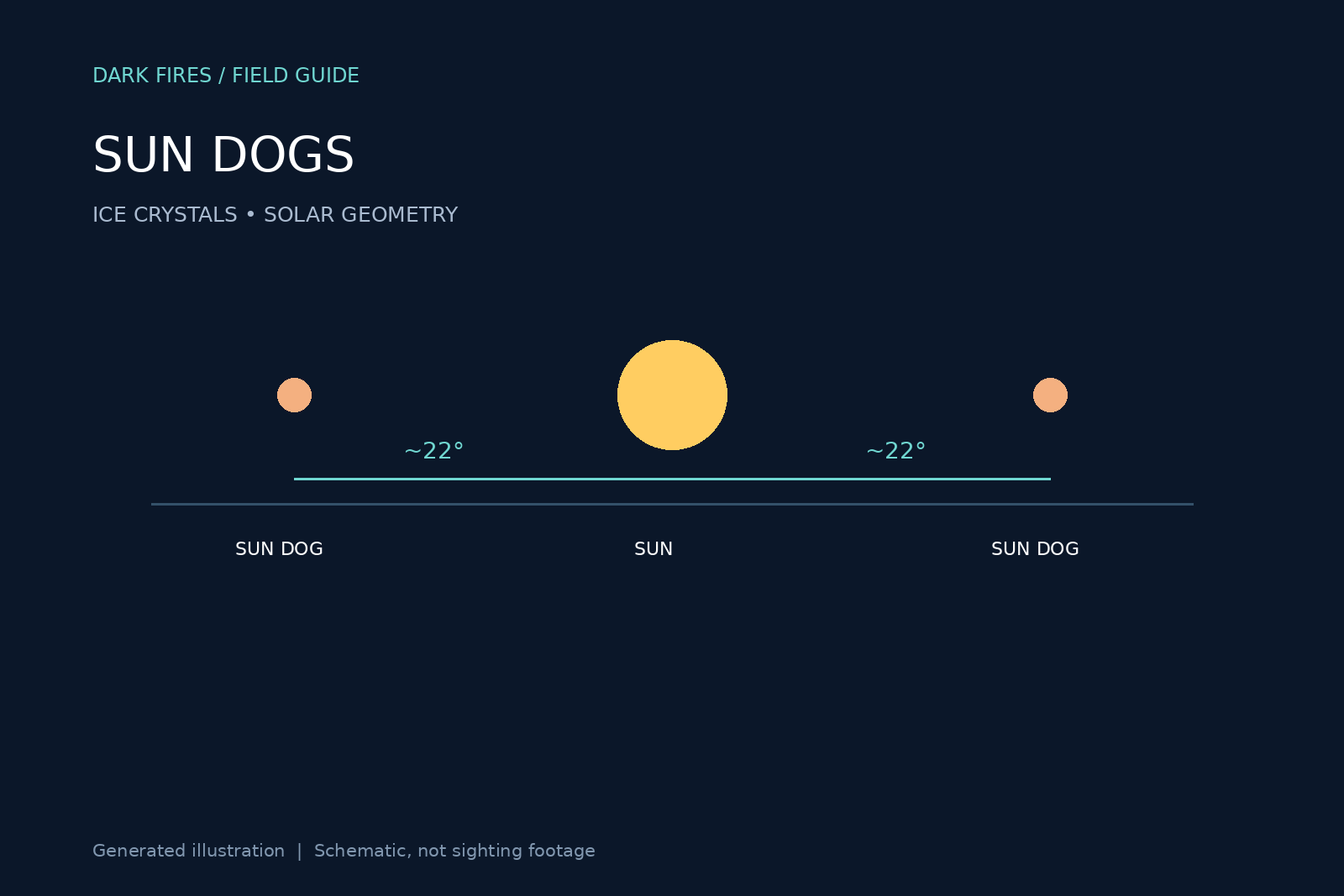
    Featured image: original Dark Fires schematic. Generated illustration; not an observation or sighting photograph.

  • A Young Stellar Neighborhood Makes SN 2026ahvu a Prompt-Supernova Candidate

    A Young Stellar Neighborhood Makes SN 2026ahvu a Prompt-Supernova Candidate

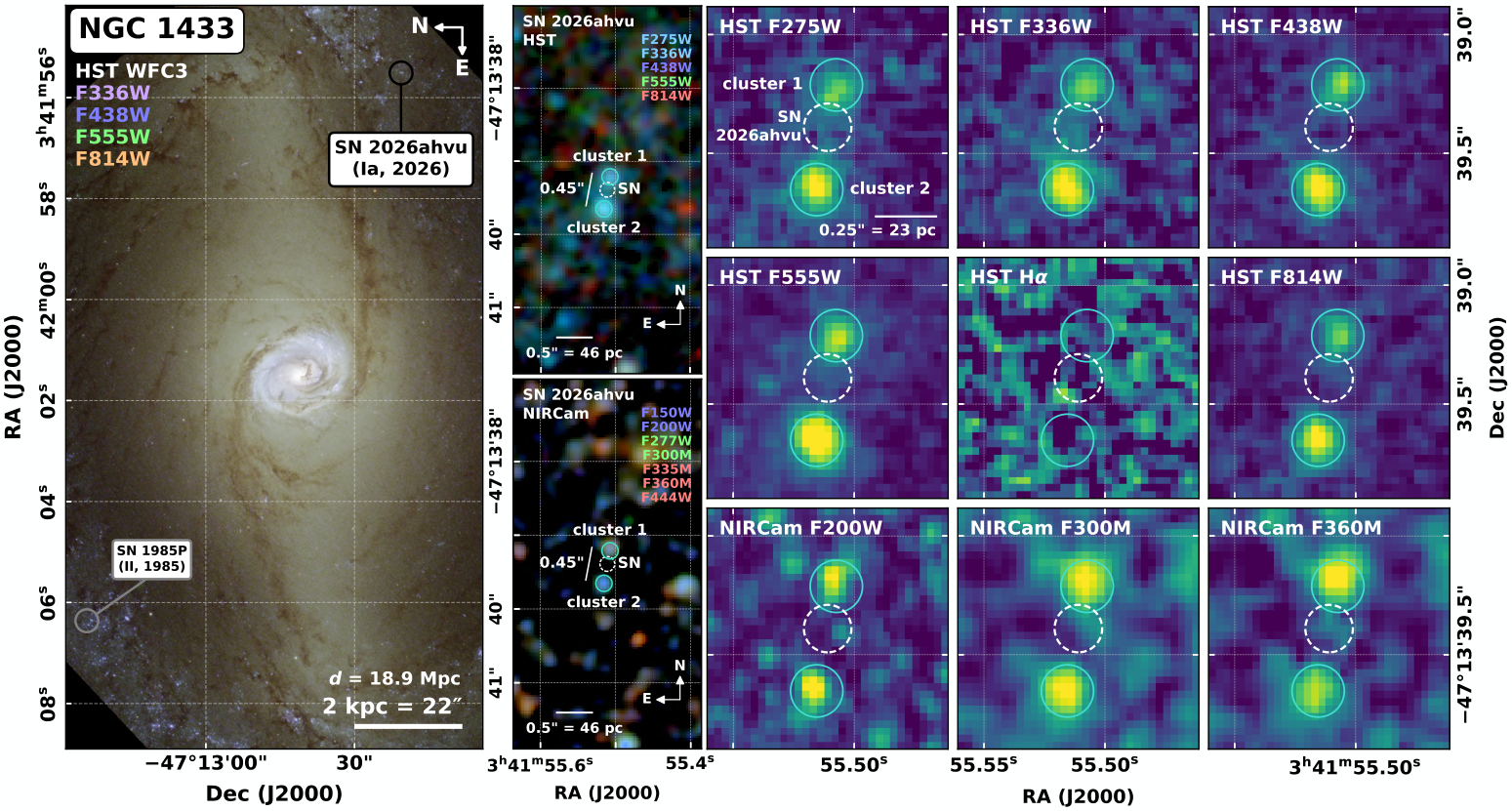
    A newly reported Type Ia supernova in NGC 1433 may offer an unusually direct way to measure how quickly an exploding white-dwarf system can form. The important word is may: the case depends on whether the supernova really belongs to one of two nearby young star clusters, rather than merely appearing beside them.

    In a preprint submitted on November 6, 2026, Sumit K. Sarbadhicary and colleagues analyze archival Hubble and James Webb observations from the PHANGS survey. They identify two ultraviolet-bright clusters close to the reported position of SN 2026ahvu. The study was submitted to the Astrophysical Journal Letters; its posting is not evidence of completed peer review.

    An explosion, then a search through older images

    The paper dates the ATLAS discovery to November 2, 2026, and reports that follow-up Keck spectroscopy classified the event as Type Ia. These are thermonuclear explosions involving carbon-oxygen white dwarfs in binary systems. Their delay time is the interval between formation of the progenitor population and the eventual explosion, not the time since astronomers noticed the flash.

    The archival images matter because they show the stellar environment before this event. The candidate clusters sit only 0.19 and 0.26 arcseconds from the reported supernova position. The authors estimate a roughly 0.4% chance of an unrelated Type Ia falling this close to a catalogued cluster under their calculation. That is an argument for association, not a direct measurement of membership or a guarantee that either cluster is the birthplace.

    Two possible clocks

    Fitting the clusters’ light across Hubble and Webb bands gives estimated ages of about 37 million and 95 million years. Either would place an associated supernova in the prompt population, with a delay below roughly 100 million years. The younger estimate is particularly interesting: it approaches the minimum time needed for the progenitor star to become a white dwarf.

    These ages are model-dependent. The paper also reports different estimates when only Hubble observations are used, and discusses conflicting published distances to NGC 1433. Changing the distance changes the physical separation represented by a small angle on the sky. Most importantly, the discovery position does not yet have a formally reported uncertainty; the authors adopt a plausible precision from ATLAS performance.

    Why the distinction matters

    A well-established cluster association could link an individual Type Ia to a relatively simple stellar population, giving a sharper evolutionary clock than a galaxy-wide average. That could help test which binary-star pathways produce the fastest explosions. It would not, by itself, identify the companion or prove a particular explosion mechanism.

    For now, this is a promising candidate and a clearly stated hypothesis. Improved positional measurements and scrutiny of the cluster ages are more consequential than treating the headline’s short delay as settled.

    Featured figure: archival Hubble/Webb imaging with the supernova position marked, not a photograph of the explosion. Sarbadhicary et al., Figure 1, CC BY 4.0; Hubble image credit ESA/Hubble & NASA.

  • Foo Fighters Before Flying Saucers: Following the RAF’s Wartime Record Trail

    Foo Fighters Before Flying Saucers: Following the RAF’s Wartime Record Trail

    Before “flying saucer” became a familiar phrase, wartime aircrew were already reporting puzzling lights. The British paper trail matters because it lets us separate a real history of military reporting from later claims that every unexplained light was the same extraordinary machine.

    What the archive actually establishes

    The UK National Archives’ UFO briefing guide describes RAF reports of balls of fire and lights that seemed to follow Allied aircraft. It says the RAF collected “night phenomena” reports from 1942 and later exchanged intelligence with the United States. Suspected German weapons were an interpretation, not an identification; the guide says no recovered advanced weapon explained the foo fighters after the war.

    That is a narrower claim than proof of nonhuman technology. A wartime intelligence service had reason to investigate something unfamiliar near its aircraft without first knowing whether the report concerned a weapon, a natural phenomenon or an observational mistake.

    A file reference is a starting point

    The guide directs researchers to AIR 2/5070 and AIR 14/2800. There is independent official confirmation of the second reference in a House of Lords written answer dated October 14, 1998. The answer lists AIR 14/2800 as the December 1943 No. 115 Squadron news sheet Bang On, No. 1, with aerial-phenomena reports from RAF bombing raids.

    The 1943 date belongs to the wartime material; 1998 is the parliamentary listing. Neither should be presented as a newly reported encounter. This review uses the archive’s published guide and Parliament’s catalogue description, not a newly examined scan of every underlying aircrew report.

    What a serious comparison would require

    The next useful step is not to collect more dramatic retellings under one nickname. It is to compare individual reports: who observed the light, whether observations were independent, the aircraft’s heading and maneuvers, duration, weather, and any contemporaneous instrumentation. “Appeared to follow” alone does not supply distance, speed or a flight path.

    It is equally important not to turn a missing explanation into a dismissal of the witnesses. An authentic report can preserve a sincere observation while leaving its cause unsettled. Conversely, an official file can contain an untested hypothesis without endorsing it.

    Bottom line: the wartime records establish a documented reporting problem worth studying. They do not, by their existence alone, establish a common cause for all foo-fighter accounts.

    Featured image: Generated illustration. Original Dark Fires conceptual graphic, not archival evidence or sighting footage.

  • A Compact Quasar Pair Puts Early Black-Hole Growth Under a Closer Lens

    A Compact Quasar Pair Puts Early Black-Hole Growth Under a Closer Lens

    Two bright sources in the young universe are presenting astronomers with a combined problem: explaining how enormous black holes grew early, and why two were active so close together. The system, J1602+4228AB, has been given the Hawaiian name Nāpōwawāʻenakaulua.

    An INAF report published November 11, 2026 describes the pair as it appeared roughly 900 million years after the Big Bang. The research was published in The Astrophysical Journal Letters on November 10; a preprint had been available since September 25. The result combines observations rather than marking the date on which the objects suddenly became active.

    Separating two distant sources

    The Aether survey with the James Webb Space Telescope first revealed the second quasar. Follow-up work with Gemini North in Hawaiʻi helped separate and characterize the closely spaced sources. INAF identifies the night of May 2–3, 2025 as a key observing window, when unusually favorable conditions allowed the ground-based work to succeed.

    A quasar’s brilliant appearance comes from material feeding a supermassive black hole. Astronomers therefore study the surrounding radiation to infer the properties of an object that does not itself emit visible light from within its event horizon. Two resolved bright sources offer much more useful information than one blended patch.

    The team used spectra from Webb’s NIRSpec instrument and Gemini’s GNIRS and GMOS instruments. Spectra separate light by wavelength, allowing researchers to compare emission features and estimate properties that a picture alone cannot establish.

    Close on a galactic scale

    The paper reports an angular separation of 0.98 arcseconds, corresponding to approximately 5.56 kiloparsecs in projected physical separation. That is a little over 18,000 light-years. The word “projected” matters: the measurement describes separation across our view of the sky, not a fully mapped three-dimensional distance.

    The estimated black-hole masses are about 1.5 billion and 400 million times the Sun’s mass. Their spectra place both sources at a redshift near 6.08. Those measurements make the system a valuable probe of an early period when massive galaxies and their central black holes were still assembling.

    The authors also compare the pair with expectations obtained by extending quasar-clustering measurements from larger distances between objects. Their analysis finds a substantial excess over those extrapolated expectations. They propose merger-triggered activity or an unusually dense environment as possible explanations, rather than claiming that one pair determines the whole early-universe population.

    A stronger test, not a completed explanation

    The result adds two connected constraints to growth models: the presence of already massive black holes and their simultaneous activity at close separation. A model must account for feeding conditions as well as the accumulation of mass. More examples could show whether this configuration is rare or whether surveys have missed a larger population of close pairs.

    The NOIRLab image accompanying the announcement is an artist’s impression, with the quasars and early-universe environment placed above Maunakea. It illustrates the discovery’s setting; it is not a photograph of giant bubbles or of the black holes’ immediate surroundings.

    The scientific advance rests on the observational record beneath that illustration: distinct sources, measured spectra and explicit comparisons with models. Together they sharpen an existing question about early black-hole growth without yet supplying its final answer.

    Artist impression of Nāpōwawāʻenakaulua above Maunakea, not a direct photograph of the pair’s surroundings. Credit: International Gemini Observatory/NOIRLab/NSF/AURA/P. Marenfeld/M. Zamani. CC BY 4.0. Image resized. Image source · License.

  • Plato’s Guest Observers Will Use Stellar Pulsations to Investigate Galactic History

    Plato’s Guest Observers Will Use Stellar Pulsations to Investigate Galactic History

    Europe’s next major planet-hunting mission is also preparing to investigate the histories written inside stars. In a November 11, 2026 report, Italy’s National Institute for Astrophysics detailed results from Plato’s first guest-observer call: 23 proposals approved and another 28 on a waiting list, from 117 submissions.

    The distinction between approved and waiting-list programs is important. The selections describe planned research, not measurements already obtained. Some observations remain dependent on the spacecraft’s performance and the available observing resources.

    Planet hunting depends on understanding stars

    ESA’s Plato factsheet lists a planned 2027 launch and a mission built around 26 cameras. The spacecraft will look for the small brightness changes caused by planets crossing their stars, while also studying stellar properties. Its observing location will be around the Sun–Earth L2 region, about 1.5 million kilometers from Earth.

    The same sustained brightness measurements can expose stellar oscillations. This technique, asteroseismology, uses patterns in a star’s pulsations to investigate its interior. The connection to exoplanets is practical: estimating a planet’s size and interpreting its evolutionary setting both require a sound understanding of its host star.

    For guest observers, those stellar measurements also become a scientific destination in their own right. Instead of treating every change in brightness as a possible planetary crossing, researchers can investigate what different patterns reveal about the stars themselves.

    Two approved investigations of old populations

    INAF describes an approved program led by Andrea Miglio targeting about 50 evolved stars in the globular clusters NGC 1851 and NGC 2298. Another, led by Ellen Ivana Leitinger, targets approximately 600 metal-poor red giants in the Milky Way’s halo. The first will test stellar-evolution models; the second aims to improve the chronology of the galaxy’s assembly.

    The two other Italian-led projects discussed in the report remain on the waiting list. They concern open clusters and blue stragglers, stars whose interactions with companions can complicate ordinary age estimates. They should not be presented as guaranteed observing allocations.

    A cluster with more than one history

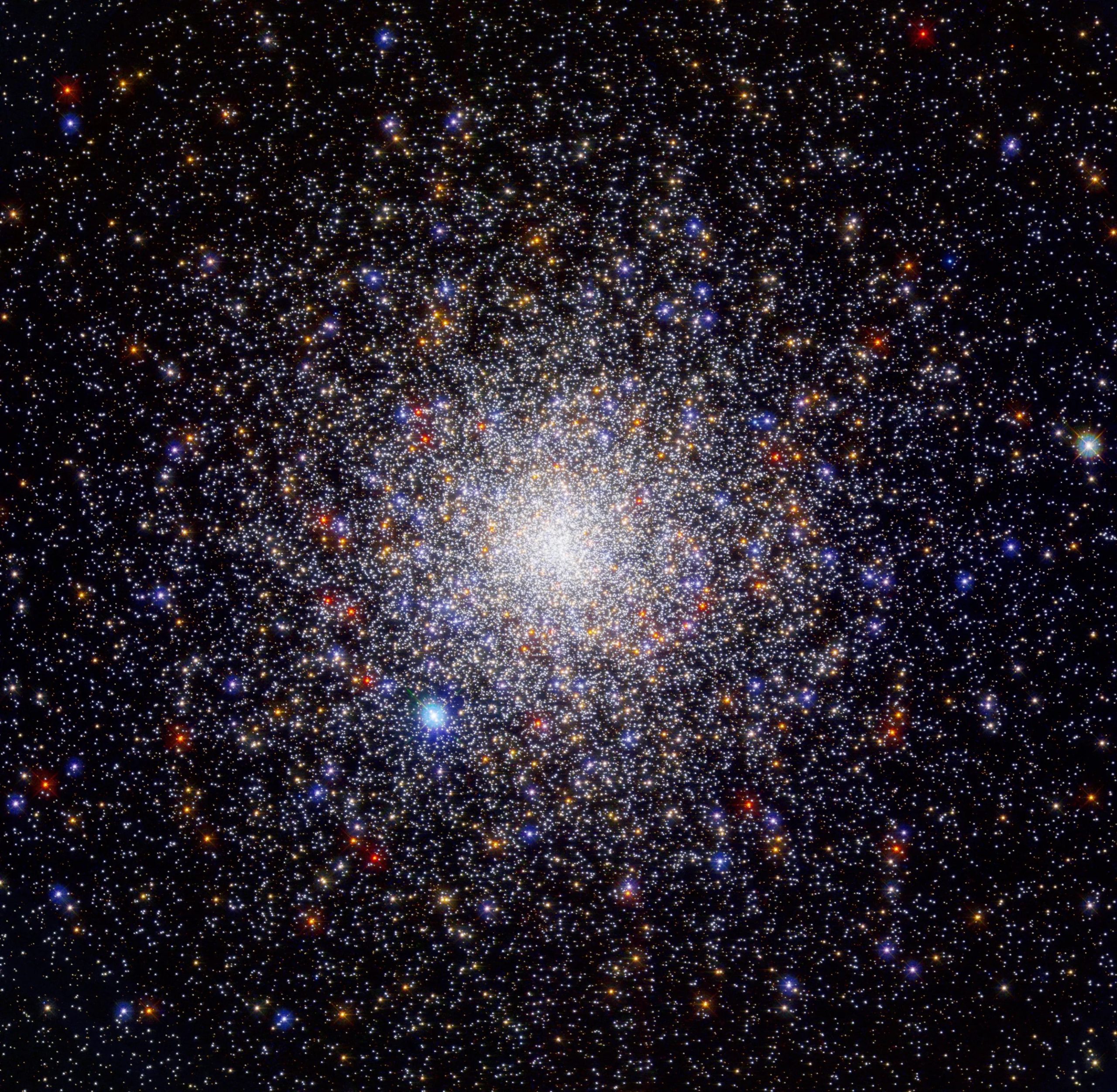
    NGC 1851 illustrates why the approved work matters. NASA’s Hubble account describes a dense cluster with multiple stellar populations and a diffuse surrounding halo. One proposed explanation is that it preserves the aftermath of two clusters merging within a dwarf galaxy. That remains an interpretation, rather than a settled origin story.

    Better stellar measurements can test such histories. A visible arrangement of stars provides one kind of evidence; their masses, evolutionary stages and ages supply another. Agreement between those lines of evidence would strengthen a reconstruction, while disagreement could expose assumptions in the models.

    Plato’s selections are therefore a meaningful planning milestone. They establish which questions researchers intend to pursue with the mission’s precise, repeated observations. The conclusions about galactic history must wait for data, but the approved programs show how a planet-searching observatory can also examine the stellar framework in which planets form.

    NGC 1851, one of the clusters targeted by an approved Plato program. Credit: NASA, ESA, and G. Piotto (Università degli Studi di Padova); processing: Gladys Kober (NASA/Catholic University of America). CC BY 2.0. Image resized. Image source · License.

  • Reading the Spectrum of an Unexplained Sky Light

    Reading the Spectrum of an Unexplained Sky Light

    A green flash, orange orb or blue-white streak can sound like a chemical clue. In practice, the color reported by a witness or recorded in an ordinary video compresses a great deal of information. Spectroscopy spreads that light into wavelengths, giving investigators a more specific measurement to compare with possible sources.

    A pattern is more useful than a color name

    NIST’s introduction to spectroscopy explains how emitted or absorbed light can reveal the substances involved. Atoms and molecules produce characteristic spectral features. A measured pattern can therefore support an identification that “green” or “white” alone cannot.

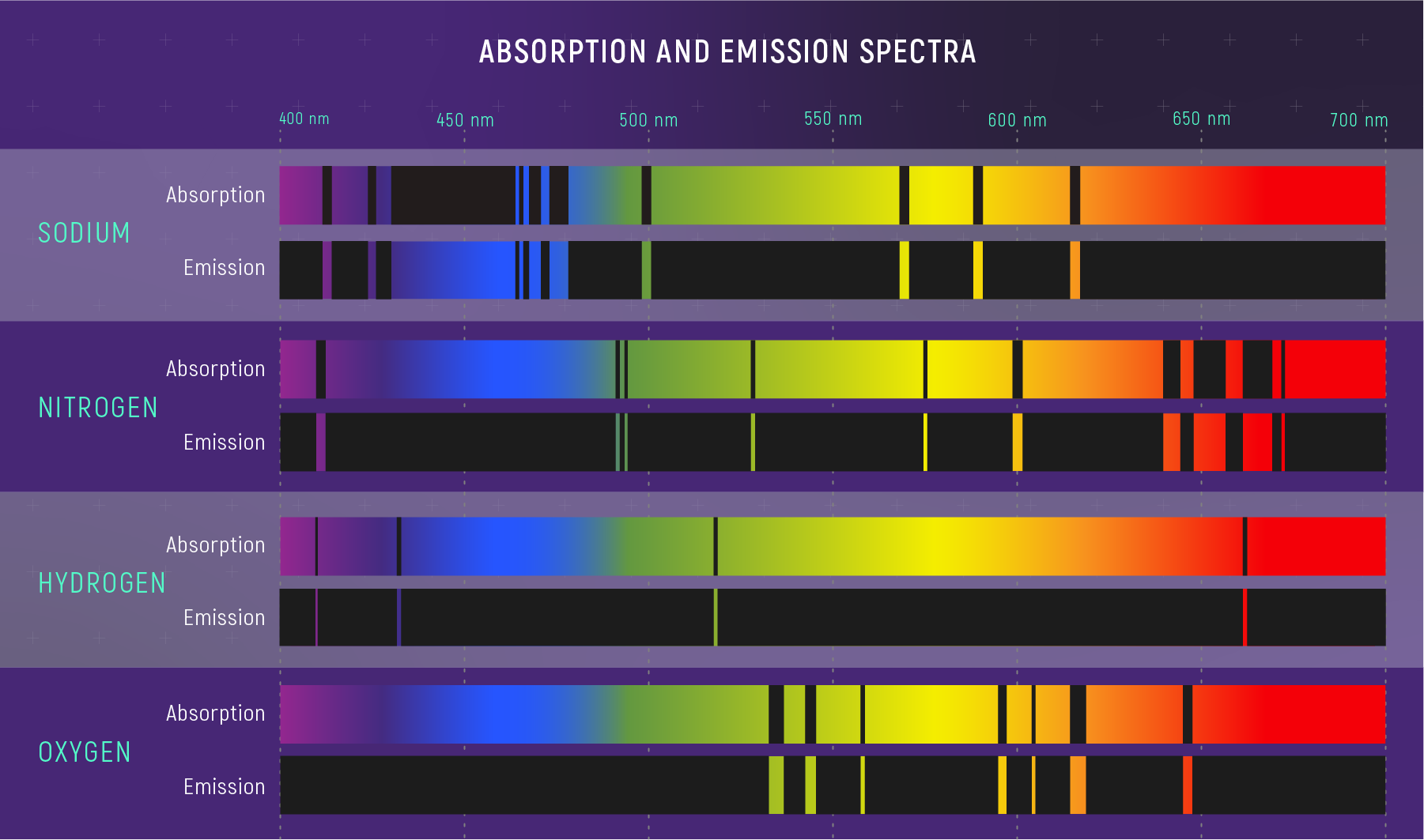
    NASA’s comparison of absorption and emission spectra shows how individual elements have distinctive arrangements of lines. The relevant evidence is the position and pattern of those features, rather than a single bright patch somewhere in the visible range.

    A conventional color camera does not usually record that detailed arrangement. Its broad color channels combine light across wavelength ranges. Two sources can consequently appear similar in a video while producing different spectra when examined with an appropriate instrument. Spectroscopy adds a measurement; enlarging the color image does not recover the missing spectral detail.

    Meteor research demonstrates the difficulty

    A useful caution comes from Althea Moorhead and Aaron Kingery’s 2020 meteor-color study, archived by NASA. The researchers tested whether broad filter measurements could recover established meteor spectral classifications. They found that color alone could not generally retrieve those classifications, with a possible exception for iron meteoroids.

    That result should not be expanded into a rule that color is worthless. It shows why the strength of a chemical claim must match the resolution of the measurement. An unusual-looking color can motivate closer examination without uniquely identifying either the material or the mechanism producing the light.

    The light and the object are not identical evidence

    Even a well-measured spectrum needs physical interpretation. Light may come from heated material, surrounding gas or illumination reflected by an object. Identifying an emitting substance does not automatically reveal the composition of an entire solid body, much less its origin or propulsion system.

    Investigators should first establish that the spectrum belongs to the reported target. In a crowded field, another light source can overlap the dispersed image. The original recording, timing and sky position help connect the spectral trace to the event. A separate view of the scene can be especially useful for checking that association.

    Calibration then determines whether positions on the detector map reliably to wavelength and how sensitively the instrument responds across the recorded band. Saturated or weak features deserve explicit treatment. A line identification is stronger when several expected features agree than when one uncertain peak is assigned to a preferred substance.

    The resulting report should show the measured spectrum, uncertainties, calibration procedure and competing interpretations. It should say which features were actually detected and which were merely consistent with the data. For UAP research, spectroscopy is most useful when it narrows a physical question that other observations can test. A credible chemical fingerprint can be an important step toward explaining a light without becoming a shortcut to identifying a craft.

    Featured image: Absorption and emission spectra of several elements. Illustration: NASA, ESA, CSA, Leah Hustak (STScI). Image source.

  • What a UAP Survey Can Learn From Finding Nothing

    What a UAP Survey Can Learn From Finding Nothing

    A sky survey can operate for months without producing a convincing anomalous detection and still make a scientific contribution. The essential question is what population of events it was capable of finding. A survey that measures its limits can constrain a claim; one that merely accumulates recording hours cannot turn silence into a reliable rate.

    Define the target before counting

    “No UAP detected” is too broad unless the survey explains what counted as a detection. Was it looking for objects above a minimum infrared brightness, within a measured distance, or exhibiting a specified motion? Were ambiguous tracks retained for follow-up or discarded? These choices define the result’s reach.

    Consider a deliberately simplified example: a survey looks for a defined class of bright events within a fixed monitored region. It obtains 100 usable hours and detects none. If events occur independently at a steady rate, and every qualifying event would be detected, the Poisson distribution described by NIST gives a useful way to interpret that zero.

    When the expected count is about three, the probability of observing zero is about five percent. Under those assumptions, zero detections therefore gives an approximately 95-percent one-sided upper confidence limit of three expected events over the observation period. In this illustrative 100-hour survey, that corresponds to roughly 0.03 events per hour in the defined monitored region.

    This is a statistical limit under a model, not a 95-percent probability that every conceivable anomalous object is absent. It says nothing about objects outside the survey’s region or below its sensitivity threshold. The example is a calculation, not a reported result from an actual UAP observatory.

    Count the chances the instrument really had

    If the system catches only half of qualifying events, the same observing time provides less constraining power. Weather, blocked sightlines, maintenance and selection rules can all reduce effective exposure. Efficiency may also change with distance, speed, apparent size and brightness, so one percentage may not describe the entire search.

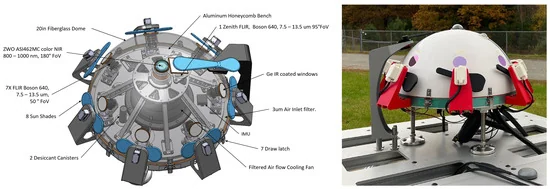
    A practical example of measuring those losses appears in the Galileo Project’s January 28, 2025 infrared-array commissioning paper. The authors reported 41-percent acceptance for ADS-B-equipped aircraft passing through the effective field of view within range, and a separate mean frame-by-frame aircraft detection efficiency of 36 percent. Those quantities describe different stages of the system and should not be casually interchanged.

    Nor can aircraft performance automatically establish sensitivity to every unknown object. A small, faint or unusually fast target might interact differently with the detection and tracking software. Simulated signals and known comparison targets can help measure those differences, provided the tests reproduce the conditions relevant to the proposed search.

    Publish the limits with the result

    A useful null-result report should state the observing interval, usable coverage, target definition, detection efficiency and statistical assumptions. It should also explain how unresolved candidates were handled. Zero confirmed anomalies is not necessarily the same dataset as zero candidates.

    This approach gives future observers something concrete to improve: longer effective exposure, broader coverage or a better-tested detection threshold. It also lets a claimed event rate face a meaningful test. Finding nothing becomes informative when the survey shows, quantitatively, what it was positioned to find.

    Featured image: Technical drawing and photograph of the Galileo Project’s Dalek infrared array. Credit: Laura Domine and colleagues, Sensors (2025), Figure 1, CC BY 4.0. Image source. License: CC BY 4.0.

  • Britain’s Six Saucers of 1967: Real Objects, Manufactured Mystery

    Britain’s Six Saucers of 1967: Real Objects, Manufactured Mystery

    On September 4, 1967, six small saucer-shaped objects were discovered across southern England. Police and military personnel responded to something tangible. The objects were a student hoax, but the episode remains useful UFO history because it separates three facts that are too easily bundled together: an object existed, officials investigated it, and its proposed extraordinary origin was false.

    The National Archives’ March 2011 UFO-file highlights guide, available here in a preserved copy, identifies the relevant record as DEFE 24/1986. Its summary describes discoveries in a line from Sheppey to the Bristol Channel and a response involving four police forces, bomb-disposal personnel, the army and Ministry of Defence intelligence staff. It attributes the stunt to engineering students from Farnborough Technical College.

    Objects that could be opened

    Filmmaker John Keeling’s published account of interviews with participants adds a physical explanation. At Chippenham, he describes a silvery object that made electronic sounds. Examination exposed ordinary components including batteries, a circuit, a loudspeaker and a switch, along with foul-smelling flour-and-water material.

    Keeling’s account is retrospective oral history, published online on August 2, 2017 and identified as reproducing a 2007 magazine article. Its remembered dialogue should not be confused with a verbatim 1967 police log. Still, the reported construction details provide something a distant-light narrative often lacks: a proposed mechanism that can be compared with the recovered object and with the builders’ account.

    This changes the evidentiary task. Investigators are no longer limited to estimating an unknown object’s size or speed from appearance. They can inspect manufacture, identify components and connect the artifact to people capable of making it. A real physical object can therefore supply evidence for a hoax just as readily as for a genuinely unexplained event.

    Why later secrecy needs context

    The archival guide also describes later correspondence about a television programme. Officials were concerned that an interview with a retired RAF group captain might reveal information about intelligence interest in UFOs. That concern belongs to the history of handling and discussing the case. It cannot, on its own, reverse the identification of the objects as student constructions.

    Likewise, calling bomb disposal or involving intelligence personnel does not tell us what officials ultimately believed. Unfamiliar objects can warrant caution before their contents are known. The response is evidence of a response, and its meaning depends on the findings that followed.

    The case is unusually effective at exposing selective citation. A summary that stops after “six saucers” and “military investigation” leaves out the evidence that resolves the episode. A summary that dismisses every witness as dishonest also fails: people could accurately report the objects they encountered while being mistaken about their origin.

    Keeping the discovery, the examination and the eventual identification together produces a stronger historical account. The six saucers were manufactured mysteries. The record of how people dealt with them is real, and worth reading without removing its conclusion.

    Generated illustration

    The featured artwork illustrates archival research. It is not a photograph of the 1967 objects or a reconstruction of their discovery.