Two bright sources in the young universe are presenting astronomers with a combined problem: explaining how enormous black holes grew early, and why two were active so close together. The system, J1602+4228AB, has been given the Hawaiian name Nāpōwawāʻenakaulua.
An INAF report published November 11, 2026 describes the pair as it appeared roughly 900 million years after the Big Bang. The research was published in The Astrophysical Journal Letters on November 10; a preprint had been available since September 25. The result combines observations rather than marking the date on which the objects suddenly became active.
Separating two distant sources
The Aether survey with the James Webb Space Telescope first revealed the second quasar. Follow-up work with Gemini North in Hawaiʻi helped separate and characterize the closely spaced sources. INAF identifies the night of May 2–3, 2025 as a key observing window, when unusually favorable conditions allowed the ground-based work to succeed.
A quasar’s brilliant appearance comes from material feeding a supermassive black hole. Astronomers therefore study the surrounding radiation to infer the properties of an object that does not itself emit visible light from within its event horizon. Two resolved bright sources offer much more useful information than one blended patch.
The team used spectra from Webb’s NIRSpec instrument and Gemini’s GNIRS and GMOS instruments. Spectra separate light by wavelength, allowing researchers to compare emission features and estimate properties that a picture alone cannot establish.
Close on a galactic scale
The paper reports an angular separation of 0.98 arcseconds, corresponding to approximately 5.56 kiloparsecs in projected physical separation. That is a little over 18,000 light-years. The word “projected” matters: the measurement describes separation across our view of the sky, not a fully mapped three-dimensional distance.
The estimated black-hole masses are about 1.5 billion and 400 million times the Sun’s mass. Their spectra place both sources at a redshift near 6.08. Those measurements make the system a valuable probe of an early period when massive galaxies and their central black holes were still assembling.
The authors also compare the pair with expectations obtained by extending quasar-clustering measurements from larger distances between objects. Their analysis finds a substantial excess over those extrapolated expectations. They propose merger-triggered activity or an unusually dense environment as possible explanations, rather than claiming that one pair determines the whole early-universe population.
A stronger test, not a completed explanation
The result adds two connected constraints to growth models: the presence of already massive black holes and their simultaneous activity at close separation. A model must account for feeding conditions as well as the accumulation of mass. More examples could show whether this configuration is rare or whether surveys have missed a larger population of close pairs.
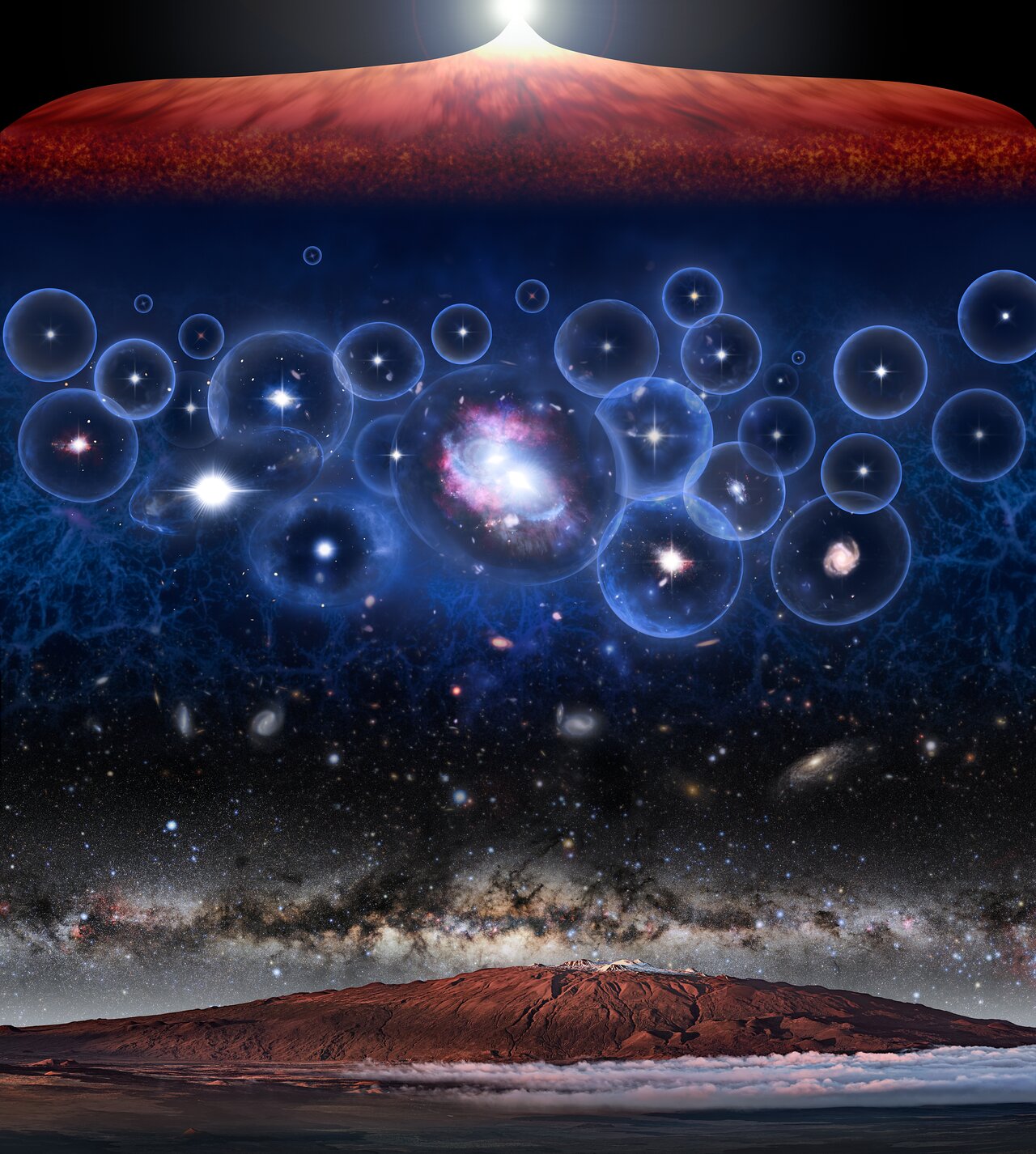
The NOIRLab image accompanying the announcement is an artist’s impression, with the quasars and early-universe environment placed above Maunakea. It illustrates the discovery’s setting; it is not a photograph of giant bubbles or of the black holes’ immediate surroundings.
The scientific advance rests on the observational record beneath that illustration: distinct sources, measured spectra and explicit comparisons with models. Together they sharpen an existing question about early black-hole growth without yet supplying its final answer.
Artist impression of Nāpōwawāʻenakaulua above Maunakea, not a direct photograph of the pair’s surroundings. Credit: International Gemini Observatory/NOIRLab/NSF/AURA/P. Marenfeld/M. Zamani. CC BY 4.0. Image resized. Image source · License.
Leave a Reply