An unidentified aircraft near a naval establishment prompted questions in Parliament more than three decades before the flying-saucer era. The Sheerness episode is often retold as an early UFO sighting, but the most useful starting point is narrower: what did the government actually say it had established?
This is a historical record review, not a new sighting or a newly released investigation. The reported event was on 14 October 1912; the parliamentary exchanges followed in November and December.
A question is not a finding
On 18 November, an MP framed his question around a Zeppelin passing Sheerness at about 8 p.m. Colonel Seely said the authorities lacked definite information. Churchill said inquiries would be made. The wording of the question therefore should not be recycled as an official identification of a German airship.
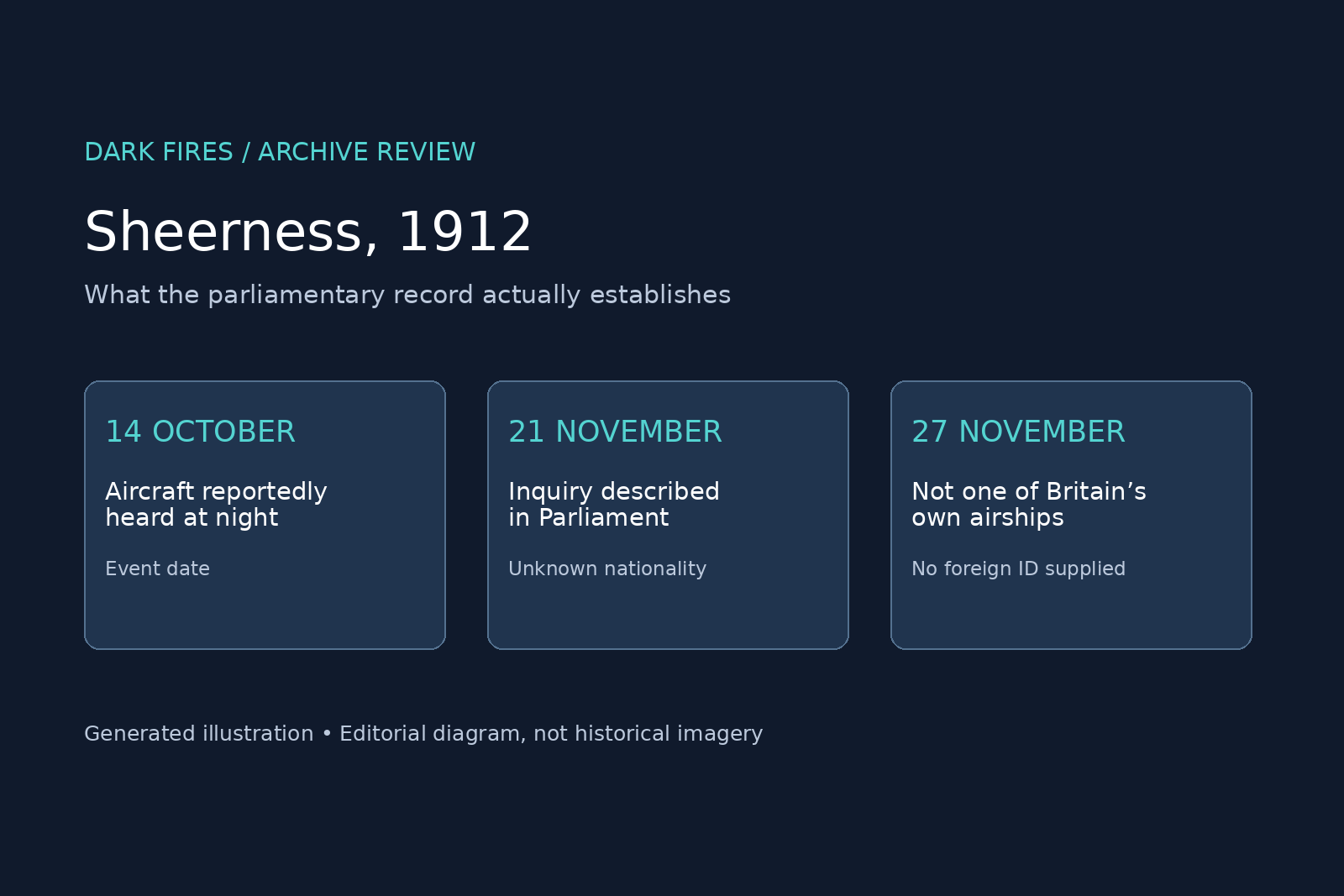
In a 21 November written answer, Churchill gave a more specific account: an unknown aircraft had been heard over Sheerness at about 7 p.m. on 14 October. Flares were lit at Eastchurch, but it did not land. He said the evidence did not establish nationality.
The important follow-up
The 27 November exchange repeated that answer. Asked whether he knew where Britain’s own airships were, Churchill said the aircraft was not one of them. That excludes one proposed category in his account; it does not provide an identification, a flight track or a technical description.
A 5 December question again treated foreign nationality as established. Churchill’s short reply concerned precautions, not a newly presented identification. Reading only the question would make the record sound more conclusive than the earlier answer supports.
Why the distinction matters
The National Archives’ historical research briefing places the episode within prewar airship fears and points researchers to files AIR 1/2455 and AIR 1/2456. Those catalogue references are leads for further study, not additional witness testimony reproduced here.
For a modern reader, three boundaries matter. A report of something heard is not automatically a detailed visual observation. An official inquiry confirms that officials investigated, not that every premise in a parliamentary question was correct. And an unidentified aircraft is not evidence of extraordinary technology merely because its nationality remained uncertain.
The strongest claim these exchanges sustain is historically interesting enough: a report near a sensitive British installation reached Parliament, drew a stated inquiry and remained publicly unidentified in the answers reviewed here. Stronger claims require stronger records.
Featured image: original Dark Fires editorial diagram, AI-authored; Generated illustration. It depicts a chronology, not the reported aircraft.
Leave a Reply