Europe’s next major planet-hunting mission is also preparing to investigate the histories written inside stars. In a November 11, 2026 report, Italy’s National Institute for Astrophysics detailed results from Plato’s first guest-observer call: 23 proposals approved and another 28 on a waiting list, from 117 submissions.
The distinction between approved and waiting-list programs is important. The selections describe planned research, not measurements already obtained. Some observations remain dependent on the spacecraft’s performance and the available observing resources.
Planet hunting depends on understanding stars
ESA’s Plato factsheet lists a planned 2027 launch and a mission built around 26 cameras. The spacecraft will look for the small brightness changes caused by planets crossing their stars, while also studying stellar properties. Its observing location will be around the Sun–Earth L2 region, about 1.5 million kilometers from Earth.
The same sustained brightness measurements can expose stellar oscillations. This technique, asteroseismology, uses patterns in a star’s pulsations to investigate its interior. The connection to exoplanets is practical: estimating a planet’s size and interpreting its evolutionary setting both require a sound understanding of its host star.
For guest observers, those stellar measurements also become a scientific destination in their own right. Instead of treating every change in brightness as a possible planetary crossing, researchers can investigate what different patterns reveal about the stars themselves.
Two approved investigations of old populations
INAF describes an approved program led by Andrea Miglio targeting about 50 evolved stars in the globular clusters NGC 1851 and NGC 2298. Another, led by Ellen Ivana Leitinger, targets approximately 600 metal-poor red giants in the Milky Way’s halo. The first will test stellar-evolution models; the second aims to improve the chronology of the galaxy’s assembly.
The two other Italian-led projects discussed in the report remain on the waiting list. They concern open clusters and blue stragglers, stars whose interactions with companions can complicate ordinary age estimates. They should not be presented as guaranteed observing allocations.
A cluster with more than one history
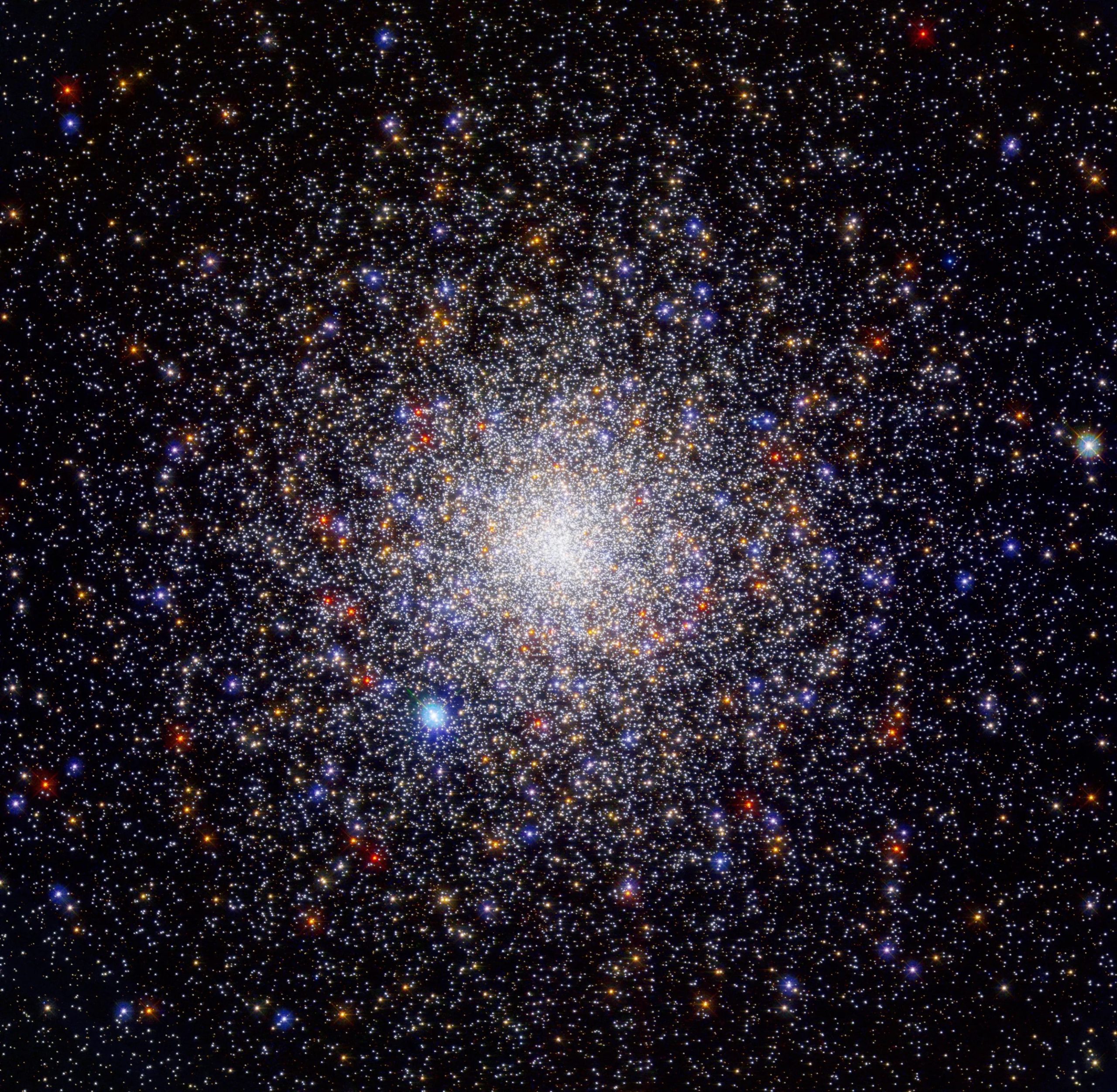
NGC 1851 illustrates why the approved work matters. NASA’s Hubble account describes a dense cluster with multiple stellar populations and a diffuse surrounding halo. One proposed explanation is that it preserves the aftermath of two clusters merging within a dwarf galaxy. That remains an interpretation, rather than a settled origin story.
Better stellar measurements can test such histories. A visible arrangement of stars provides one kind of evidence; their masses, evolutionary stages and ages supply another. Agreement between those lines of evidence would strengthen a reconstruction, while disagreement could expose assumptions in the models.
Plato’s selections are therefore a meaningful planning milestone. They establish which questions researchers intend to pursue with the mission’s precise, repeated observations. The conclusions about galactic history must wait for data, but the approved programs show how a planet-searching observatory can also examine the stellar framework in which planets form.
NGC 1851, one of the clusters targeted by an approved Plato program. Credit: NASA, ESA, and G. Piotto (Università degli Studi di Padova); processing: Gladys Kober (NASA/Catholic University of America). CC BY 2.0. Image resized. Image source · License.

Leave a Reply