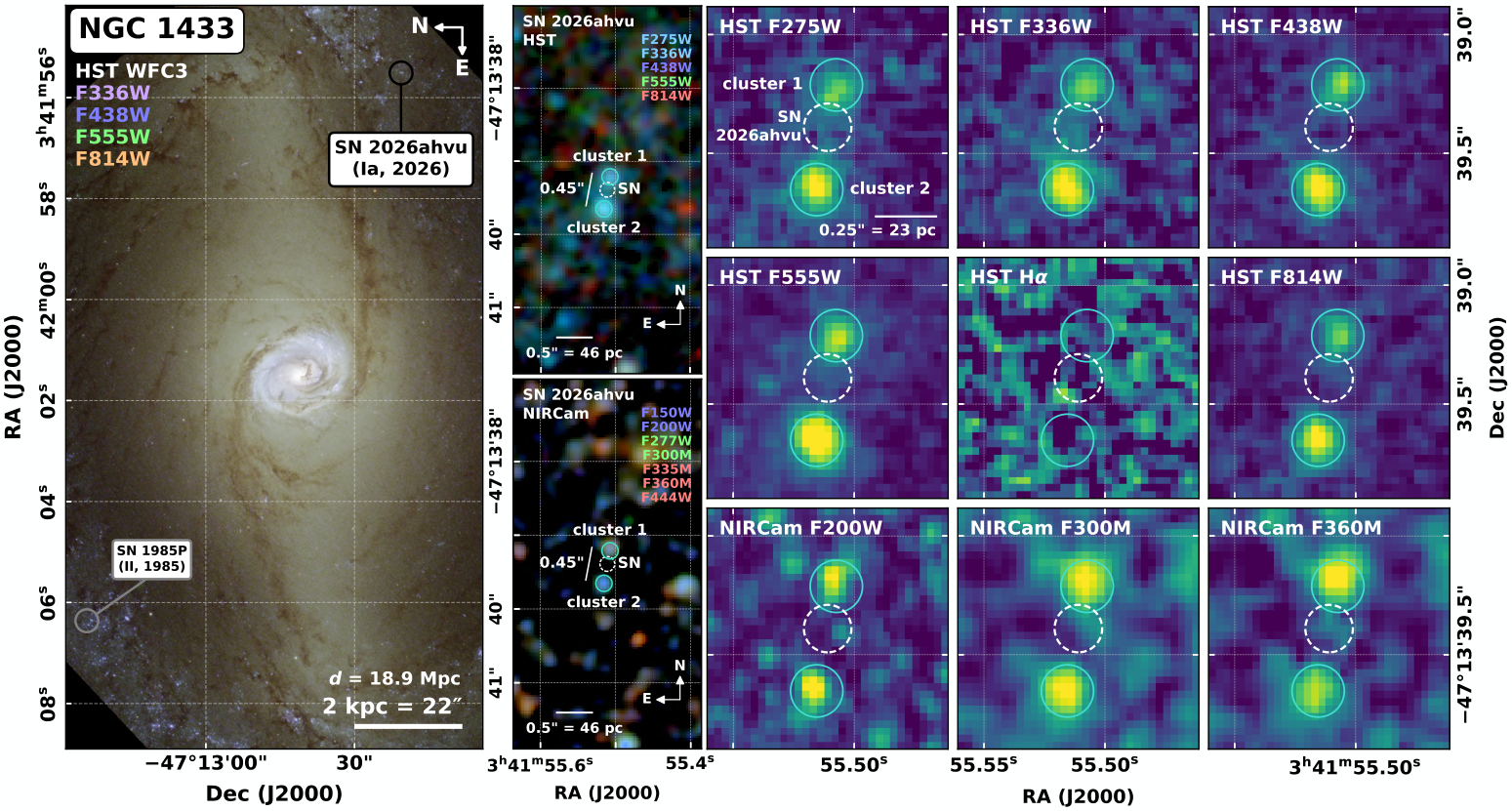
A newly reported Type Ia supernova in NGC 1433 may offer an unusually direct way to measure how quickly an exploding white-dwarf system can form. The important word is may: the case depends on whether the supernova really belongs to one of two nearby young star clusters, rather than merely appearing beside them.
In a preprint submitted on November 6, 2026, Sumit K. Sarbadhicary and colleagues analyze archival Hubble and James Webb observations from the PHANGS survey. They identify two ultraviolet-bright clusters close to the reported position of SN 2026ahvu. The study was submitted to the Astrophysical Journal Letters; its posting is not evidence of completed peer review.
An explosion, then a search through older images
The paper dates the ATLAS discovery to November 2, 2026, and reports that follow-up Keck spectroscopy classified the event as Type Ia. These are thermonuclear explosions involving carbon-oxygen white dwarfs in binary systems. Their delay time is the interval between formation of the progenitor population and the eventual explosion, not the time since astronomers noticed the flash.
The archival images matter because they show the stellar environment before this event. The candidate clusters sit only 0.19 and 0.26 arcseconds from the reported supernova position. The authors estimate a roughly 0.4% chance of an unrelated Type Ia falling this close to a catalogued cluster under their calculation. That is an argument for association, not a direct measurement of membership or a guarantee that either cluster is the birthplace.
Two possible clocks
Fitting the clusters’ light across Hubble and Webb bands gives estimated ages of about 37 million and 95 million years. Either would place an associated supernova in the prompt population, with a delay below roughly 100 million years. The younger estimate is particularly interesting: it approaches the minimum time needed for the progenitor star to become a white dwarf.
These ages are model-dependent. The paper also reports different estimates when only Hubble observations are used, and discusses conflicting published distances to NGC 1433. Changing the distance changes the physical separation represented by a small angle on the sky. Most importantly, the discovery position does not yet have a formally reported uncertainty; the authors adopt a plausible precision from ATLAS performance.
Why the distinction matters
A well-established cluster association could link an individual Type Ia to a relatively simple stellar population, giving a sharper evolutionary clock than a galaxy-wide average. That could help test which binary-star pathways produce the fastest explosions. It would not, by itself, identify the companion or prove a particular explosion mechanism.
For now, this is a promising candidate and a clearly stated hypothesis. Improved positional measurements and scrutiny of the cluster ages are more consequential than treating the headline’s short delay as settled.
Featured figure: archival Hubble/Webb imaging with the supernova position marked, not a photograph of the explosion. Sarbadhicary et al., Figure 1, CC BY 4.0; Hubble image credit ESA/Hubble & NASA.
Leave a Reply