A green flash, orange orb or blue-white streak can sound like a chemical clue. In practice, the color reported by a witness or recorded in an ordinary video compresses a great deal of information. Spectroscopy spreads that light into wavelengths, giving investigators a more specific measurement to compare with possible sources.
A pattern is more useful than a color name
NIST’s introduction to spectroscopy explains how emitted or absorbed light can reveal the substances involved. Atoms and molecules produce characteristic spectral features. A measured pattern can therefore support an identification that “green” or “white” alone cannot.
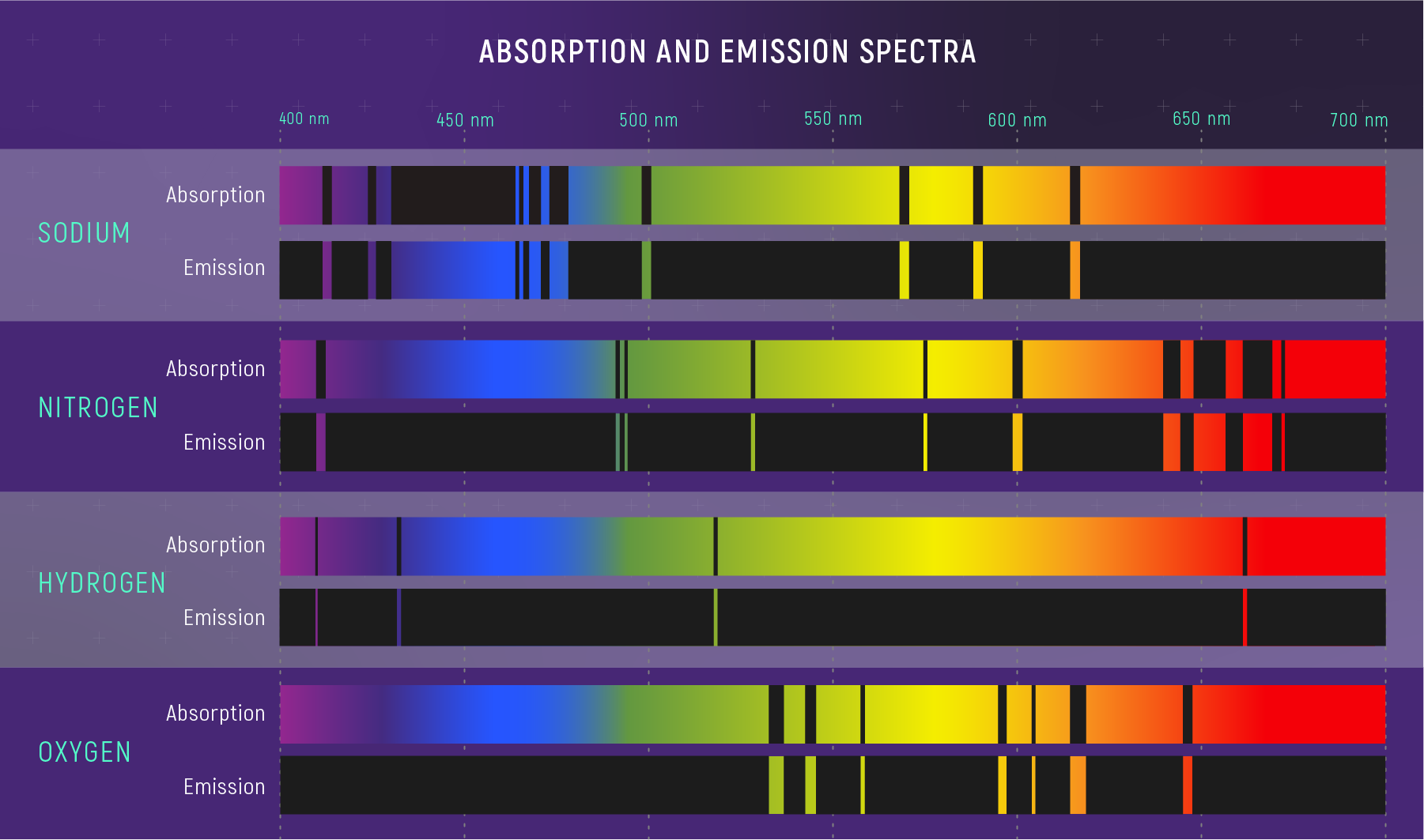
NASA’s comparison of absorption and emission spectra shows how individual elements have distinctive arrangements of lines. The relevant evidence is the position and pattern of those features, rather than a single bright patch somewhere in the visible range.
A conventional color camera does not usually record that detailed arrangement. Its broad color channels combine light across wavelength ranges. Two sources can consequently appear similar in a video while producing different spectra when examined with an appropriate instrument. Spectroscopy adds a measurement; enlarging the color image does not recover the missing spectral detail.
Meteor research demonstrates the difficulty
A useful caution comes from Althea Moorhead and Aaron Kingery’s 2020 meteor-color study, archived by NASA. The researchers tested whether broad filter measurements could recover established meteor spectral classifications. They found that color alone could not generally retrieve those classifications, with a possible exception for iron meteoroids.
That result should not be expanded into a rule that color is worthless. It shows why the strength of a chemical claim must match the resolution of the measurement. An unusual-looking color can motivate closer examination without uniquely identifying either the material or the mechanism producing the light.
The light and the object are not identical evidence
Even a well-measured spectrum needs physical interpretation. Light may come from heated material, surrounding gas or illumination reflected by an object. Identifying an emitting substance does not automatically reveal the composition of an entire solid body, much less its origin or propulsion system.
Investigators should first establish that the spectrum belongs to the reported target. In a crowded field, another light source can overlap the dispersed image. The original recording, timing and sky position help connect the spectral trace to the event. A separate view of the scene can be especially useful for checking that association.
Calibration then determines whether positions on the detector map reliably to wavelength and how sensitively the instrument responds across the recorded band. Saturated or weak features deserve explicit treatment. A line identification is stronger when several expected features agree than when one uncertain peak is assigned to a preferred substance.
The resulting report should show the measured spectrum, uncertainties, calibration procedure and competing interpretations. It should say which features were actually detected and which were merely consistent with the data. For UAP research, spectroscopy is most useful when it narrows a physical question that other observations can test. A credible chemical fingerprint can be an important step toward explaining a light without becoming a shortcut to identifying a craft.
Featured image: Absorption and emission spectra of several elements. Illustration: NASA, ESA, CSA, Leah Hustak (STScI). Image source.
Leave a Reply