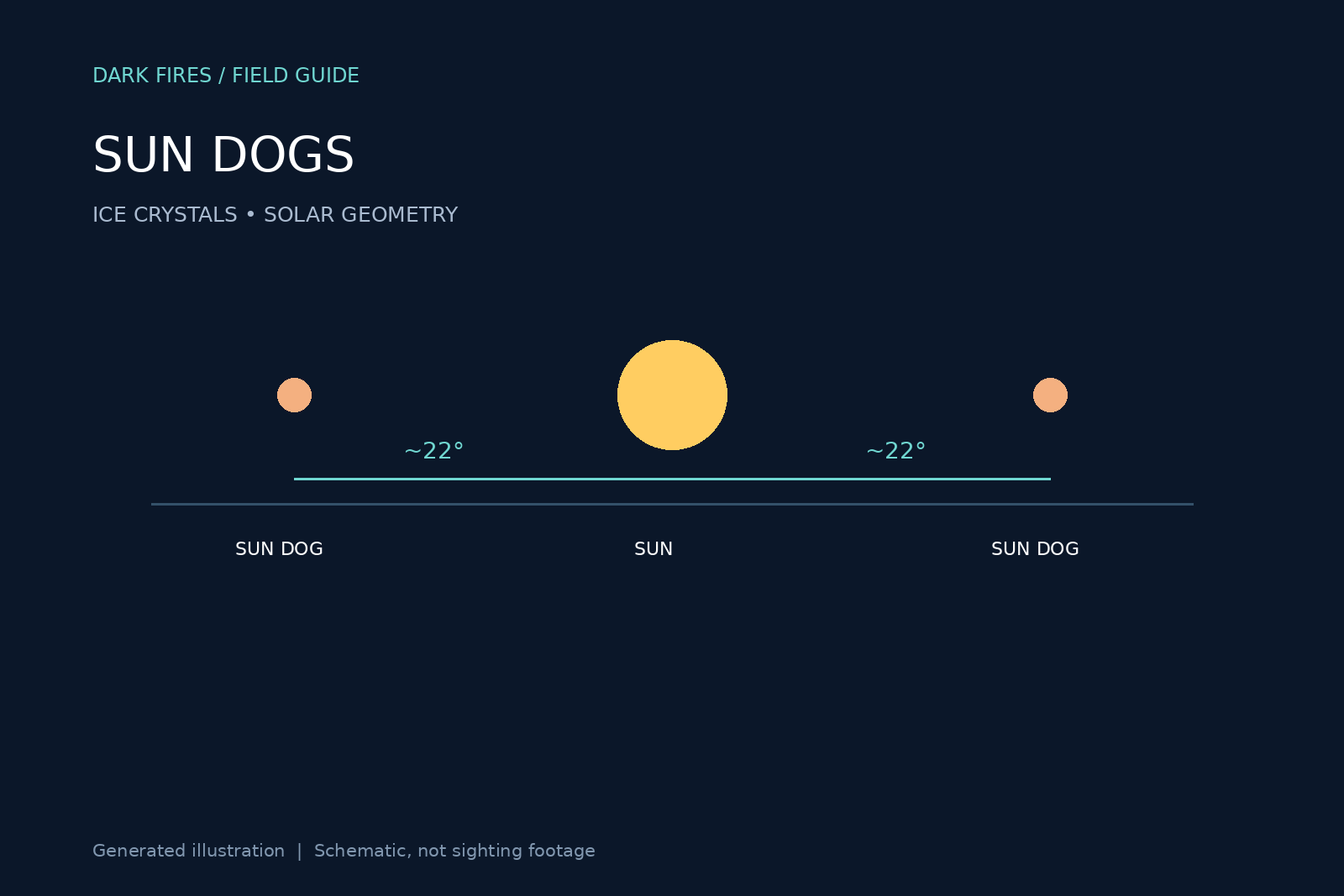
A brilliant patch beside the setting Sun can look detached from the weather around it. Before treating it as a hovering object, an investigator can test a specific atmospheric explanation: a sun dog, or parhelion. The useful question is not whether the image looks strange, but whether its geometry fits sunlight refracted by ice crystals.
The pattern to look for
The National Weather Service explanation of halos, sun dogs and pillars places sun dogs to either side of the Sun, commonly about 22 degrees away. Thin, high clouds can contain the ice crystals responsible even when the ground is warm. A halo and a sun dog are related optical effects, not interchangeable names for every bright patch.
A useful documented example comes from the Hong Kong Observatory’s September 2009 analysis of a photograph taken on July 2, 2009. Its account combines the spot’s position and color with cloud and upper-air observations. A reddish inner edge, paler outer portion and roughly level position beside a low Sun were clues, not a verdict based on shape alone.
Why one bright spot is possible
A missing partner does not rule out a sun dog. The Hong Kong Observatory notes that suitable crystals need not be distributed evenly; cloud or an obstruction can also hide one side. Conversely, two lights are not enough to establish the explanation. Their angular relationship to the Sun and the atmospheric setting still matter.
The familiar 22-degree spacing is a useful low-Sun reference, not a universal exact measurement for every solar elevation. A cropped image that omits the Sun removes an important test. Image pixels also cannot be converted to degrees without knowing the lens field of view and any crop.
A practical record checklist
- Preserve the original uncropped frame, timestamp and viewing location. Record which direction the camera faced.
- Note the Sun’s position relative to the patch using existing photographs or a safe reconstruction. Never stare at the Sun or aim unfiltered binoculars or a telescope at it.
- Check whether the patch stayed at a similar elevation to the Sun, whether a second patch or halo was visible, and how clouds changed during the observation.
- Compare contemporaneous cloud records with the geometry. Cloud evidence supports a mechanism; it does not substitute for the image.
These are suggested documentation steps, not a claim that a particular unexplained report has been solved. A poor geometric match should weaken the sun-dog hypothesis. A strong match should be explained openly, including which measurements were actually available. The aim is to distinguish a testable atmospheric identification from a resemblance offered after the fact.
Featured image: original Dark Fires schematic. Generated illustration; not an observation or sighting photograph.
Leave a Reply