DARK FIRESORIGINS UNKNOWN

Author: Dark Fires

  • Chu Lai, 1969: What One Army Journal Entry Can Establish

    Chu Lai, 1969: What One Army Journal Entry Can Establish

    An unusual report in an Army daily journal offers a compact lesson in the limits of historical UAP evidence. The entry is dated January 6, 1969, at Chu Lai, Vietnam, and was described by National Archives processing archivist Joe Gillette in June 2011.

    At 1:52 a.m., Tower 72 reported an apparently egg-shaped object near the base. The journal recorded estimates of its size and distance, a glowing light during movement, and an apparent landing. It also recorded that the control tower’s radar had detected nothing.

    The logged response was notification of the duty officer. Gillette found no further account in subsequent journals and noted that the January 7 and 8 journals were missing from the records he examined.

    Those gaps do not establish suppression, and the radar non-detection is not corroboration of a physical craft. The surviving entry establishes that a report was recorded within the base’s routine documentation. It does not establish the object’s identity, measured performance, or an extraterrestrial origin.

    Keeping those distinctions intact preserves the case’s genuine historical value without making the record say more than it does. It is an unresolved account in a military journal, not a documented alien encounter.

    Primary source: National Archives: the Chu Lai journal entry (June 6, 2011).

    Featured image: Task Force Oregon headquarters at Chu Lai, May 16, 1967. Context photograph, not an image of the 1969 reported object. U.S. Army photo by SSG H. C. Breedlove, NARA 111-CCV-445-CC40134; public domain. Image source and license.
  • A Gap in Merging Black Hole Masses Points Toward Stars That Failed to Explode

    A Gap in Merging Black Hole Masses Points Toward Stars That Failed to Explode

    A concentration of merging black holes near ten solar masses, followed by a relative scarcity at somewhat higher masses, may preserve a clue to how massive stars die. A study published November 10, 2026 in Physical Review D finds the distribution consistent with a distinct population formed through failed supernovae. That is a population-level inference, not a recording of a star collapsing without an explosion.

    The pattern being explained

    The paper’s abstract reports a strong ten-solar-mass peak using 153 observations from the GWTC-4.0 gravitational-wave catalog. Its inferred merger rate falls sharply in the roughly 12–16 solar-mass interval, then rises again above it. The authors say the conclusions persist in GWTC-5.0. The proposed explanation is especially efficient direct collapse within a narrow mass range.

    That does not mean no black hole can exist between twelve and sixteen solar masses. The study concerns an inferred distribution for merging systems, with statistical uncertainties. A low estimated rate in that selected population is a narrower statement than a universal prohibition.

    Evidence for an origin, not direct confirmation

    Caltech’s November 10 account describes the wider analysis in terms of 257 mergers and reports that the ten-solar-mass group also has a narrower range of spins. Those two features motivate a common-origin hypothesis. The institutional account explicitly says the work did not provide direct evidence of a failed supernova.

    The distinction matters because the observation and the proposed cause occur at different stages of stellar history. Gravitational waves reveal properties of black holes when they merge; the researchers then ask which formation processes could produce that pattern. A successful model must explain the excess near ten solar masses and the neighboring deficit together, rather than fitting one isolated feature.

    The result makes quiet stellar collapse a testable explanation for a particular population. It does not turn every missing supernova into a confirmed black-hole birth, nor establish one pathway for all black holes. Additional observations can test whether the structure remains as catalogs grow and whether competing formation models reproduce it.

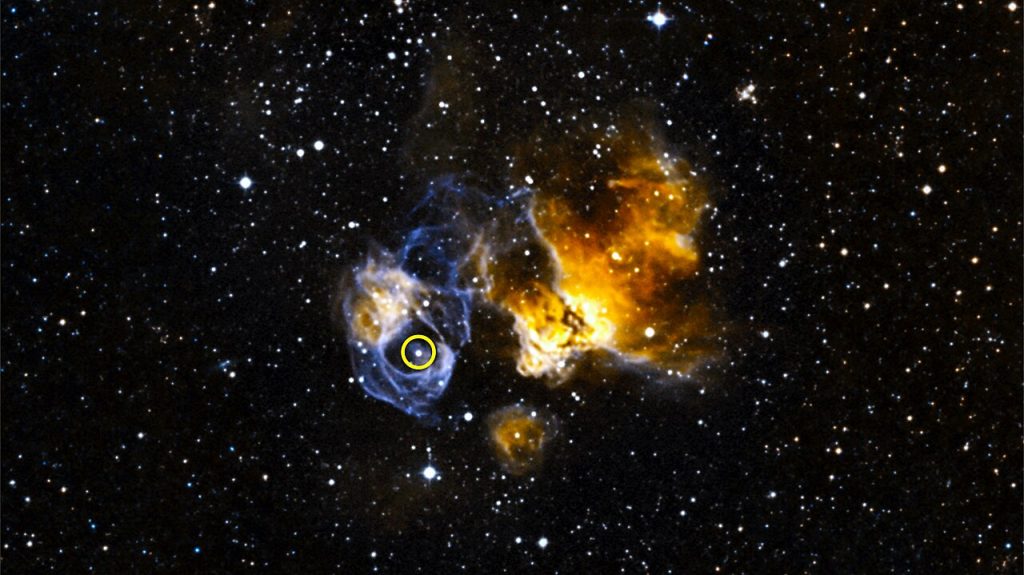
    Featured image: LMC P3 marked inside the DEM L241 supernova remnant, shown as context for stellar death. It is not a failed-supernova detection or one of the merging systems analyzed here. Credit: Chandra X-ray Observatory Center/NASA’s Goddard Space Flight Center, public domain. Image source.

  • Light Pillars: Testing a Vertical Beam Before Calling It a Craft

    Light Pillars: Testing a Vertical Beam Before Calling It a Craft

    A vertical glow above a town can look like a searchlight, a descending object or a structure hanging in the sky. Before assigning it a vehicle, test a different possibility: a light pillar. The useful question is not whether the image looks strange, but whether the lighting, weather and viewing geometry fit a known optical effect.

    What makes the column

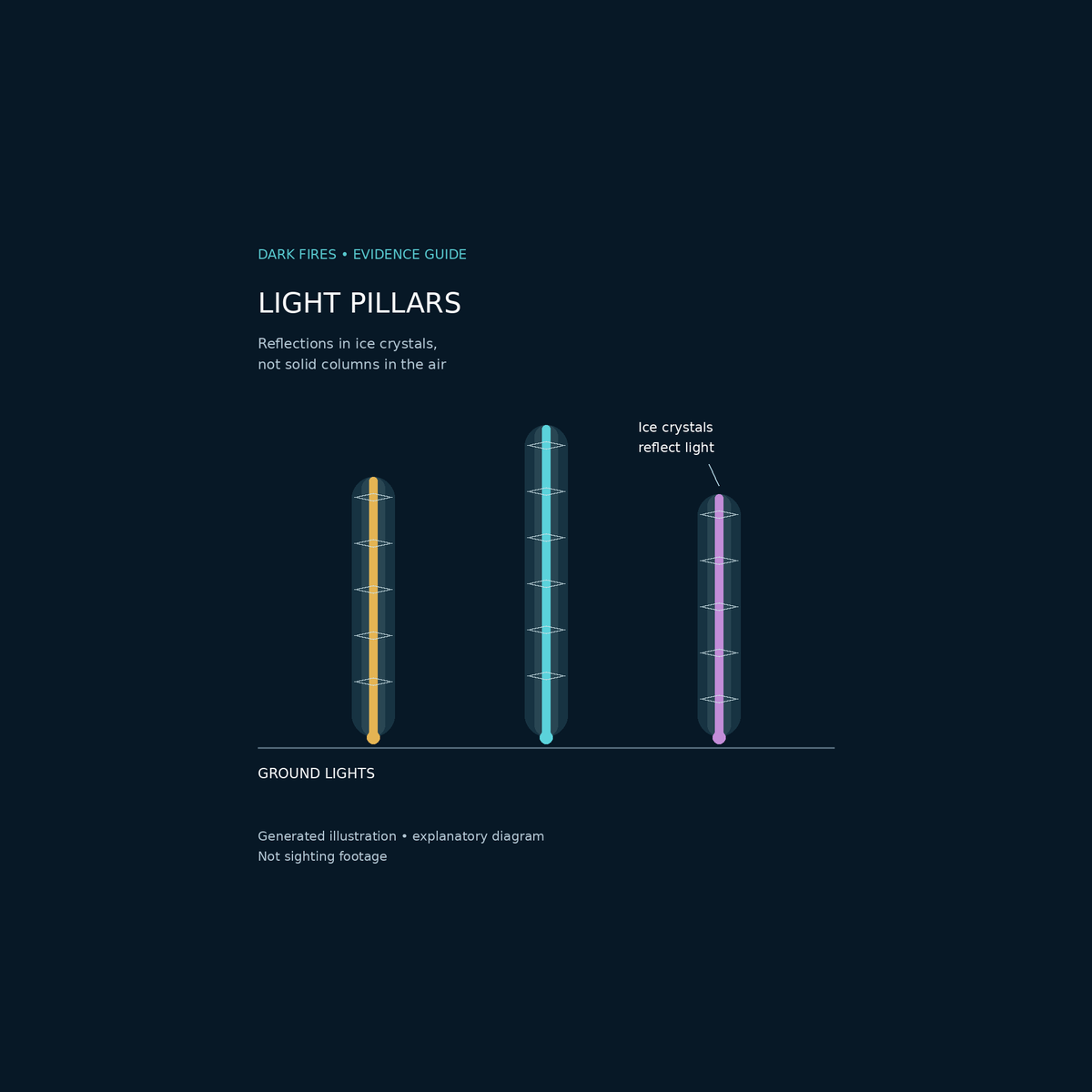
    The National Weather Service’s light-pillar explanation describes reflections from thin, plate-shaped ice crystals in the atmosphere. Their orientation helps produce the apparent vertical column. Its appearance depends on the crystals’ height, shape and angle, as well as the distance to the light source. The source can be the Sun or Moon, but it can also be an ordinary streetlight.

    MetService’s example from Paraparaumu identifies artificial ground lights reflected by ice crystals toward the observer. Its photograph was taken by Leah Cameron in May 2016; that is an example of the mechanism, not a new event. A pillar therefore need not mean that a powerful beam is physically being fired upward. The observed shape is produced by the light’s path to the viewer.

    A practical comparison

    For an unexplained report, start with an uncropped view that includes the horizon. Note the observation time, location and compass direction, then map candidate lights along that line of sight. A row of differently colored pillars above corresponding industrial or town lights is a more informative clue than a tight crop of one bright streak.

    Check weather observations for conditions compatible with ice crystals, but keep their limits in mind. A reading at a nearby station is not a direct measurement of every layer along the sightline. Record whether the glow changes as clouds pass, whether other pillars appear, and whether another observer sees a corresponding effect from a different position. Preserve the original image rather than enhancing its outline into a seemingly solid object.

    Do not turn a candidate into a verdict

    These are investigation steps, not a diagnosis of any particular photograph. A light source and plausible weather make the pillar hypothesis testable; they do not automatically prove it. Conversely, an incomplete weather record does not establish an exotic object. The strongest conclusion comes from a match between the recorded scene and the proposed optical geometry, with remaining gaps stated plainly.

    Featured graphic: Generated illustration. Explanatory diagram by Dark Fires, not a photograph of a reported sighting.

  • Project Magnet: Canada’s Magnetic-Propulsion Question Was Not a Proven Discovery

    Project Magnet: Canada’s Magnetic-Propulsion Question Was Not a Proven Discovery

    Project Magnet is a real part of Canadian UFO history. That does not make its proposed mechanism a demonstrated technology. A useful starting point is to distinguish permission to investigate an idea from evidence that the idea worked.

    What the official retrospective says

    The Office of Canada’s Chief Science Advisor describes the project in its June 2025 Sky Canada report. In 1950, the Department of Transport allowed engineer Wilbert Smith to undertake part-time research into whether UFOs might obtain propulsion from Earth’s magnetic field. His work widened to examining UFO observations.

    The account includes an unusual reporting experiment: Smith launched a balloon over Ottawa and monitored public and media reactions. It also describes an observatory outside Ottawa. According to the report, his detection efforts were unsuccessful, while publicity brought unwelcome attention to the department. Official support ended in 1954, and Smith continued privately. Read the government report’s historical section.

    Three different claims

    Our assessment separates the existence of the project, the merit of its proposed physical mechanism, and the identity of any particular reported object. Records of departmental permission establish the first. They do not automatically settle either of the others.

    The balloon experiment is especially useful to think about. A known object and a record of how people describe it can help investigate reporting behavior. That is a different kind of evidence from an instrument detecting an unknown craft, and different again from a repeatable demonstration of propulsion. Mixing those categories makes a research programme sound more conclusive than its measurements warrant.

    The distinction also works in the other direction. An unsuccessful detection effort does not prove that every unfamiliar aerial observation was imaginary. To interpret a negative result, a researcher would need to know what the equipment could detect, how long it operated, and which signals it could distinguish from background effects.

    A limit on this review

    This article relies on the government’s published retrospective, not a fresh inspection of Smith’s original experimental logs. It should not be read as an independent audit of every Magnet claim. The defensible historical point is narrower: a permitted investigation and an ambitious hypothesis existed; the account cited here does not establish a successful magnetic-propulsion discovery. Keeping that distinction visible lets the history remain interesting without converting official involvement into proof.

    Featured image: Generated illustration. Generic archival research artwork created for Dark Fires, not a photograph of Project Magnet equipment or an official document.

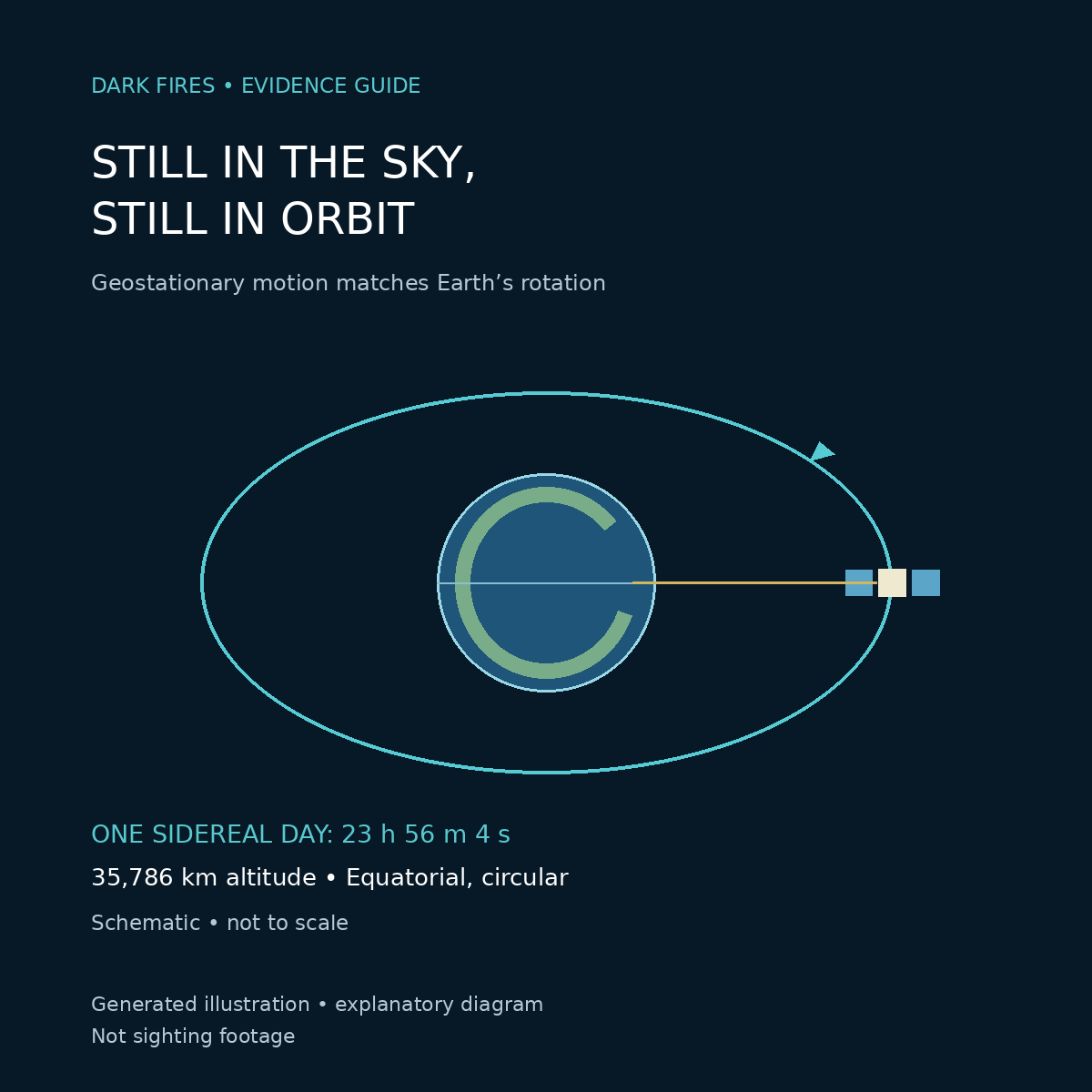
  • A Stationary Sky Light Can Still Be Moving: The Geostationary Orbit Test

    A Stationary Sky Light Can Still Be Moving: The Geostationary Orbit Test

    “It stayed in the same place” is an observation, not a propulsion measurement. A satellite can move rapidly around Earth while remaining almost fixed relative to an observer on the ground. That does not identify every stationary light as a satellite. It does explain why apparent hovering, by itself, cannot establish extraordinary flight.

    Motion that matches the observer

    ESA’s guide to orbital types describes geostationary satellites traveling west to east above the equator, completing an orbit in 23 hours, 56 minutes and 4 seconds. That is a sidereal day. At roughly 35,786 kilometers above the surface, they move at about three kilometers per second while keeping pace with Earth’s rotation.

    The crucial relationship is between two motions: the spacecraft’s orbit and the observer’s rotation with Earth. A fixed-looking direction does not mean the satellite has stopped. This geometry is useful for communications antennas and weather monitoring because it provides a persistent view of the same region.

    Geosynchronous is not always geostationary

    NASA’s catalog of Earth satellite orbits distinguishes the broader geosynchronous family from the circular, equatorial geostationary case. Matching Earth’s rotation period alone is not enough to guarantee an unchanging apparent position. The orbit’s shape and inclination matter too. Using the two terms interchangeably can turn a useful satellite check into a misleading one.

    What a sighting comparison needs

    For a UAP report, the practical inference is to compare a candidate’s predicted direction with the recorded direction from the actual observing location and time. A general statement that satellites exist in that part of the sky is insufficient. Preserve landmarks, timestamp information and the camera’s field of view so that “stationary” can be measured relative to something outside the frame.

    Also separate position from visibility. An orbital match alone does not establish that a particular spacecraft produced the recorded brightness or color. Nor does an object held near the center of a hand-tracked video demonstrate that it remained stationary relative to the ground. The observer may have followed it.

    A good conclusion specifies what matched and what did not: direction, duration and apparent motion, followed by any unresolved visibility questions. Geostationary orbit is an ordinary explanation worth testing where the geometry fits, not a blanket label for every distant light. Without those comparisons, both “hovering craft” and “definitely a satellite” go beyond the available observation.

    Featured graphic: Generated illustration. Dark Fires explanatory schematic, not to scale and not sighting footage.

  • Bennu’s Beta-Alanine Shows Why a Molecular Average Can Hide Its History

    Bennu’s Beta-Alanine Shows Why a Molecular Average Can Hide Its History

    Two samples can share nearly the same average carbon-isotope signature yet preserve different chemical histories inside individual molecules. That is the central lesson of a beta-alanine study comparing asteroid Bennu with the Murchison meteorite, highlighted in a Penn State account updated November 12, 2026.

    The peer-reviewed study was published September 24 in Communications Earth & Environment. The later university coverage is not the date of a new asteroid sample return or the discovery of life.

    Looking within the molecule

    According to Penn State’s explanation, the team measured isotope differences at separate carbon positions in beta-alanine. The average carbon values for the two samples agreed within uncertainty, but their internal values differed. Both showed one carbon position enriched in the heavier isotope and two depleted positions, with different magnitudes.

    Researchers interpret that shared arrangement as potentially related chemistry, while the differences point toward different source environments. This is a reconstruction of formation conditions, not a direct observation of the reactions occurring in the early solar system. Beta-alanine is relevant to prebiotic chemistry but is not one of the standard twenty protein-forming amino acids.

    Why this changes the question

    A bulk average compresses several measurements into one number. Two different combinations can produce the same average, so agreement at that level need not imply an identical history. Position-specific measurements retain information that the average discards. The scientific gain is therefore not simply another entry on a list of molecules found in space; it is a way to distinguish histories that previously looked alike.

    One next step identified by the researchers is testing how processes such as exposure to water change these internal isotope patterns. Until those effects are better understood, the pattern should be treated as evidence constraining possible pathways, rather than a unique address labeling where each molecule formed. Organic chemistry in an asteroid is important to origins-of-life research without being evidence that the asteroid hosted organisms.

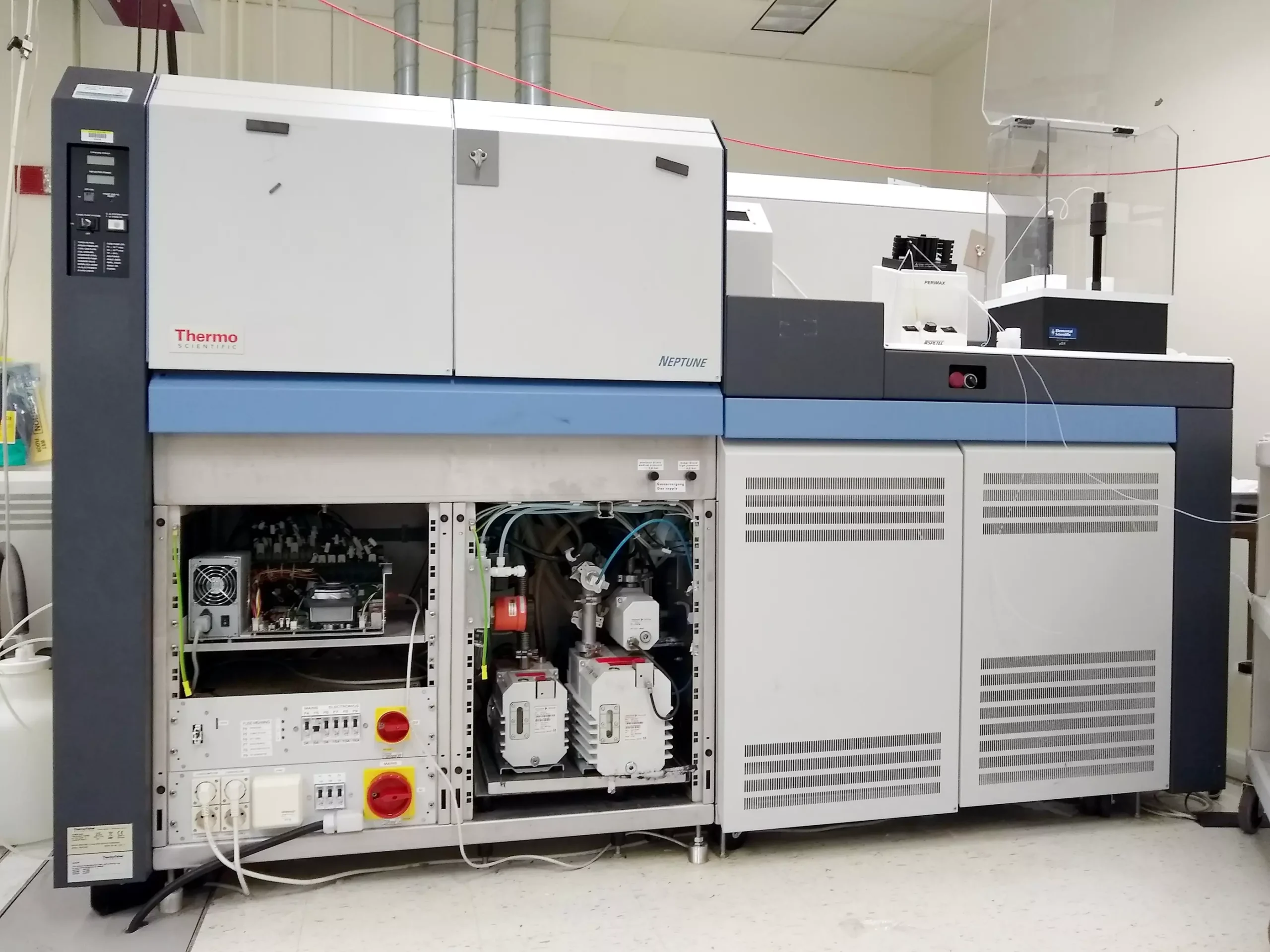
    Featured image: A NIST multicollector mass spectrometer, illustrating isotope measurement generally, not the instruments used in this Bennu study. Credit: Lane Sander / NIST. Image source; reuse policy.

  • Churchill’s 1952 UFO Memo: A Request for Answers, Not a Disclosure

    Churchill’s 1952 UFO Memo: A Request for Answers, Not a Disclosure

    Winston Churchill’s question about flying saucers survives. So does the reply. Reading the two together produces a more useful historical record than circulating the prime minister’s question alone.

    The exchange, with its dates intact

    On 28 July 1952, Churchill sent a minute to the Secretary of State for Air, copied to his scientific adviser Lord Cherwell, asking for an explanation of the saucer reports. The National Archives reproduces the document, reference PREM 11/855, in its published extract from The UFO Files. It belongs to the period of intense reporting around the Washington sightings, not to a newly released contemporary investigation. See the reproduced minute and surrounding correspondence discussion.

    The reply dated 9 August 1952 referred back to a 1951 intelligence study. It described explanations involving ordinary phenomena, mistaken identification, illusions and hoaxes, and said the Air Staff had not changed its position. The same archive publication records Cherwell’s agreement and a contrasting view from Minister of Supply Duncan Sandys, who considered an unexplained phenomenon worthy of attention.

    What the documents can support

    The historical finding is modest but important: the prime minister asked, officials answered, and senior figures did not all frame the uncertainty identically. This is evidence of administrative attention and disagreement. It is not, by itself, evidence that anyone had recovered an extraordinary vehicle.

    Our interpretation is that three separate questions should remain separate. What information reached a leader? What explanation did officials offer? What physical evidence actually supported that explanation? A memorandum can answer the first two while leaving substantial work on the third.

    There is also a reading trap in the word “secret.” A document’s restricted circulation tells us about how it was handled. It does not validate every assertion inside it. Conversely, a skeptical official conclusion should not be mistaken for a new independent measurement of every sighting to which it might be applied.

    The useful way to cite this episode is therefore as a dated exchange, including the response and its stated basis. Quoting the question without the reply exaggerates mystery; quoting the reassurance as universal proof exaggerates certainty. The file gives readers a way to examine what was actually asked and answered, rather than recruit Churchill’s name as an authority for a conclusion he was seeking from others.

    Featured image: Generated illustration. Generic archival research artwork created for Dark Fires, not an image of Churchill’s papers or an actual official record.

  • Eight-Minute Radio Pulses Trace an Unusual White Dwarf and Sun-Like Companion

    Eight-Minute Radio Pulses Trace an Unusual White Dwarf and Sun-Like Companion

    A repeating radio source now has a more specific physical explanation: a white dwarf paired with a star resembling the Sun. The result, reported by ICRAR on November 12, 2026, concerns GPM J071507−114153. It expands the known variety of long-period radio transients, rather than providing evidence for an artificial transmission.

    Locating the pulse source

    The white dwarf spins about once every eight minutes. Researchers detected the system with the Murchison Widefield Array, localized it with MeerKAT, and used Keck optical observations to identify its G-type companion. According to ICRAR’s account, more than 100 hours of radio observations helped reveal orbital motion in the pulses. That places the emission near the white dwarf, though it does not uniquely establish the exact emitting site.

    The team also interpreted changes in the radio signal as evidence of magnetized material associated with the companion, possibly a stellar prominence. The qualification matters: detecting a signal change and explaining the intervening structure are related but distinct steps.

    Why the companion matters

    Previously identified systems of this kind commonly involved smaller, cooler red dwarfs. A Sun-like companion widens the circumstances in which astronomers must explain the phenomenon. The discovery does not establish that every slow radio transient has the same origin.

    The Nature Astronomy paper, published November 12, provides links to the detected-pulse measurements and dynamic spectra, with processing code also identified. Those materials make this more than an intriguing description of a periodic signal: they give other researchers a route to scrutinize how the timing and interpretation were obtained.

    The useful distinction is between recognizing a rhythm and identifying its source. A regular interval alone would leave many possibilities open. Here, radio localization, optical identification and orbital behavior constrain the explanation together. The remaining question is how the stars produce and modify the radiation, not whether a regular pulse is automatically a message.

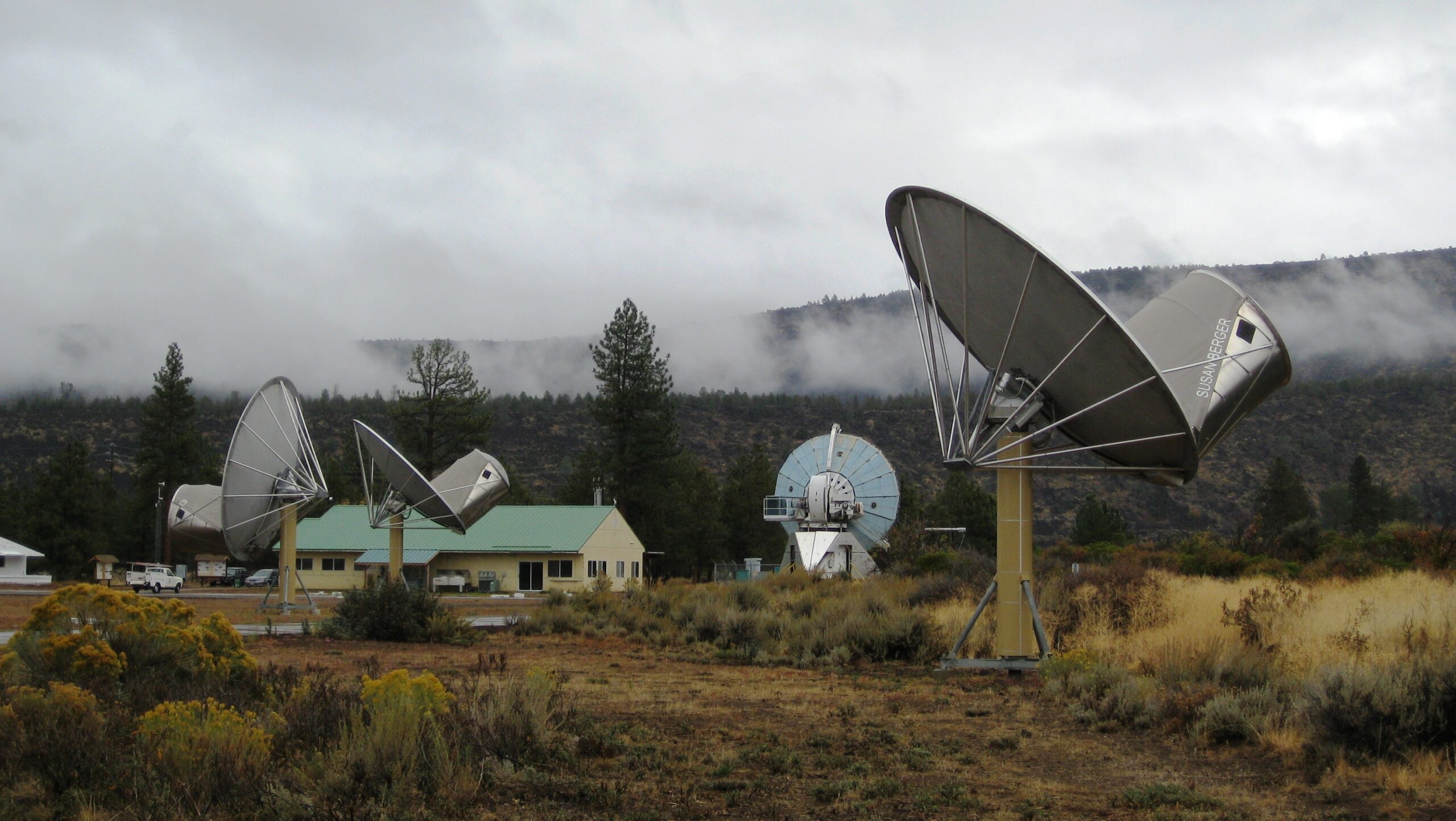
    Featured image: Archival Allen Telescope Array photograph, used to illustrate radio astronomy; this is not one of the instruments used for this discovery. Photo: brewbooks, CC BY-SA 2.0.

  • Berwyn, 1974: The Seismic Record Behind the UFO Crash Story

    Berwyn, 1974: The Seismic Record Behind the UFO Crash Story

    A loud disturbance, lights and an emergency search can sound like a single extraordinary event. The Berwyn Mountains story shows why those elements should first be separated. The strongest physical record from North Wales on 23 January 1974 is an earthquake, not evidence of a recovered aircraft.

    What the instruments and logs establish

    British Geological Survey seismologist Roger Musson revisited the event in a 2006 research paper. Instrumental evidence places the shock at 20:38. Its instrumental magnitude was 3.5 ML; estimates from reported ground effects were somewhat higher. The paper discusses uncertain location and depth, but concludes that the source was underground rather than a surface impact.

    Musson also reconstructs the emergency response using contemporary reports and police logs. Searches followed concern that an aircraft had crashed. No missing aircraft or impact site was established. His review distinguishes the earthquake from meteor observations that evening and notes that some reported lights occurred later than the shock. It also identifies the arriving scientific investigators as an earthquake-survey team, not evidence of a covert recovery operation. Read Musson’s original research paper.

    A file reference is not a crash finding

    The National Archives’ UFO briefing guide points readers to AIR 2/19083 and DEFE 24/2045/1 for material concerning the incident. That is a useful documentary route, not a separate scientific endorsement of the crash story. An archive can preserve questions, correspondence and disputed claims alongside operational records. Consult the archive’s guide.

    Our reading is that the crucial test is whether the alleged connections survive chronology. A light seen after the ground shook does not by itself explain the shock. A rescue team dispatched because a crash was feared does not prove a crash was found. An investigator asking residents questions can be doing ordinary field science.

    This does not require dismissing every person who reported an unfamiliar light. It requires giving each observation the evidential weight it can carry. The seismic data answer a physical question about the ground movement; the logs answer a historical question about the response. Neither should be replaced by a later narrative that treats the search itself as proof of what was supposedly recovered.

    Featured image: Generated illustration. Generic archival research artwork created for Dark Fires, not a photograph of the incident or a reproduction of an official record.

  • Roman Aligns Its Instruments Before the Harder Test of Suppressing Starlight

    Roman Aligns Its Instruments Before the Harder Test of Suppressing Starlight

    NASA reported on November 13, 2026 that the Nancy Grace Roman Space Telescope has aligned its instruments, a commissioning milestone rather than the start of its full science program. The update concerns the precision of the observatory’s measurements, not a new planet or cosmological discovery.

    A telescope needs an accurate internal map

    Launch and the space environment can shift an observatory from its ground-tested configuration. Roman’s team compared observed star positions with expected positions to refine that internal map. Its Wide Field Instrument’s 18 detectors must work together for accurate guiding.

    The instrument also keeps watch on guide stars while the Coronagraph Instrument observes another field. The coronagraph’s next challenge is active control of starlight using its deformable mirrors. Aligning optics is necessary, but is not equivalent to demonstrating the final ability to uncover faint planets beside bright stars. NASA’s November 13 update describes that distinction.

    What commissioning establishes

    NASA’s commissioning overview describes a sequence of turning systems on, making adjustments and calibrating performance. Roman’s destination is a halo orbit near the Sun–Earth L2 region, which offers a relatively stable thermal environment and a broad, largely unobstructed sky view. The agency cautions that commissioning schedules can change as engineers assess the observatory.

    The practical question now is whether the calibrated system performs consistently in the observations it was designed to make. A telescope can point correctly yet still require extensive characterization of the residual light that obscures a planet. Reading alignment as a completed scientific result would skip that essential distinction.

    This is progress worth tracking because surveys depend on repeatable measurements. The milestone reduces one source of uncertainty while leaving the next performance tests visible, rather than presenting the mission as already finished.

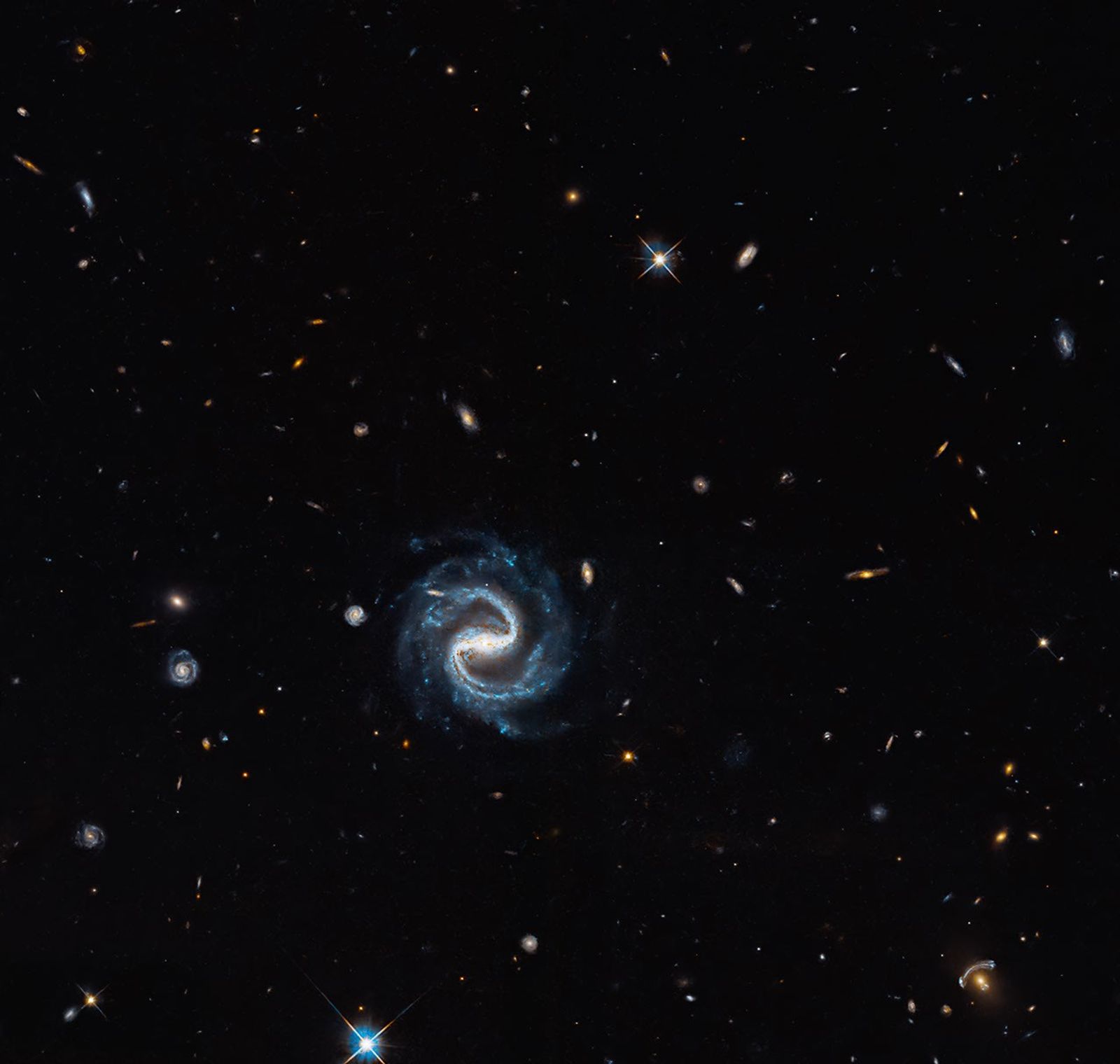
    Featured image: Archival Hubble gravitational-lens field DESI J194.5345+03.5358, an example of the sky targets that motivate Roman’s surveys, not a Roman alignment image. Credit: NASA, ESA, and X. Huang (University of San Francisco); Processing: Gladys Kober (NASA/Catholic University of America).