Before “flying saucer” became a familiar phrase, wartime aircrew were already reporting puzzling lights. The British paper trail matters because it lets us separate a real history of military reporting from later claims that every unexplained light was the same extraordinary machine.
What the archive actually establishes
The UK National Archives’ UFO briefing guide describes RAF reports of balls of fire and lights that seemed to follow Allied aircraft. It says the RAF collected “night phenomena” reports from 1942 and later exchanged intelligence with the United States. Suspected German weapons were an interpretation, not an identification; the guide says no recovered advanced weapon explained the foo fighters after the war.
That is a narrower claim than proof of nonhuman technology. A wartime intelligence service had reason to investigate something unfamiliar near its aircraft without first knowing whether the report concerned a weapon, a natural phenomenon or an observational mistake.
A file reference is a starting point
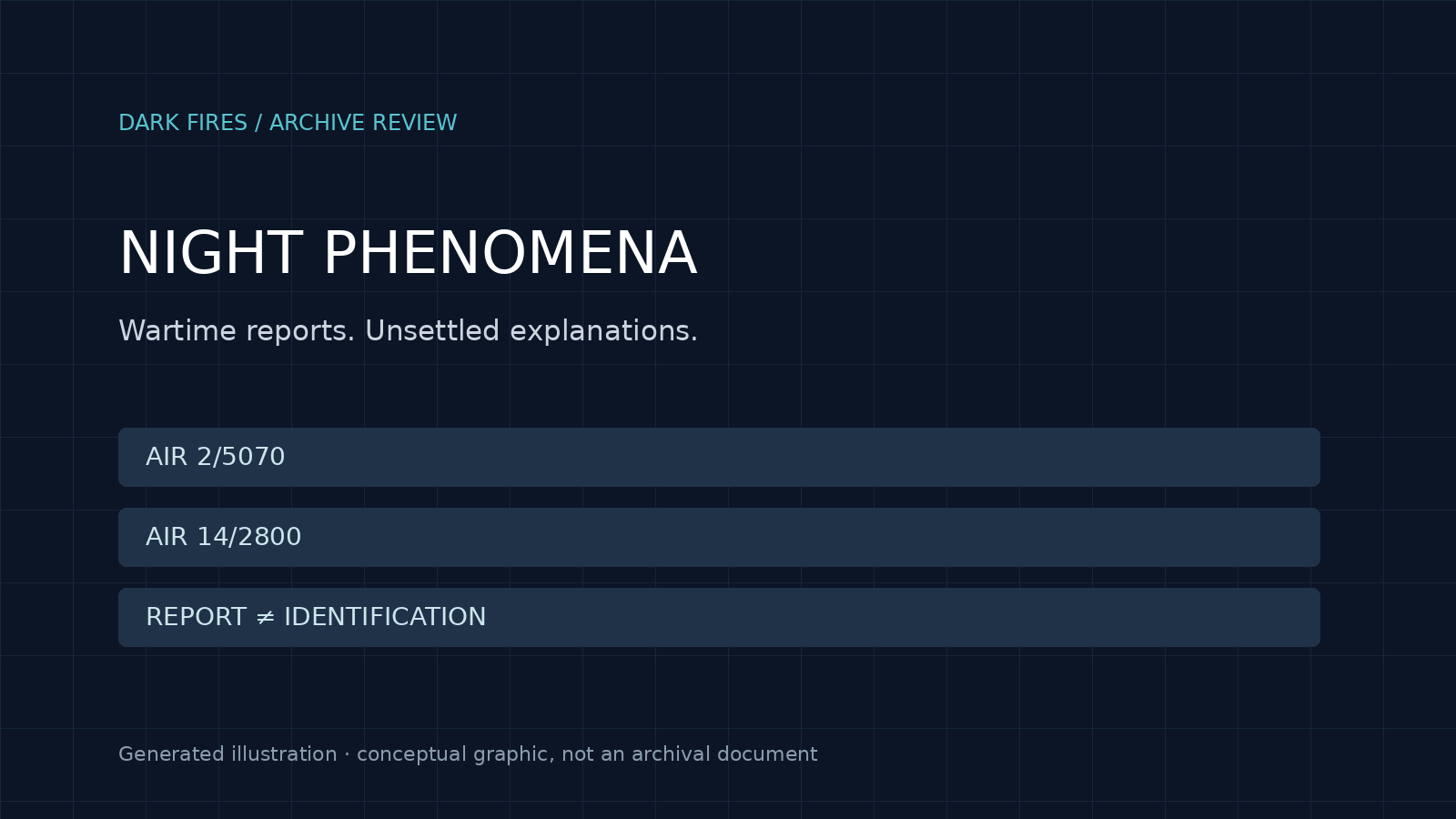
The guide directs researchers to AIR 2/5070 and AIR 14/2800. There is independent official confirmation of the second reference in a House of Lords written answer dated October 14, 1998. The answer lists AIR 14/2800 as the December 1943 No. 115 Squadron news sheet Bang On, No. 1, with aerial-phenomena reports from RAF bombing raids.
The 1943 date belongs to the wartime material; 1998 is the parliamentary listing. Neither should be presented as a newly reported encounter. This review uses the archive’s published guide and Parliament’s catalogue description, not a newly examined scan of every underlying aircrew report.
What a serious comparison would require
The next useful step is not to collect more dramatic retellings under one nickname. It is to compare individual reports: who observed the light, whether observations were independent, the aircraft’s heading and maneuvers, duration, weather, and any contemporaneous instrumentation. “Appeared to follow” alone does not supply distance, speed or a flight path.
It is equally important not to turn a missing explanation into a dismissal of the witnesses. An authentic report can preserve a sincere observation while leaving its cause unsettled. Conversely, an official file can contain an untested hypothesis without endorsing it.
Bottom line: the wartime records establish a documented reporting problem worth studying. They do not, by their existence alone, establish a common cause for all foo-fighter accounts.
Featured image: Generated illustration. Original Dark Fires conceptual graphic, not archival evidence or sighting footage.
Leave a Reply