DARK FIRESORIGINS UNKNOWN

Author: Dark Fires

  • A Fading Sky Light Does Not Measure Its Speed

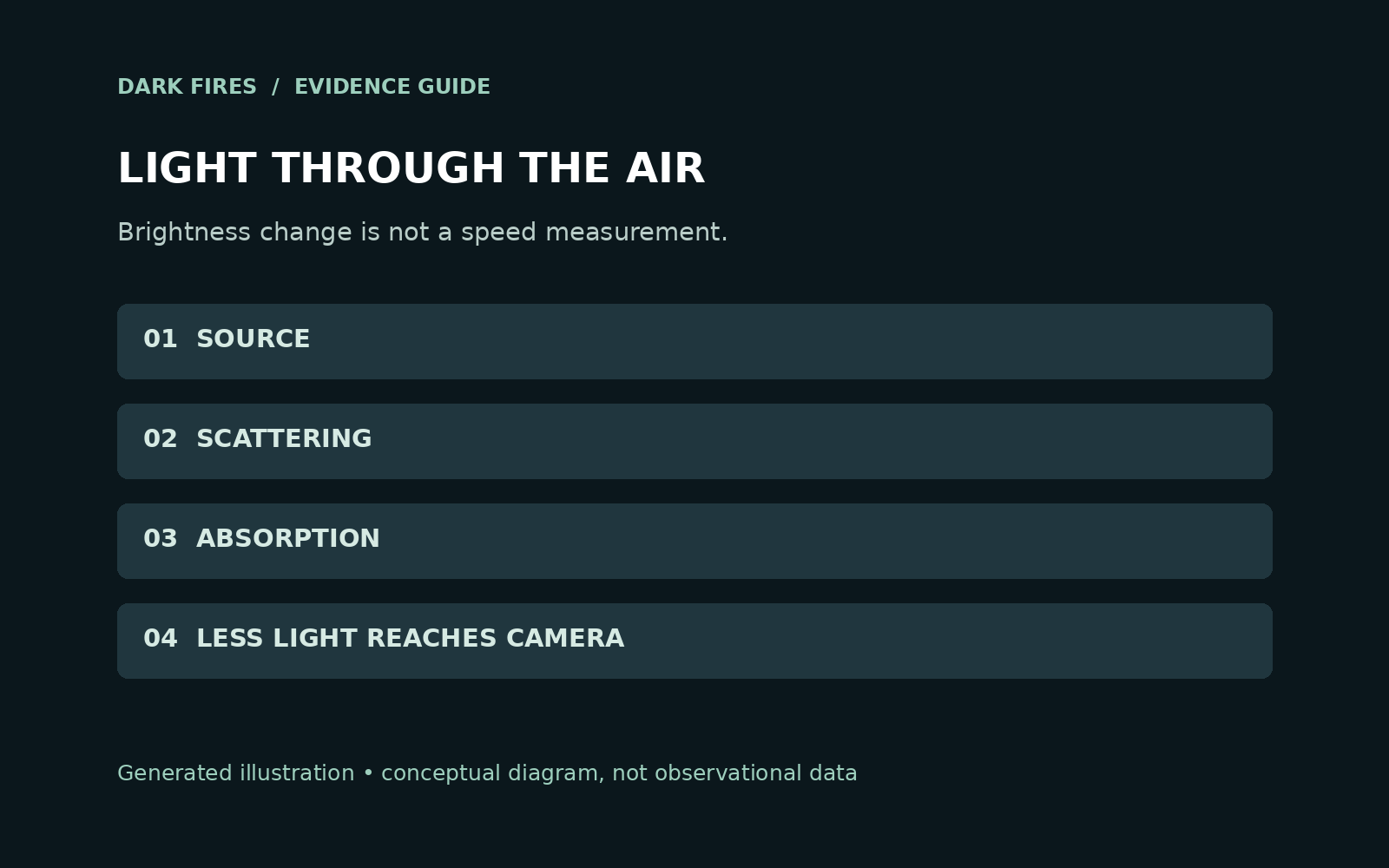
    A Fading Sky Light Does Not Measure Its Speed

    When a light fades from view, the observation establishes a change in received brightness. It does not, by itself, establish how quickly the source moved or even whether it moved away.

    Atmospheric extinction is one reason. NOAA-hosted aerosol measurement guidance describes extinction as the combined effect of scattering and absorption. Light can be redirected or absorbed along its path, reducing what reaches an observer or camera. NOAA also measures how particle scattering changes with humidity and wavelength.

    This matters when assessing unfamiliar lights near haze, thin cloud or a long atmospheric viewing path. A brightness change may involve the source, the intervening air, the camera or several factors together. Treating every fade as physical departure skips those alternatives.

    A useful record preserves the original video, including the seconds before and after the event. Note cloud and haze conditions, viewing direction and whether other lights dimmed at the same time. Record exposure changes if known rather than assuming brightness stayed comparable throughout.

    Applying these atmospheric principles to UAP reports is an analytical inference, not a resolution of a specific incident. Extinction cannot explain every disappearance. Its value is narrower: it shows why brightness and motion must be investigated separately before assigning an extraordinary speed.

    Primary sources: NOAA-hosted aerosol measurement procedures; NOAA aerosol instrumentation.

    Generated illustration

    Original Dark Fires conceptual diagram, not observational data or a reconstruction of a sighting.
  • Thermal Crossover: When Infrared Contrast Fades

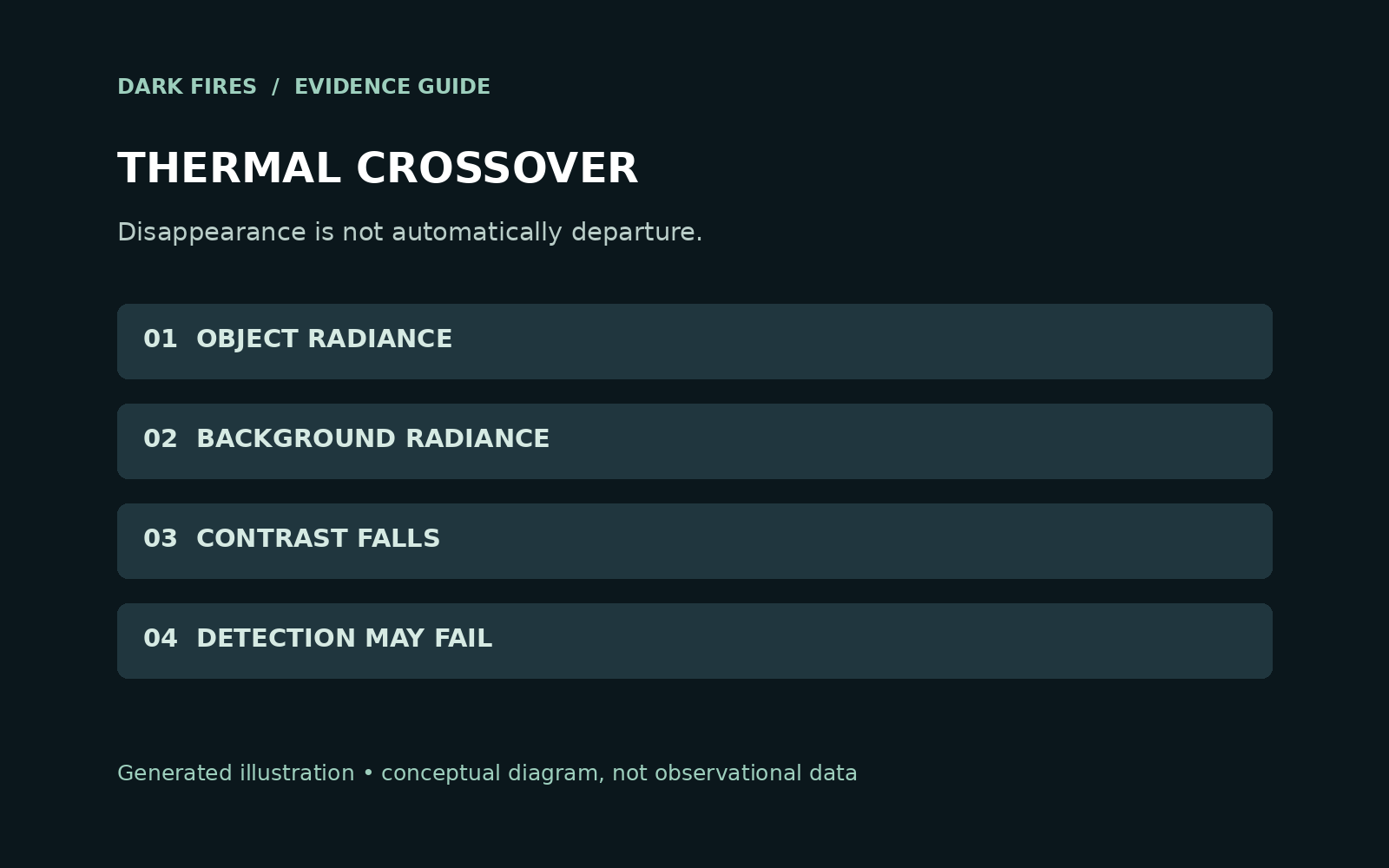
    Thermal Crossover: When Infrared Contrast Fades

    An object can become difficult to distinguish in a thermal image without leaving the scene. One reason is thermal crossover: conditions in which a target and its surroundings produce too little contrast for clear separation.

    Infrared imagery is not simply an outline of everything present. A 2010 experimental study of conventional and polarimetric thermal imaging explains that effective temperatures depend on actual temperature and emissivity, the efficiency with which a surface emits radiation. As those signatures change, objects that were conspicuous can become less distinct.

    The researchers compared mid-wave and long-wave infrared observations through crossover periods. Their results suggested that combining polarimetric information from those bands could improve conventional thermal imagery. That is an instrument-performance finding, not evidence that any particular unexplained sighting has been solved.

    For UAP footage, the relevant question is therefore not just “Where did it go?” Ask whether contrast changed, whether the camera settings changed, and whether another sensor continued to detect the object. Preserve the unedited sequence before and after the apparent disappearance.

    Thermal crossover is one possible mechanism among many. A clip alone may not establish that it occurred. Equally, losing a thermal signature does not by itself demonstrate acceleration, dematerialization or a transition into water.

    Primary sources: Experimental paper; U.S. Army technical discussion of thermal imagery.

    Generated illustration

    Original Dark Fires conceptual diagram, not observational data or a reconstruction of a sighting.
  • Why the PURSUE Videos Cannot Settle Claims of Extreme Speed

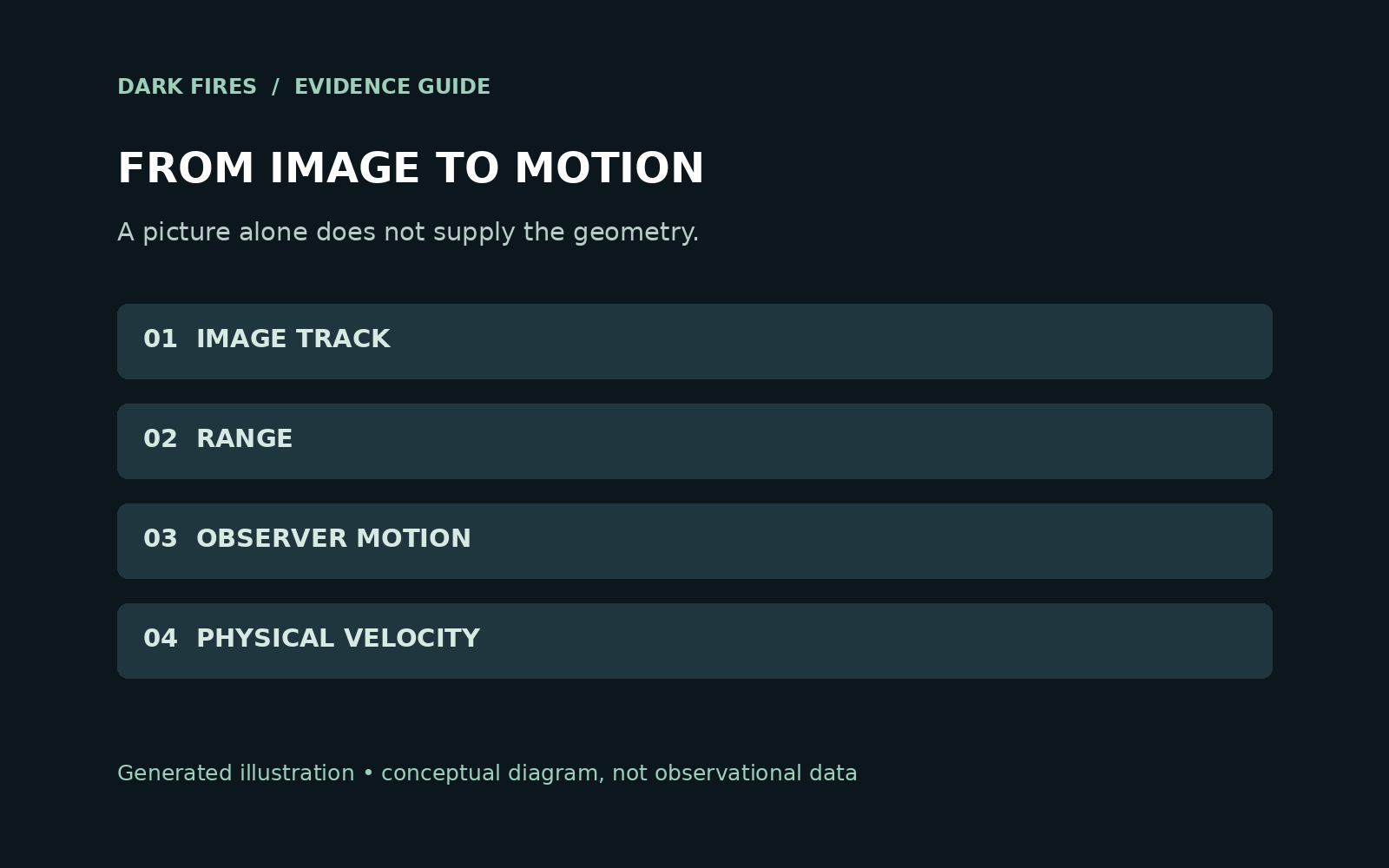
    Why the PURSUE Videos Cannot Settle Claims of Extreme Speed

    A fast crossing on a screen is not yet a measured speed through the air. That distinction drives a 2026 analysis of 112 publicly released PURSUE sensor videos by Jacob Haqq-Misra and Ravi Kopparapu.

    Their paper, first submitted August 12 and revised August 28, examines what the footage permits researchers to calculate. Converting image motion into physical velocity requires additional information: distance, the observing aircraft’s motion, viewing geometry and the camera’s angular scale. The authors report that no video supplies the complete combination.

    Two examples illustrate the limits. Markings in PR113 permit an estimate of angular scale, but not a unique physical speed or identity. In PR149, a ship provides a reference for a conditional velocity bound. Neither example turns a moving patch of contrast into an identified vehicle.

    The practical lesson is to ask which quantities were measured and which were assumed before accepting an extraordinary speed claim. More pixels do not supply missing range data. Flight logs, sensor information and correlated observations would be more useful than enlarging the same clip.

    This is a preprint submitted to a journal, not a verified identification of the objects or proof that anomalous motion is impossible.

    Primary source: Original research, version 2.

    Generated illustration

    Original Dark Fires conceptual diagram, not observational data or a reconstruction of a sighting.
  • Timing Old Planet Transits Could Expose Shrinking Orbits

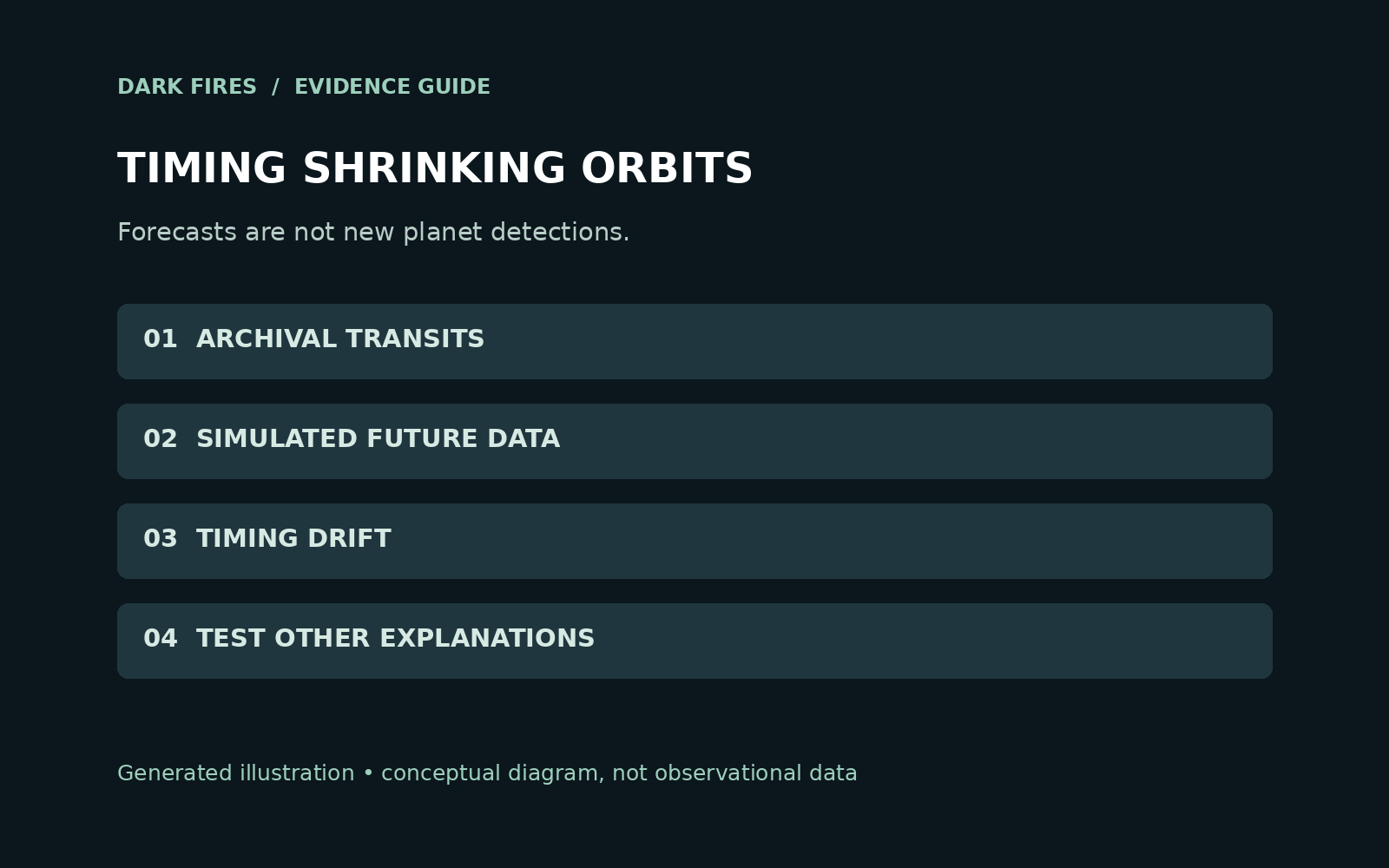
    Timing Old Planet Transits Could Expose Shrinking Orbits

    A future telescope could extract new physics from planets already discovered years ago. A study posted November 5, 2026 examines how the planned Earth 2.0 mission might reveal hot Jupiters whose orbits are gradually shrinking.

    The proposed measurement is timing, not a dramatic image of a planet falling into its star. Repeated transits can arrive progressively earlier if an orbital period shortens. That change can help researchers study how tidal energy is dissipated inside stars.

    Wenqin Wang and colleagues combined archival Kepler and TESS observations with four years of simulated Earth 2.0 observations. In their modeled scenarios, the extended record substantially improves sensitivity to period changes. Under assumptions about stellar tidal dissipation, they forecast three additional detectable systems.

    Those are predictions, not three new detections. The manuscript reports acceptance on October 30, 2026, but the Earth 2.0 observations used in the analysis remain simulated.

    The team also emphasizes a central ambiguity: additional companions can change light-travel times and imitate an orbital-decay signal. A longer timeline helps, but interpreting a timing drift still requires testing competing explanations.

    Primary source: Read the study.

    Generated illustration

    Original Dark Fires conceptual diagram, not observational data or a reconstruction of a sighting.
  • A Second Climate Model Checks the Habitable Zone

    A Second Climate Model Checks the Habitable Zone

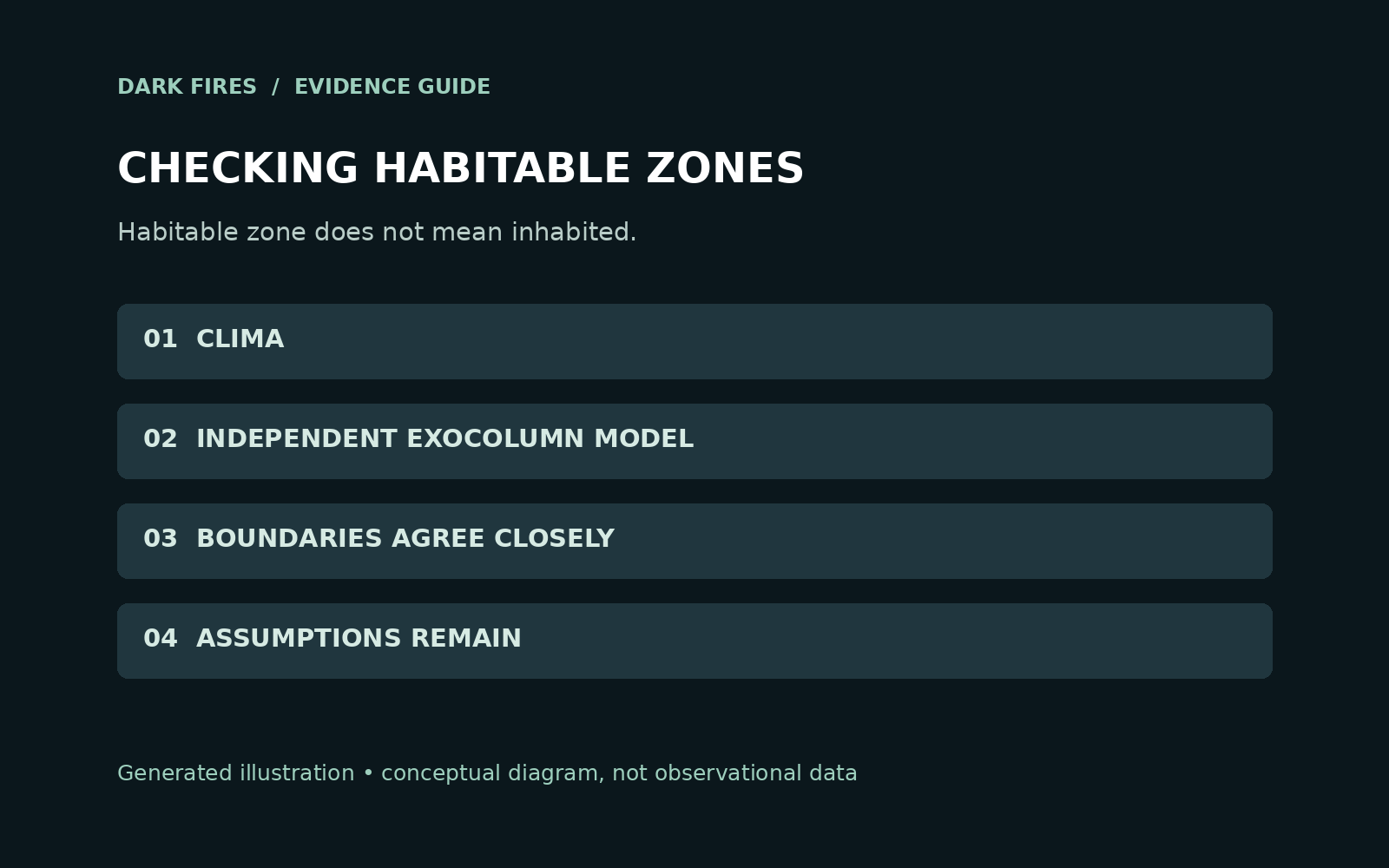
    The familiar “habitable zone” is not a map of inhabited planets. It is a modeling tool for estimating where certain rocky worlds might sustain surface liquid water. A new study tests whether widely used boundaries survive an independent calculation.

    Jacob Haqq-Misra, Eric Wolf and Ravi Kopparapu developed ExoColumn, a one-dimensional atmospheric model, and compared its results with the established Clima framework. The paper’s publication record gives November 6, 2026; it appears in The Astrophysical Journal, volume 1011, article 253.

    Across their calculations, ExoColumn’s boundaries fall somewhat closer to the star but agree with Clima within a few percent in orbital distance. The authors tested different stellar temperatures and planetary masses, producing updated coefficients for other researchers.

    That agreement supports the robustness of a common target-selection tool. It does not remove the assumptions behind it. Actual climates also depend on atmospheric composition, clouds and circulation; a one-dimensional model cannot represent every three-dimensional process.

    The practical lesson is two-sided: being inside a modeled zone does not prove a planet is habitable, and being outside it does not exclude every conceivable environment for life.

    Primary source: Read the published paper.

    Generated illustration

    Original Dark Fires conceptual diagram, not observational data or a reconstruction of a sighting.
  • Webb Study Traces a Cold Giant’s Chemical Past

    Webb Study Traces a Cold Giant’s Chemical Past

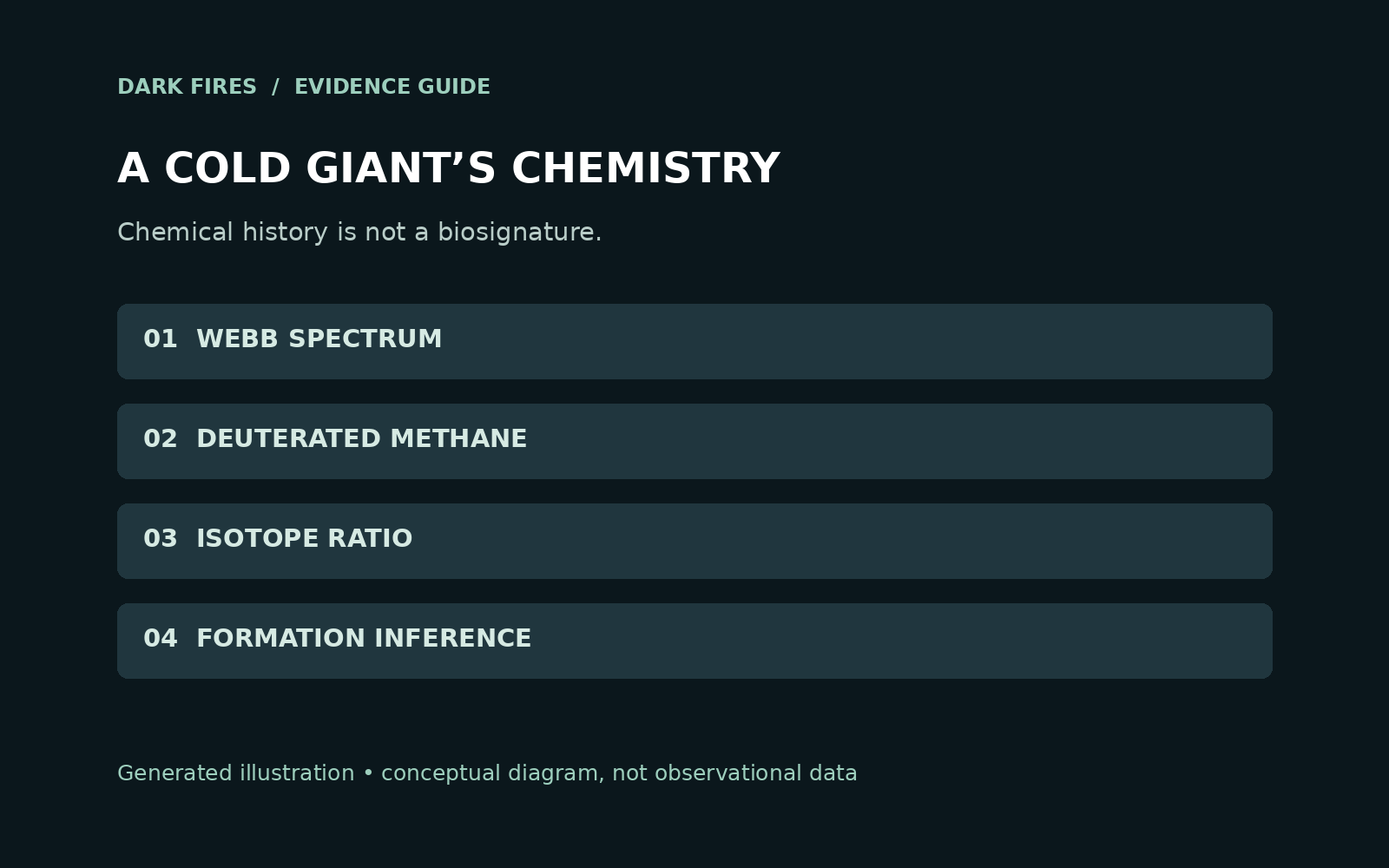
    A new study uses an unusual form of methane to investigate how a giant planet assembled. Jerry Xuan and colleagues report detecting deuterated methane in the atmosphere of epsilon Indi Ab, a cold, mature planet several times Jupiter’s mass.

    The preprint was posted November 6, 2026 and is marked under review. Its observations came from Webb’s NIRSpec instrument on October 25, 2025, not from a newly acquired November image.

    Deuterium is a heavier form of hydrogen. The team derives an atmospheric deuterium-to-hydrogen ratio about twice the values associated with Jupiter, Saturn and the material from which the Sun formed. Their interpretation is that the planet incorporated exceptionally deuterium-rich solids originating in a very cold environment.

    The distinction between measurement and reconstruction matters. Methane’s spectral signature is the observational result; the composition and birthplace of material swallowed during formation are inferred through atmospheric and formation models.

    The work is about chemical history, not a biosignature. Finding methane in a giant planet’s atmosphere does not establish biological activity. Independent scrutiny remains important while the manuscript is under review.

    Primary source: Xuan and colleagues: study and methods.

    Generated illustration

    Original Dark Fires conceptual diagram, not observational data or a reconstruction of a sighting.
  • A Cold Giant Around HIP 88962 Tests How Planets Grow

    A Cold Giant Around HIP 88962 Tests How Planets Grow

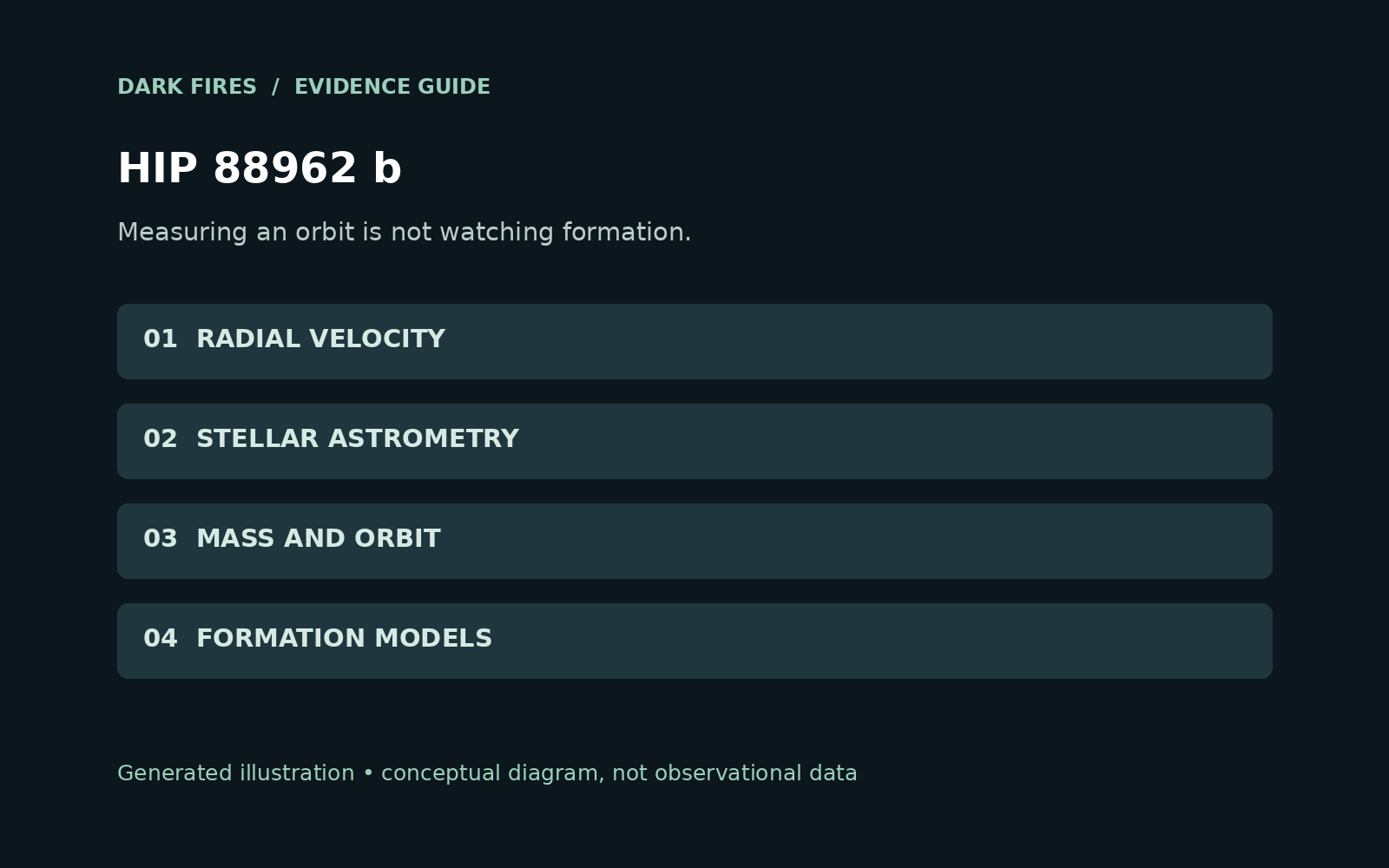
    A newly reported giant planet offers a demanding test for theories of planet formation. In a paper posted November 11, 2026 and listed as in press at The Astrophysical Journal Letters, Alan Boss and colleagues describe HIP 88962 b, a cold world orbiting a star less massive than the Sun.

    The team combined long-running measurements from the Planet Finder Spectrograph in Chile with Hipparcos and Gaia astrometry. Their joint analysis puts the planet at about 4.83 Jupiter masses, with a highly elongated orbit and a characteristic orbital size of roughly 6.15 astronomical units.

    That combination matters because a very massive planet far from a relatively small star is difficult to produce in the particular core-accretion population models the authors compared. They favor gravitational instability, in which part of a gaseous disk collapses, instead.

    This is an interpretation of the evidence, not a direct observation of the planet forming. Nor does the paper establish a second planet: the authors explicitly reject a short-period residual signal as a robust candidate because stellar activity could explain it.

    Primary source: Boss and colleagues: HIP 88962 b, observations and analysis.

    Generated illustration

    Original Dark Fires conceptual diagram, not observational data or a reconstruction of a sighting.
  • Project TWINKLE: The Green-Fireball Investigation’s Missing Measurement

    Project TWINKLE: The Green-Fireball Investigation’s Missing Measurement

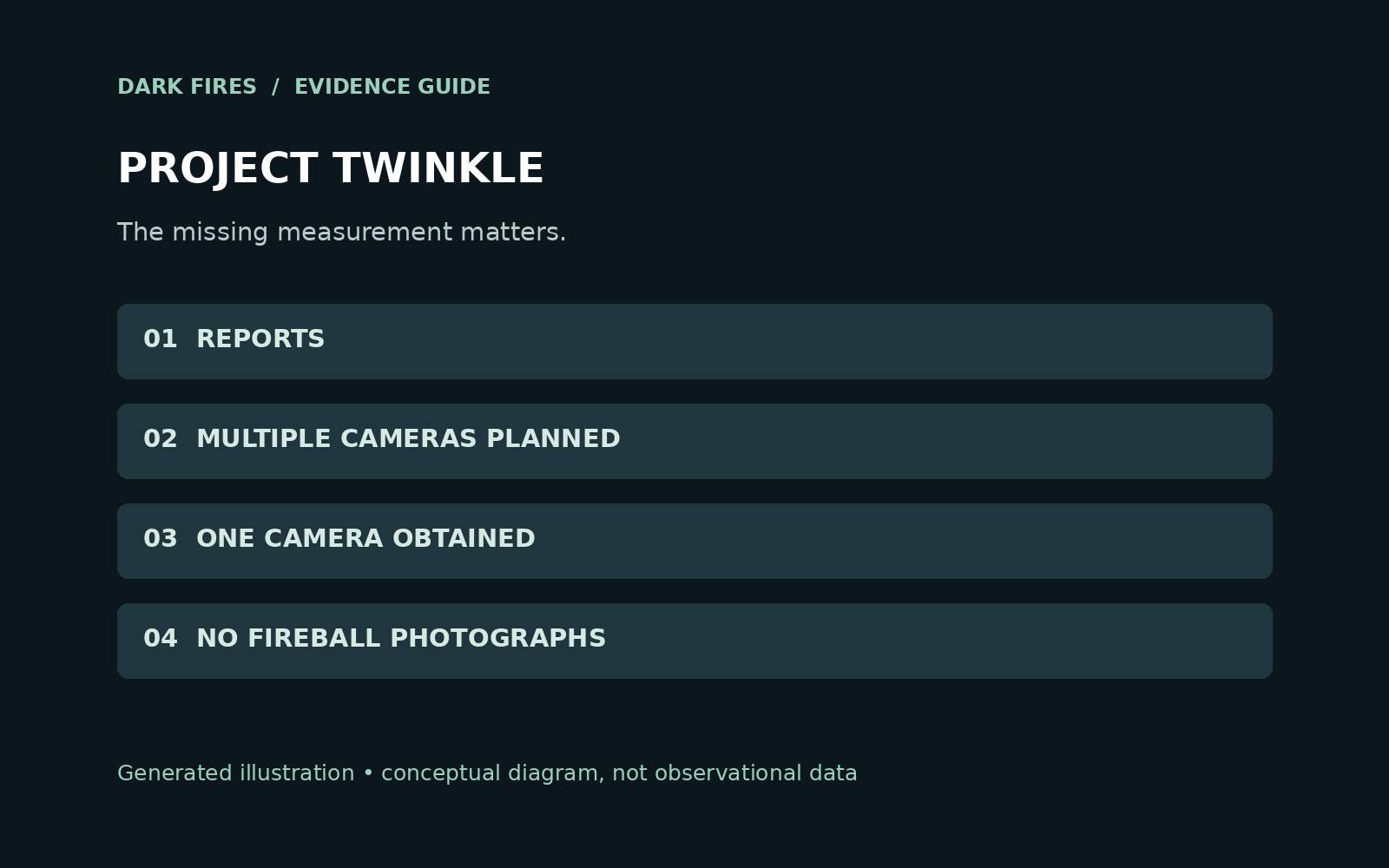
    Project TWINKLE tried to turn reports of strange lights into measurable evidence. Its most instructive feature is the gap between that plan and the observations it actually secured.

    AARO’s February 2024 historical review describes reports of green fireballs in Nevada and New Mexico and an investigation managed by the Air Force’s Cambridge Research Laboratory. Investigators intended to use multiple cameras near White Sands. Images of the same event from separate positions could help establish its altitude and speed, rather than relying entirely on how fast it appeared to a witness.

    According to that review, the project obtained only one camera, moved it between locations following reports, and captured no photographs of the fireballs. AARO dates the effort to summer 1949–summer 1950 and notes uncertainty over its relationship with the original Project GRUDGE.

    This is not evidence that the reported lights were extraterrestrial. Nor does an unsuccessful photography campaign show that witnesses saw nothing. It shows why an investigation can end without the measurements needed to discriminate among explanations. TWINKLE remains relevant to modern UAP work for that methodological reason: impressive intentions do not substitute for synchronized, usable observations.

    Primary source: AARO Historical Record Report, Volume 1, February 2024, page 15.

    Generated illustration

    Original Dark Fires conceptual diagram, not observational data or a reconstruction of a sighting.
  • KONA BLUE: Why a Proposed Recovery Program Is Not Evidence of Recovered Craft

    KONA BLUE: Why a Proposed Recovery Program Is Not Evidence of Recovered Craft

    KONA BLUE matters to the UAP debate because it illustrates a crucial distinction: documents can establish that people proposed a secret program without establishing that the extraordinary material they hoped to study existed.

    In its February 2024 historical review, AARO traced the proposal to supporters of the earlier AAWSAP/AATIP effort. They sought a Department of Homeland Security program that would investigate UAP and examine purported off-world technology. A prospective special-access arrangement was requested, but DHS leadership rejected the proposal, according to AARO.

    The report says the program never became an approved special access program, and no extraterrestrial craft, bodies, data or material were transferred to DHS. Those are AARO’s findings, not a new discovery announced in November 2026.

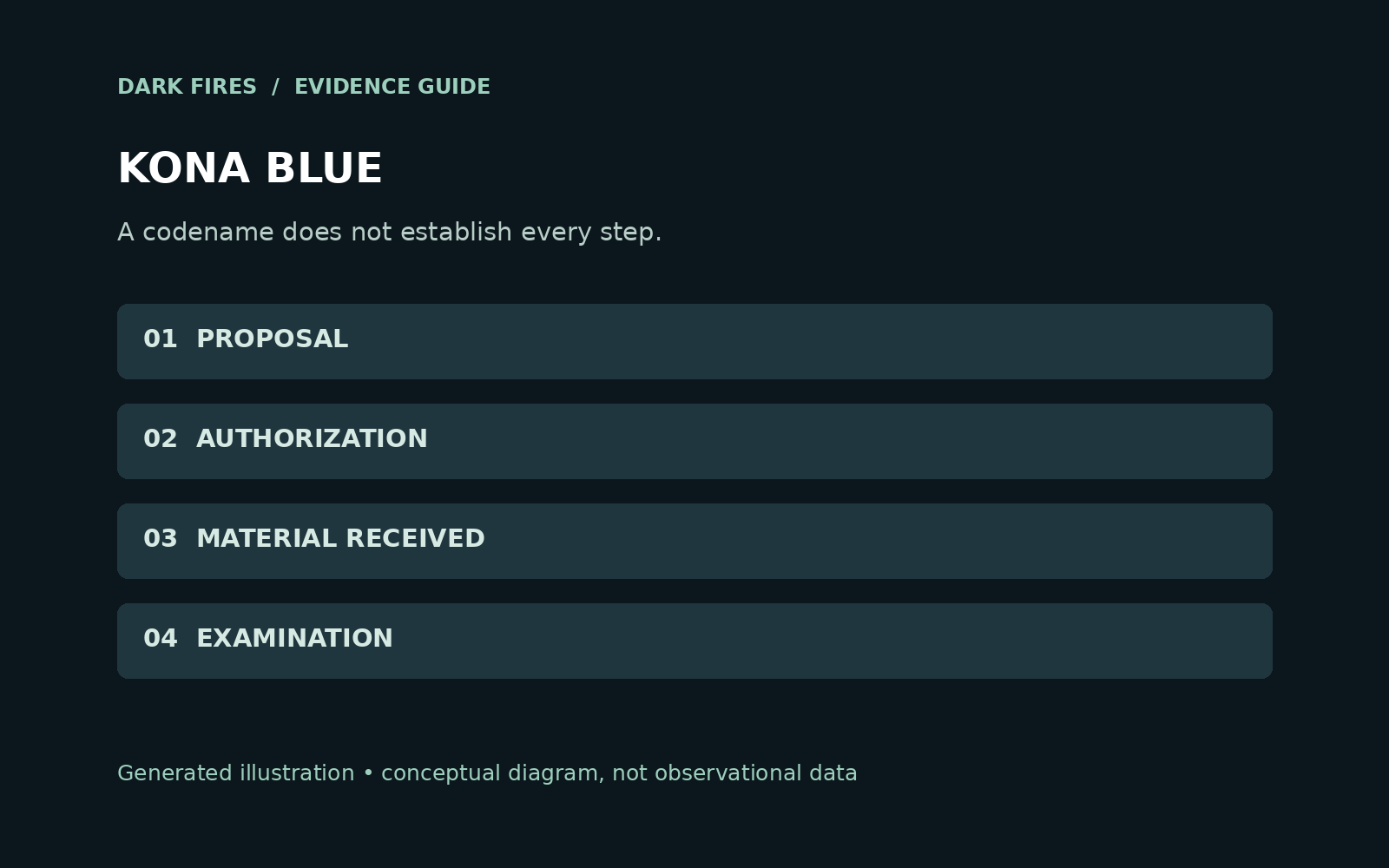
    The useful question for readers is therefore not simply whether the codename was real. It was. The question is what each record demonstrates: a proposal, authorization, funding, receipt of material, or an actual examination. Those are separate evidentiary steps. Treating the first as proof of the last turns an authentic document into support for a claim it does not establish.

    Primary source: AARO Historical Record Report, Volume 1, February 2024, pages 34–35.

    Generated illustration

    Original Dark Fires conceptual diagram, not observational data or a reconstruction of a sighting.
  • Bavaria’s 1948 Flying-Disc Directive: Reporting Is Not Confirmation

    Bavaria’s 1948 Flying-Disc Directive: Reporting Is Not Confirmation

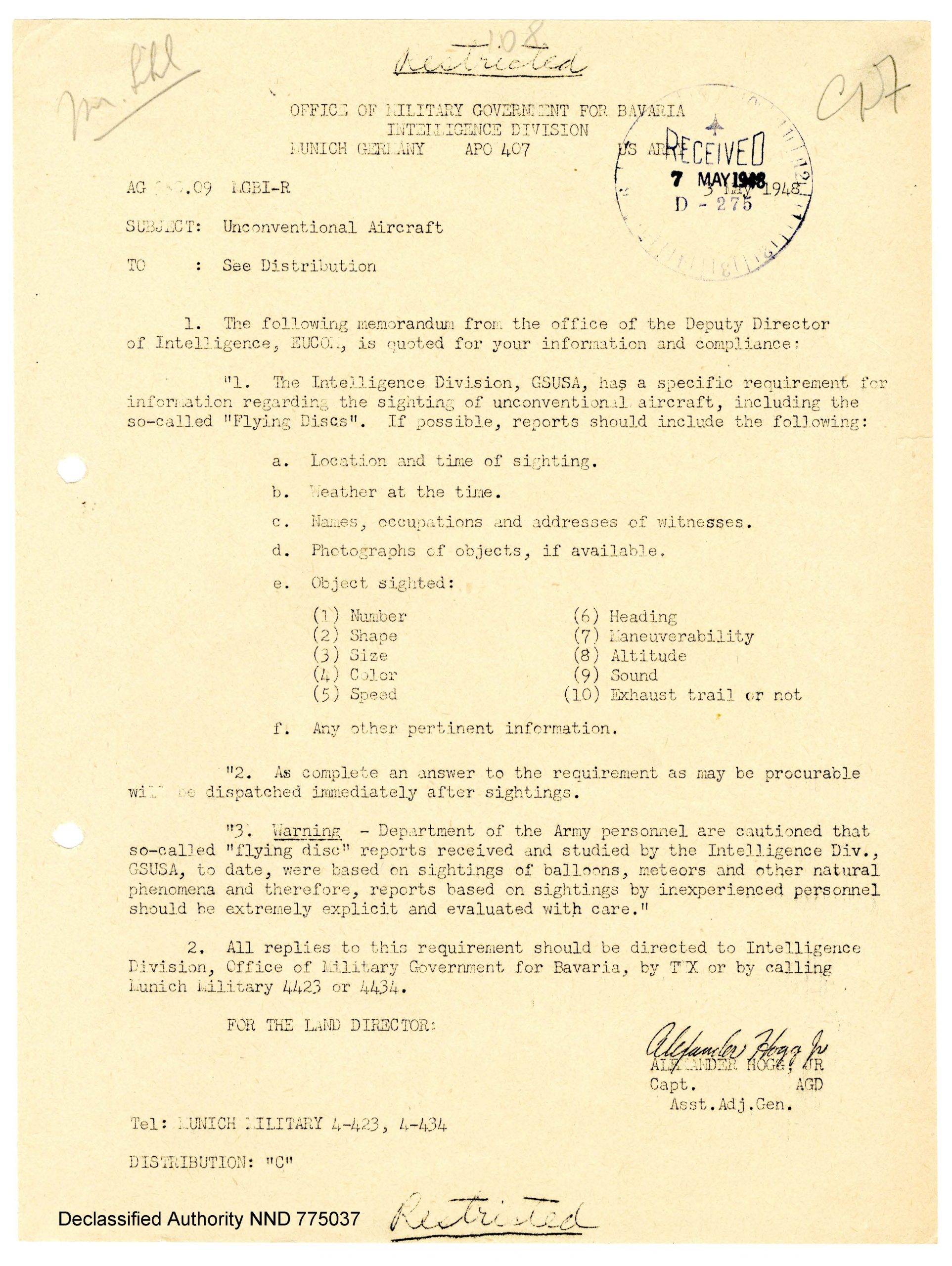
    Long before today’s UAP reporting systems, American authorities overseas were instructing personnel to document unfamiliar objects in the sky. A May 3, 1948 memorandum from the Office of Military Government for Bavaria is one surviving example.

    National Archives archivists Greg Bradsher and Sylvia Naylor described the directive in a July 5, 2017 article. Their account places it in the aftermath of the 1947 flying-saucer reports and explains that the instructions followed requirements from higher headquarters in Germany and the United States. The original directive belongs to Record Group 260, with its catalog series identified as NAID 23810602.

    Its significance is administrative rather than extraterrestrial. An instruction to collect sightings establishes that authorities wanted information. It does not, by itself, validate a particular observer’s description or identify the object observed.

    That distinction is useful when older documents resurface online. The date and originating office answer who requested the information and when. Separate case records, observations and analysis are needed to answer what happened. Bavaria’s directive shows the reporting machinery expanding beyond the United States, not an official determination that alien aircraft were present.

    Primary source: National Archives account and original memorandum (July 5, 2017).

    Featured image: Memorandum on unconventional aircraft, Office of Military Government for Bavaria, May 3, 1948. U.S. government record, Record Group 260, courtesy National Archives; public domain.