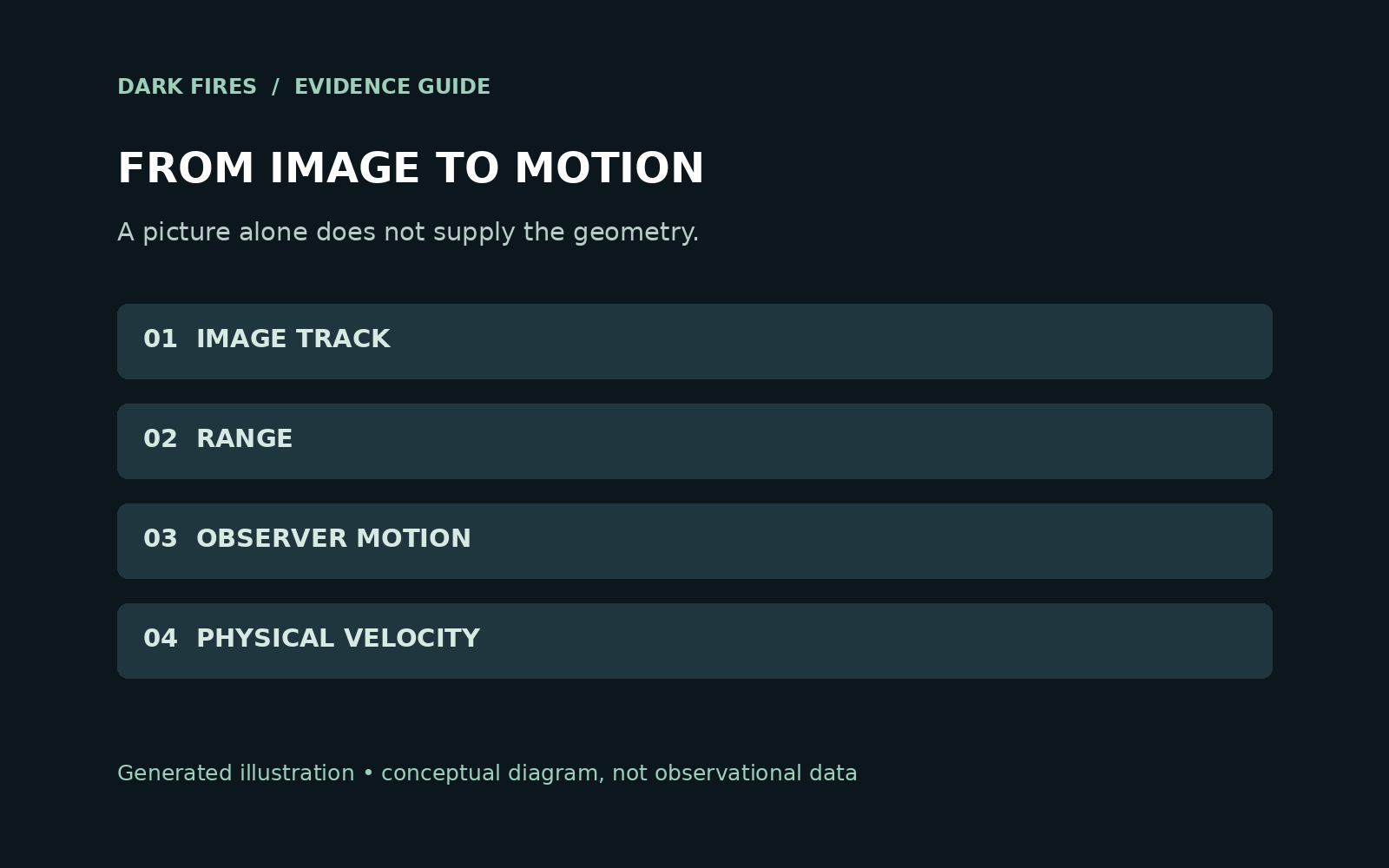
A fast crossing on a screen is not yet a measured speed through the air. That distinction drives a 2026 analysis of 112 publicly released PURSUE sensor videos by Jacob Haqq-Misra and Ravi Kopparapu.
Their paper, first submitted August 12 and revised August 28, examines what the footage permits researchers to calculate. Converting image motion into physical velocity requires additional information: distance, the observing aircraft’s motion, viewing geometry and the camera’s angular scale. The authors report that no video supplies the complete combination.
Two examples illustrate the limits. Markings in PR113 permit an estimate of angular scale, but not a unique physical speed or identity. In PR149, a ship provides a reference for a conditional velocity bound. Neither example turns a moving patch of contrast into an identified vehicle.
The practical lesson is to ask which quantities were measured and which were assumed before accepting an extraordinary speed claim. More pixels do not supply missing range data. Flight logs, sensor information and correlated observations would be more useful than enlarging the same clip.
This is a preprint submitted to a journal, not a verified identification of the objects or proof that anomalous motion is impossible.
Primary source: Original research, version 2.
Generated illustration
Original Dark Fires conceptual diagram, not observational data or a reconstruction of a sighting.
Leave a Reply