The familiar “habitable zone” is not a map of inhabited planets. It is a modeling tool for estimating where certain rocky worlds might sustain surface liquid water. A new study tests whether widely used boundaries survive an independent calculation.
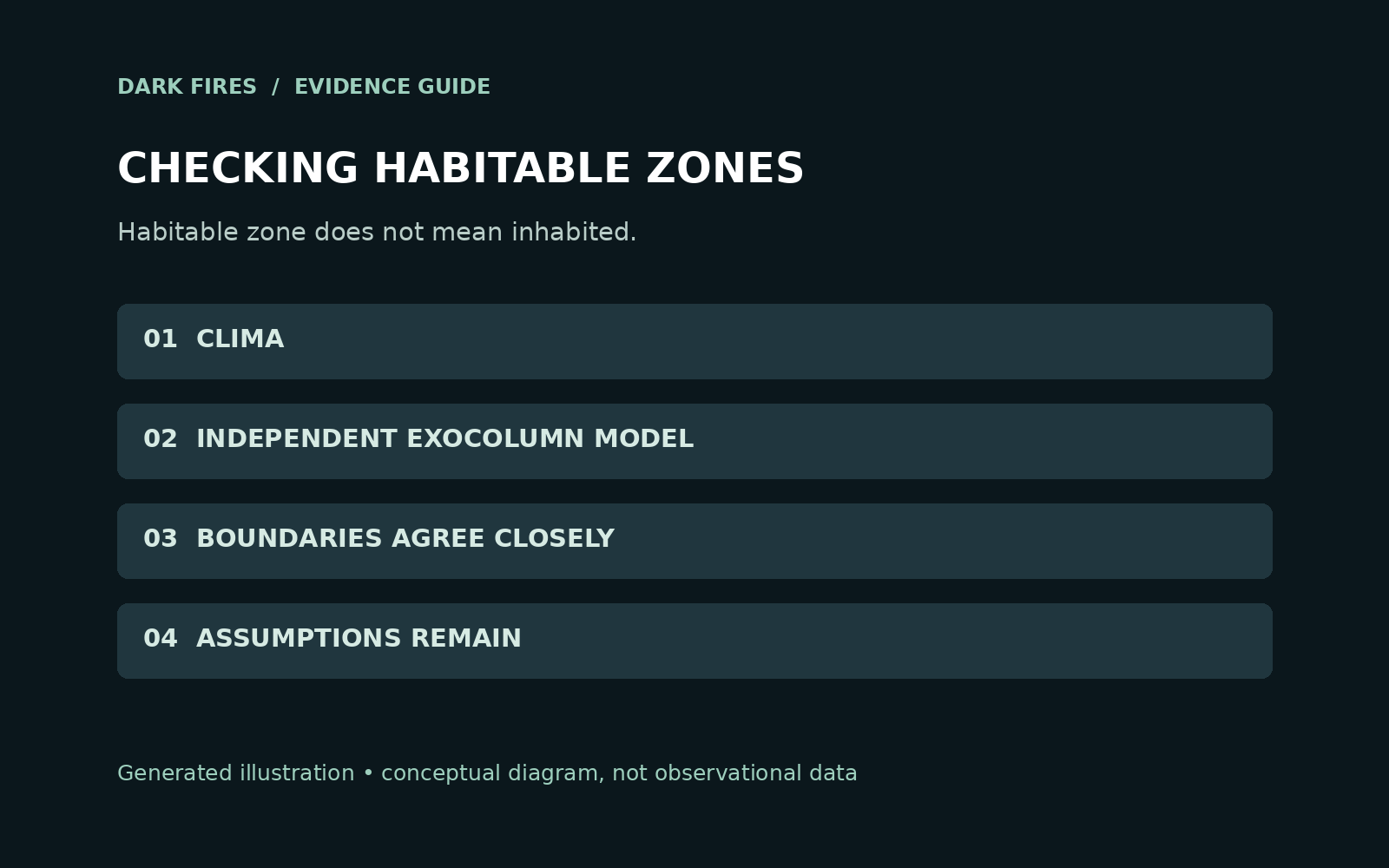
Jacob Haqq-Misra, Eric Wolf and Ravi Kopparapu developed ExoColumn, a one-dimensional atmospheric model, and compared its results with the established Clima framework. The paper’s publication record gives November 6, 2026; it appears in The Astrophysical Journal, volume 1011, article 253.
Across their calculations, ExoColumn’s boundaries fall somewhat closer to the star but agree with Clima within a few percent in orbital distance. The authors tested different stellar temperatures and planetary masses, producing updated coefficients for other researchers.
That agreement supports the robustness of a common target-selection tool. It does not remove the assumptions behind it. Actual climates also depend on atmospheric composition, clouds and circulation; a one-dimensional model cannot represent every three-dimensional process.
The practical lesson is two-sided: being inside a modeled zone does not prove a planet is habitable, and being outside it does not exclude every conceivable environment for life.
Primary source: Read the published paper.
Generated illustration
Original Dark Fires conceptual diagram, not observational data or a reconstruction of a sighting.
Leave a Reply