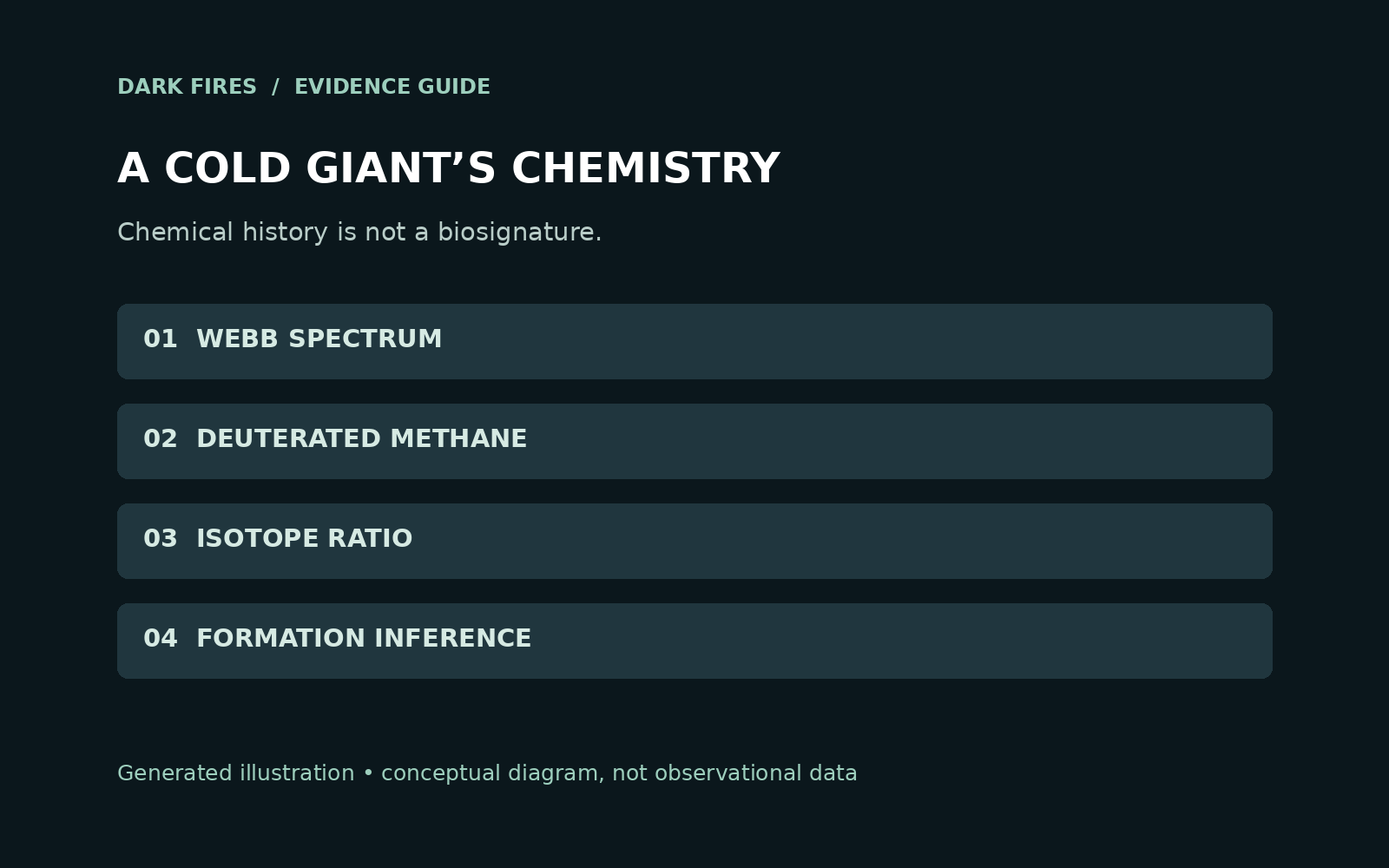
A new study uses an unusual form of methane to investigate how a giant planet assembled. Jerry Xuan and colleagues report detecting deuterated methane in the atmosphere of epsilon Indi Ab, a cold, mature planet several times Jupiter’s mass.
The preprint was posted November 6, 2026 and is marked under review. Its observations came from Webb’s NIRSpec instrument on October 25, 2025, not from a newly acquired November image.
Deuterium is a heavier form of hydrogen. The team derives an atmospheric deuterium-to-hydrogen ratio about twice the values associated with Jupiter, Saturn and the material from which the Sun formed. Their interpretation is that the planet incorporated exceptionally deuterium-rich solids originating in a very cold environment.
The distinction between measurement and reconstruction matters. Methane’s spectral signature is the observational result; the composition and birthplace of material swallowed during formation are inferred through atmospheric and formation models.
The work is about chemical history, not a biosignature. Finding methane in a giant planet’s atmosphere does not establish biological activity. Independent scrutiny remains important while the manuscript is under review.
Primary source: Xuan and colleagues: study and methods.
Generated illustration
Original Dark Fires conceptual diagram, not observational data or a reconstruction of a sighting.
Leave a Reply