A future telescope could extract new physics from planets already discovered years ago. A study posted November 5, 2026 examines how the planned Earth 2.0 mission might reveal hot Jupiters whose orbits are gradually shrinking.
The proposed measurement is timing, not a dramatic image of a planet falling into its star. Repeated transits can arrive progressively earlier if an orbital period shortens. That change can help researchers study how tidal energy is dissipated inside stars.
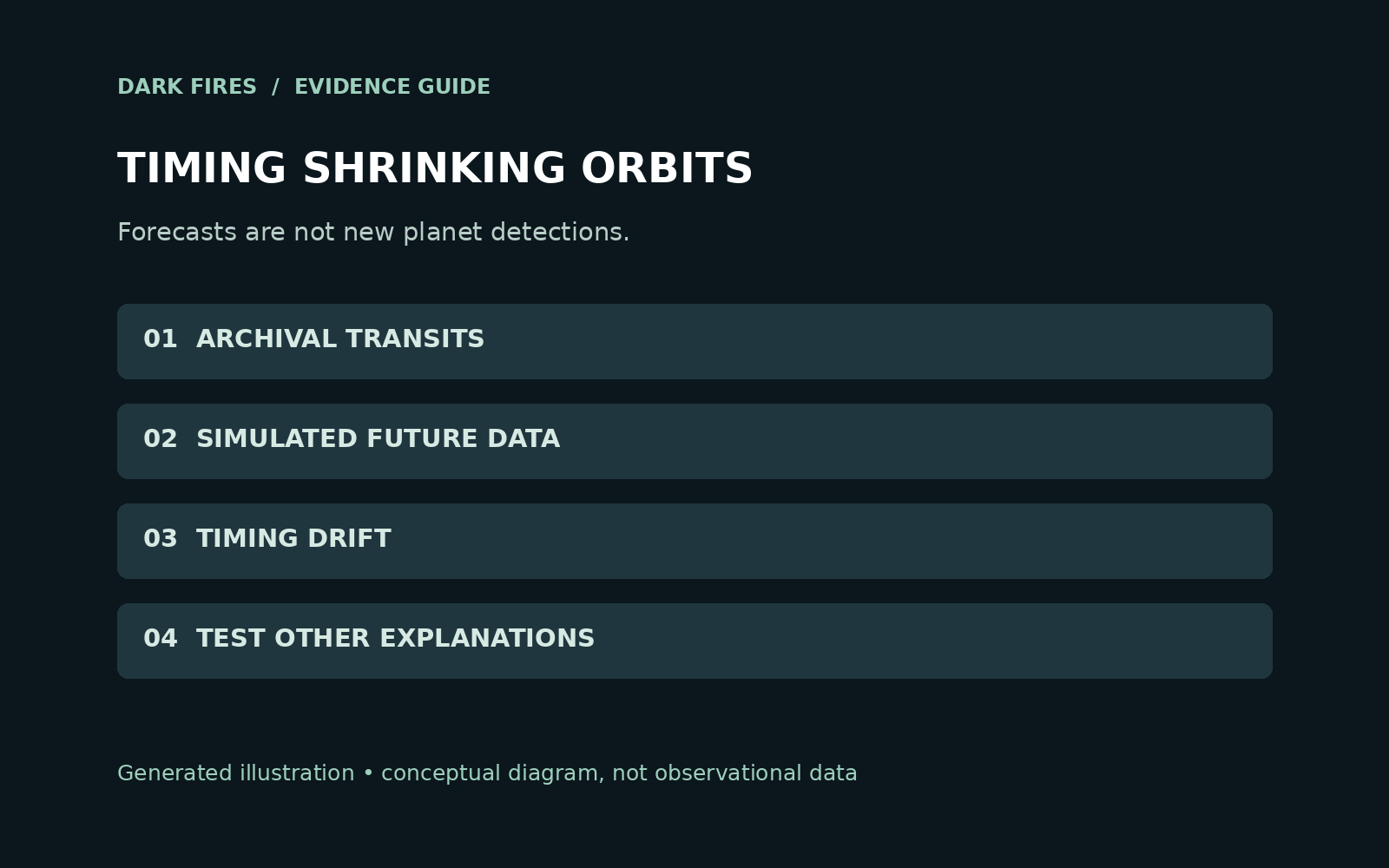
Wenqin Wang and colleagues combined archival Kepler and TESS observations with four years of simulated Earth 2.0 observations. In their modeled scenarios, the extended record substantially improves sensitivity to period changes. Under assumptions about stellar tidal dissipation, they forecast three additional detectable systems.
Those are predictions, not three new detections. The manuscript reports acceptance on October 30, 2026, but the Earth 2.0 observations used in the analysis remain simulated.
The team also emphasizes a central ambiguity: additional companions can change light-travel times and imitate an orbital-decay signal. A longer timeline helps, but interpreting a timing drift still requires testing competing explanations.
Primary source: Read the study.
Generated illustration
Original Dark Fires conceptual diagram, not observational data or a reconstruction of a sighting.
Leave a Reply