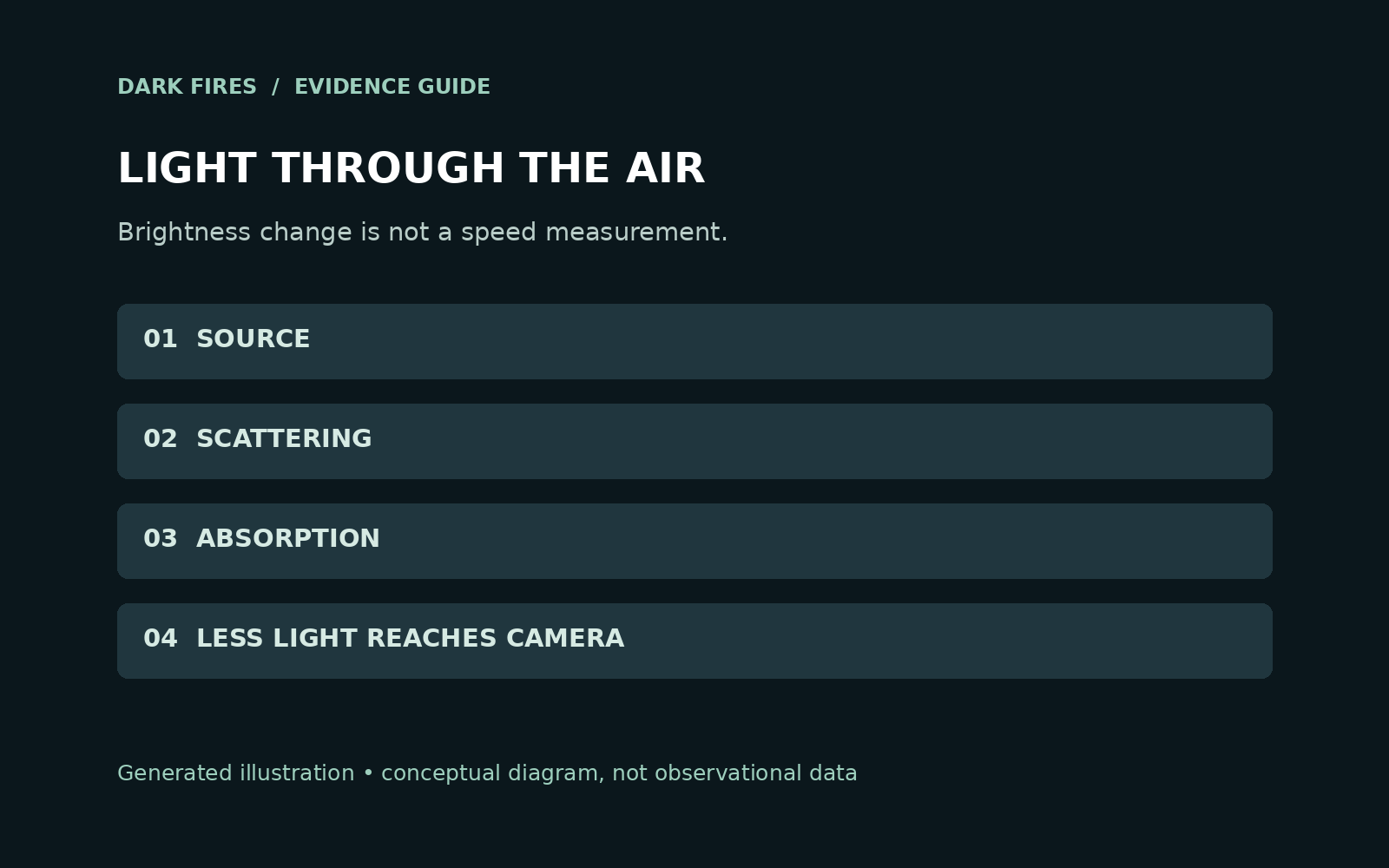
When a light fades from view, the observation establishes a change in received brightness. It does not, by itself, establish how quickly the source moved or even whether it moved away.
Atmospheric extinction is one reason. NOAA-hosted aerosol measurement guidance describes extinction as the combined effect of scattering and absorption. Light can be redirected or absorbed along its path, reducing what reaches an observer or camera. NOAA also measures how particle scattering changes with humidity and wavelength.
This matters when assessing unfamiliar lights near haze, thin cloud or a long atmospheric viewing path. A brightness change may involve the source, the intervening air, the camera or several factors together. Treating every fade as physical departure skips those alternatives.
A useful record preserves the original video, including the seconds before and after the event. Note cloud and haze conditions, viewing direction and whether other lights dimmed at the same time. Record exposure changes if known rather than assuming brightness stayed comparable throughout.
Applying these atmospheric principles to UAP reports is an analytical inference, not a resolution of a specific incident. Extinction cannot explain every disappearance. Its value is narrower: it shows why brightness and motion must be investigated separately before assigning an extraordinary speed.
Primary sources: NOAA-hosted aerosol measurement procedures; NOAA aerosol instrumentation.
Generated illustration
Original Dark Fires conceptual diagram, not observational data or a reconstruction of a sighting.
Leave a Reply